
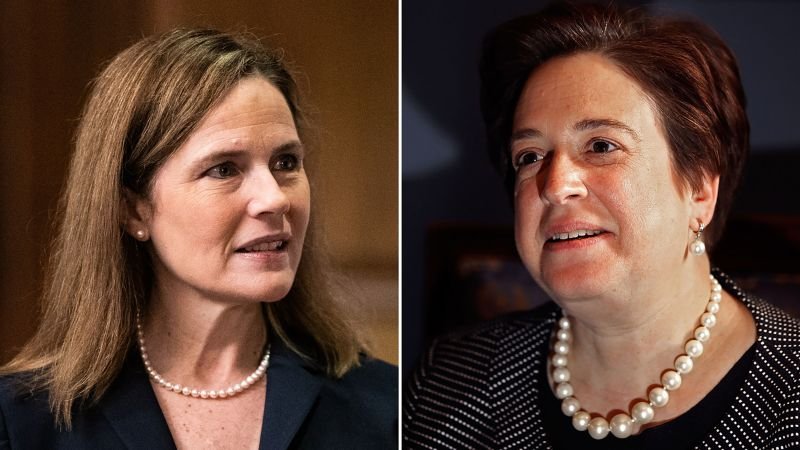
As the federal judiciary makes a rare personal pitch to Congress this week for tens of millions of dollars in additional security funding, the Supreme Court is sending a messenger who is positioned to speak in unusually personal terms about the threats the judiciary faces.
Justice Amy Coney Barrett has been at the center of several startling security incidents since President Donald Trump named her to the high court nearly six years ago, most recently a swatting attempt at her home in May that was thwarted after police realized she was the target.
“She has firsthand experience with this issue,” said Gabe Roth, who leads Fix the Court, a group that advocates for transparency and other reforms in the judiciary. “She’s a smart pick for the testimony.”
But Barrett will also be speaking at two hearings Tuesday just days after the Supreme Court wrapped a divisive term that invalidated Trump’s efforts to end birthright citizenship and impose global tariffs. Despite being closely aligned with the court’s conservatives, she has drawn a storm of criticism on the right for supporting those decisions.
It’s not clear whether that friction will come up at the hearings Tuesday, though multiple congressional aides told CNN that lawmakers are preparing questions that will take Barrett and Justice Elena Kagan, a member of the court’s liberal wing who will also appear at the hearings, far beyond their budget talking points.
The nine members of the Supreme Court rarely appear on Capitol Hill — a justice last testified before Congress in 2019 — and most of their off-the-bench appearances tend to be heavily scripted, moderated by federal judges speaking before reverential audiences.
But the Supreme Court, like every other part of the federal government, relies on Congress for most of its budget. And this year, with a well-documented wave of physical and cyber threats, the judicial branch is asking for a lot.
The judiciary has requested nearly $921 million for security, a $29 million increase over last year, for frontline security forces at federal courthouses. The request includes an increase of nearly $15 million to make members of the Supreme Court Police available to protect the justices and their families, including at their homes. The US Marshals Service took on the responsibility of protecting the justices’ homes in 2022 following the unprecedented leak of a draft opinion of the decision overturning Roe v. Wade, but that was never intended to be a permanent solution.
Overall, the judiciary is seeking $9.7 billion in discretionary funding, a 4.5% increase over last year.
Security incidents involving judges that the Marshals Service classified as of “significant concern” jumped 57% in 2025 — a point Barrett and Kagan are sure to stress.
Barrett has been involved with several close calls that have become public. Police in Washington’s Virginia suburbs said in May that they had been called to the home of a Supreme Court justice for what they determined was a “fictitious” report of gunfire. CNN later reported that it was Barrett’s home that was targeted, though neither the justice nor the court has publicly acknowledged the incident.
The home of Barrett’s sister in South Carolina was the target of a bomb threat a year earlier. Barrett, meanwhile, spoke openly at a conference in 2024 about being sent home from the Supreme Court with a bulletproof vest. The court, which is exceedingly closed-lipped about security, never explained why Barrett was issued protective gear.
The highest-profile incident involving a Supreme Court justice took place in 2022, when a Californian who now identifies as Sophie Roske flew across the country and appeared in Justice Brett Kavanaugh’s neighborhood with a bag full of guns and other weapons intending to kill the justice. Roske last year was sentenced to just over 8 years in prison and a lifetime of supervised release.
Roth said he supported the increase “that will help them hire the right amount of personnel and protection that they sadly but definitely need.” But at the same time, he said, “it’s a precipitous increase and lawmakers have every right to want to examine rather than just giving the justices a blank check.”
The judiciary’s 2027 budget request is only the latest to ask for additional security funding. That has led to a noticeably beefier security presence when the justices travel.
Justice Clarence Thomas, a member of the court’s conservative wing, has openly groused about the heightened security that has become necessary in recent years, telling an audience in Florida in May that it is now far more difficult for him to take part in activities outside the courthouse.
“The security concerns now are much different from the way they were when I first became a circuit justice,” Thomas told a conference of judges and lawyers outside Miami. “That’s really one of the big changes since I’ve been on the court — that it’s become very, very dicey.”
While Kagan and Barrett will be eager to keep the focus on security funding, they are certain to be asked about other more controversial topics as well. Lawmakers are expected to ask how the judiciary is dealing with prediction markets internally, the processes the court has implemented to clamp down on leaks and lingering questions about ethics procedures following a series of high-profile scandals involving luxury travel by some of the justices, multiple congressional aides told CNN.
What’s less clear is whether Barrett, in particular, will face questions about a series of votes she has taken in high-profile appeals this year against Trump. The tension between Trump’s most recent nominee and some in the conservative legal movement has been palpable for more than a year. That friction was exacerbated last month when Barrett sided with Chief Justice John Roberts and the court’s liberals in concluding that the president’s attempt to end automatic birthright citizenship through an executive order was unconstitutional.
Barrett voted to overturn Roe v. Wade in 2022 and has been a reliable vote for conservative outcomes in Second Amendment and religious cases. She was one of six justices who voted to grant Trump sweeping immunity from criminal prosecution for official actions. Just last term, she authored an opinion that limited the ability of lower court judges to block the president’s agenda.
But she’s nevertheless drawn criticism from some conservatives for notable breaks with the president. This year, in addition to the birthright case, she joined the court’s majority opinion in February shutting down the president’s sweeping global tariffs.
Mike Davis, a conservative legal operative who is close to the Trump administration, has been among Barrett’s most vocal critics — including on her vote in the birthright citizenship case. But Davis said he doesn’t think the hearings Tuesday will be the right place to raise those concerns.
“While Justice Barrett’s vote on birthright citizenship is highly destructive and inexcusable,” Davis told CNN, “it is not the job of Congress to grill Supreme Court justices over their legal rulings at appropriations hearings.”
CNN’s Holmes Lybrand contributed to this report.





Responses