
• Nuclear monitoring: President Donald Trump dismissed Iran’s claims that no visit has been scheduled for International Atomic Energy Agency inspectors, saying Tehran had already agreed to the arrangement.
• Diplomatic moves: US Secretary of State Marco Rubio said he will be listening to what Persian Gulf allies have to say about the US-Iran agreement while he is in the region. Meanwhile, Iran’s president and foreign minister traveled to Pakistan following negotiations in Switzerland over the weekend.
• Israel-Lebanon talks: A fresh round of talks between Israel and Lebanon is happening in Washington, DC, in an effort to end deadly fighting in Lebanon between Iran-backed Hezbollah and Israel.
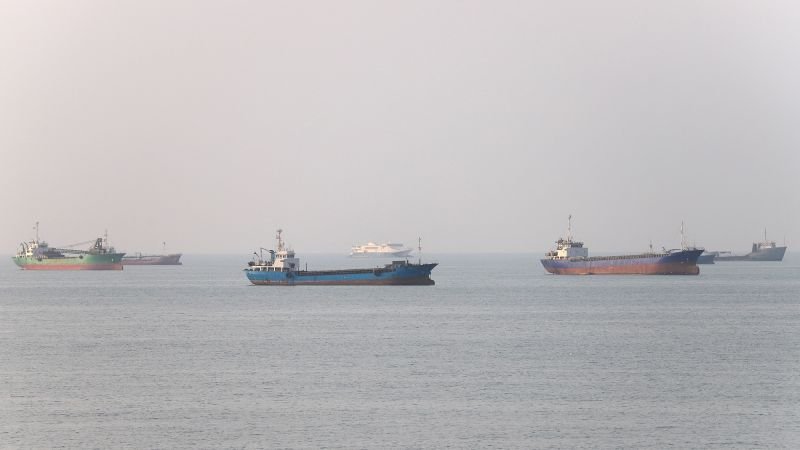
• Strait of Hormuz: The UN’s maritime agency is launching an evacuation plan for over 11,000 seafarers stranded in the region. Iran and Oman have also formed a joint committee to discuss the vital waterway, according to Tehran’s top negotiator.
30 Posts
Iranian President Masoud Pezeshkian said Tuesday that Iran’s missiles are not part of the memorandum of understanding with the United States, according to video shared by state-run Islamic Republic of Iran Broadcasting (IRIB).
“The discussion over our missiles does not exist in the MoU, and it never will,” Pezeshkian said during a news conference in Pakistan.
He defended Iran’s missile program as essential to national defense. “If we did not have the missiles we use for our defense, Israel and the United States would have devastated Iran,” he said.
Pezeshkian made the comments during a visit to Islamabad, where he held talks with Pakistani officials on bilateral ties and regional developments.
Last week, the United States released the official text of the memorandum of understanding reached with Iran.
A senior US administration official read out the 14-point document, which includes provisions for reopening the Strait of Hormuz, easing certain financial restrictions on Iran and setting out expectations for future technical talks on Iran’s nuclear program.
The released text does not mention any requirement for Iran to restrict its missile program or broader defense capabilities. Its only explicit weapons-related restriction concerns Iran’s pledge not to “procure or develop nuclear weapons.”
While President Donald Trump previously made limiting Iran’s missile program a central rationale for US military operations, his stance shifted during diplomatic negotiations. He stated at last week’s G7 summit that “missiles aren’t the problem.”
President Donald Trump rebuffed Iran’s claim that no visit has been scheduled for International Atomic Energy Agency inspectors, insisting Tehran had already agreed to the arrangement.
“They’re wrong, they’re wrong, they know they’re wrong,” Trump told reporters today.
The mixed messaging comes amid Secretary of State Marco Rubio’s visit to the Persian Gulf region to “make sure that (allies’) views are taken into account,” he said, as the US moves forward on negotiations with Iran.
Catch up on the latest:
Rubio continued to try to delink the ongoing US-mediated Israel-Lebanon talks from the US-Iran negotiations, even as Iran has repeatedly insisted that the issues are entwined. “It’s separate because Lebanon is a sovereign country,” Rubio said upon his arrival in the United Arab Emirates.
The Trump administration is studying the formation of a cell made up of the United States, Lebanon and Iran to shore up the ceasefire in Lebanon and monitor related measures, the Lebanese Presidency said.
Meanwhile, Israeli Ambassador to the US Yechiel Leiter warned that Israel and Lebanon are “heading toward a train wreck,” at the start of the fifth round of talks between the two countries in Washington, DC. The president of Lebanon, Joseph Aoun, has said that Beirut will “accept nothing less than the end of the Israeli occupation” in the country’s south.
Hezbollah has accused Israel of a “blatant violation” of the US-Iran 14-point ceasefire plan after Lebanon’s Health Ministry said Israeli attacks killed two people on Tuesday.
Separately, the International Maritime Organization (IMO), a specialized United Nations agency, said the US-Iran agreement has cleared the way for the evacuation from the Persian Gulf region of more than 11,000 stranded seafarers, following the easing of restrictions on the Strait of Hormuz.
The cadence of vessels transiting the Strait of Hormuz remained steady Tuesday afternoon, according to MarineTraffic data.
CNN’s Dana Karni, Oren Liebermann, Avery Schmitz, Alejandra Jaramillo, Mohammed Tawfeeq, Jennifer Hansler, Charbel Mallo, James Frater, Catherine Nicholls, Eyad Kourdi, Sarah Tamimi, Tal Shalev and Charlotte Reck contributed to this report.
Israel and Lebanon are “heading toward a train wreck,” warned Israeli Ambassador to the US Yechiel Leiter at the start of the fifth round of talks between the two countries in Washington, DC.
In his opening remarks, Leiter said Hezbollah’s ongoing presence in Lebanon, coupled with Iran’s influence, threaten to derail the Trump administration’s goal for the talks: a comprehensive peace agreement between two neighboring countries that have never had diplomatic relations.
But the memorandum of understanding between the US and Iran calls for a complete ceasefire in Lebanon, which would ultimately protect Hezbollah’s presence. Iran has delayed further talks with the US over Israeli strikes in Lebanon, allowing Tehran to exert pressure there.
In ongoing talks between the US and Iran, negotiators agreed to create a “deconfliction cell” to ensure the ceasefire in Lebanon, but Israel was not included in the mechanism. Leiter said such an effort was not necessary.
Talks between Israel and Lebanon are scheduled to last three days, including discussions at the political and military levels.
The cadence of vessels transiting the Strait of Hormuz remained steady Tuesday afternoon, according to MarineTraffic data, as negotiations to end the US-Iran war continue.
In the past 24 hours, nearly two dozen vessels transited the strait that connects the Persian Gulf and the Gulf of Oman. At least seven cargo ships and seven tankers exited into the Gulf of Oman, and six cargo ships crossed into the Persian Gulf — including two sailing under the Iranian flag. Before the war an average of 110 vessels transited the strait daily.
The movements follow an uptick in shipping volume since the beginning of negotiations between American and Iranian principals in Geneva.
GPS interference, which grew notably more intense as US-Iranian tensions peaked, has also subsided in recent days.
This development comes as the UN’s maritime agency launches an evacuation plan for over 11,000 seafarers stranded in the region. The evacuation will be carried out “in close cooperation with Iran, Oman, all other coastal States in the region, the United States and the maritime industry,” agency Secretary-General Arsenio Dominguez said in a statement Tuesday.
At the same time, the shipping industry is confronting a new challenge to restoring the critical trade route: For months, ships waiting to cross the strait have accumulated hundreds of thousands of square feet worth of debris on their hulls, which now needs to be removed.
The International Atomic Energy Agency (IAEA) inspected an active Iranian nuclear facility in early June, when it conducted a routine inspection of the Bushehr nuclear power plant, but it’s been roughly a year since the agency has had access to any of the nuclear facilities damaged in the 2025 US-Israeli war with Iran.
As a result, the UN nuclear watchdog said earlier this month that it has been unable to verify the suspension of all uranium enrichment by Iran.
“Consequently, the Agency cannot currently exercise its right and fulfill effectively its obligations under the NPT Safeguards Agreement, except for the Bushehr NPP,” IAEA Director General Rafael Grossi said earlier this month, referring to the nuclear Non-Proliferation Treaty by its initials.
Iran’s parliament passed a law last summer that restricted cooperation with the IAEA and suspended inspections. However, the official Islamic Republic News Agency (IRNA) reported, cooperation with the IAEA has never been completely cut off, and the law allows IAEA inspectors to visit “active nuclear sites,” such as the Bushehr nuclear power plant, on a “case-by-case basis.”
Iran’s Foreign Ministry spokesman said yesterday that cooperation with the IAEA will continue under existing procedures and in line with resolutions passed by the Iranian parliament, according to IRNA.
President Donald Trump on Tuesday dismissed claims that no Iran visit has been scheduled for International Atomic Energy Agency inspectors, insisting Tehran had already agreed to the arrangement.
“They’re wrong, they’re wrong, they know they’re wrong,” Trump told reporters upon landing in Pennsylvania, when asked about Iranian officials saying there is no scheduled visit for IAEA inspectors and about whether inspections were part of the agreement reached between the two countries.
“They told us inside, and we have it down 100%,” Trump said. “And if they were right, I’d cancel the meetings right now.”
Asked when inspectors would be on the ground in Iran, Trump declined to provide a timeline.
“At the appropriate time,” he said, adding, “There is no rush.”
Earlier Tuesday, Trump claimed Iran had agreed to nuclear inspections into “infinity,” despite Tehran denying it had made any commitments following negotiations in Switzerland over the weekend.
The International Maritime Organization (IMO), a specialized United Nations agency, says a US-Iran peace agreement has cleared the way for the evacuation from the Persian Gulf region of more than 11,000 stranded seafarers.
Here is what we know:
IMO Secretary-General Arsenio Dominguez said the operation will be carried out in coordination with Iran, Oman, other coastal states, the United States and the maritime industry. The plan appears to focus first on moving vessel traffic out of the region in a gradual, tightly controlled way, rather than reopening normal shipping flows all at once.
Oman’s National Hydrographic Office said a “temporary maritime corridor” is being made available in the Strait of Hormuz, one of the world’s most strategically important shipping chokepoints. The notice says the usual traffic separation scheme, or TSS, is “not safe for use at this time.”
Instead, ships may be routed via two temporary outbound lanes through the strait — one to the north of the existing TSS and one to the south.
The Omani navigation warning says the evacuation will unfold in phases. Vessels will be divided into groups, with departures managed under an IMO-coordinated plan. Ships will not simply leave at will. Vessels in designated groups will be contacted individually and given instructions on when they are allowed to depart. Each vessel will be assigned a specific transit day by parties coordinating with the IMO.
After getting that information, vessels may proceed to a designated waiting area in international waters. Once there, ships must contact the relevant coastal state for their chosen route to confirm that traffic conditions allow them to proceed.
Oman’s notice gives one set of authorized coordinates for eastbound transit only.
The warning does not spell out the second temporary route’s detailed coordinates in the text provided but says two routes — one north and one south of the existing scheme — may be used. Vessel traffic can also be temporarily suspended for safety or security reasons, including to avoid conflicts with naval vessels.
US Secretary of State Marco Rubio on Tuesday continued to try to delink the ongoing US-mediated Israel-Lebanon talks from the US-Iran negotiations, even as Iran has repeatedly insisted that the issues are entwined.
“It’s separate because Lebanon is a sovereign country,” Rubio said upon his arrival in the United Arab Emirates. “When it comes to Lebanon, and what’s happening inside of Lebanon, we’re going to negotiate and deal directly with the Lebanese government.”
“There’s an Iranian issue with regards to Lebanon,” he said, “and that is their support and sponsorship of Hezbollah.”
“That factor will be discussed as part of our conversations with the Iranians, but as far as the future of Lebanon, the future of Lebanon belongs to the Lebanese people through their sovereign elected government, and that’s who we’re going to be working with,” Rubio said.
His comments come as the latest round of Israel-Lebanon talks are underway at the US State Department. Iran has repeatedly threatened to leave its negotiations with the US over strikes by Israel in Lebanon during the nominal ceasefire. Israel says the strikes are in self-defense against Hezbollah.
US Secretary of State Marco Rubio is visiting the Persian Gulf region to “make sure that their views are taken into account” as the US moves forward on negotiations with Iran, he said upon arriving in the United Arab Emirates on Tuesday.
“We’re really here to hear from them more than we are to talk,” Rubio told reporters on the tarmac in Abu Dhabi, saying he wants to hear about economic and security concerns.
“We want to hear their thoughts, especially in the aftermath of this weekend in Switzerland, and make sure that their views are taken into account in every decision that we make, because they’re our partners,” Rubio said as he kicked off his trip to the UAE, Kuwait and Bahrain. He will also meet with the Gulf Cooperation Council (GCC) during the three-day trip.
Rubio said that all of the allies “are on board for peace,” but he added, “Obviously, it all depends on the details of that peace as we work through.”
“It’s a work in progress,” he said. “I think good groundwork was laid over the last 72 hours, but a lot of work remains to be done.”
The top US diplomat said he would not be asking allies for monetary help with a discussed $300 billion Iran reconstruction fund, calling that “far down the road.”
He said concerns about Iran’s missile program and proxy support — a key issue for the region — will “most certainly come up in these conversations.”
Rubio claimed that the issue, which is not spelled out in the memorandum of understanding announced by the US and Iran last week, is addressed by it because a complete “end of hostilities in the entire region” is not possible “as long as Iranian proxies are launching missiles and drones from Iraq and are participating in terrorism, like Hamas did, and like Hezbollah did.”
“It is an issue that will be gotten to at the appropriate time in these negotiations,” he said.
The Trump administration is studying the formation of a cell made up of the United States, Lebanon and Iran to shore up the ceasefire in Lebanon and monitor related measures, the Lebanese Presidency said Tuesday.
In a post on X, it said Lebanese President Joseph Aoun received a phone call Tuesday afternoon from US Vice President JD Vance and US Secretary of State Marco Rubio, to discuss the latest developments in Lebanon and follow up on the implementation of agreements reached at talks in Switzerland on Sunday.
Arrangements for the cell’s structure and work remain under consideration, it added.
According to the Presidency, Vance and Rubio both reaffirmed US support for “the positions of the President and the Lebanese government” in efforts to strengthen the authority of the legitimate state and extend national sovereignty across Lebanese territory through “its army and security forces alone.”
Fighting between Israel and Iran-backed militant group Hezbollah in Lebanon has continued despite the ceasefire agreement.
In a statement after the Switzerland talks concluded in the early hours of Monday, mediators Qatar and Pakistan said the US and Iran had agreed to create a “de-confliction cell” to ensure the end of military operations in Lebanon. Iran’s Foreign Minister Abbas Aragchi later said the “first real test” will be the effectiveness of that effort.
The International Maritime Organization, a specialized United Nations agency, said it is launching an evacuation of thousands of stranded seafarers following easing of restrictions on the Strait of Hormuz.
Restrictions imposed on the Strait of Hormuz by Iran during the war sparked an unprecedented crisis in the region, which left thousands of crews trapped on ships with no clear way out. When the US imposed its own blockade on Iranian ports, the situation worsened.
The competing measures created a standoff that brought traffic through the strategic chokepoint to a near halt, with only a handful of vessels transiting the waterway each day compared to more than a hundred in normal conditions.
The IMO reported that 14 seafarers were killed in attacks during the conflict.
CNN’s Adam Pourahmadi and Magdalena Vitores Moreno contributed to this report.
As Lebanese and Israeli diplomats meet for discussions in Washington, DC, today, the president of Lebanon, Joseph Aoun, has said that Beirut will “accept nothing less than the end of the Israeli occupation” in the country’s south.
“Developments over the past days have proven the correctness of our choice to pursue negotiations, because this is the only internationally recognized path to achieving national objectives and restoring all rights,” Aoun said, according to a post on X by the Lebanese Presidency.
The president said he hoped that the new round of talks with Israel would “be decisive on the path toward achieving what we seek for the good of our country and our people,” which includes “Lebanon’s full sovereignty over every inch of its land.”
Despite the diplomacy currently taking place, and a renewed ceasefire being agreed to on Friday, fighting between Israel and Hezbollah in Lebanon has continued.
At least 4,192 people have been killed and 12,171 injured in Israeli attacks on Lebanon since March 2, the country’s Health Ministry said today. The ministry does not distinguish between civilians and combatants in its figures.
Hezbollah has accused Israel of a “blatant violation” of the US-Iran 14-point ceasefire plan after Lebanon’s Health Ministry said Israeli attacks killed two people on Tuesday.
“At 11:30, the Israeli enemy army opened fire with machine guns from between residential houses toward a group of civilians in the al-Dayr neighborhood of the city of Nabatiyeh,” the Iran-backed militant group said.
“The Islamic Resistance warns that what the enemy has committed constitutes a blatant violation of the ceasefire,” the organization added.
Hezbollah said those killed were part of a group clearing roads and recovering bodies from rubble.
Earlier Tuesday, the Israel Defense Forces (IDF) said it struck “armed terrorists who posed an immediate threat to IDF soldiers operating in the Security Zone in southern Lebanon.”
“The IDF will continue to operate to remove immediate threats and will not allow the Hezbollah terrorist organization to harm Israeli civilians and IDF soldiers,” it added.
In a separate incident, the IDF said it fired at what it described as four Hezbollah members riding a bulldozer and a motorcycle approaching Israeli troops in the security zone.
Despite the nascent agreement between the US and Iran, which calls for a complete end to hostilities in Lebanon, fighting continued between Israel and Hezbollah over the weekend.
This post has been updated with additional information.
A fresh round of talks between Israel and Lebanon has started in Washington, DC, the Israeli Embassy in the US said.
“The discussions will be conducted simultaneously on diplomatic and military tracks,” the embassy added.
The talks will begin with a “joint military and political session, then a military session, followed by a political closing round,” a State Department official said Monday.
The talks are scheduled to last until Thursday.
CNN’s Jennifer Hansler contributed reporting.
Officials from the US, Iran, Pakistan and Qatar met at the Swiss mountain resort of Bürgenstock over the weekend, where they discussed an agreement aimed at ending the US war with Iran “on all fronts.”
Here’s what we learned about what was negotiated:
Lebanon: An emergency session on Israel’s fighting in Lebanon was added to the talks and was set to be the first topic addressed, a diplomat briefed on the session told CNN. US Vice President JD Vance touted “progress,” while Qatar and Pakistan said the US and Iran agreed to create a “de-confliction cell” involving Lebanon to ensure the end of military operations in the country. Yesterday, Vance said talks to end fighting in southern Lebanon were still a “work in progress.”
Strait of Hormuz: Iranian Foreign Ministry spokesperson Esmaeil Baghaei said the US and Iran agreed that ships must be allowed to pass safely through the Strait of Hormuz, Iran’s semi-official Tasnim News Agency reported. Tehran and Washington agreed to set up a “telephone hotline” to “prevent and resolve any misunderstandings” in the waterway, Iran’s chief negotiator, Mohammad Bagher Ghalibaf, said.
Sanctions: Iranian Foreign Minister Abbas Araghchi said sanctions on Iran’s oil had been waived and some of Iran’s assets frozen abroad had been released. US Treasury Secretary Scott Bessent confirmed the Trump administration is temporarily lifting sanctions on the sale of Iranian oil.
Nuclear program: Vance told reporters that Iran agreed to admit nuclear monitors into the country. Pushing back on this, Baghaei said Iran has not made any new commitments, according to the official Islamic Republic News Agency (IRNA).
US-Iran relations: Vance said the US was willing to “fundamentally transform” its relations with Iran if it abandons its nuclear ambitions “for the long term.”
CNN’s Lex Harvey, Becky Anderson, Michael Williams, Yasha Saebi, Rupert Neate, Adam Cancryn, Donald Judd, Mohammed Tawfeeq and Thom Poole contributed to this reporting.
President Donald Trump insisted Tuesday that Iran had agreed to the “highest level Nuclear inspections” in perpetuity, even after Tehran said nothing had changed in its cooperation with the United Nations’ nuclear watchdog.
“Iran has fully and completely agreed to highest level Nuclear inspections long into the future (Infinity!!!),” he wrote on Truth Social. “This will insure ‘Nuclear Honesty.’ If they did not agree to this, there would be no further negotiations!”
It was the latest salvo in dueling narratives about the state of the talks, which began over the weekend in Switzerland. On Monday, Vice President JD Vance said a “major milestone” had been reached when Iran agreed to allow inspectors from the International Atomic Energy Agency into the country.
He didn’t specify what type of access they would have. And hours later, Tehran said its cooperation with the UN nuclear watchdog would continue “under the current procedures.”
Trump, in his post, reaffirmed the US blockade of Iranian ports would remain lifted, a provision of the memorandum of understanding signed with Iran last week.
And he claimed any financial relief offered to Iran would come with conditions, namely that freed-up money would be put toward “the purchase of food and medical supplies, exclusively from the United States, including Corn, Wheat, and Soybeans from our great American Farmers.”
“These are things that are desperately needed by Iran. This is a humanitarian crisis, and I feel it is necessary to help, NOW, before it is too late. Talks are going well!” he wrote.
Iranian President Masoud Pezeshkian and Foreign Minister Abbas Araghchi have arrived in Islamabad, Pakistan.
The Iranian delegation was welcomed by Pakistan’s President Asif Ali Zardari, Prime Minister Shehbaz Sharif, and several ministers.
The visit comes a day after Pakistan and Qatar said the round of US-Iran talks in Switzerland over the weekend was productive.
“Pakistan and Iran share strong brotherly ties, deeply rooted in history, faith, and culture,” a statement from Pakistan’s Ministry of Foreign Affairs said. “The leadership and people of Pakistan extend a warm welcome to Foreign Minister Araghchi and the Iranian delegation to Islamabad.”
Israeli Prime Minister Benjamin Netanyahu said on Tuesday that the country must have “arms independence” as billions in US military aid is set to expire in 2028.
“I want arms independence,” said Netanyahu, speaking to reserve officers in the occupied West Bank. “I deeply appreciate the support we have received – and that I have also secured over the years – from our American friends. Today I say: we must have our own independent armaments system. We must produce our own weapons.”
In September, Netanyahu acknowledged that Israel is facing a “kind of isolation” that could last for years, claiming that Israel would develop its own weapons industry and became “Athens and super Sparta combined.”
Under a 10-year Memorandum of Understanding signed in 2018, Israel receives $3.8 billion a year in military aid from the United States, much of which Israel is required to spend on US arms manufacturers.
The agreement would need to be renegotiated ahead of its expiration in 2028, but Israel has become an increasingly political issue in the US. The Democratic Party has been harshly critical of Netanyahu and Israel’s conduct in war in Gaza and Lebanon, while younger Republicans have also increasingly criticized Israel.
In early June the Israeli Defense Ministry announced the launch of formal talks with the Trump administration on a new security cooperation framework to replace the current 10-year memorandum of understanding.
The next round of US-mediated talks between Israel and Lebanon is expected to take place in Washington, DC today, with leaders set to hold discussions on both military and political issues, according to a US State Department official.
It is the first face-to-face meeting between Lebanese and Israeli representatives since a renewed ceasefire was agreed to on Friday, after fighting that killed at least 83 people in Lebanon, according to the Lebanese Health Ministry, and four Israeli soldiers, the IDF said.
Here’s a look at what has happened since then:
Following the deadly attacks, Israel and Hezbollah agreed to renew the ceasefire in Lebanon. There was no formal agreement, nor were there any specific terms of the deal that were publicized.
The next day, at least 16 people were killed by Israeli strikes in Lebanon, according to Lebanese Civil Defense. Hezbollah said that it “will not hesitate to confront any attempt by the enemy to seize land and expand its occupation.”
Iran’s military command said it would close the Strait of Hormuz due to Israel’s “ongoing” violations of the ceasefire in Lebanon and the US “failing” to stop this, Iranian state media reported.
On Sunday, Iran’s Deputy of Communications and Information Dissemination of the President’s Office, Seyed Mehdi Tabatabaie, said that the US-Iran peace agreement cannot be implemented unless the war in Lebanon ends.
Meanwhile, Israeli Defense Minister Israel Katz said his country’s military “will not withdraw from the security zone” in Lebanon, declaring that there is “no restriction” on soldiers operating there.
Israeli military raids killed at least seven people in Lebanon on Sunday, including a child and two elderly people, Lebanese state media reported.
Yesterday, an Israeli source familiar with the matter told CNN Israel is considering announcing “symbolic” withdrawals from occupied territory in southern Lebanon.
US Vice President JD Vance said talks to end fighting in southern Lebanon were still a “work in progress.”
The US and Iran agreed to create a “de-confliction cell” involving Lebanon to ensure the end of military operations there, mediators said.
A US official also said yesterday that Washington has set up a “monitoring mechanism” involving US Central Command “so that our policymakers have real-time and accurate information about fighting in Lebanon.”
CNN’s Jennifer Hansler, Eyad Kourdi, Charbel Mallo, Oren Liebermann, Charlotte Reck, Adam Pourahmadi, Sophie Tanno, Dana Karni, Sana Noor Haq, Tal Shalev, Michael Williams, Lex Harvey and Deva Lee contributed to this reporting.
A US fighter jet pilot rescued by special forces after being shot down over Iran in April described a shocking sight before ejecting from his aircraft: multiple Iranian drones hovering in the air, moving as one, in a formation that resembled a jellyfish, according to four sources familiar with the matter.
The account, which has not been previously reported, was shared by the F-15 pilot with intelligence officials during a debriefing after the incident. It immediately set off a firestorm of debate within the US intelligence community that has yet to be resolved.
If the airman really saw what he described — a formation moving in unison — it would be an alarming advance in Iranian drone capabilities.
Another source told CNN the pilot described witnessing a “minefield of drones” in the air.
While the exact cause of the F-15 downing is still being investigated, initial reports indicated that it was possible the drone formation had in some way enabled Iran to shoot down the American jet, according to two of the sources.
The downing of the F-15 fighter jet marked the first time a US aircraft has been shot down over Iran during the conflict.
• Nuclear monitoring: President Donald Trump dismissed Iran’s claims that no visit has been scheduled for International Atomic Energy Agency inspectors, saying Tehran had already agreed to the arrangement.
• Diplomatic moves: US Secretary of State Marco Rubio said he will be listening to what Persian Gulf allies have to say about the US-Iran agreement while he is in the region. Meanwhile, Iran’s president and foreign minister traveled to Pakistan following negotiations in Switzerland over the weekend.
• Israel-Lebanon talks: A fresh round of talks between Israel and Lebanon is happening in Washington, DC, in an effort to end deadly fighting in Lebanon between Iran-backed Hezbollah and Israel.
• Strait of Hormuz: The UN’s maritime agency is launching an evacuation plan for over 11,000 seafarers stranded in the region. Iran and Oman have also formed a joint committee to discuss the vital waterway, according to Tehran’s top negotiator.
Iranian President Masoud Pezeshkian said Tuesday that Iran’s missiles are not part of the memorandum of understanding with the United States, according to video shared by state-run Islamic Republic of Iran Broadcasting (IRIB).
“The discussion over our missiles does not exist in the MoU, and it never will,” Pezeshkian said during a news conference in Pakistan.
He defended Iran’s missile program as essential to national defense. “If we did not have the missiles we use for our defense, Israel and the United States would have devastated Iran,” he said.
Pezeshkian made the comments during a visit to Islamabad, where he held talks with Pakistani officials on bilateral ties and regional developments.
Last week, the United States released the official text of the memorandum of understanding reached with Iran.
A senior US administration official read out the 14-point document, which includes provisions for reopening the Strait of Hormuz, easing certain financial restrictions on Iran and setting out expectations for future technical talks on Iran’s nuclear program.
The released text does not mention any requirement for Iran to restrict its missile program or broader defense capabilities. Its only explicit weapons-related restriction concerns Iran’s pledge not to “procure or develop nuclear weapons.”
While President Donald Trump previously made limiting Iran’s missile program a central rationale for US military operations, his stance shifted during diplomatic negotiations. He stated at last week’s G7 summit that “missiles aren’t the problem.”
President Donald Trump rebuffed Iran’s claim that no visit has been scheduled for International Atomic Energy Agency inspectors, insisting Tehran had already agreed to the arrangement.
“They’re wrong, they’re wrong, they know they’re wrong,” Trump told reporters today.
The mixed messaging comes amid Secretary of State Marco Rubio’s visit to the Persian Gulf region to “make sure that (allies’) views are taken into account,” he said, as the US moves forward on negotiations with Iran.
Catch up on the latest:
Rubio continued to try to delink the ongoing US-mediated Israel-Lebanon talks from the US-Iran negotiations, even as Iran has repeatedly insisted that the issues are entwined. “It’s separate because Lebanon is a sovereign country,” Rubio said upon his arrival in the United Arab Emirates.
The Trump administration is studying the formation of a cell made up of the United States, Lebanon and Iran to shore up the ceasefire in Lebanon and monitor related measures, the Lebanese Presidency said.
Meanwhile, Israeli Ambassador to the US Yechiel Leiter warned that Israel and Lebanon are “heading toward a train wreck,” at the start of the fifth round of talks between the two countries in Washington, DC. The president of Lebanon, Joseph Aoun, has said that Beirut will “accept nothing less than the end of the Israeli occupation” in the country’s south.
Hezbollah has accused Israel of a “blatant violation” of the US-Iran 14-point ceasefire plan after Lebanon’s Health Ministry said Israeli attacks killed two people on Tuesday.
Separately, the International Maritime Organization (IMO), a specialized United Nations agency, said the US-Iran agreement has cleared the way for the evacuation from the Persian Gulf region of more than 11,000 stranded seafarers, following the easing of restrictions on the Strait of Hormuz.
The cadence of vessels transiting the Strait of Hormuz remained steady Tuesday afternoon, according to MarineTraffic data.
CNN’s Dana Karni, Oren Liebermann, Avery Schmitz, Alejandra Jaramillo, Mohammed Tawfeeq, Jennifer Hansler, Charbel Mallo, James Frater, Catherine Nicholls, Eyad Kourdi, Sarah Tamimi, Tal Shalev and Charlotte Reck contributed to this report.
Israel and Lebanon are “heading toward a train wreck,” warned Israeli Ambassador to the US Yechiel Leiter at the start of the fifth round of talks between the two countries in Washington, DC.
In his opening remarks, Leiter said Hezbollah’s ongoing presence in Lebanon, coupled with Iran’s influence, threaten to derail the Trump administration’s goal for the talks: a comprehensive peace agreement between two neighboring countries that have never had diplomatic relations.
But the memorandum of understanding between the US and Iran calls for a complete ceasefire in Lebanon, which would ultimately protect Hezbollah’s presence. Iran has delayed further talks with the US over Israeli strikes in Lebanon, allowing Tehran to exert pressure there.
In ongoing talks between the US and Iran, negotiators agreed to create a “deconfliction cell” to ensure the ceasefire in Lebanon, but Israel was not included in the mechanism. Leiter said such an effort was not necessary.
Talks between Israel and Lebanon are scheduled to last three days, including discussions at the political and military levels.
The cadence of vessels transiting the Strait of Hormuz remained steady Tuesday afternoon, according to MarineTraffic data, as negotiations to end the US-Iran war continue.
In the past 24 hours, nearly two dozen vessels transited the strait that connects the Persian Gulf and the Gulf of Oman. At least seven cargo ships and seven tankers exited into the Gulf of Oman, and six cargo ships crossed into the Persian Gulf — including two sailing under the Iranian flag. Before the war an average of 110 vessels transited the strait daily.
The movements follow an uptick in shipping volume since the beginning of negotiations between American and Iranian principals in Geneva.
GPS interference, which grew notably more intense as US-Iranian tensions peaked, has also subsided in recent days.
This development comes as the UN’s maritime agency launches an evacuation plan for over 11,000 seafarers stranded in the region. The evacuation will be carried out “in close cooperation with Iran, Oman, all other coastal States in the region, the United States and the maritime industry,” agency Secretary-General Arsenio Dominguez said in a statement Tuesday.
At the same time, the shipping industry is confronting a new challenge to restoring the critical trade route: For months, ships waiting to cross the strait have accumulated hundreds of thousands of square feet worth of debris on their hulls, which now needs to be removed.
The International Atomic Energy Agency (IAEA) inspected an active Iranian nuclear facility in early June, when it conducted a routine inspection of the Bushehr nuclear power plant, but it’s been roughly a year since the agency has had access to any of the nuclear facilities damaged in the 2025 US-Israeli war with Iran.
As a result, the UN nuclear watchdog said earlier this month that it has been unable to verify the suspension of all uranium enrichment by Iran.
“Consequently, the Agency cannot currently exercise its right and fulfill effectively its obligations under the NPT Safeguards Agreement, except for the Bushehr NPP,” IAEA Director General Rafael Grossi said earlier this month, referring to the nuclear Non-Proliferation Treaty by its initials.
Iran’s parliament passed a law last summer that restricted cooperation with the IAEA and suspended inspections. However, the official Islamic Republic News Agency (IRNA) reported, cooperation with the IAEA has never been completely cut off, and the law allows IAEA inspectors to visit “active nuclear sites,” such as the Bushehr nuclear power plant, on a “case-by-case basis.”
Iran’s Foreign Ministry spokesman said yesterday that cooperation with the IAEA will continue under existing procedures and in line with resolutions passed by the Iranian parliament, according to IRNA.
President Donald Trump on Tuesday dismissed claims that no Iran visit has been scheduled for International Atomic Energy Agency inspectors, insisting Tehran had already agreed to the arrangement.
“They’re wrong, they’re wrong, they know they’re wrong,” Trump told reporters upon landing in Pennsylvania, when asked about Iranian officials saying there is no scheduled visit for IAEA inspectors and about whether inspections were part of the agreement reached between the two countries.
“They told us inside, and we have it down 100%,” Trump said. “And if they were right, I’d cancel the meetings right now.”
Asked when inspectors would be on the ground in Iran, Trump declined to provide a timeline.
“At the appropriate time,” he said, adding, “There is no rush.”
Earlier Tuesday, Trump claimed Iran had agreed to nuclear inspections into “infinity,” despite Tehran denying it had made any commitments following negotiations in Switzerland over the weekend.
The International Maritime Organization (IMO), a specialized United Nations agency, says a US-Iran peace agreement has cleared the way for the evacuation from the Persian Gulf region of more than 11,000 stranded seafarers.
Here is what we know:
IMO Secretary-General Arsenio Dominguez said the operation will be carried out in coordination with Iran, Oman, other coastal states, the United States and the maritime industry. The plan appears to focus first on moving vessel traffic out of the region in a gradual, tightly controlled way, rather than reopening normal shipping flows all at once.
Oman’s National Hydrographic Office said a “temporary maritime corridor” is being made available in the Strait of Hormuz, one of the world’s most strategically important shipping chokepoints. The notice says the usual traffic separation scheme, or TSS, is “not safe for use at this time.”
Instead, ships may be routed via two temporary outbound lanes through the strait — one to the north of the existing TSS and one to the south.
The Omani navigation warning says the evacuation will unfold in phases. Vessels will be divided into groups, with departures managed under an IMO-coordinated plan. Ships will not simply leave at will. Vessels in designated groups will be contacted individually and given instructions on when they are allowed to depart. Each vessel will be assigned a specific transit day by parties coordinating with the IMO.
After getting that information, vessels may proceed to a designated waiting area in international waters. Once there, ships must contact the relevant coastal state for their chosen route to confirm that traffic conditions allow them to proceed.
Oman’s notice gives one set of authorized coordinates for eastbound transit only.
The warning does not spell out the second temporary route’s detailed coordinates in the text provided but says two routes — one north and one south of the existing scheme — may be used. Vessel traffic can also be temporarily suspended for safety or security reasons, including to avoid conflicts with naval vessels.
US Secretary of State Marco Rubio on Tuesday continued to try to delink the ongoing US-mediated Israel-Lebanon talks from the US-Iran negotiations, even as Iran has repeatedly insisted that the issues are entwined.
“It’s separate because Lebanon is a sovereign country,” Rubio said upon his arrival in the United Arab Emirates. “When it comes to Lebanon, and what’s happening inside of Lebanon, we’re going to negotiate and deal directly with the Lebanese government.”
“There’s an Iranian issue with regards to Lebanon,” he said, “and that is their support and sponsorship of Hezbollah.”
“That factor will be discussed as part of our conversations with the Iranians, but as far as the future of Lebanon, the future of Lebanon belongs to the Lebanese people through their sovereign elected government, and that’s who we’re going to be working with,” Rubio said.
His comments come as the latest round of Israel-Lebanon talks are underway at the US State Department. Iran has repeatedly threatened to leave its negotiations with the US over strikes by Israel in Lebanon during the nominal ceasefire. Israel says the strikes are in self-defense against Hezbollah.
US Secretary of State Marco Rubio is visiting the Persian Gulf region to “make sure that their views are taken into account” as the US moves forward on negotiations with Iran, he said upon arriving in the United Arab Emirates on Tuesday.
“We’re really here to hear from them more than we are to talk,” Rubio told reporters on the tarmac in Abu Dhabi, saying he wants to hear about economic and security concerns.
“We want to hear their thoughts, especially in the aftermath of this weekend in Switzerland, and make sure that their views are taken into account in every decision that we make, because they’re our partners,” Rubio said as he kicked off his trip to the UAE, Kuwait and Bahrain. He will also meet with the Gulf Cooperation Council (GCC) during the three-day trip.
Rubio said that all of the allies “are on board for peace,” but he added, “Obviously, it all depends on the details of that peace as we work through.”
“It’s a work in progress,” he said. “I think good groundwork was laid over the last 72 hours, but a lot of work remains to be done.”
The top US diplomat said he would not be asking allies for monetary help with a discussed $300 billion Iran reconstruction fund, calling that “far down the road.”
He said concerns about Iran’s missile program and proxy support — a key issue for the region — will “most certainly come up in these conversations.”
Rubio claimed that the issue, which is not spelled out in the memorandum of understanding announced by the US and Iran last week, is addressed by it because a complete “end of hostilities in the entire region” is not possible “as long as Iranian proxies are launching missiles and drones from Iraq and are participating in terrorism, like Hamas did, and like Hezbollah did.”
“It is an issue that will be gotten to at the appropriate time in these negotiations,” he said.
The Trump administration is studying the formation of a cell made up of the United States, Lebanon and Iran to shore up the ceasefire in Lebanon and monitor related measures, the Lebanese Presidency said Tuesday.
In a post on X, it said Lebanese President Joseph Aoun received a phone call Tuesday afternoon from US Vice President JD Vance and US Secretary of State Marco Rubio, to discuss the latest developments in Lebanon and follow up on the implementation of agreements reached at talks in Switzerland on Sunday.
Arrangements for the cell’s structure and work remain under consideration, it added.
According to the Presidency, Vance and Rubio both reaffirmed US support for “the positions of the President and the Lebanese government” in efforts to strengthen the authority of the legitimate state and extend national sovereignty across Lebanese territory through “its army and security forces alone.”
Fighting between Israel and Iran-backed militant group Hezbollah in Lebanon has continued despite the ceasefire agreement.
In a statement after the Switzerland talks concluded in the early hours of Monday, mediators Qatar and Pakistan said the US and Iran had agreed to create a “de-confliction cell” to ensure the end of military operations in Lebanon. Iran’s Foreign Minister Abbas Aragchi later said the “first real test” will be the effectiveness of that effort.
The International Maritime Organization, a specialized United Nations agency, said it is launching an evacuation of thousands of stranded seafarers following easing of restrictions on the Strait of Hormuz.
Restrictions imposed on the Strait of Hormuz by Iran during the war sparked an unprecedented crisis in the region, which left thousands of crews trapped on ships with no clear way out. When the US imposed its own blockade on Iranian ports, the situation worsened.
The competing measures created a standoff that brought traffic through the strategic chokepoint to a near halt, with only a handful of vessels transiting the waterway each day compared to more than a hundred in normal conditions.
The IMO reported that 14 seafarers were killed in attacks during the conflict.
CNN’s Adam Pourahmadi and Magdalena Vitores Moreno contributed to this report.
As Lebanese and Israeli diplomats meet for discussions in Washington, DC, today, the president of Lebanon, Joseph Aoun, has said that Beirut will “accept nothing less than the end of the Israeli occupation” in the country’s south.
“Developments over the past days have proven the correctness of our choice to pursue negotiations, because this is the only internationally recognized path to achieving national objectives and restoring all rights,” Aoun said, according to a post on X by the Lebanese Presidency.
The president said he hoped that the new round of talks with Israel would “be decisive on the path toward achieving what we seek for the good of our country and our people,” which includes “Lebanon’s full sovereignty over every inch of its land.”
Despite the diplomacy currently taking place, and a renewed ceasefire being agreed to on Friday, fighting between Israel and Hezbollah in Lebanon has continued.
At least 4,192 people have been killed and 12,171 injured in Israeli attacks on Lebanon since March 2, the country’s Health Ministry said today. The ministry does not distinguish between civilians and combatants in its figures.
Hezbollah has accused Israel of a “blatant violation” of the US-Iran 14-point ceasefire plan after Lebanon’s Health Ministry said Israeli attacks killed two people on Tuesday.
“At 11:30, the Israeli enemy army opened fire with machine guns from between residential houses toward a group of civilians in the al-Dayr neighborhood of the city of Nabatiyeh,” the Iran-backed militant group said.
“The Islamic Resistance warns that what the enemy has committed constitutes a blatant violation of the ceasefire,” the organization added.
Hezbollah said those killed were part of a group clearing roads and recovering bodies from rubble.
Earlier Tuesday, the Israel Defense Forces (IDF) said it struck “armed terrorists who posed an immediate threat to IDF soldiers operating in the Security Zone in southern Lebanon.”
“The IDF will continue to operate to remove immediate threats and will not allow the Hezbollah terrorist organization to harm Israeli civilians and IDF soldiers,” it added.
In a separate incident, the IDF said it fired at what it described as four Hezbollah members riding a bulldozer and a motorcycle approaching Israeli troops in the security zone.
Despite the nascent agreement between the US and Iran, which calls for a complete end to hostilities in Lebanon, fighting continued between Israel and Hezbollah over the weekend.
This post has been updated with additional information.
A fresh round of talks between Israel and Lebanon has started in Washington, DC, the Israeli Embassy in the US said.
“The discussions will be conducted simultaneously on diplomatic and military tracks,” the embassy added.
The talks will begin with a “joint military and political session, then a military session, followed by a political closing round,” a State Department official said Monday.
The talks are scheduled to last until Thursday.
CNN’s Jennifer Hansler contributed reporting.
Officials from the US, Iran, Pakistan and Qatar met at the Swiss mountain resort of Bürgenstock over the weekend, where they discussed an agreement aimed at ending the US war with Iran “on all fronts.”
Here’s what we learned about what was negotiated:
Lebanon: An emergency session on Israel’s fighting in Lebanon was added to the talks and was set to be the first topic addressed, a diplomat briefed on the session told CNN. US Vice President JD Vance touted “progress,” while Qatar and Pakistan said the US and Iran agreed to create a “de-confliction cell” involving Lebanon to ensure the end of military operations in the country. Yesterday, Vance said talks to end fighting in southern Lebanon were still a “work in progress.”
Strait of Hormuz: Iranian Foreign Ministry spokesperson Esmaeil Baghaei said the US and Iran agreed that ships must be allowed to pass safely through the Strait of Hormuz, Iran’s semi-official Tasnim News Agency reported. Tehran and Washington agreed to set up a “telephone hotline” to “prevent and resolve any misunderstandings” in the waterway, Iran’s chief negotiator, Mohammad Bagher Ghalibaf, said.
Sanctions: Iranian Foreign Minister Abbas Araghchi said sanctions on Iran’s oil had been waived and some of Iran’s assets frozen abroad had been released. US Treasury Secretary Scott Bessent confirmed the Trump administration is temporarily lifting sanctions on the sale of Iranian oil.
Nuclear program: Vance told reporters that Iran agreed to admit nuclear monitors into the country. Pushing back on this, Baghaei said Iran has not made any new commitments, according to the official Islamic Republic News Agency (IRNA).
US-Iran relations: Vance said the US was willing to “fundamentally transform” its relations with Iran if it abandons its nuclear ambitions “for the long term.”
CNN’s Lex Harvey, Becky Anderson, Michael Williams, Yasha Saebi, Rupert Neate, Adam Cancryn, Donald Judd, Mohammed Tawfeeq and Thom Poole contributed to this reporting.
President Donald Trump insisted Tuesday that Iran had agreed to the “highest level Nuclear inspections” in perpetuity, even after Tehran said nothing had changed in its cooperation with the United Nations’ nuclear watchdog.
“Iran has fully and completely agreed to highest level Nuclear inspections long into the future (Infinity!!!),” he wrote on Truth Social. “This will insure ‘Nuclear Honesty.’ If they did not agree to this, there would be no further negotiations!”
It was the latest salvo in dueling narratives about the state of the talks, which began over the weekend in Switzerland. On Monday, Vice President JD Vance said a “major milestone” had been reached when Iran agreed to allow inspectors from the International Atomic Energy Agency into the country.
He didn’t specify what type of access they would have. And hours later, Tehran said its cooperation with the UN nuclear watchdog would continue “under the current procedures.”
Trump, in his post, reaffirmed the US blockade of Iranian ports would remain lifted, a provision of the memorandum of understanding signed with Iran last week.
And he claimed any financial relief offered to Iran would come with conditions, namely that freed-up money would be put toward “the purchase of food and medical supplies, exclusively from the United States, including Corn, Wheat, and Soybeans from our great American Farmers.”
“These are things that are desperately needed by Iran. This is a humanitarian crisis, and I feel it is necessary to help, NOW, before it is too late. Talks are going well!” he wrote.
Iranian President Masoud Pezeshkian and Foreign Minister Abbas Araghchi have arrived in Islamabad, Pakistan.
The Iranian delegation was welcomed by Pakistan’s President Asif Ali Zardari, Prime Minister Shehbaz Sharif, and several ministers.
The visit comes a day after Pakistan and Qatar said the round of US-Iran talks in Switzerland over the weekend was productive.
“Pakistan and Iran share strong brotherly ties, deeply rooted in history, faith, and culture,” a statement from Pakistan’s Ministry of Foreign Affairs said. “The leadership and people of Pakistan extend a warm welcome to Foreign Minister Araghchi and the Iranian delegation to Islamabad.”
Israeli Prime Minister Benjamin Netanyahu said on Tuesday that the country must have “arms independence” as billions in US military aid is set to expire in 2028.
“I want arms independence,” said Netanyahu, speaking to reserve officers in the occupied West Bank. “I deeply appreciate the support we have received – and that I have also secured over the years – from our American friends. Today I say: we must have our own independent armaments system. We must produce our own weapons.”
In September, Netanyahu acknowledged that Israel is facing a “kind of isolation” that could last for years, claiming that Israel would develop its own weapons industry and became “Athens and super Sparta combined.”
Under a 10-year Memorandum of Understanding signed in 2018, Israel receives $3.8 billion a year in military aid from the United States, much of which Israel is required to spend on US arms manufacturers.
The agreement would need to be renegotiated ahead of its expiration in 2028, but Israel has become an increasingly political issue in the US. The Democratic Party has been harshly critical of Netanyahu and Israel’s conduct in war in Gaza and Lebanon, while younger Republicans have also increasingly criticized Israel.
In early June the Israeli Defense Ministry announced the launch of formal talks with the Trump administration on a new security cooperation framework to replace the current 10-year memorandum of understanding.
The next round of US-mediated talks between Israel and Lebanon is expected to take place in Washington, DC today, with leaders set to hold discussions on both military and political issues, according to a US State Department official.
It is the first face-to-face meeting between Lebanese and Israeli representatives since a renewed ceasefire was agreed to on Friday, after fighting that killed at least 83 people in Lebanon, according to the Lebanese Health Ministry, and four Israeli soldiers, the IDF said.
Here’s a look at what has happened since then:
Following the deadly attacks, Israel and Hezbollah agreed to renew the ceasefire in Lebanon. There was no formal agreement, nor were there any specific terms of the deal that were publicized.
The next day, at least 16 people were killed by Israeli strikes in Lebanon, according to Lebanese Civil Defense. Hezbollah said that it “will not hesitate to confront any attempt by the enemy to seize land and expand its occupation.”
Iran’s military command said it would close the Strait of Hormuz due to Israel’s “ongoing” violations of the ceasefire in Lebanon and the US “failing” to stop this, Iranian state media reported.
On Sunday, Iran’s Deputy of Communications and Information Dissemination of the President’s Office, Seyed Mehdi Tabatabaie, said that the US-Iran peace agreement cannot be implemented unless the war in Lebanon ends.
Meanwhile, Israeli Defense Minister Israel Katz said his country’s military “will not withdraw from the security zone” in Lebanon, declaring that there is “no restriction” on soldiers operating there.
Israeli military raids killed at least seven people in Lebanon on Sunday, including a child and two elderly people, Lebanese state media reported.
Yesterday, an Israeli source familiar with the matter told CNN Israel is considering announcing “symbolic” withdrawals from occupied territory in southern Lebanon.
US Vice President JD Vance said talks to end fighting in southern Lebanon were still a “work in progress.”
The US and Iran agreed to create a “de-confliction cell” involving Lebanon to ensure the end of military operations there, mediators said.
A US official also said yesterday that Washington has set up a “monitoring mechanism” involving US Central Command “so that our policymakers have real-time and accurate information about fighting in Lebanon.”
CNN’s Jennifer Hansler, Eyad Kourdi, Charbel Mallo, Oren Liebermann, Charlotte Reck, Adam Pourahmadi, Sophie Tanno, Dana Karni, Sana Noor Haq, Tal Shalev, Michael Williams, Lex Harvey and Deva Lee contributed to this reporting.
A US fighter jet pilot rescued by special forces after being shot down over Iran in April described a shocking sight before ejecting from his aircraft: multiple Iranian drones hovering in the air, moving as one, in a formation that resembled a jellyfish, according to four sources familiar with the matter.
The account, which has not been previously reported, was shared by the F-15 pilot with intelligence officials during a debriefing after the incident. It immediately set off a firestorm of debate within the US intelligence community that has yet to be resolved.
If the airman really saw what he described — a formation moving in unison — it would be an alarming advance in Iranian drone capabilities.
Another source told CNN the pilot described witnessing a “minefield of drones” in the air.
While the exact cause of the F-15 downing is still being investigated, initial reports indicated that it was possible the drone formation had in some way enabled Iran to shoot down the American jet, according to two of the sources.
The downing of the F-15 fighter jet marked the first time a US aircraft has been shot down over Iran during the conflict.





Responses