
Washington —
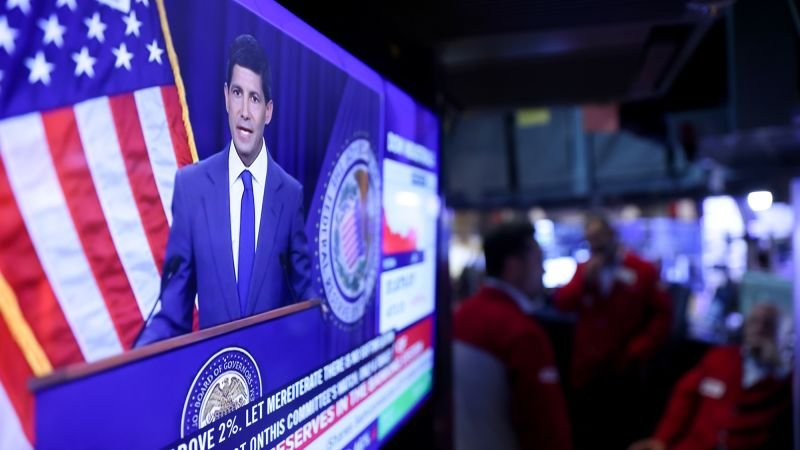
The Federal Reserve finds itself in a confusing economic moment, but one thing has become clear: Interest rates are moving higher, likely starting Wednesday. That’s an awkward reality for Kevin Warsh, the Fed chairman handpicked by President Donald Trump to lower rates.
If the Fed hikes its key interest rate as Wall Street expects, it would effectively put him at odds with the president, who has continued to demand lower borrowing costs, even as inflation remains stubbornly above the Fed’s 2% target.
Fed officials are expected to begin what could be a series of rate hikes designed to slow the US economy and put inflation back on track. The ongoing war in the Middle East has pushed up energy prices and now threatens to make inflation more persistent. If expectations bear out, the Fed’s decision would mark the first rate increase since July 2023.
Wall Street expects the Fed to hike rates twice by year’s end — this month and again in December. While that probably would not be enough to cause serious economic damage, the larger question is what happens if inflation doesn’t come down.
So, the Fed is mulling how many rate hikes may be necessary, which raises the other question of how well American consumers and businesses can endure those higher rates, especially in the face of mounting consumer debt, weaker spending and longer spells of unemployment. Raising rates could weaken an economy that is already showing signs of strain.
“The odds of a serious Fed policy mistake are uncomfortably high and rising,” Mark Zandi, chief economist at Moody’s, wrote on social media. “If the Fed tightens to bring inflation down faster… that is hard to do without layoffs, rising unemployment, and igniting a self-reinforcing negative cycle.”
It’s unclear just how many rate increases are coming— or how many it would take to push the US economy over the edge.
One rate increase probably won’t make much difference, but history shows that the Fed rarely hikes just once whenever it determines that inflation requires action. Some investors and economists even worry the handful of rate hikes the market expects might not be enough to curb AI-driven inflation, potentially requiring the Fed to push rates much higher.
“The Fed creates recessions, and it does so by taking the policy rate too high and/or keeping it there for too long,” said Chris Galipeau, senior market strategist at Franklin Templeton Institute. “If we get to three (rate hikes) and go above that, then that’s a really big risk.”
That is the key question for Wall Street: How far is Warsh prepared to go? Investors will be looking for any signal from the chairman that an aggressive rate-hiking cycle is on the horizon. But in a new era of Fed communication, it’s unclear what such a hint would look like, or if there would even be one. In a major speech last month, Warsh only said that there’s more “work to do” in fighting inflation.
The bond market, meanwhile, has already started doing some of the Fed’s work for it, making borrowing more expensive even before any rate hike. The yield on the 10-year US Treasury, a key benchmark for borrowing costs, rose above 5% on Tuesday, its highest closing level since 2007. That’s putting pressure on households and businesses.
For now, higher bond yields and the first Fed rate hike in more than three years probably won’t be enough to push the US labor market over the edge: Job growth picked up sharply in August, according to the Bureau of Labor Statistics, while the unemployment rate held steady at a relatively low 4.1%. Economic growth has also been on solid footing, though an increasing share of it has been driven by red-hot spending on AI — some of which is now being propelled by credit.
“There are multiple engines that the economy is running on,” said Jim Baird, chief investment officer at Plante Moran Financial Advisors.
But some of those engines are sputtering.
Consumer spending, which accounts for about two-thirds of the US economy, has trended lower in recent months as the boost from bigger tax returns faded and higher energy costs took a bite out of people’s paychecks.
Consumer sentiment continues to languish near record lows and fell earlier this month to its second-lowest reading in data that goes back more than 70 years.
The number of Americans unemployed for more than 26 weeks hovered last month slightly below a five-year high last reached in May.
And a greater share of Americans are falling behind on their mortgage and car loan payments than at any time in the past decade, according to the New York Fed.
“One or two rate hikes likely won’t lead to a massive implosion of the labor market, but there are many other risks out there that would have a much more profound effect, including if the AI investment boom slows down for whatever reason,” said Bjoern Griesbach, head of macroeconomics and capital markets research at Allianz Trade.




Responses