
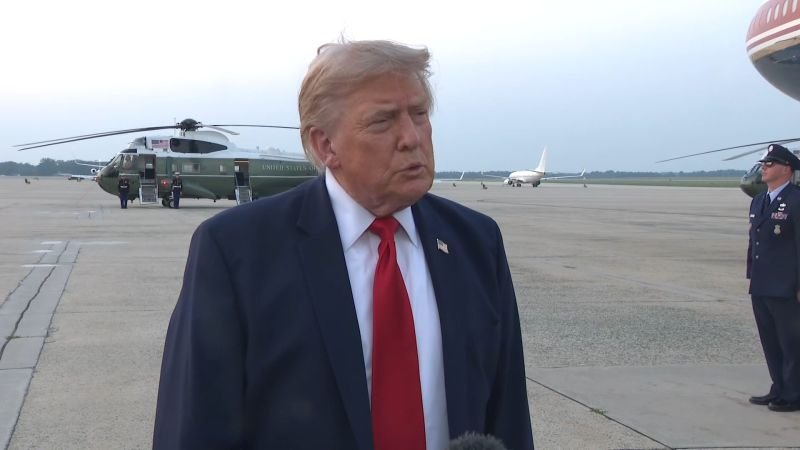
• US troops killed: President Donald Trump warned Iran “will pay” for three US troop deaths over the past few days. An American service member was killed in northern Iraq during the controlled detonation of a downed Iranian drone, and a separate Iranian attack in Jordan left two US troops dead and one missing in action.
• Weighing next steps: The US is increasing the number of fighter jets in the Middle East as Trump considers how to proceed, an official said. US Secretary of State Marco Rubio and a senior Iranian official have both said they remain open to diplomacy.
• In the region: The Kuwaiti military intercepted “hostile targets,” while sirens sounded multiple times in Bahrain. Iran has stepped up attacks on Kuwait, Bahrain and Jordan — all countries that host the US military.
• Gas prices rise: The average price for gallon of gas in the US hit $4, as intensified fighting further disrupts oil flows through the Strait of Hormuz.
30 Posts
President Donald Trump will attend the dignified transfer of US service members killed in the war with Iran, the White House announced on Monday.
“President Trump will attend the dignified transfer of our fallen heroes tomorrow evening at Dover Air Force Base. The President and the entire White House are praying for their families,” White House press secretary Karoline Leavitt wrote in a post on X.
The announcement comes after Trump earlier Monday vowed retaliation against Iran following the deaths of US troops over the weekend.
The Pentagon said three US service members were killed over the weekend, including two at a military base in Jordan and one in northern Iraq.
The United States is sending more aircraft to the Middle East as fears of a prolonged regional conflict grow after the US and Iran exchanged strikes over the weekend and Washington announced the deaths of three American service members.
The US plans to send additional F-16 and F-35 fighter jets from bases in Europe, as well as additional aerial refueling tankers, according to a US official.
We’re tracking the latest developments in the region. Catch up here.
President Donald Trump warned Iran of strong retribution after US troop deaths in the deadly weekend for American service members. The US Department of Defense identified two US soldiers who were killed in Iranian strikes in Jordan.
Iranian Interior Minister Eskandar Momeni has arrived in Pakistan, where Pakistani Interior Minister Mohsin Naqvi welcomed him at the airport, according to Pakistan’s Foreign Ministry. Naqvi told Momeni he hoped he “brought good news.” The visit comes after Iran’s Foreign Ministry spokesperson said mediators had sent Tehran additional proposals despite the hostilities.
The Kuwaiti military said it intercepted “hostile targets” for the second time on Monday, after Iran fired an initial salvo in the early morning local time.
In Bahrain, sirens sounded in the evening local time, according to the country’s Interior Ministry, for the fifth time Monday.
Iranian Foreign Ministry spokesperson Esmaeil Baghaei also later warned of “repercussions” if the US moves against Kharg Island, after being asked about threats made by Trump.
Meanwhile, the Iran-backed Houthi group in Yemen has declared its own maritime blockade on Saudi shipping, an escalation that could reignite yet another dormant regional conflict.
Air France said it is halting flights to Riyadh and Dubai because of the worsening security situation in the region. It also extended the suspension of flights to and from Beirut until August 2.
Separately, in a key step of the ceasefire agreement between Lebanon and Israel, the US announced the launch of pilot zones in southern Lebanon intended to transfer control of the area to the Lebanese military.
CNN’s Mostafa Salem, Dana Karni and Zeena Saifi, Eyad Kourdi, Sana Noor Haq, Michael Williams, Kevin Liptak, Tal Shalev, Robert North, Mohammed Tawfeeq, Sophia Saifi, Max Saltman and Aida Karimi contributed to this report.
A vessel off the coast of the United Arab Emirates was struck by a projectile last night, according to the UK Maritime Trade Operations (UKMTO) center, a British shipping monitor.
The incident occurred around 6:30 p.m. ET on Sunday, the UKMTO said.
“The Master of a vessel reports being struck by an unknown projectile causing damage to the steering gear,” UKMTO said in its report. “All the crew are reported as safe. There is no environmental impact. Authorities are investigating.”
UKMTO monitors shipping in the Persian Gulf, northern Indian Ocean and Red Sea. As the war with Iran has impeded shipping in the Strait of Hormuz since late February, the group has fielded a large number of emergency calls from vessels.
President Donald Trump said Israeli Prime Minister Benjamin Netanyahu will “not be arrested, in any way, shape, or form” when visiting the US, pushing back on recent comments from New York City Mayor Zohran Mamdani that his office is looking into arresting the prime minister during the United Nations General Assembly in September.
“Benjamin Netanyahu will not be arrested, in any way, shape, or form, while in the United States of America. He is fighting against the Islamic Republic of Iran, which recently killed 52,000 innocent protestors, and has spent the last 47 years killing American Soldiers, and others,” Trump said in a post on Truth Social.
Mamdani told a New York Times podcast that his administration’s legal department is actively discussing the potential arrest of Netanyahu, something he vowed on the campaign trail to pursue.
“I believe that Prime Minister Netanyahu belongs in The Hague,” Mamdani said on “The Interview” podcast. “He’s a war criminal who has been charged by the International Criminal Court. And what you will find is that is an opinion that is held by many purely because of what his actions have wrought over these last many years.”
Asked what he believed the law allowed him to do, Mamdani responded: “That’s an active conversation with our legal department. However, what we’ve seen at the national level is a desire sometimes to write your own laws, to go outside of the bounds of legality. That’s not something we have an interest in.”
French Foreign Minister Jean-Noël Barrot said Monday there would be “consequences” after two staff members of the French Embassy in Tehran were detained for several hours by Iranian security services.
In a statement, Barrot said the two embassy staff members were targeted Sunday evening in “an extremely serious act of intimidation,” which he described as a blatant violation of their diplomatic immunity.
He said they were held “without reason” for several hours, questioned and, in one case, physically assaulted, before later returning to the embassy.
Barrot said the two officials were now safe and awaiting their return to France in the coming hours.
He said the incident was especially shocking because the two staff members were responsible for French programs supporting civil society, particularly Iranian artists and scientists.
Barrot added that he has informed Iran’s foreign minister that “this extremely serious and unacceptable violation of the physical integrity of our staff will not go without consequences.”
There was no immediate public response from Iranian authorities.
President Donald Trump is warning of strong retribution for US troop deaths caused by Iran after a deadly weekend for American service members.
“Every time Iran kills an American Soldier they will pay for that killing many times over!” he wrote on Truth Social on Monday.
He said he had communicated his instructions to top military brass.
“This directive has been passed on to Secretary of War, Pete Hegseth, Chairman of the Joint Chiefs of Staff, Daniel Caine, and every Leader in the Military,” he wrote.
The Pentagon confirmed three US deaths over the weekend, including two at a military base in Jordan and one in northern Iraq.
The military continues to examine unidentified remains found at the site of the Jordan attack, an indication the death toll could rise.
Iranian Foreign Ministry spokesperson Esmaeil Baghaei warned Monday of “repercussions” if the United States moves against Kharg Island, after being asked about threats made by US President Donald Trump.
During a press conference from Tehran, Baghaei was asked about what the questioner described as Trump’s repeated threat, through social media posts, to potentially seize the island and what the consequences would be.
“They will face the repercussions,” Baghaei said. “There are numerous people in those very regions who are eagerly awaiting their arrival.”
Baghaei did not elaborate further on what actions Iran might take.
Iranian Interior Minister Eskandar Momeni has arrived in Pakistan, according to the Pakistani Foreign Ministry.
Pakistani Interior Minister Mohsin Naqvi welcomed Momeni and a delegation of Iranian officials at the airport, according to a Foreign Ministry statement, telling him that he hoped Momeni “brought good news.”
“We also hope for progress on the regional solution,” Naqvi added.
Iran’s state-run Islamic Republic News Agency (IRNA) earlier reported that Momeni is expected to discuss bilateral ties, including “economic, transit and agricultural cooperation” between Iran and Pakistan during his one-day visit to Islamabad.
Air France said Monday it is halting flights to Riyadh and Dubai because of the worsening security situation in the region.
The airline said it was suspending flights to and from Riyadh, Saudi Arabia, through July 25, and suspending services to and from Dubai, United Arab Emirates, through July 28. It also extended the suspension of flights to and from Beirut until August 2, those flights have been suspended since March 1.
Air France said the resumption of flights would depend on reassessment of the security situation, which it said was “rapidly evolving”. “Air France reiterates that the safety of its customers and crews is its utmost priority,” it added.
The move came as the United States announced it is sending more fighter jets to the region as tensions with Iran intensifies.
Several international airlines from various countries—including the US, Canada, Germany, Hong Kong, Singapore, and the UK—have already suspended flights to countries in Middle East amid US war with Iran.
The United States is increasing aircraft numbers in the Middle East as tensions soar with Iran.
The US plans to send additional F-16 and F-35 fighter jets from bases in Europe, as well as additional aerial refueling tankers, according to a US official.
Dozens of US fuelers have arrived in Israel in recent days and are still incoming, an Israeli source said. During the March operation, there were roughly 94 fuelers. That had dropped to 40, but has been rising since last week, this source said.
The additional resources could expand President Donald Trump’s options as he weighs how to proceed in the escalating conflict.
Last week, Trump received a Situation Room briefing on options to intensify the war. He has considered whether to attempt to capture Kharg Island, a key Iranian export hub, or to bomb Iranian nuclear facilities at Pickaxe Mountain.
Trump, however, has not entirely ruled out seeking a diplomatic solution, and US Secretary of State Marco Rubio said overnight the door remains open to returning to the negotiating table.
This post has been updated with additional reporting.
The Kuwaiti military was “intercepting hostile targets” for the second time on Monday, the country’s armed forces said, after Iran fired an initial salvo in the early morning local time.
Any “explosions that may be heard” were caused by activated air defense systems, the military posted on X.
Further south, in Bahrain, sirens sounded in the evening local time, according to the country’s Interior Ministry, for the fifth time on Monday.
Some background: The Iranian military has hiked attacks on three regional countries — Kuwait, Jordan and Bahrain — in recent days, all of which accommodate US regional bases.
CNN’s Mostafa Salem and Adrienne Vogt contributed reporting.
This post has been updated with the latest information.
In a key step of the ceasefire agreement between Lebanon and Israel, the US announced on Monday the launch of pilot zones in southern Lebanon intended to transfer control of the area to the Lebanese military.
The State Department named three towns near the so-called “Yellow Line,” the boundary for the territory Israel occupies in southern Lebanon. Only one had been occupied by Israeli forces; the other two had come under Israeli attack during the war. Under the US-brokered ceasefire agreement, Israel is supposed to withdraw its military forces from these zones and allow the Lebanese Armed Forces (LAF) to enter.
The zones are supposed to be clear of Hezbollah, the Iranian proxy whose base of power is in southern Lebanon. Israel has vowed it will not fully withdraw from the area until Hezbollah is disarmed and pushed back from the border.
Pictures of southern Lebanon shared with CNN last week show the LAF patrolling several southern villages along the border, including some previously occupied by Israeli forces, like Bint Jbeil, and others that have seen heavy Israeli bombardment, like Nabatiyeh. CNN has reached out to the Israel Defense Forces (IDF) for comment.
The announcement comes one day before Lebanese President Joseph Aoun is set to visit the White House and meet President Donald Trump. Aoun will be the first Lebanese president to visit the White House since 2009.
On Sunday, Aoun met with Secretary of State Marco Rubio. “The United States remains committed to supporting this effort and Lebanon’s efforts to deliver security, peace and a better future for the Lebanese people,” Rubio said in a statement after the meeting.
The Iran-backed Houthi group in Yemen has declared its own maritime blockade on Saudi shipping, an escalation that could reignite yet another dormant regional conflict.
The militant Houthi group announced in a televised statement by its spokesperson that it was imposing “a maritime embargo against the criminal Saudi enemy, based on the equation of an ‘eye for an eye,’ effective immediately.”
Last week, the Houthis accused Saudi Arabia of carrying out strikes on the capital’s airport warning that the attack marks the end of a years-long de facto truce with Riyadh. The opposing Saudi-backed Yemeni government based in Riyadh had accused Iran of sending a flight carrying military and security personnel destined for the Houthis, as well as Iranian experts in drone and missile-system development.
Tension has been growing between the Houthis and Saudi Arabia over a range of issues, including a long-running Saudi blockade of Houthi-held territory in the country’s north and direct flights between Tehran and Sanaa.
The Houthis are one of Iran’s principal allies in the region, and on several occasions since the start of the war between the US and Iran have warned they could take action to block the Bab al Mandab Strait, a chokepoint at the southern end of the Red Sea.
The flare-up follows more than four years of relative calm that began with a UN-brokered truce in 2022 and was sustained by direct Saudi-Houthi talks after Riyadh and Tehran restored diplomatic ties the following year.
After the United States and Israel launched their war on Iran, Tehran responded by stricking every country in the Gulf region, including the United Arab Emirates, Saudi Arabia, Israel and even its allies like Oman.
The current round of escalation, however, has witnessed more intense Iranian military actions against three regional countries: Kuwait, Bahrain, and Jordan — countries that have given the US access to use their territories for regional bases.
It is an indication that the Islamic Republic is making a more concerted effort to use smaller countries to display its capability to inflict damage, while retaining more options to escalate further against other countries if needed.
While Iran has sporadically launched attacks against other countries in the region since the latest round of escalation this month, Bahrain, which hosts the US Navy’s Fifth Fleet, and Kuwait, which hosts US bases such as Camp Arifjan and Ali Al Salem Air Base, have reported near-daily attacks since June 8.
Iran has also intensified its strikes on Jordan since last week, killing two American service members. Another soldier is still missing and others were injured.
While Tehran claims it is targeting US military installations and assets in the region, it has also been striking civilian infrastructure, including Kuwait’s sensitive water desalination infrastructure and Bahrain’s civil aviation navigation systems. It has also launched attacks on Kuwait International Airport in recent weeks, damaging a newly renovated terminal.
Beyond Iran’s stated goal of targeting these countries for their support of the US, Tehran’s strikes on these nations may also carry a political dimension. Bahrain has cracked down on segments of its Shiite population for their alleged support of Iran, while Kuwaiti authorities have prosecuted dozens of individuals for expressing sympathy with the Islamic Republic.
Iran could also be keeping its options open for strikes against other countries in the region — such as the UAE, Saudi Arabia, and Israel — treating them as the next step up the escalation ladder, which is a big indication that Iran could be trying to still contain the current round of escalation.
US and Iranian forces unleashed another wave of fire late Sunday, as government officials from both parties insisted the key to diplomacy lay beyond the memorandum of understanding (MOU) – adding they would follow through with “defensive” attacks.
Iran’s foreign ministry spokesperson, Esmaeil Baghaei, warned Tehran would not implement the 14-point agreement after Washington “violated it.” US Secretary of State Marco Rubio also relayed that accusation and said Iran was “not complying” with plan, telling reporters on Sunday, “They can’t have an MOU that’s alive if they’re violating the terms.”
Meanwhile, the Department of Defense identified two soldiers – 1st Lt. Tyler James Feehan, 25, and Pvt. Isabella Gonzales, 19 – who were killed in Iranian strikes in Jordan last week, marking the first US casualties from such attacks since March.
In Iran, more than 50 people have been killed and 517 others injured between June 27 and July 19, state media IRNA reported on Sunday, citing the country’s health ministry.
Here are the latest developments:
Iran warns US violated MOU in “text and its spirit”: Baghaei said the MOU summarized reciprocal commitments with Washington, adding once the US “breached them,” implementation became “practically impossible.” Mediators have sent alternative proposals to Iran, he added.
Tehran strikes US-allied Gulf nations: Kuwaiti forces were intercepting “hostile attacks” on Monday morning local time, the country’s army said. Further south, sirens also sounded in Bahran, according to the country’s Interior Ministry.
Tanker hit in Strait of Hormuz: A vessel was “struck by an unknown projectile” in the choked Strait of Hormuz, the UK maritime authority (UKMTO) said on Monday. The vessel caught aflame and was adrift off the coast of Oman, while the crew “safely abandoned” the ship, the UKMTO added.
Oil prices climb: Global oil costs spiked this past week after US and Iranian forces unleashed heavy fire and strained tenuous peace talks. For the first time in more than a month, Brent crude – the international litmus – peaked beyond $90 a barrel, before dropping back to $88.94.
CNN’s Aida Karimi, Mostafa Salem, Lex Harvey, Michael Williams and Hanna Ziady contributed reporting.
The Department of Defense on Monday identified two US soldiers who were killed in Iranian strikes in Jordan.
1st Lt. Tyler James Feehan, 25, and Pvt. Isabella Gonzales, 19, were killed as part of the Friday attack on Muwaffaq Salti Air Base in Jordan.
Gonzales, of Carrollton, Texas, died Friday, while Feehan, of Ewa Beach, Hawaii, died Saturday, the Defense Department said.
The deaths mark the first American casualties resulting from Iranian strikes since March.
US Secretary of State Marco Rubio insisted Washington “remains open” to negotiations late Sunday, just as the military had launched a ninth night of strikes on Iran.
Rubio claimed US officials would “continue to try” pushing for long term peace with Tehran, adding that the Trump administration “remains open to a diplomatic solution.” “(Iranian officials) continue to send signals that they want to talk, that they want to negotiate, but their behavior is what we’re responding to,” the US secretary of state told reporters.
When asked if Tehran was amenable to discussions, Rubio said he’d received signals “directly” and “through multiple channels from other countries.”
A senior Iranian official mirrored that same approach on Monday, saying that Tehran also “remains open to diplomacy.” Esmaeil Baghaei, the spokesperson for Iran’s Foreign Ministry, added that mediators “remained active” but that forces would prolong “defensive military operations for as long as attacks continue.”
Remember: Both US and Iranian officials have hinted at the possibility of renewed diplomacy, even as Tehran and Washington launched lethal strikes that point to the risk of regional conflagration – and the collapse of the Memorandum of Understanding.
It came after US President Donald Trump warned Iran was hit “very hard” after forces unleashed a ninth night of strikes. The Iranian military has fired drone and missile attacks on US-allied Gulf and Arab nations.
CNN’s Aleena Fayaz contributed reporting.
Iran will not implement the memorandum of understanding signed with the United States last month after Washington “violated it,” the Iranian Foreign Ministry spokesperson told reporters.
“The other side not only failed to implement it, but violated it and acted contrary to both its text and its spirit,” Esmail Baghaei said Monday, reiterating comments by Iranian officials over the weekend.
“We, in turn, announced that we would not implement it. That is entirely clear,” Baghaei said, adding that the agreement, which “safeguarded” Iran’s interests, consisted of reciprocal commitments with Washington, and once the US “breached them,” implementation by Tehran became “practically impossible.”
Responding to questions about how Iran would react if Washington requested more negotiations, after Iran’s Supreme Leader Mojtaba Khamenei called President Donald Trump’s signature “worthless and unreliable,” Baghaei suggested that talks could still take place. He said that just as war serves to “safeguard” Iran’s interests, negotiations are another means to achieve the same goal.
He added that mediators have sent other proposals to Tehran despite the hostilities, but refused to go into details. Qatar and Pakistan have acted as mediators between Iran and the US.
Oil prices rose above $90 a barrel for the first time in more than a month, as the conflict between the United States and Iran escalated further, resulting in the deaths of three US service members and a strike on a tanker.
Brent crude, the global oil benchmark, rose to its highest level since June 11, before paring gains to trade around 1% higher at $88.94 a barrel. West Texas Intermediate, the US oil benchmark, rose less than 1% to $82.26 a barrel.
Brent climbed nearly 16% last week, its largest weekly rise since April, and European benchmark natural gas prices saw their highest close since March, according to Deutsche Bank.
Global energy prices are marching higher after a ninth consecutive night of US strikes against Iran. A crew was forced to abandon a vessel struck Monday near the Strait of Hormuz, according to the UK maritime authority. Expanded attacks in recent days have deepened fears about a wider war.
“The Memorandum of Understanding is effectively dead in the Strait of Hormuz, and Gulf energy infrastructure is now back in the firing in line with all the associated market risks,” Neil Wilson, a strategist at investment bank Saxo wrote in a note.
“Risks now seem skewed towards higher for longer energy prices, inflation and (interest) rates.”
Ryanair’s profits fell by more than a third during the last quarter as the US-Iran war raised fuel costs and forced the carrier to cut fares to entice customers.
In results published Monday, Europe’s largest airline said that profit in the three months to the end of June had tumbled 34% to €538 million from the same quarter in 2025.
The company said its operating costs were up 11% during the period, which it attributed mostly to a doubling in its unhedged fuel prices — fuel bought at the current market rate, rather than supplies locked in at a set price for future delivery.
Ryanair cut average air fares by 6% “as the Middle East conflict led to consumer hesitancy, concerns about EU jet-fuel shortages, economic uncertainty and later bookings,” Ryanair CEO Michael O’Leary said in a statement.
The budget airline said fares over the summer were also likely to fall year-over-year. Its shares were trading down 4.3% by 4.32 a.m. ET.
Global oil prices have climbed sharply since the US and Iran resumed fighting over a week ago, imperiling peace talks. A barrel of Brent crude, the global benchmark, rose above $90 for the first time in more than a month on Monday.
• US troops killed: President Donald Trump warned Iran “will pay” for three US troop deaths over the past few days. An American service member was killed in northern Iraq during the controlled detonation of a downed Iranian drone, and a separate Iranian attack in Jordan left two US troops dead and one missing in action.
• Weighing next steps: The US is increasing the number of fighter jets in the Middle East as Trump considers how to proceed, an official said. US Secretary of State Marco Rubio and a senior Iranian official have both said they remain open to diplomacy.
• In the region: The Kuwaiti military intercepted “hostile targets,” while sirens sounded multiple times in Bahrain. Iran has stepped up attacks on Kuwait, Bahrain and Jordan — all countries that host the US military.
• Gas prices rise: The average price for gallon of gas in the US hit $4, as intensified fighting further disrupts oil flows through the Strait of Hormuz.
President Donald Trump will attend the dignified transfer of US service members killed in the war with Iran, the White House announced on Monday.
“President Trump will attend the dignified transfer of our fallen heroes tomorrow evening at Dover Air Force Base. The President and the entire White House are praying for their families,” White House press secretary Karoline Leavitt wrote in a post on X.
The announcement comes after Trump earlier Monday vowed retaliation against Iran following the deaths of US troops over the weekend.
The Pentagon said three US service members were killed over the weekend, including two at a military base in Jordan and one in northern Iraq.
The United States is sending more aircraft to the Middle East as fears of a prolonged regional conflict grow after the US and Iran exchanged strikes over the weekend and Washington announced the deaths of three American service members.
The US plans to send additional F-16 and F-35 fighter jets from bases in Europe, as well as additional aerial refueling tankers, according to a US official.
We’re tracking the latest developments in the region. Catch up here.
President Donald Trump warned Iran of strong retribution after US troop deaths in the deadly weekend for American service members. The US Department of Defense identified two US soldiers who were killed in Iranian strikes in Jordan.
Iranian Interior Minister Eskandar Momeni has arrived in Pakistan, where Pakistani Interior Minister Mohsin Naqvi welcomed him at the airport, according to Pakistan’s Foreign Ministry. Naqvi told Momeni he hoped he “brought good news.” The visit comes after Iran’s Foreign Ministry spokesperson said mediators had sent Tehran additional proposals despite the hostilities.
The Kuwaiti military said it intercepted “hostile targets” for the second time on Monday, after Iran fired an initial salvo in the early morning local time.
In Bahrain, sirens sounded in the evening local time, according to the country’s Interior Ministry, for the fifth time Monday.
Iranian Foreign Ministry spokesperson Esmaeil Baghaei also later warned of “repercussions” if the US moves against Kharg Island, after being asked about threats made by Trump.
Meanwhile, the Iran-backed Houthi group in Yemen has declared its own maritime blockade on Saudi shipping, an escalation that could reignite yet another dormant regional conflict.
Air France said it is halting flights to Riyadh and Dubai because of the worsening security situation in the region. It also extended the suspension of flights to and from Beirut until August 2.
Separately, in a key step of the ceasefire agreement between Lebanon and Israel, the US announced the launch of pilot zones in southern Lebanon intended to transfer control of the area to the Lebanese military.
CNN’s Mostafa Salem, Dana Karni and Zeena Saifi, Eyad Kourdi, Sana Noor Haq, Michael Williams, Kevin Liptak, Tal Shalev, Robert North, Mohammed Tawfeeq, Sophia Saifi, Max Saltman and Aida Karimi contributed to this report.
A vessel off the coast of the United Arab Emirates was struck by a projectile last night, according to the UK Maritime Trade Operations (UKMTO) center, a British shipping monitor.
The incident occurred around 6:30 p.m. ET on Sunday, the UKMTO said.
“The Master of a vessel reports being struck by an unknown projectile causing damage to the steering gear,” UKMTO said in its report. “All the crew are reported as safe. There is no environmental impact. Authorities are investigating.”
UKMTO monitors shipping in the Persian Gulf, northern Indian Ocean and Red Sea. As the war with Iran has impeded shipping in the Strait of Hormuz since late February, the group has fielded a large number of emergency calls from vessels.
President Donald Trump said Israeli Prime Minister Benjamin Netanyahu will “not be arrested, in any way, shape, or form” when visiting the US, pushing back on recent comments from New York City Mayor Zohran Mamdani that his office is looking into arresting the prime minister during the United Nations General Assembly in September.
“Benjamin Netanyahu will not be arrested, in any way, shape, or form, while in the United States of America. He is fighting against the Islamic Republic of Iran, which recently killed 52,000 innocent protestors, and has spent the last 47 years killing American Soldiers, and others,” Trump said in a post on Truth Social.
Mamdani told a New York Times podcast that his administration’s legal department is actively discussing the potential arrest of Netanyahu, something he vowed on the campaign trail to pursue.
“I believe that Prime Minister Netanyahu belongs in The Hague,” Mamdani said on “The Interview” podcast. “He’s a war criminal who has been charged by the International Criminal Court. And what you will find is that is an opinion that is held by many purely because of what his actions have wrought over these last many years.”
Asked what he believed the law allowed him to do, Mamdani responded: “That’s an active conversation with our legal department. However, what we’ve seen at the national level is a desire sometimes to write your own laws, to go outside of the bounds of legality. That’s not something we have an interest in.”
French Foreign Minister Jean-Noël Barrot said Monday there would be “consequences” after two staff members of the French Embassy in Tehran were detained for several hours by Iranian security services.
In a statement, Barrot said the two embassy staff members were targeted Sunday evening in “an extremely serious act of intimidation,” which he described as a blatant violation of their diplomatic immunity.
He said they were held “without reason” for several hours, questioned and, in one case, physically assaulted, before later returning to the embassy.
Barrot said the two officials were now safe and awaiting their return to France in the coming hours.
He said the incident was especially shocking because the two staff members were responsible for French programs supporting civil society, particularly Iranian artists and scientists.
Barrot added that he has informed Iran’s foreign minister that “this extremely serious and unacceptable violation of the physical integrity of our staff will not go without consequences.”
There was no immediate public response from Iranian authorities.
President Donald Trump is warning of strong retribution for US troop deaths caused by Iran after a deadly weekend for American service members.
“Every time Iran kills an American Soldier they will pay for that killing many times over!” he wrote on Truth Social on Monday.
He said he had communicated his instructions to top military brass.
“This directive has been passed on to Secretary of War, Pete Hegseth, Chairman of the Joint Chiefs of Staff, Daniel Caine, and every Leader in the Military,” he wrote.
The Pentagon confirmed three US deaths over the weekend, including two at a military base in Jordan and one in northern Iraq.
The military continues to examine unidentified remains found at the site of the Jordan attack, an indication the death toll could rise.
Iranian Foreign Ministry spokesperson Esmaeil Baghaei warned Monday of “repercussions” if the United States moves against Kharg Island, after being asked about threats made by US President Donald Trump.
During a press conference from Tehran, Baghaei was asked about what the questioner described as Trump’s repeated threat, through social media posts, to potentially seize the island and what the consequences would be.
“They will face the repercussions,” Baghaei said. “There are numerous people in those very regions who are eagerly awaiting their arrival.”
Baghaei did not elaborate further on what actions Iran might take.
Iranian Interior Minister Eskandar Momeni has arrived in Pakistan, according to the Pakistani Foreign Ministry.
Pakistani Interior Minister Mohsin Naqvi welcomed Momeni and a delegation of Iranian officials at the airport, according to a Foreign Ministry statement, telling him that he hoped Momeni “brought good news.”
“We also hope for progress on the regional solution,” Naqvi added.
Iran’s state-run Islamic Republic News Agency (IRNA) earlier reported that Momeni is expected to discuss bilateral ties, including “economic, transit and agricultural cooperation” between Iran and Pakistan during his one-day visit to Islamabad.
Air France said Monday it is halting flights to Riyadh and Dubai because of the worsening security situation in the region.
The airline said it was suspending flights to and from Riyadh, Saudi Arabia, through July 25, and suspending services to and from Dubai, United Arab Emirates, through July 28. It also extended the suspension of flights to and from Beirut until August 2, those flights have been suspended since March 1.
Air France said the resumption of flights would depend on reassessment of the security situation, which it said was “rapidly evolving”. “Air France reiterates that the safety of its customers and crews is its utmost priority,” it added.
The move came as the United States announced it is sending more fighter jets to the region as tensions with Iran intensifies.
Several international airlines from various countries—including the US, Canada, Germany, Hong Kong, Singapore, and the UK—have already suspended flights to countries in Middle East amid US war with Iran.
The United States is increasing aircraft numbers in the Middle East as tensions soar with Iran.
The US plans to send additional F-16 and F-35 fighter jets from bases in Europe, as well as additional aerial refueling tankers, according to a US official.
Dozens of US fuelers have arrived in Israel in recent days and are still incoming, an Israeli source said. During the March operation, there were roughly 94 fuelers. That had dropped to 40, but has been rising since last week, this source said.
The additional resources could expand President Donald Trump’s options as he weighs how to proceed in the escalating conflict.
Last week, Trump received a Situation Room briefing on options to intensify the war. He has considered whether to attempt to capture Kharg Island, a key Iranian export hub, or to bomb Iranian nuclear facilities at Pickaxe Mountain.
Trump, however, has not entirely ruled out seeking a diplomatic solution, and US Secretary of State Marco Rubio said overnight the door remains open to returning to the negotiating table.
This post has been updated with additional reporting.
The Kuwaiti military was “intercepting hostile targets” for the second time on Monday, the country’s armed forces said, after Iran fired an initial salvo in the early morning local time.
Any “explosions that may be heard” were caused by activated air defense systems, the military posted on X.
Further south, in Bahrain, sirens sounded in the evening local time, according to the country’s Interior Ministry, for the fifth time on Monday.
Some background: The Iranian military has hiked attacks on three regional countries — Kuwait, Jordan and Bahrain — in recent days, all of which accommodate US regional bases.
CNN’s Mostafa Salem and Adrienne Vogt contributed reporting.
This post has been updated with the latest information.
In a key step of the ceasefire agreement between Lebanon and Israel, the US announced on Monday the launch of pilot zones in southern Lebanon intended to transfer control of the area to the Lebanese military.
The State Department named three towns near the so-called “Yellow Line,” the boundary for the territory Israel occupies in southern Lebanon. Only one had been occupied by Israeli forces; the other two had come under Israeli attack during the war. Under the US-brokered ceasefire agreement, Israel is supposed to withdraw its military forces from these zones and allow the Lebanese Armed Forces (LAF) to enter.
The zones are supposed to be clear of Hezbollah, the Iranian proxy whose base of power is in southern Lebanon. Israel has vowed it will not fully withdraw from the area until Hezbollah is disarmed and pushed back from the border.
Pictures of southern Lebanon shared with CNN last week show the LAF patrolling several southern villages along the border, including some previously occupied by Israeli forces, like Bint Jbeil, and others that have seen heavy Israeli bombardment, like Nabatiyeh. CNN has reached out to the Israel Defense Forces (IDF) for comment.
The announcement comes one day before Lebanese President Joseph Aoun is set to visit the White House and meet President Donald Trump. Aoun will be the first Lebanese president to visit the White House since 2009.
On Sunday, Aoun met with Secretary of State Marco Rubio. “The United States remains committed to supporting this effort and Lebanon’s efforts to deliver security, peace and a better future for the Lebanese people,” Rubio said in a statement after the meeting.
The Iran-backed Houthi group in Yemen has declared its own maritime blockade on Saudi shipping, an escalation that could reignite yet another dormant regional conflict.
The militant Houthi group announced in a televised statement by its spokesperson that it was imposing “a maritime embargo against the criminal Saudi enemy, based on the equation of an ‘eye for an eye,’ effective immediately.”
Last week, the Houthis accused Saudi Arabia of carrying out strikes on the capital’s airport warning that the attack marks the end of a years-long de facto truce with Riyadh. The opposing Saudi-backed Yemeni government based in Riyadh had accused Iran of sending a flight carrying military and security personnel destined for the Houthis, as well as Iranian experts in drone and missile-system development.
Tension has been growing between the Houthis and Saudi Arabia over a range of issues, including a long-running Saudi blockade of Houthi-held territory in the country’s north and direct flights between Tehran and Sanaa.
The Houthis are one of Iran’s principal allies in the region, and on several occasions since the start of the war between the US and Iran have warned they could take action to block the Bab al Mandab Strait, a chokepoint at the southern end of the Red Sea.
The flare-up follows more than four years of relative calm that began with a UN-brokered truce in 2022 and was sustained by direct Saudi-Houthi talks after Riyadh and Tehran restored diplomatic ties the following year.
After the United States and Israel launched their war on Iran, Tehran responded by stricking every country in the Gulf region, including the United Arab Emirates, Saudi Arabia, Israel and even its allies like Oman.
The current round of escalation, however, has witnessed more intense Iranian military actions against three regional countries: Kuwait, Bahrain, and Jordan — countries that have given the US access to use their territories for regional bases.
It is an indication that the Islamic Republic is making a more concerted effort to use smaller countries to display its capability to inflict damage, while retaining more options to escalate further against other countries if needed.
While Iran has sporadically launched attacks against other countries in the region since the latest round of escalation this month, Bahrain, which hosts the US Navy’s Fifth Fleet, and Kuwait, which hosts US bases such as Camp Arifjan and Ali Al Salem Air Base, have reported near-daily attacks since June 8.
Iran has also intensified its strikes on Jordan since last week, killing two American service members. Another soldier is still missing and others were injured.
While Tehran claims it is targeting US military installations and assets in the region, it has also been striking civilian infrastructure, including Kuwait’s sensitive water desalination infrastructure and Bahrain’s civil aviation navigation systems. It has also launched attacks on Kuwait International Airport in recent weeks, damaging a newly renovated terminal.
Beyond Iran’s stated goal of targeting these countries for their support of the US, Tehran’s strikes on these nations may also carry a political dimension. Bahrain has cracked down on segments of its Shiite population for their alleged support of Iran, while Kuwaiti authorities have prosecuted dozens of individuals for expressing sympathy with the Islamic Republic.
Iran could also be keeping its options open for strikes against other countries in the region — such as the UAE, Saudi Arabia, and Israel — treating them as the next step up the escalation ladder, which is a big indication that Iran could be trying to still contain the current round of escalation.
US and Iranian forces unleashed another wave of fire late Sunday, as government officials from both parties insisted the key to diplomacy lay beyond the memorandum of understanding (MOU) – adding they would follow through with “defensive” attacks.
Iran’s foreign ministry spokesperson, Esmaeil Baghaei, warned Tehran would not implement the 14-point agreement after Washington “violated it.” US Secretary of State Marco Rubio also relayed that accusation and said Iran was “not complying” with plan, telling reporters on Sunday, “They can’t have an MOU that’s alive if they’re violating the terms.”
Meanwhile, the Department of Defense identified two soldiers – 1st Lt. Tyler James Feehan, 25, and Pvt. Isabella Gonzales, 19 – who were killed in Iranian strikes in Jordan last week, marking the first US casualties from such attacks since March.
In Iran, more than 50 people have been killed and 517 others injured between June 27 and July 19, state media IRNA reported on Sunday, citing the country’s health ministry.
Here are the latest developments:
Iran warns US violated MOU in “text and its spirit”: Baghaei said the MOU summarized reciprocal commitments with Washington, adding once the US “breached them,” implementation became “practically impossible.” Mediators have sent alternative proposals to Iran, he added.
Tehran strikes US-allied Gulf nations: Kuwaiti forces were intercepting “hostile attacks” on Monday morning local time, the country’s army said. Further south, sirens also sounded in Bahran, according to the country’s Interior Ministry.
Tanker hit in Strait of Hormuz: A vessel was “struck by an unknown projectile” in the choked Strait of Hormuz, the UK maritime authority (UKMTO) said on Monday. The vessel caught aflame and was adrift off the coast of Oman, while the crew “safely abandoned” the ship, the UKMTO added.
Oil prices climb: Global oil costs spiked this past week after US and Iranian forces unleashed heavy fire and strained tenuous peace talks. For the first time in more than a month, Brent crude – the international litmus – peaked beyond $90 a barrel, before dropping back to $88.94.
CNN’s Aida Karimi, Mostafa Salem, Lex Harvey, Michael Williams and Hanna Ziady contributed reporting.
The Department of Defense on Monday identified two US soldiers who were killed in Iranian strikes in Jordan.
1st Lt. Tyler James Feehan, 25, and Pvt. Isabella Gonzales, 19, were killed as part of the Friday attack on Muwaffaq Salti Air Base in Jordan.
Gonzales, of Carrollton, Texas, died Friday, while Feehan, of Ewa Beach, Hawaii, died Saturday, the Defense Department said.
The deaths mark the first American casualties resulting from Iranian strikes since March.
US Secretary of State Marco Rubio insisted Washington “remains open” to negotiations late Sunday, just as the military had launched a ninth night of strikes on Iran.
Rubio claimed US officials would “continue to try” pushing for long term peace with Tehran, adding that the Trump administration “remains open to a diplomatic solution.” “(Iranian officials) continue to send signals that they want to talk, that they want to negotiate, but their behavior is what we’re responding to,” the US secretary of state told reporters.
When asked if Tehran was amenable to discussions, Rubio said he’d received signals “directly” and “through multiple channels from other countries.”
A senior Iranian official mirrored that same approach on Monday, saying that Tehran also “remains open to diplomacy.” Esmaeil Baghaei, the spokesperson for Iran’s Foreign Ministry, added that mediators “remained active” but that forces would prolong “defensive military operations for as long as attacks continue.”
Remember: Both US and Iranian officials have hinted at the possibility of renewed diplomacy, even as Tehran and Washington launched lethal strikes that point to the risk of regional conflagration – and the collapse of the Memorandum of Understanding.
It came after US President Donald Trump warned Iran was hit “very hard” after forces unleashed a ninth night of strikes. The Iranian military has fired drone and missile attacks on US-allied Gulf and Arab nations.
CNN’s Aleena Fayaz contributed reporting.
Iran will not implement the memorandum of understanding signed with the United States last month after Washington “violated it,” the Iranian Foreign Ministry spokesperson told reporters.
“The other side not only failed to implement it, but violated it and acted contrary to both its text and its spirit,” Esmail Baghaei said Monday, reiterating comments by Iranian officials over the weekend.
“We, in turn, announced that we would not implement it. That is entirely clear,” Baghaei said, adding that the agreement, which “safeguarded” Iran’s interests, consisted of reciprocal commitments with Washington, and once the US “breached them,” implementation by Tehran became “practically impossible.”
Responding to questions about how Iran would react if Washington requested more negotiations, after Iran’s Supreme Leader Mojtaba Khamenei called President Donald Trump’s signature “worthless and unreliable,” Baghaei suggested that talks could still take place. He said that just as war serves to “safeguard” Iran’s interests, negotiations are another means to achieve the same goal.
He added that mediators have sent other proposals to Tehran despite the hostilities, but refused to go into details. Qatar and Pakistan have acted as mediators between Iran and the US.
Oil prices rose above $90 a barrel for the first time in more than a month, as the conflict between the United States and Iran escalated further, resulting in the deaths of three US service members and a strike on a tanker.
Brent crude, the global oil benchmark, rose to its highest level since June 11, before paring gains to trade around 1% higher at $88.94 a barrel. West Texas Intermediate, the US oil benchmark, rose less than 1% to $82.26 a barrel.
Brent climbed nearly 16% last week, its largest weekly rise since April, and European benchmark natural gas prices saw their highest close since March, according to Deutsche Bank.
Global energy prices are marching higher after a ninth consecutive night of US strikes against Iran. A crew was forced to abandon a vessel struck Monday near the Strait of Hormuz, according to the UK maritime authority. Expanded attacks in recent days have deepened fears about a wider war.
“The Memorandum of Understanding is effectively dead in the Strait of Hormuz, and Gulf energy infrastructure is now back in the firing in line with all the associated market risks,” Neil Wilson, a strategist at investment bank Saxo wrote in a note.
“Risks now seem skewed towards higher for longer energy prices, inflation and (interest) rates.”
Ryanair’s profits fell by more than a third during the last quarter as the US-Iran war raised fuel costs and forced the carrier to cut fares to entice customers.
In results published Monday, Europe’s largest airline said that profit in the three months to the end of June had tumbled 34% to €538 million from the same quarter in 2025.
The company said its operating costs were up 11% during the period, which it attributed mostly to a doubling in its unhedged fuel prices — fuel bought at the current market rate, rather than supplies locked in at a set price for future delivery.
Ryanair cut average air fares by 6% “as the Middle East conflict led to consumer hesitancy, concerns about EU jet-fuel shortages, economic uncertainty and later bookings,” Ryanair CEO Michael O’Leary said in a statement.
The budget airline said fares over the summer were also likely to fall year-over-year. Its shares were trading down 4.3% by 4.32 a.m. ET.
Global oil prices have climbed sharply since the US and Iran resumed fighting over a week ago, imperiling peace talks. A barrel of Brent crude, the global benchmark, rose above $90 for the first time in more than a month on Monday.





Responses