
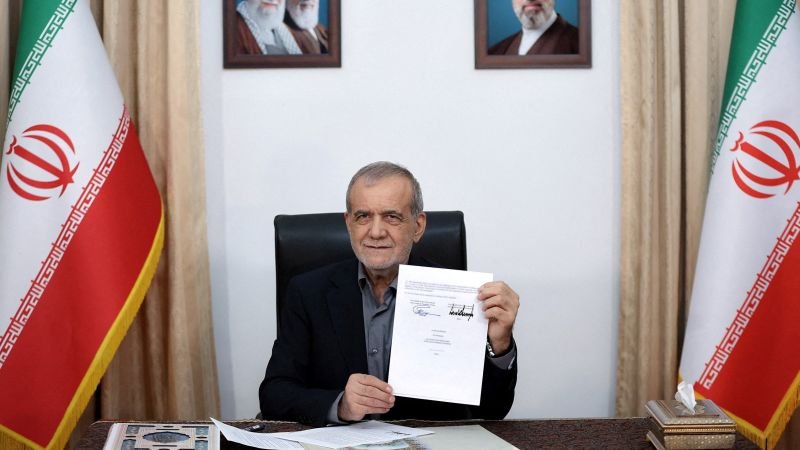
• US-Iran agreement: The US and Iran have signed an initial agreement, kicking off a 60-day period of negotiations on a final deal to end the war. Iran’s supreme leader authorized the signing despite holding a “different view,” he said in a statement.
• Secret proposals: The US and Iran have been working on laying out secret proposals for implementing the 14 points that were signed this week, including details on how to address the future of Iran’s nuclear program, according to US officials.
• Tension with Israel: Meanwhile, US Vice President JD Vance criticized Israeli operations in Lebanon, saying they’ve sometimes gotten in the way of negotiations. In response to reports of Israeli displeasure with the agreement, he said, “If I was in the cabinet of the Israeli government, I might not be attacking the only powerful ally that I have anywhere left in the entire world.”
68 Posts
President Donald Trump suggested the memorandum of understanding reached with Iran amounts to “unconditional surrender” and that the conflict demonstrated the breadth of his presidential powers.
Caputo then told the president that “at the beginning of the conflict, you had talked about you only wanted unconditional surrender and the MOU doesn’t look like unconditional surrender.”
The comments come after the United States and Iran signed a memorandum of understanding that begins a 60-day negotiating period toward a final agreement aimed at ending the war.
CNN reported that as key Republicans on Capitol Hill first learned the details of Trump’s agreement with Iran, some were so stunned that they wouldn’t speak about it. But now, a significant bloc of GOP senators has begun to openly doubt the terms of Trump’s Iran negotiations — with many urging him to pivot his strategy entirely.
In the Axios interview, set to release on Friday, Trump was asked what he had learned about the exercise of power and the limits on his power as a result of the conflict. “There are no limits,” he said.
US Vice President JD Vance had strong words for members of the Israeli government who have criticized President Donald Trump over the US-Iran agreement.
“If I was in the Cabinet of the Israeli government, I might not be attacking the only powerful ally that I have anywhere left in the entire world,” Vance said.
If you missed it, here’s that moment from today’s briefing:
President Donald Trump said Thursday the United States expects a “complete ceasefire on all fronts” as he called on “everyone in the Middle East” to uphold their commitments.
The US and Iran signed an initial agreement, kicking off a 60-day period of negotiations on a final deal to end the war.
Catch up on the latest:
More on the ceasefire: The text of the memorandum of understanding calls for “the immediate and permanent termination of military operations on all fronts, including in Lebanon.” But Israel has once again vowed that it will not withdraw from Lebanon.
Word out of Iran: Iran’s supreme leader, Ayatollah Seyyed Mojtaba Khamenei, confirmed he authorized an agreement with the US, despite holding a different view on the deal. Khamenei said Trump had “out of desperation, resorted to various forms of pressure and leverage to bring about this outcome,” according to a text message read on Iran’s state broadcaster IRIB on Thursday evening.
The latest on the strait: Iran’s Persian Gulf Waterway Management Authority (PGSA) will manage traffic through the Strait of Hormuz following the US-Iran agreement, the country’s Supreme National Security Council announced today. The maritime security threat level in the strategic waterway was also downgraded to “moderate” by the United Kingdom Maritime Trade Operations (UKMTO) following the US-Iran agreement to reopen it.
And here’s how more have reacted to the US-Iran agreement:
Some Republican lawmakers lit into the Trump administration’s memorandum of understanding with Iran today, especially over the billions of dollars that could be paid to Iran as part of a permanent truce. US Senate Minority Leader Chuck Schumer called the agreement a “fiasco,” pointing to Senate GOP concerns with the memorandum and arguing Trump “gave away the store.”
Meanwhile, Israel’s Ambassador to the United Nations Danny Danon said his country trusts Trump to negotiate a peace deal with Iran, as Israel is continuing strikes in Lebanon and potentially throwing uncertainty into diplomatic efforts.
Aida Karimi, Alejandra Jaramillo, Mitchell McCluskey, Elise Hammond, Lauren Fox, Morgan Rimmer, Manu Raju, Ellis Kim, Adam Cancryn and Caitlin Danaher contributed reporting.
Iran’s parliament speaker and key negotiator Mohammad Bagher Ghalibaf has warned the United States that any breach of the agreement or excessive demands will be met with a “crushing response” as both sides work to negotiate a permanent truce over the next 60 days.
“They were once slapped during the war; if they wish to tread that path again, they will receive an even harder slap,” he added.
The Iranian official noted that his team of negotiators are seeking to “pursue the realization of the conditions and clauses of the agreement,” at the behest of Iran’s supreme leader, Ayatollah Seyyed Mojtaba Khamenei.
Earlier, Khamenei confirmed he authorized an agreement with the US, and claimed US President Donald Trump resorted to various forms of pressure and leverage “out of desperation” to secure the initial deal.
Senate Majority Leader John Thune called the US agreement with Iran “a step in the right direction,” though he acknowledged there will “continue to be a contentious conversation” over a final deal, after top congressional leaders were briefed by the White House.
“There’s obviously more to come, and this … sort of sets the stage, if you will, for a negotiation. Hopefully, ultimately it leads to an end to Iran’s nuclear program,” he told CNN.
Asked whether the briefing had assuaged any concerns he had with the financial incentives for Iran included in the initial agreement, Thune replied, “I think the, all of those financial incentives, perhaps with the exception of the toll on the blockade, those are all going to be contingent upon or conditioned upon things that happen later that the Iranians have to do.”
“So I think this is – like I said, I view this as a first step in what will probably be somewhat long and continue to be a contentious conversation about what a final deal looks like, but I think it’s a, obviously it’s a step in the right direction, it opens up the strait and gets the shipping lanes open, and I think that’s a good, a good outcome for the economy,” he continued.
The maritime security threat level in the Strait of Hormuz has been downgraded to ‘moderate’ by the the United Kingdom Maritime Trade Operations (UKMTO) following the announced agreement between the United States and Iran to reopen the strategic waterway.
The threat level in the crucial maritime corridor had previously been declared “critical” due to ongoing regional military operations, according to the UKMTO, a British organization run by the Royal Navy that provides maritime security information.
The organization also warned of expected congestion through transit routes, with naval forces present to support the free flow of traffic.
The update comes as the US military announced earlier today it was lifting the naval blockade on Iranian ports that had been in place since April.
US Senate Minority Leader Chuck Schumer called the agreement with Iran a “fiasco,” pointing to Senate GOP concerns with the memorandum and arguing President Donald Trump “gave away the store.”
“This is not the art of the deal. This is the art of surrender. Trump didn’t get peace through strength, he got payoff through weakness. Americans got almost nothing we wanted and needed, and Trump gave away the store. The Iranians took him to the cleaners,” Schumer said.
The minority leader said “Democrats are not going to vote for” any potential deal that includes $300 billion for rebuilding in Iran. Asked about Trump’s insistence that the US would not be providing the money itself, Schumer responded, “We’re not paying for it.”
Schumer also accused Trump of starting the war with Iran in an effort to distract from domestic issues.
“He had no aim, no goals, and as a result, America and the world suffered from one of the worst deals that Trump has ever put together, one of the worst deals that we’ve ever seen in United States foreign and diplomatic policy,” he said.
The Democratic leader also noted that most Senate Republicans are not clamoring to back the agreement.
The White House on Thursday afternoon briefed a handful of senior Senate and House lawmakers on its agreement with Iran, a source familiar with the matter told CNN.
The participants on the private call included congressional leadership, as well as top lawmakers on the Senate Foreign Relations Committee and House Foreign Affairs Committee. It marked the first major briefing that the White House has provided to lawmakers about the specifics of the pact with Iran that President Donald Trump signed earlier this week.
On the call, senior officials provided specifics of the agreement, answered questions and offered a preview of the next stage of negotiations aimed at striking a permanent truce over the next 60 days, the source said.
The briefing came amid rising criticism of the agreement on Capitol Hill, including from Republicans who questioned whether it had extracted enough concessions from Iran following nearly four months of war.
Punchbowl News first reported the call.
Some Republican lawmakers lit into the Trump administration’s memorandum of understanding with Iran today, especially over the billions of dollars that could be paid to Iran as part of a permanent truce.
Here’s what is going on on Capitol Hill:
Sen. Ted Cruz of Texas railed against the framework’s $300 billion economic fund for Iran. “History demonstrates that giving billions of dollars to theocratic lunatics who want to murder us is an exceptionally bad idea, and I think unfortunately the president is receiving some really bad advice on this deal,” Cruz said. He faulted the president’s advisers before singling out “mistakes,” including Iran “having an ongoing role in administering the Strait of Hormuz and potentially charging fees or tolls.”
Sen. Bill Cassidy of Louisiana, who has blasted the deal on social media, argued that “Iran’s left stronger, we are left weaker, our allies are left weaker.” Cassidy, who lost a primary and will retire from Congress, said that “Iran gets $300 billion to rebuild, which I’ll tell you some of it is to support things that we don’t care for.” He said there’s “a lot of stuff in there that’s bad.”
Sen. Joni Ernst of Iowa, who is retiring at the end of her term, raised questions about the deal. “I think there are many of us that just really want to fully understand what the administration is thinking, where they’re going to go with this,” she told reporters. “I want to know, what are the follow-on repercussions?”
Sen. Lisa Murkowski of Alaska said: “It’s tough to say that the agreement is one that leaves Iran in a worse place and the United States in a better place.” She was also skeptical that there would be a real nuclear deal at the end of 60 days.
This post has been updated with additional comments from lawmakers.
Iran’s Persian Gulf Waterway Management Authority (PGSA) will manage traffic through the Strait of Hormuz following the US-Iran agreement, the country’s Supreme National Security Council announced on Thursday.
According to a statement carried by Iranian state media, vessels will not be charged application fees for 60 days as the government will cover those costs.
The PGSA has been instructed to quickly review and respond to requests to transit the strait, the council said.
Iran is also working to clear mines from the waterway, as outlined in the deal, the council said.
The PGSA will provide more information on how the operation works, the council added.
US President Donald Trump signed the new US-Iran peace plan at the Palace of Versailles — a place with dark history for diplomatic dealmaking.
CNN’s Melissa Bell looks at the historic peace deals signed there and why the location matters to the US president:
Israel’s Ambassador to the United Nations Danny Danon said his country trusts US President Donald Trump to negotiate a peace deal with Iran, as Israel is continuing strikes in Lebanon and potentially throwing uncertainty into diplomatic efforts.
“We have a very strong bond with the United States, with President Trump, his administration. We fought together. We won the war together against Tehran, and we are grateful for his leadership,” Danon told CNN’s Christiane Amanpour.
He said the memorandum of understanding is “only the start of the negotiations” and said Israel trusts that Trump will “do the right thing and will bring a good agreement.”
The agreement between Iran and the US states that all military operations will cease, including in Lebanon. But, Israel has rebuffed this aspect of the framework. Prime Minister Benjamin Netanyahu told Trump that Israel does not see itself as bound by the agreement and has continued to carry out strikes in southern Lebanon.
Trump on Wednesday said the US sent Israel a copy of the agreement, and again criticized Israel’s military actions against Hezbollah in Lebanon.
Now that technical negotiations are expected to begin this weekend, Netanyahu is aiming to influence the final Iran deal, according to an Israeli source, using right-wing media figures and friendly senators to exert pressure on Trump.
Tal Shalev contributed reporting to this post.
President Donald Trump said Thursday that the United States expects a “complete ceasefire on all fronts” as he called on “everyone in the Middle East” to uphold their commitments.
“The United States is committed to PEACE, and we encourage everyone in the Middle East Region to maintain their commitment to allowing our negotiations to beautifully unfold,” Trump wrote on Truth Social.
“We expect a complete Ceasefire on all fronts, including Lebanon, Hezbollah, and Israel,” he added.
The United States and Iran signed an initial agreement that starts a 60-day negotiating period on a final deal. The text of the memorandum of understanding calls for “the immediate and permanent termination of military operations on all fronts, including in Lebanon.” But Israel has once again vowed that it will not withdraw from Lebanon.
Iran’s supreme leader, Ayatollah Seyyed Mojtaba Khamenei, confirmed he authorized an agreement with the US, despite holding a different view on the deal.
In a text message read on Iran’s state broadcaster IRIB on Thursday evening, Khamenei said that US President Donald Trump had “out of desperation, resorted to various forms of pressure and leverage to bring about this outcome.”
“As a matter of principle, I held a different view. However, in light of the commitment given to me by the respected President, in his capacity as head of the Supreme National Security Council, on behalf of himself and the other members, to safeguard the rights of the Iranian nation and the Resistance Front—and given his explicit acceptance of responsibility for doing so—I authorized it,” Khamenei said.
Iran will now “await the fulfillment of the conditions that have been stated” in the agreement, the Iranian leader continued.
He added that any potential future face-to-face negotiations “do not signify acceptance of the enemy’s position.”
Khamenei later posted an English-language version of his statement on his official X account.
Foreign Minister Seyed Abbas Araghchi issued a statement welcoming the supreme leader’s “wise” message, according to IRIB.
Iran’s “foreign policy apparatus will be devoted to securing the supreme interests” of the country, Araghchi added.
This post has been updated with more details on the supreme leader’s statement.
After the US and Iran signed a memorandum of understanding, ships have begun to pass through the Strait of Hormuz, according to marine traffic data.
CNN’s Paula Hancocks explains what is next for the vital shipping route:
The US military has lifted the naval blockade on Iranian ports, Central Command announced Thursday, though US Navy ships are remaining “in the general area.”
“Today, US forces lifted the blockade on all maritime traffic entering and exiting Iranian ports and coastal areas, in accordance with the President’s direction. American forces are not impeding the transit of vessels to or from Iranian ports on the Arabian Gulf and Gulf of Oman,” a CENTCOM post on X said. “All US military blockade enforcement efforts have ceased. Our great Naval Ships will remain in the general area to make sure that all aspects of the agreement are adhered to, obeyed and in full force and effect.”
The removal of the blockade — which has been in place since April — comes the day after President Donald Trump signed a hard copy of the US-Iran agreement at the Palace of Versailles. Vice President JD Vance said Wednesday that the US was “honoring our end of the early part of the agreement” by lifting the blockade, and said the Iranians were also honoring “their end of the commitment” by not firing on any ships in the Strait of Hormuz.
The US Navy has had significant firepower in the Middle East for months now; in May, there were more than 15 destroyers and two aircraft carriers in the region, in addition to an Amphibious Ready Group-Marine Expeditionary Unit.
The blockade also extended outside of the Middle East region, resulting in American forces boarding some ships in the Pacific region.
A 60-day period to reach a final agreement with Iran — as set forth in a newly signed memorandum of understanding — begins today, according to US Vice President JD Vance.
Vance answered questions about the framework and what will happen moving forward at a news conference that wrapped up last hour.
Here’s what he said:
The memorandum of understanding was “signed technically today, Iran time,” Vance said. That would set the deadline for a permanent agreement at August 17. The vice president said he is not worried about being blamed if the deal falls apart in the interim.
Vance notably confirmed the existence of “gentleman’s agreements” with Tehran on certain aspects of negotiations, saying in response to a question from CNN that some of the understandings are written down.
The Iranians are so far honoring their end of the agreement militarily, Vance said, and the US is also honoring its commitment to lift the blockade on Iranian ports. Time will tell whether Tehran will “comply with the next step” of the plan, he said.
The vice president said he plans to go to Switzerland for an in-person signing of the agreement, but he is not sure when. Technical negotiations on final details in the deal are expected to begin this weekend, he said.
A final agreement will address the long-term operation of the Strait of Hormuz, Vance said, and the US is working with regional allies to ensure security provisions in the waterway.
Vance declined to say who would fund the $300 billion that could be paid to Iran as part of a permanent truce. He speculated that there might be both governmental and private investors. Additionally, he said he doesn’t know how much money comprises frozen assets that Iran would be eligible to receive under the terms.
The vice president reiterated Israel’s right to defend itself, but urged the country to “respect this peace process.” He conceded that Israeli military operations in Lebanon have sometimes gotten in the way of achieving a breakthrough in negotiations.
Vance defended the Trump administration’s shifting stance on allowing Iran to obtain ballistic missiles, suggesting the US has significantly degraded Iran’s capability and that the US is allowing Iran to have “self-defense.”
Congress will be formally briefed on the US-Iran agreement “very soon,” as some lawmakers have expressed concerns about the framework.
CNN’s Kit Maher, Adam Cancryn, Aileen Graef, Betsy Klein, Michael Williams, Alayna Treene, Aditi Sangal and Morgan Leason contributed reporting to this post.
Vice President JD Vance said that Israeli military operations in Lebanon have sometimes gotten in the way of achieving a breakthrough in negotiations with Iran, which has been a source of frustration for President Donald Trump.
Trump gets “frustrated” sometimes when they seem to be “on the cusp of a major breakthrough in the agreement, and then all of a sudden, there is a major explosion that goes off in a civilian population center in Beirut, and a lot of people who have nothing to do with Hezbollah lose their lives,” Vance said. “That’s not acceptable. That’s the sort of thing that we’ve asked for closer coordination, so that we ensure it doesn’t happen.”
His comments come as Israel has once again vowed that it will not withdraw from Lebanon despite the first bullet point of the US-Iran agreement calling for “the immediate and permanent termination of military operations on all fronts, including in Lebanon.” Israel has continued to carry out strikes in southern Lebanon, where it says it is targeting the Iran-backed militant group Hezbollah.
“The Israelis — just like everybody else — have to respect this peace process that is fundamentally good for them and good for the entire region,” Vance said.
Vance also addressed reports of Israeli government leaders being unhappy with the agreement, saying “it does bother me” to see them personally attacking Trump.
“If I was in the cabinet of the Israeli government, I might not be attacking the only powerful ally that I have anywhere left in the entire world,” Vance said in a message to the cabinet members. “Over the last three months, two-thirds of the defensive weapons that have protected your homeland have been built by American hands and paid for by American tax dollars.”
This post has been updated with additional comments from Vance.
US Vice President JD Vance said that the confusion around the signing of the memorandum of understanding between the US and Iran came down to “accommodating” an Iranian request to delay the release of the document’s text.
“I think dealing with a fractured Iranian system, where communication isn’t great, is just sometimes something that we don’t fully appreciate or we don’t fully understand,” Vance said at a White House briefing on Thursday.
Vance said that he didn’t “really understand” why the Iranians requested not to have the document’s text released, but speculated that Iran might have wanted a translated version of the text complete before its release.
“This is pure conjecture, I’m just guessing at this,” Vance said. “I wonder if part of it is that they wanted to have a Persian translation, a Farsi translation that they felt good about.”
Vance said that the US delayed the text’s release as an attempt to “show good faith to the Iranians.”
Pakistan’s Prime Minister Shehbaz Sharif will no longer travel to Switzerland for a signing ceremony of the US-Iran agreement because the deal has already been electronically signed and is being implemented, a Pakistani official source told CNN on Thursday.
A source affirmed that the negotiators had secured a political breakthrough between Iran and the US “at the highest level.”
The next phase of the agreement will proceed through “separate technical-level tracks on multiple issues under this comprehensive framework,” the source added.
Pakistan remains engaged in diplomatic efforts on the issue, they said.
• US-Iran agreement: The US and Iran have signed an initial agreement, kicking off a 60-day period of negotiations on a final deal to end the war. Iran’s supreme leader authorized the signing despite holding a “different view,” he said in a statement.
• Secret proposals: The US and Iran have been working on laying out secret proposals for implementing the 14 points that were signed this week, including details on how to address the future of Iran’s nuclear program, according to US officials.
• Tension with Israel: Meanwhile, US Vice President JD Vance criticized Israeli operations in Lebanon, saying they’ve sometimes gotten in the way of negotiations. In response to reports of Israeli displeasure with the agreement, he said, “If I was in the cabinet of the Israeli government, I might not be attacking the only powerful ally that I have anywhere left in the entire world.”
President Donald Trump suggested the memorandum of understanding reached with Iran amounts to “unconditional surrender” and that the conflict demonstrated the breadth of his presidential powers.
Caputo then told the president that “at the beginning of the conflict, you had talked about you only wanted unconditional surrender and the MOU doesn’t look like unconditional surrender.”
The comments come after the United States and Iran signed a memorandum of understanding that begins a 60-day negotiating period toward a final agreement aimed at ending the war.
CNN reported that as key Republicans on Capitol Hill first learned the details of Trump’s agreement with Iran, some were so stunned that they wouldn’t speak about it. But now, a significant bloc of GOP senators has begun to openly doubt the terms of Trump’s Iran negotiations — with many urging him to pivot his strategy entirely.
In the Axios interview, set to release on Friday, Trump was asked what he had learned about the exercise of power and the limits on his power as a result of the conflict. “There are no limits,” he said.
US Vice President JD Vance had strong words for members of the Israeli government who have criticized President Donald Trump over the US-Iran agreement.
“If I was in the Cabinet of the Israeli government, I might not be attacking the only powerful ally that I have anywhere left in the entire world,” Vance said.
If you missed it, here’s that moment from today’s briefing:
President Donald Trump said Thursday the United States expects a “complete ceasefire on all fronts” as he called on “everyone in the Middle East” to uphold their commitments.
The US and Iran signed an initial agreement, kicking off a 60-day period of negotiations on a final deal to end the war.
Catch up on the latest:
More on the ceasefire: The text of the memorandum of understanding calls for “the immediate and permanent termination of military operations on all fronts, including in Lebanon.” But Israel has once again vowed that it will not withdraw from Lebanon.
Word out of Iran: Iran’s supreme leader, Ayatollah Seyyed Mojtaba Khamenei, confirmed he authorized an agreement with the US, despite holding a different view on the deal. Khamenei said Trump had “out of desperation, resorted to various forms of pressure and leverage to bring about this outcome,” according to a text message read on Iran’s state broadcaster IRIB on Thursday evening.
The latest on the strait: Iran’s Persian Gulf Waterway Management Authority (PGSA) will manage traffic through the Strait of Hormuz following the US-Iran agreement, the country’s Supreme National Security Council announced today. The maritime security threat level in the strategic waterway was also downgraded to “moderate” by the United Kingdom Maritime Trade Operations (UKMTO) following the US-Iran agreement to reopen it.
And here’s how more have reacted to the US-Iran agreement:
Some Republican lawmakers lit into the Trump administration’s memorandum of understanding with Iran today, especially over the billions of dollars that could be paid to Iran as part of a permanent truce. US Senate Minority Leader Chuck Schumer called the agreement a “fiasco,” pointing to Senate GOP concerns with the memorandum and arguing Trump “gave away the store.”
Meanwhile, Israel’s Ambassador to the United Nations Danny Danon said his country trusts Trump to negotiate a peace deal with Iran, as Israel is continuing strikes in Lebanon and potentially throwing uncertainty into diplomatic efforts.
Aida Karimi, Alejandra Jaramillo, Mitchell McCluskey, Elise Hammond, Lauren Fox, Morgan Rimmer, Manu Raju, Ellis Kim, Adam Cancryn and Caitlin Danaher contributed reporting.
Iran’s parliament speaker and key negotiator Mohammad Bagher Ghalibaf has warned the United States that any breach of the agreement or excessive demands will be met with a “crushing response” as both sides work to negotiate a permanent truce over the next 60 days.
“They were once slapped during the war; if they wish to tread that path again, they will receive an even harder slap,” he added.
The Iranian official noted that his team of negotiators are seeking to “pursue the realization of the conditions and clauses of the agreement,” at the behest of Iran’s supreme leader, Ayatollah Seyyed Mojtaba Khamenei.
Earlier, Khamenei confirmed he authorized an agreement with the US, and claimed US President Donald Trump resorted to various forms of pressure and leverage “out of desperation” to secure the initial deal.
Senate Majority Leader John Thune called the US agreement with Iran “a step in the right direction,” though he acknowledged there will “continue to be a contentious conversation” over a final deal, after top congressional leaders were briefed by the White House.
“There’s obviously more to come, and this … sort of sets the stage, if you will, for a negotiation. Hopefully, ultimately it leads to an end to Iran’s nuclear program,” he told CNN.
Asked whether the briefing had assuaged any concerns he had with the financial incentives for Iran included in the initial agreement, Thune replied, “I think the, all of those financial incentives, perhaps with the exception of the toll on the blockade, those are all going to be contingent upon or conditioned upon things that happen later that the Iranians have to do.”
“So I think this is – like I said, I view this as a first step in what will probably be somewhat long and continue to be a contentious conversation about what a final deal looks like, but I think it’s a, obviously it’s a step in the right direction, it opens up the strait and gets the shipping lanes open, and I think that’s a good, a good outcome for the economy,” he continued.
The maritime security threat level in the Strait of Hormuz has been downgraded to ‘moderate’ by the the United Kingdom Maritime Trade Operations (UKMTO) following the announced agreement between the United States and Iran to reopen the strategic waterway.
The threat level in the crucial maritime corridor had previously been declared “critical” due to ongoing regional military operations, according to the UKMTO, a British organization run by the Royal Navy that provides maritime security information.
The organization also warned of expected congestion through transit routes, with naval forces present to support the free flow of traffic.
The update comes as the US military announced earlier today it was lifting the naval blockade on Iranian ports that had been in place since April.
US Senate Minority Leader Chuck Schumer called the agreement with Iran a “fiasco,” pointing to Senate GOP concerns with the memorandum and arguing President Donald Trump “gave away the store.”
“This is not the art of the deal. This is the art of surrender. Trump didn’t get peace through strength, he got payoff through weakness. Americans got almost nothing we wanted and needed, and Trump gave away the store. The Iranians took him to the cleaners,” Schumer said.
The minority leader said “Democrats are not going to vote for” any potential deal that includes $300 billion for rebuilding in Iran. Asked about Trump’s insistence that the US would not be providing the money itself, Schumer responded, “We’re not paying for it.”
Schumer also accused Trump of starting the war with Iran in an effort to distract from domestic issues.
“He had no aim, no goals, and as a result, America and the world suffered from one of the worst deals that Trump has ever put together, one of the worst deals that we’ve ever seen in United States foreign and diplomatic policy,” he said.
The Democratic leader also noted that most Senate Republicans are not clamoring to back the agreement.
The White House on Thursday afternoon briefed a handful of senior Senate and House lawmakers on its agreement with Iran, a source familiar with the matter told CNN.
The participants on the private call included congressional leadership, as well as top lawmakers on the Senate Foreign Relations Committee and House Foreign Affairs Committee. It marked the first major briefing that the White House has provided to lawmakers about the specifics of the pact with Iran that President Donald Trump signed earlier this week.
On the call, senior officials provided specifics of the agreement, answered questions and offered a preview of the next stage of negotiations aimed at striking a permanent truce over the next 60 days, the source said.
The briefing came amid rising criticism of the agreement on Capitol Hill, including from Republicans who questioned whether it had extracted enough concessions from Iran following nearly four months of war.
Punchbowl News first reported the call.
Some Republican lawmakers lit into the Trump administration’s memorandum of understanding with Iran today, especially over the billions of dollars that could be paid to Iran as part of a permanent truce.
Here’s what is going on on Capitol Hill:
Sen. Ted Cruz of Texas railed against the framework’s $300 billion economic fund for Iran. “History demonstrates that giving billions of dollars to theocratic lunatics who want to murder us is an exceptionally bad idea, and I think unfortunately the president is receiving some really bad advice on this deal,” Cruz said. He faulted the president’s advisers before singling out “mistakes,” including Iran “having an ongoing role in administering the Strait of Hormuz and potentially charging fees or tolls.”
Sen. Bill Cassidy of Louisiana, who has blasted the deal on social media, argued that “Iran’s left stronger, we are left weaker, our allies are left weaker.” Cassidy, who lost a primary and will retire from Congress, said that “Iran gets $300 billion to rebuild, which I’ll tell you some of it is to support things that we don’t care for.” He said there’s “a lot of stuff in there that’s bad.”
Sen. Joni Ernst of Iowa, who is retiring at the end of her term, raised questions about the deal. “I think there are many of us that just really want to fully understand what the administration is thinking, where they’re going to go with this,” she told reporters. “I want to know, what are the follow-on repercussions?”
Sen. Lisa Murkowski of Alaska said: “It’s tough to say that the agreement is one that leaves Iran in a worse place and the United States in a better place.” She was also skeptical that there would be a real nuclear deal at the end of 60 days.
This post has been updated with additional comments from lawmakers.
Iran’s Persian Gulf Waterway Management Authority (PGSA) will manage traffic through the Strait of Hormuz following the US-Iran agreement, the country’s Supreme National Security Council announced on Thursday.
According to a statement carried by Iranian state media, vessels will not be charged application fees for 60 days as the government will cover those costs.
The PGSA has been instructed to quickly review and respond to requests to transit the strait, the council said.
Iran is also working to clear mines from the waterway, as outlined in the deal, the council said.
The PGSA will provide more information on how the operation works, the council added.
US President Donald Trump signed the new US-Iran peace plan at the Palace of Versailles — a place with dark history for diplomatic dealmaking.
CNN’s Melissa Bell looks at the historic peace deals signed there and why the location matters to the US president:
Israel’s Ambassador to the United Nations Danny Danon said his country trusts US President Donald Trump to negotiate a peace deal with Iran, as Israel is continuing strikes in Lebanon and potentially throwing uncertainty into diplomatic efforts.
“We have a very strong bond with the United States, with President Trump, his administration. We fought together. We won the war together against Tehran, and we are grateful for his leadership,” Danon told CNN’s Christiane Amanpour.
He said the memorandum of understanding is “only the start of the negotiations” and said Israel trusts that Trump will “do the right thing and will bring a good agreement.”
The agreement between Iran and the US states that all military operations will cease, including in Lebanon. But, Israel has rebuffed this aspect of the framework. Prime Minister Benjamin Netanyahu told Trump that Israel does not see itself as bound by the agreement and has continued to carry out strikes in southern Lebanon.
Trump on Wednesday said the US sent Israel a copy of the agreement, and again criticized Israel’s military actions against Hezbollah in Lebanon.
Now that technical negotiations are expected to begin this weekend, Netanyahu is aiming to influence the final Iran deal, according to an Israeli source, using right-wing media figures and friendly senators to exert pressure on Trump.
Tal Shalev contributed reporting to this post.
President Donald Trump said Thursday that the United States expects a “complete ceasefire on all fronts” as he called on “everyone in the Middle East” to uphold their commitments.
“The United States is committed to PEACE, and we encourage everyone in the Middle East Region to maintain their commitment to allowing our negotiations to beautifully unfold,” Trump wrote on Truth Social.
“We expect a complete Ceasefire on all fronts, including Lebanon, Hezbollah, and Israel,” he added.
The United States and Iran signed an initial agreement that starts a 60-day negotiating period on a final deal. The text of the memorandum of understanding calls for “the immediate and permanent termination of military operations on all fronts, including in Lebanon.” But Israel has once again vowed that it will not withdraw from Lebanon.
Iran’s supreme leader, Ayatollah Seyyed Mojtaba Khamenei, confirmed he authorized an agreement with the US, despite holding a different view on the deal.
In a text message read on Iran’s state broadcaster IRIB on Thursday evening, Khamenei said that US President Donald Trump had “out of desperation, resorted to various forms of pressure and leverage to bring about this outcome.”
“As a matter of principle, I held a different view. However, in light of the commitment given to me by the respected President, in his capacity as head of the Supreme National Security Council, on behalf of himself and the other members, to safeguard the rights of the Iranian nation and the Resistance Front—and given his explicit acceptance of responsibility for doing so—I authorized it,” Khamenei said.
Iran will now “await the fulfillment of the conditions that have been stated” in the agreement, the Iranian leader continued.
He added that any potential future face-to-face negotiations “do not signify acceptance of the enemy’s position.”
Khamenei later posted an English-language version of his statement on his official X account.
Foreign Minister Seyed Abbas Araghchi issued a statement welcoming the supreme leader’s “wise” message, according to IRIB.
Iran’s “foreign policy apparatus will be devoted to securing the supreme interests” of the country, Araghchi added.
This post has been updated with more details on the supreme leader’s statement.
After the US and Iran signed a memorandum of understanding, ships have begun to pass through the Strait of Hormuz, according to marine traffic data.
CNN’s Paula Hancocks explains what is next for the vital shipping route:
The US military has lifted the naval blockade on Iranian ports, Central Command announced Thursday, though US Navy ships are remaining “in the general area.”
“Today, US forces lifted the blockade on all maritime traffic entering and exiting Iranian ports and coastal areas, in accordance with the President’s direction. American forces are not impeding the transit of vessels to or from Iranian ports on the Arabian Gulf and Gulf of Oman,” a CENTCOM post on X said. “All US military blockade enforcement efforts have ceased. Our great Naval Ships will remain in the general area to make sure that all aspects of the agreement are adhered to, obeyed and in full force and effect.”
The removal of the blockade — which has been in place since April — comes the day after President Donald Trump signed a hard copy of the US-Iran agreement at the Palace of Versailles. Vice President JD Vance said Wednesday that the US was “honoring our end of the early part of the agreement” by lifting the blockade, and said the Iranians were also honoring “their end of the commitment” by not firing on any ships in the Strait of Hormuz.
The US Navy has had significant firepower in the Middle East for months now; in May, there were more than 15 destroyers and two aircraft carriers in the region, in addition to an Amphibious Ready Group-Marine Expeditionary Unit.
The blockade also extended outside of the Middle East region, resulting in American forces boarding some ships in the Pacific region.
A 60-day period to reach a final agreement with Iran — as set forth in a newly signed memorandum of understanding — begins today, according to US Vice President JD Vance.
Vance answered questions about the framework and what will happen moving forward at a news conference that wrapped up last hour.
Here’s what he said:
The memorandum of understanding was “signed technically today, Iran time,” Vance said. That would set the deadline for a permanent agreement at August 17. The vice president said he is not worried about being blamed if the deal falls apart in the interim.
Vance notably confirmed the existence of “gentleman’s agreements” with Tehran on certain aspects of negotiations, saying in response to a question from CNN that some of the understandings are written down.
The Iranians are so far honoring their end of the agreement militarily, Vance said, and the US is also honoring its commitment to lift the blockade on Iranian ports. Time will tell whether Tehran will “comply with the next step” of the plan, he said.
The vice president said he plans to go to Switzerland for an in-person signing of the agreement, but he is not sure when. Technical negotiations on final details in the deal are expected to begin this weekend, he said.
A final agreement will address the long-term operation of the Strait of Hormuz, Vance said, and the US is working with regional allies to ensure security provisions in the waterway.
Vance declined to say who would fund the $300 billion that could be paid to Iran as part of a permanent truce. He speculated that there might be both governmental and private investors. Additionally, he said he doesn’t know how much money comprises frozen assets that Iran would be eligible to receive under the terms.
The vice president reiterated Israel’s right to defend itself, but urged the country to “respect this peace process.” He conceded that Israeli military operations in Lebanon have sometimes gotten in the way of achieving a breakthrough in negotiations.
Vance defended the Trump administration’s shifting stance on allowing Iran to obtain ballistic missiles, suggesting the US has significantly degraded Iran’s capability and that the US is allowing Iran to have “self-defense.”
Congress will be formally briefed on the US-Iran agreement “very soon,” as some lawmakers have expressed concerns about the framework.
CNN’s Kit Maher, Adam Cancryn, Aileen Graef, Betsy Klein, Michael Williams, Alayna Treene, Aditi Sangal and Morgan Leason contributed reporting to this post.
Vice President JD Vance said that Israeli military operations in Lebanon have sometimes gotten in the way of achieving a breakthrough in negotiations with Iran, which has been a source of frustration for President Donald Trump.
Trump gets “frustrated” sometimes when they seem to be “on the cusp of a major breakthrough in the agreement, and then all of a sudden, there is a major explosion that goes off in a civilian population center in Beirut, and a lot of people who have nothing to do with Hezbollah lose their lives,” Vance said. “That’s not acceptable. That’s the sort of thing that we’ve asked for closer coordination, so that we ensure it doesn’t happen.”
His comments come as Israel has once again vowed that it will not withdraw from Lebanon despite the first bullet point of the US-Iran agreement calling for “the immediate and permanent termination of military operations on all fronts, including in Lebanon.” Israel has continued to carry out strikes in southern Lebanon, where it says it is targeting the Iran-backed militant group Hezbollah.
“The Israelis — just like everybody else — have to respect this peace process that is fundamentally good for them and good for the entire region,” Vance said.
Vance also addressed reports of Israeli government leaders being unhappy with the agreement, saying “it does bother me” to see them personally attacking Trump.
“If I was in the cabinet of the Israeli government, I might not be attacking the only powerful ally that I have anywhere left in the entire world,” Vance said in a message to the cabinet members. “Over the last three months, two-thirds of the defensive weapons that have protected your homeland have been built by American hands and paid for by American tax dollars.”
This post has been updated with additional comments from Vance.
US Vice President JD Vance said that the confusion around the signing of the memorandum of understanding between the US and Iran came down to “accommodating” an Iranian request to delay the release of the document’s text.
“I think dealing with a fractured Iranian system, where communication isn’t great, is just sometimes something that we don’t fully appreciate or we don’t fully understand,” Vance said at a White House briefing on Thursday.
Vance said that he didn’t “really understand” why the Iranians requested not to have the document’s text released, but speculated that Iran might have wanted a translated version of the text complete before its release.
“This is pure conjecture, I’m just guessing at this,” Vance said. “I wonder if part of it is that they wanted to have a Persian translation, a Farsi translation that they felt good about.”
Vance said that the US delayed the text’s release as an attempt to “show good faith to the Iranians.”
Pakistan’s Prime Minister Shehbaz Sharif will no longer travel to Switzerland for a signing ceremony of the US-Iran agreement because the deal has already been electronically signed and is being implemented, a Pakistani official source told CNN on Thursday.
A source affirmed that the negotiators had secured a political breakthrough between Iran and the US “at the highest level.”
The next phase of the agreement will proceed through “separate technical-level tracks on multiple issues under this comprehensive framework,” the source added.
Pakistan remains engaged in diplomatic efforts on the issue, they said.





Responses