
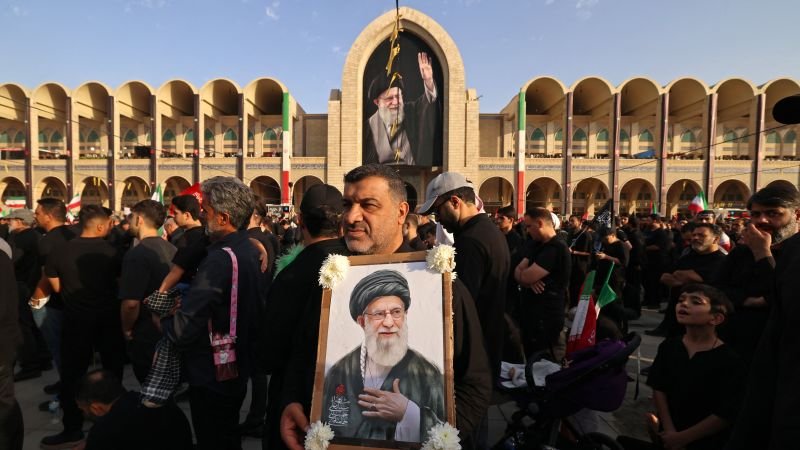
• Funeral ceremonies begin: Mourners have turned up at the Imam Khomeini Grand Mosalla in Tehran, where coffins containing the bodies of Iranian Supreme Leader Ayatollah Ali Khamenei and several members of his family are on display. Funeral processions are expected to take place at multiple locations in Iran and Iraq until July 9.
• Tight security: Iran is on watch for any attacks that may target the funeral, where millions of people and several foreign dignitaries are expected to take part.
• Strait of Hormuz: Iran warned the UK and France against military deployment in the critical waterway, after they said they were ready to send their militaries to support freedom of navigation.
• Tensions remain high: Iran’s army general has warned the US and Israel against launching attacks during the ceremonies. US President Donald Trump, meanwhile, has said the US is giving Iran “a week off for a funeral.”
7 Posts
Iran warned the United Kingdom and France against any military movement in the Strait of Hormuz on Saturday, after the two countries said they were ready to send their militaries to support freedom of navigation in the critical waterway.
“As a responsible power and guarantor of the Strait’s security, Iran warns against any military movement in this waterway,” Deputy Foreign Minister Kazem Gharibabadi said on X.
“The security of Hormuz lies with the coastal states.”
Gharibabadi’s post featured a screenshot of the UK-French declaration from Friday.
Both countries have stepped up efforts to safeguard freedom of navigation and uphold international law in the strait, including hosting a summit with 51 other nations in April.
Earlier this week Iran also pushed back against a statement from France’s President Emmanuel Macron that said France, Oman and others would collaborate on removing mines from the strait. Removing mines from the waterway would be done solely by Iran, Gharibabadi said at the time.
Scores of Iranians, mostly wearing black-colored clothes, gathered at Imam Khomeini Grand Mosalla in Tehran on Saturday as the country kicked off a multi-day funeral for its late Supreme Leader Ayatollah Ali Khamenei.
The mosque is open to the public for a farewell ceremony. Processions have been scheduled in several locations in Iran and Iraq in the coming days.
Earlier images released by Iranian state media showed people already turning up at the Grand Mosalla on Friday night.
Some waving flags, others wiping away tears, thousands have gathered in Tehran for the funeral of Iran’s former supreme leader.
Mourners beat their chests rhythmically in the intense summer heat, the wails of women cutting through the noise as the body of Ayatollah Ali Khamenei was unveiled beneath a glass case at the Grand Mosalla.
“Our word is one! Revenge! Revenge!” the crowd chanted, according to the Associated Press.
Live Reuters footage showed hundreds marching along car-free streets, with women carrying bouquets of white flowers.
Others carried banners, while billboards across the city bore Khamenei’s image.
Water jets sprayed mist onto the crowd of mourners, who mostly wore black, with temperatures set to reach 36 degrees Celsius (97 degrees Fahrenheit), according to a forecast from the UK’s Met Office.
“I am here to say goodbye to my beloved leader Ali Khamenei,” Hananeh Mousavi, 27, told the Associated Press. “I never expected to see such a day. I wish I had died before this tragedy.”
Ali Kazemi, who traveled 330 miles (530 kilometers) from the city of Tabriz to attend, said: “We attended the funeral to show that we are all committed to defend our country and religion.”
Iran’s Islamic Revolutionary Guard Corps (IRGC) warned on Friday against any attempts to target the country in the coming days, ahead of the funeral of slain Supreme Leader Ayatollah Ali Khamenei.
This comes after Israel’s Defense Minister Israel Katz said that Iran’s Supreme Leader Mojtaba Khamenei was “marked for death,” in comments reported by the Israeli news agency Ynet on Monday.
The Islamic Republic is on watch for any potential attacks that may target the funeral ceremony, where millions of Iranians and several foreign dignitaries are expected to take part.
As crowds gather for the funeral, any attack could kill thousands, while senior Iranian officials appearing in public face the added risk of assassination.
A Reuters video on Friday showed security personnel patrolling the streets of Tehran ahead of funeral processions. Iran also announced the complete closure of airspace over Tehran on Monday.
“There are threats that they are considering from the air and from the ground,” Danny Citrinowitz, former head of the Iran branch of Israel’s military intelligence, told CNN, adding that the Iranians “don’t want to take any chances” and have therefore “heavily guarded everything.”
Questions remain over whether the funeral will mark the first public appearance of Mojtaba Khamenei since his father and family members were killed on the first day of the war.
The United States and Israel are only the external threats Iran faces. The country is also home to several minority groups that have clashed with regime forces in the past, including Kurdish militants, Arab and Baloch separatists, among others.
Iran may also be wary of attacks by the exiled Mujahadin-e Khalq (MeK), which Iran accuses of carrying out attacks inside Iran over several decades.
Citrinowitz said that the appearance of multiple officials, such as IRGC chief Brig. Gen. Ahmad Vahidi, may however indicate that they are confident in their security measures despite knowing the risks.
Crowds gathered on Saturday outside the Imam Khomeini Grand Mosalla in Tehran as public funeral ceremonies for the late Iranian Supreme Leader Ayatollah Ali Khamenei and several members of his family began.
Iran has paused indirect talks over ending the war with the US ahead of the multi-day funeral. Its military also warned the US and Israel against “any miscalculation” during the rites.
Meanwhile, US President Donald Trump said the US is giving Iran “a week off for a funeral, because we’re nice.” Speaking on Friday night at Mount Rushmore, he added: “They’re dying to settle, they want to settle so badly.”
Here’s the latest:
The coffins of several members of Khamenei’s family, including his 14-month-old granddaughter, are on display at the Imam Khomeini Grand Mosalla in Tehran. The mosque opened to the public on Saturday for a farewell ceremony.
Video from the Reuters news agency showed security personnel patrolling the streets of Tehran ahead of funeral processions, which are expected to take place at multiple locations in Iran and Iraq.
Officials from China, India and Pakistan are among the international dignitaries attending the funeral, according to their foreign ministries.
The commander-in-chief of Iran’s Islamic Revolutionary Guard Corps, Brig. Gen. Ahmad Vahidi, made a rare appearance next to Khamenei’s casket on Friday, according to state broadcaster IRIB.
The airspace over Tehran will be “completely closed” on Monday for Khamenei’s funeral procession, Iran’s Civil Aviation Organization said.
Meanwhile, Israeli Prime Minister Benjamin Netanyahu held a phone call with Trump and they agreed to meet “soon,” according to a statement from the prime minister’s office.
Commercial activity in the Strait of Hormuz is recovering despite uncertainty over the waterway’s future, according to data from the maritime risk consultancy Marisks. The leaders of France and the United Kingdom also released a statement saying they are ready to deploy a multinational military mission to support freedom of navigation in the strait.
In Lebanon, at least 100,000 children risk missing out on school unless classrooms damaged by Israeli strikes are urgently repaired or rebuilt before September, the United Nations children’s agency UNICEF has warned.
CNN’s Issy Ronald, Aida Karimi, Nadeen Ebrahim and Mustafa Qadri contributed reporting.
Ayatollah Ali Khamenei’s funeral will last for several days. Here’s what to expect in the coming days:
July 4 – The public part of the funeral begins Saturday 6 a.m. local time when Tehran’s Imam Khomeini Mosalla opens for a continuous 24-hour farewell ceremony.
July 5 – The second day is dedicated to funeral prayers for Khamenei and members of his family, after which the public farewell ceremony will continue.
July 6 – This is when the main funeral procession in Tehran will happen. The ceremony is expected to begin at 6 a.m. local time, and the procession, which includes funeral prayers, will follow the 10-kilometer distance from Imam Hossein Square to Azadi Square.
July 7 – Prayers will be held at the Jamkaran Mosque in Qom, an important holy city about 150 kilometers south of Tehran. A funeral procession may also be held here, if conditions allow.
July 8 – Khamenei’s body will be transported to the Iraqi city of Najaf, as the regime seeks to show its revolutionary ideology can still transcend its borders. There will be an official reception attended by Iraq’s prime minister, senior government officials and religious leaders before the cortege travels to the Imam Ali Shrine, an important pilgrimage site for Shiite Muslims. Afterward, the body will travel by helicopter to the Shrine of Imam Hussein in Karbala, about 80 kilometers away, before flying back to Iran.
July 9 – Khamenei will be buried at the Imam Reza shrine, one of Shiite Islam’s holiest sites, in Mashhad, the town where he was born.
CNN’s Frederik Pleitgen is reporting from central Tehran as funeral ceremonies for Iran’s slain Supreme Leader Ayatollah Ali Khamenei gets underway.
Millions of Iranians are expected to flood the streets of the capital to mourn their former leader in a funeral that will be marked across five cities in two countries.
CNN operates in Iran only with the permission of the government but maintains full editorial control of its reports.
• Funeral ceremonies begin: Mourners have turned up at the Imam Khomeini Grand Mosalla in Tehran, where coffins containing the bodies of Iranian Supreme Leader Ayatollah Ali Khamenei and several members of his family are on display. Funeral processions are expected to take place at multiple locations in Iran and Iraq until July 9.
• Tight security: Iran is on watch for any attacks that may target the funeral, where millions of people and several foreign dignitaries are expected to take part.
• Strait of Hormuz: Iran warned the UK and France against military deployment in the critical waterway, after they said they were ready to send their militaries to support freedom of navigation.
• Tensions remain high: Iran’s army general has warned the US and Israel against launching attacks during the ceremonies. US President Donald Trump, meanwhile, has said the US is giving Iran “a week off for a funeral.”
Iran warned the United Kingdom and France against any military movement in the Strait of Hormuz on Saturday, after the two countries said they were ready to send their militaries to support freedom of navigation in the critical waterway.
“As a responsible power and guarantor of the Strait’s security, Iran warns against any military movement in this waterway,” Deputy Foreign Minister Kazem Gharibabadi said on X.
“The security of Hormuz lies with the coastal states.”
Gharibabadi’s post featured a screenshot of the UK-French declaration from Friday.
Both countries have stepped up efforts to safeguard freedom of navigation and uphold international law in the strait, including hosting a summit with 51 other nations in April.
Earlier this week Iran also pushed back against a statement from France’s President Emmanuel Macron that said France, Oman and others would collaborate on removing mines from the strait. Removing mines from the waterway would be done solely by Iran, Gharibabadi said at the time.
Scores of Iranians, mostly wearing black-colored clothes, gathered at Imam Khomeini Grand Mosalla in Tehran on Saturday as the country kicked off a multi-day funeral for its late Supreme Leader Ayatollah Ali Khamenei.
The mosque is open to the public for a farewell ceremony. Processions have been scheduled in several locations in Iran and Iraq in the coming days.
Earlier images released by Iranian state media showed people already turning up at the Grand Mosalla on Friday night.
Some waving flags, others wiping away tears, thousands have gathered in Tehran for the funeral of Iran’s former supreme leader.
Mourners beat their chests rhythmically in the intense summer heat, the wails of women cutting through the noise as the body of Ayatollah Ali Khamenei was unveiled beneath a glass case at the Grand Mosalla.
“Our word is one! Revenge! Revenge!” the crowd chanted, according to the Associated Press.
Live Reuters footage showed hundreds marching along car-free streets, with women carrying bouquets of white flowers.
Others carried banners, while billboards across the city bore Khamenei’s image.
Water jets sprayed mist onto the crowd of mourners, who mostly wore black, with temperatures set to reach 36 degrees Celsius (97 degrees Fahrenheit), according to a forecast from the UK’s Met Office.
“I am here to say goodbye to my beloved leader Ali Khamenei,” Hananeh Mousavi, 27, told the Associated Press. “I never expected to see such a day. I wish I had died before this tragedy.”
Ali Kazemi, who traveled 330 miles (530 kilometers) from the city of Tabriz to attend, said: “We attended the funeral to show that we are all committed to defend our country and religion.”
Iran’s Islamic Revolutionary Guard Corps (IRGC) warned on Friday against any attempts to target the country in the coming days, ahead of the funeral of slain Supreme Leader Ayatollah Ali Khamenei.
This comes after Israel’s Defense Minister Israel Katz said that Iran’s Supreme Leader Mojtaba Khamenei was “marked for death,” in comments reported by the Israeli news agency Ynet on Monday.
The Islamic Republic is on watch for any potential attacks that may target the funeral ceremony, where millions of Iranians and several foreign dignitaries are expected to take part.
As crowds gather for the funeral, any attack could kill thousands, while senior Iranian officials appearing in public face the added risk of assassination.
A Reuters video on Friday showed security personnel patrolling the streets of Tehran ahead of funeral processions. Iran also announced the complete closure of airspace over Tehran on Monday.
“There are threats that they are considering from the air and from the ground,” Danny Citrinowitz, former head of the Iran branch of Israel’s military intelligence, told CNN, adding that the Iranians “don’t want to take any chances” and have therefore “heavily guarded everything.”
Questions remain over whether the funeral will mark the first public appearance of Mojtaba Khamenei since his father and family members were killed on the first day of the war.
The United States and Israel are only the external threats Iran faces. The country is also home to several minority groups that have clashed with regime forces in the past, including Kurdish militants, Arab and Baloch separatists, among others.
Iran may also be wary of attacks by the exiled Mujahadin-e Khalq (MeK), which Iran accuses of carrying out attacks inside Iran over several decades.
Citrinowitz said that the appearance of multiple officials, such as IRGC chief Brig. Gen. Ahmad Vahidi, may however indicate that they are confident in their security measures despite knowing the risks.
Crowds gathered on Saturday outside the Imam Khomeini Grand Mosalla in Tehran as public funeral ceremonies for the late Iranian Supreme Leader Ayatollah Ali Khamenei and several members of his family began.
Iran has paused indirect talks over ending the war with the US ahead of the multi-day funeral. Its military also warned the US and Israel against “any miscalculation” during the rites.
Meanwhile, US President Donald Trump said the US is giving Iran “a week off for a funeral, because we’re nice.” Speaking on Friday night at Mount Rushmore, he added: “They’re dying to settle, they want to settle so badly.”
Here’s the latest:
The coffins of several members of Khamenei’s family, including his 14-month-old granddaughter, are on display at the Imam Khomeini Grand Mosalla in Tehran. The mosque opened to the public on Saturday for a farewell ceremony.
Video from the Reuters news agency showed security personnel patrolling the streets of Tehran ahead of funeral processions, which are expected to take place at multiple locations in Iran and Iraq.
Officials from China, India and Pakistan are among the international dignitaries attending the funeral, according to their foreign ministries.
The commander-in-chief of Iran’s Islamic Revolutionary Guard Corps, Brig. Gen. Ahmad Vahidi, made a rare appearance next to Khamenei’s casket on Friday, according to state broadcaster IRIB.
The airspace over Tehran will be “completely closed” on Monday for Khamenei’s funeral procession, Iran’s Civil Aviation Organization said.
Meanwhile, Israeli Prime Minister Benjamin Netanyahu held a phone call with Trump and they agreed to meet “soon,” according to a statement from the prime minister’s office.
Commercial activity in the Strait of Hormuz is recovering despite uncertainty over the waterway’s future, according to data from the maritime risk consultancy Marisks. The leaders of France and the United Kingdom also released a statement saying they are ready to deploy a multinational military mission to support freedom of navigation in the strait.
In Lebanon, at least 100,000 children risk missing out on school unless classrooms damaged by Israeli strikes are urgently repaired or rebuilt before September, the United Nations children’s agency UNICEF has warned.
CNN’s Issy Ronald, Aida Karimi, Nadeen Ebrahim and Mustafa Qadri contributed reporting.
Ayatollah Ali Khamenei’s funeral will last for several days. Here’s what to expect in the coming days:
July 4 – The public part of the funeral begins Saturday 6 a.m. local time when Tehran’s Imam Khomeini Mosalla opens for a continuous 24-hour farewell ceremony.
July 5 – The second day is dedicated to funeral prayers for Khamenei and members of his family, after which the public farewell ceremony will continue.
July 6 – This is when the main funeral procession in Tehran will happen. The ceremony is expected to begin at 6 a.m. local time, and the procession, which includes funeral prayers, will follow the 10-kilometer distance from Imam Hossein Square to Azadi Square.
July 7 – Prayers will be held at the Jamkaran Mosque in Qom, an important holy city about 150 kilometers south of Tehran. A funeral procession may also be held here, if conditions allow.
July 8 – Khamenei’s body will be transported to the Iraqi city of Najaf, as the regime seeks to show its revolutionary ideology can still transcend its borders. There will be an official reception attended by Iraq’s prime minister, senior government officials and religious leaders before the cortege travels to the Imam Ali Shrine, an important pilgrimage site for Shiite Muslims. Afterward, the body will travel by helicopter to the Shrine of Imam Hussein in Karbala, about 80 kilometers away, before flying back to Iran.
July 9 – Khamenei will be buried at the Imam Reza shrine, one of Shiite Islam’s holiest sites, in Mashhad, the town where he was born.
CNN’s Frederik Pleitgen is reporting from central Tehran as funeral ceremonies for Iran’s slain Supreme Leader Ayatollah Ali Khamenei gets underway.
Millions of Iranians are expected to flood the streets of the capital to mourn their former leader in a funeral that will be marked across five cities in two countries.
CNN operates in Iran only with the permission of the government but maintains full editorial control of its reports.



Responses