
• Get the latest updates on the war with Iran here.
21 Posts
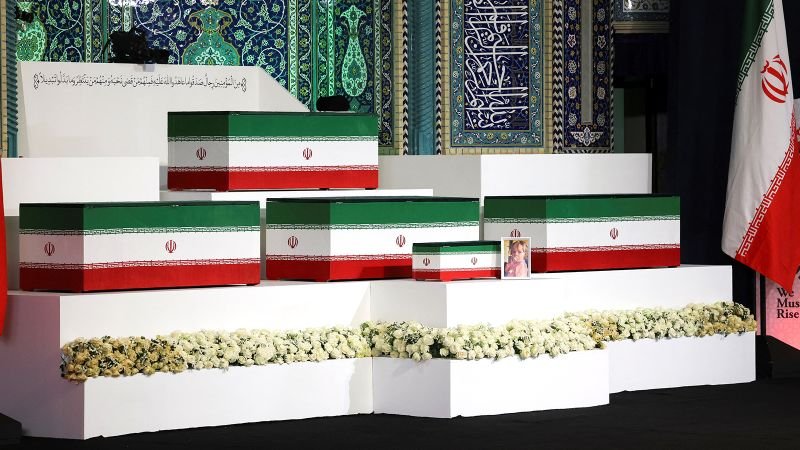
• Khamenei’s funeral: Coffins containing the bodies of slain Supreme Leader Ayatollah Ali Khamenei and several family members are on display in Tehran ahead of funeral processions in multiple locations that millions are expected to attend between July 4-9.
• Who’s there? China and India are among the countries sending representatives. Iran’s new leader of the powerful Revolutionary Guards made a rare appearances. But it is not known if the new Supreme Leader — Mojtaba Khamenei — will attend his father’s funeral.
• Tensions remain high: Iran’s army general warned the US and Israel against launching attacks during the procession. The US military, meanwhile, announced that a second Marine unit, typically numbering more than 2,000 Marines, is now operating in the Middle East.
Photos released by Iranian state media Press TV showed crowds gathered on Friday night outside the Imam Khomeini Grand Mosalla in Tehran ahead of former Supreme Leader Ayatollah Ali Khamenei’s funeral.
The public part of the multi-day funeral begins on Saturday, when the mosque opens for a 24-hour farewell ceremony.
France and the United Kingdom are ready to deploy a multinational military mission to support the freedom of navigation in the Strait of Hormuz, French President Emmanuel Macron and UK Prime Minister Starmer said in a joint statement on Friday.
The Sultanate of Oman has agreed to work with the two countries to ensure that the waterway is safe to navigate, according to the statement.
Omani officials have not yet commented on the reported agreement.
Israeli Prime Minister Benjamin Netanyahu held a phone call with President Donald Trump on Friday, the prime minister’s office said.
Netanyahu congratulated Trump on the occasion of the United States’ 250th birthday.
The two leaders agreed to meet soon in the US, the statement read.
CNN has reached out to the White House for comment on the call.
The casket of Iran’s late Supreme Leader Ayatollah Ali Khamenei is on display in Tehran today, with funeral processions for the late leader and several members of his family set to begin tomorrow.
Iran has paused diplomacy ahead of the funeral. Earlier this week, negotiators from Tehran and Washington traveled to Doha, Qatar, for indirect talks on the Memorandum of Understanding between them.
If you’re just joining us, here’s the latest:
The coffins of several members of Khamenei’s family, including his 14-month-old granddaughter, are on display at the Imam Khomeini Grand Mosalla in Tehran today, according to Iranian state media.
Video from Reuters showed security personnel patrolling the streets of Tehran ahead of funeral processions, which are expected to take place at multiple locations in Iran and Iraq from tomorrow until Thursday.
Officials from China, India and Pakistan are among the international dignitaries attending the funeral, according to their foreign ministries.
The Commander-in-Chief of Iran’s Islamic Revolutionary Guard Corps, Brig. Gen. Ahmad Vahidi, made a rare appearance next to Khamenei’s casket yesterday, according to state broadcaster IRIB.
The airspace over Tehran will be “completely closed” on Monday for Khamenei’s funeral procession, Iran’s Civil Aviation Organization said.
Meanwhile, in Lebanon, at least 100,000 children risk missing out on school unless classrooms damaged by Israeli strikes are urgently repaired or rebuilt before September, the United Nations children’s agency UNICEF has warned.
CNN’s Xiaoqian Lin, Issy Ronald, Aida Karimi, Nadeen Ebrahim and Mustafa Qadri contributed to this reporting.
Ayatollah Ali Khamenei’s funeral will last for several days. Here’s what to expect from the next week:
July 3 – At a ceremony in Tehran today, foreign delegations are being greeted by senior Iranian officials, including President Masoud Pezeshkian and Parliament Speaker Mohammad Bagher Ghalibaf.
July 4 – The public part of the funeral begins Saturday 6 a.m. local time when Tehran’s Imam Khomeini Mosalla opens for a continuous 24-hour farewell ceremony.
July 5 – The second day is dedicated to funeral prayers for Khamenei and members of his family, after which the public farewell ceremony will continue.
July 6 – This is when the main funeral procession in Tehran will happen. The ceremony is expected to begin at 6 a.m. local time, and the procession, which includes funeral prayers, will follow the 10-kilometer distance from Imam Hossein Square to Azadi Square.
July 7 – Prayers will be held at the Jamkaran Mosque in Qom, an important holy city about 150 kilometers south of Tehran. A funeral procession may also be held here, if conditions allow.
July 8 – Khamenei’s body will be transported to the Iraqi city of Najaf, as the regime seeks to show its revolutionary ideology can still transcend its borders. There will be an official reception attended by Iraq’s prime minister, senior government officials and religious leaders before the cortege travels to the Imam Ali Shrine, an important pilgrimage site for Shiite Muslims. Afterward, the body will travel by helicopter to the Shrine of Imam Hussein in Karbala, about 80 kilometers away, before flying back to Iran.
July 9 – Khamenei will be buried at the Imam Reza shrine, one of Shiite Islam’s holiest sites, in Mashhad, the town where he was born.
Some of Iran’s most high-level figures have turned up to mourn slain Supreme Leader Ayatollah Ali Khamenei.
A number of foreign dignitaries also appeared at the ceremony, paying tribute to the leader and signaling continued support for Iran’s new leadership.
Here are some of the key Iranian figures at Khanemei’s funeral today:
Chief negotiator Mohammad Bagher Ghalibaf: The powerful speaker of Iran’s parliament, who led talks with the US that resulted in an interim agreement last month.
President Masoud Pezeshkian: He has emerged as an unlikely survivor during one of the most turbulent periods in the Islamic Republic’s history, while retaining a measure of public support despite wartime pressure and attacks from hardliners and opposition forces alike.
Iranian Foreign Minister Abbas Araghchi: One of the most outspoken politicians and key member of Iran’s negotiating team with the US.
Notable foreign attendees:
Iraqi President Nizar Amidi
Georgian President Mikheil Kavelashvili
Tajikistan’s President Emomali Rahmon
Turkish Vice President Cevdet Yilmaz
Pakistani Prime Minister Shehbaz Sharif
Lebanese Defese Minister Michel Menassa
Afghanistan’s Foreign Minister Amir Khan Muttaqi
Saudi Arabia’s Deputy Foreign Minister Waleed Elkhereiji
Russian Security Council Deputy Chairman Dmitry Medvedev
Chairman of Oman’s State Council, Abdulmalik bin Abdullah Al Khalili
Speaker of Qatar’s Shura Council, Hassan bin Abdullah Al Ghanim
Hezbollah official and former Lebanese minister, Mahmoud Qomati
Burkina Faso foreign minister Karamoko Jean-Marie Traoré
Myanmar special envoy Tin Amsan
Foreign minister of the Democratic Republic of Congo, Jean-Claude Gakosso
Sri Lanka’s speaker of Parliament, Jagath Wickramaratne
CNN’s Frederik Pleitgen is reporting from central Tehran as a week of funeral ceremonies for Iran’s slain Supreme Leader Ali Khamenei gets underway.
Millions of Iranians are expected to flood the streets of the capital to mourn their former leader in a funeral that will be marked across five cities in two countries.
Coffins of the late leader and several of his family members who were killed in US-Israeli strikes are on display inside the Mosalla religious complex.
CNN operates in Iran only with the permission of the government but maintains full editorial control of its reports.
Iran’s Islamic Revolutionary Guard Corps (IRGC) warned on Friday against any attempts to target the country in the coming days, ahead of the funeral of slain Supreme Leader Ayatollah Ali Khamenei.
This comes after Israel’s Defense Minister Israel Katz said that Iran’s Supreme Leader Mojtaba Khamenei was “marked for death,” in comments reported by the Israeli news agency Ynet on Monday.
The Islamic Republic is on watch for any potential attacks that may target the funeral ceremony, where millions of Iranians and several foreign dignitaries are expected to take part.
As crowds gather for the funeral, any attack could kill thousands, while senior Iranian officials appearing in public face the added risk of assassination.
A Reuters video on Friday showed security personnel patrolling the streets of Tehran ahead of funeral processions. Iran also announced the complete closure of airspace over Tehran on Monday.
Questions remain over whether the funeral will mark the first public appearance of Mojtaba Khamenei since his father and family members were killed on the first day of the war.
The United States and Israel are only the external threats Iran faces. The country is also home to several minority groups that have clashed with regime forces in the past, including Kurdish militants, Arab and Baloch separatists, among others.
Iran may also be wary of attacks by the exiled Mujahadin-e Khalq (MeK), which Iran accuses of carrying out attacks inside Iran over several decades.
Citrinowitz said that the appearance of multiple officials, such as IRGC chief Brig. Gen. Ahmad Vahidi, may however indicate that they are confident in their security measures despite knowing the risks.
Airspace over Tehran will be “completely closed” on Monday for the late Supreme Leader Ayatollah Ali Khamenei’s funeral procession, Iran’s Civil Aviation Organization said on Friday.
“On Monday, coinciding with the funeral procession for the late revolutionary leader, Tehran’s airspace will be completely closed, and no flights will be permitted,” the organization said.
Funeral ceremonies for the killed leader are expected to take place at multiple locations in Iran and Iraq from July 4 to July 9, and millions of people are expected to attend.
Commercial activity in the Strait of Hormuz is recovering despite uncertainty over the crucial waterway’s future, according to data from the maritime risk consultancy Marisks.
It said 335 vessels transited through the strait last week, while this week is on course for a similar number, with up to 215 transits expected to have been completed by the end of today. That compares to about 100 commercial transits a day before the start of the war.
However, Marisks cautioned that while overall activity is recovering, international merchant shipping “is likely returning at a more measured pace than local and regional traffic, with many shipowners, charterers and insurers continuing to adopt a cautious approach.”
Uncertainty over the risk of wider conflict remains, especially after an Iranian strike on a vessel last week forced a pause on evacuations of stranded seafarers.
Traffic through the strait remains divided across several routes, but Tehran says ships must use only its designated paths or face consequences.
At least 100,000 children in Lebanon risk missing out on school unless classrooms damaged by Israeli strikes are urgently repaired or rebuilt before September, the United Nations children’s agency UNICEF has warned.
An assessment by the Lebanese government found that 340 public, private and Technical and Vocational Education and Training (TVET) schools were damaged, 17 of which were completely destroyed, UNICEF said in a statement on Thursday.
“Schools are far more than buildings,” said UNICEF representative in Lebanon Marcoluigi Corsi. “They are places where children learn, feel safe, and begin to recover from crisis… With the new school year approaching, urgent investment is needed to rehabilitate damaged schools and ensure children can return to learning without delay.”
The US and Iran signed a memorandum of understanding on June 14 aimed at halting the war on all fronts, including in Lebanon. But Israel and Iran-backed Hezbollah have continued to trade blows.
Brig. Gen. Ahmad Vahidi, commander-in-chief of Iran’s Islamic Revolutionary Guard Corps (IRGC), made a rare appearance on Thursday as Tehran prepared for the funeral of the late Supreme Leader Ayatollah Ali Khamenei.
Photos released by state broadcaster IRIB showed the hardline commander sitting next to Khamenei’s casket during a farewell ceremony in Tehran on Thursday.
Vahidi, who assumed the role after his predecessor Mohammad Pakpour was killed in US-Israeli strikes on the first day of the war, has not been seen in public for months. He was previously head of the elite Quds Force.
Sanctioned by the US and wanted by Interpol, Vahidi has been helping to craft Tehran’s next moves during the war and is known to be a prominent voice in the country’s decision-making circles.
Several of his predecessors were assassinated by the US and Israel – including Qasem Soleimani, the former commander of the Quds Force.
Read more about Vahidi here.
Not to be lost in the ceremony of the slain supreme leader’s funeral is the apparently deliberate symbolism of the chosen dates.
Ayatollah Ali Khamenei’s body is scheduled to lie in state on July 4 — the same day the US will celebrate 250 years of independence with large-scale public events across the country, including a speech from US President Donald Trump.
Another key day in Khamenei’s procession coincides with a major Shiite commemoration of a historic religious figure’s death.
The entire spectacle unfolds during the Islamic month of Muharram, a period deeply associated in Shiite Islam with mourning, betrayal and martyrdom – specifically the 7th century martyrdom of Imam Hussein, one of the Shia saints to whom Khamenei traces his lineage.
Khamenei’s casket was draped in the sacred flag that once flew over Hussein’s shrine, according to a post on his official X account Friday. The red flag with white lettering is a “symbol of resistance, sacrifice, and unwavering devotion to truth,” according to a post from the Iranian government.
Video from the Reuters news agency on Friday showed security personnel patrolling the streets of Tehran ahead of funeral processions for slain Iranian Supreme Leader Ayatollah Ali Khamenei.
Coffins containing the bodies of Khamenei and multiple family members were laid out at Imam Khomeini Grand Mosalla in Tehran on Friday.
Funeral ceremonies are expected to take place at multiple locations in Iran and Iraq from July 4 to July 9, and millions of people are expected to attend.
Four months after he was killed at the outset of the US-Israeli war on Iran, Supreme Leader Ali Khamenei is being memorialized in a weeklong funeral spectacle stretching across five cities in two countries, with millions of mourners expected to attend.
Despite a costly war against two of the world’s strongest militaries and decades of crushing economic hardship, Tehran is sparing no expense to send off Khamenei in a grand ceremony shrouded in religious symbolism that overlaps with the 250th US Independence Day celebrations.
Authorities say they’ve launched one of the largest logistical efforts in the Islamic Republic’s history, mobilizing government employees, universities, labor unions, firefighters, soldiers, aid workers and even religious “mourning groups” to organize the funeral and manage the millions of “pilgrims” expected to travel to cities and holy sites across Iran and Iraq to bid the ayatollah farewell. Authorities in neighboring Iraq, where Shiite Muslims are a majority, say millions of mourners are expected to pay their respects.
For more than 10 days, the overwhelming coverage across Iranian media has been building up to this moment, with tribute songs and documentaries on Khamenei’s life overtaking news of talks with the US that had previously dominated headlines. The scale of the spectacle is designed to send a message to the world and to the Islamic Republic’s enemies: the regime not only survived an existential war, but will stubbornly immortalize its slain leader as a symbol of its resilience.
Read the full story here.
Coffins containing the bodies of slain Supreme Leader Ayatollah Ali Khamenei and several family members are on display in Tehran ahead of funeral processions from July 4-9.
People were seen streaming into the Imam Khomeini Grand Mosalla on Friday after the bodies of slain Supreme Leader Ayatollah Ali Khamenei and multiple family members were taken to the mosque.
Khamenei and his family members were killed in the opening stages of the US and Israel’s war with Iran in late February.
Iranian state media said the coffins laid out included the bodies of Khamenei’s son-in-law Mesbah-ol-Hoda Bagheri, his eldest daughter Seyyedeh Boshra Hosseini Khamenei, his daughter-in-law Zahra Haddad Adel and his 14-month-old granddaughter Zahra Mohammadi Golpaygani.
A photo of an infant, reported by state media IRNA to be of Zahra Mohammadi Golpaygani, was also on display in front of a baby-sized coffin. All the caskets were painted with Iran’s flag.
Religious figures from Afghanistan and Indonesia were among some of the first at the Grand Mosalla to pay their respects, reported IRIB.
Diplomacy is on hold as Tehran prepares for the multi-day funeral of its former Supreme Leader Ayatollah Ali Khamenei, killed in joint US-Israeli strikes on the first day of the war.
The Islamic Republic will come to a standstill as it lays Khamenei to rest in a funeral carefully staged to demonstrate the regime’s survival to the very actors responsible for the supreme leader’s death.
Here’s the latest:
After two days of talks held indirectly between the US and Iran, Iranian officials left Doha. Those talks made “positive progress” and further discussions will be scheduled after Khamenei’s funeral, according to Qatar, a key mediator. It isn’t clear what was discussed in Doha. Iranian officials said they were discussing unfreezing their assets while Axios reported that US envoys were trying to persuade Iran not to introduce tolls for ships passing through the Strait of Hormuz.
US-Iran tensions remain high, with Iran issuing a fresh warning for vessels to follow Tehran-designated routes through the Strait of Hormuz. And Iran has warned the US and Israel against attacks during the funeral.
US Central Command has announced that a second Marine Expeditionary Unit, typically numbering more than 2,000 Marines, is operating in the Middle East. The group joins the amphibious assault ship USS Tripoli, its escorts and embarked Marines that have been in the region since late March.
Attention now turns to Khamenei’s funeral, scheduled to stretch between Tehran, Qom and Mashhad in Iran and Najaf and Karbala in Iraq from July 4 through July 9. Iran’s President Masoud Pezeshkian called on Iranians to turn out in “large numbers” to portray a united front to the world.
Several foreign dignitaries of varying seniority will attend the funeral, including Pakistan’s Prime Minister Shehbaz Sharif as well as representatives from China and India.
It’s not known whether Mojtaba Khamenei, the new supreme leader and son of the slain ayatollah, will appear to lead prayers for his father.
The first images are emerging of the casket holding the body of Khamenei. Iranian state media reported that his body was transported to Imam Khomeini Grand Mosalla in Tehran.
Elsewhere, the US Navy is searching for a missing crew member after a helicopter made an emergency landing in the Arabian Sea.
And Syria’s foreign minister is visiting Beirut for talks with Lebanese officials on his first official trip to the country since Trump suggested Syrian forces could intervene in the conflict
CNN’s Sarah Tamimi, Haley Britzky, Mostafa Salem, Mustafa Qadri, Brad Lendon and Aida Karimi contributed reporting.
A central question looming over the funeral is whether Mojtaba Khamenei, the new supreme leader and son of the slain Ayatollah, will appear to lead prayers for his father, who died in a US-Israeli strike.
Mojtaba is believed to have been seriously wounded in that attack, which also killed his mother and his wife. He has remained in hiding since the war began in late February, communicating with his supporters only through written statements, never showing his face or using his voice.
Iranian officials have worked to project an image of full recovery, claiming he is even directing Tehran’s negotiations with Washington.
His appearance would be momentous, marking his first public emergence, and helping to establish his legitimacy at home.
But a failure to appear will fuel doubts about his wellbeing, as well as questions over who is running the country. On Wednesday, the leader failed to attend a private ceremony for his late wife.
Iranian Foreign Minister Abbas Araqchi warned on Wednesday that Tehran would deliver an immediate and powerful response to any threat against its leadership after Israeli Defense Minister Israel Katz said that Khamenei was “marked for death.”
Not appearing at the funeral would likely be spun by the Islamic Republic as a necessary security measure amid the ongoing conflict. Yet it would leave far more questions unanswered and deepen skepticism about his health and readiness to lead.
Questions are already swirling inside Iran. When asked this week about Khamenei’s attendance, the head of the authority organizing the funeral, Ali Akbar Pourjamshidian, deflected. “This matter is not within our domain and the decision lies entirely with the (supreme) leader’s office,” he said.
• Khamenei’s funeral: Coffins containing the bodies of slain Supreme Leader Ayatollah Ali Khamenei and several family members are on display in Tehran ahead of funeral processions in multiple locations that millions are expected to attend between July 4-9.
• Who’s there? China and India are among the countries sending representatives. Iran’s new leader of the powerful Revolutionary Guards made a rare appearances. But it is not known if the new Supreme Leader — Mojtaba Khamenei — will attend his father’s funeral.
• Tensions remain high: Iran’s army general warned the US and Israel against launching attacks during the procession. The US military, meanwhile, announced that a second Marine unit, typically numbering more than 2,000 Marines, is now operating in the Middle East.
Photos released by Iranian state media Press TV showed crowds gathered on Friday night outside the Imam Khomeini Grand Mosalla in Tehran ahead of former Supreme Leader Ayatollah Ali Khamenei’s funeral.
The public part of the multi-day funeral begins on Saturday, when the mosque opens for a 24-hour farewell ceremony.
France and the United Kingdom are ready to deploy a multinational military mission to support the freedom of navigation in the Strait of Hormuz, French President Emmanuel Macron and UK Prime Minister Starmer said in a joint statement on Friday.
The Sultanate of Oman has agreed to work with the two countries to ensure that the waterway is safe to navigate, according to the statement.
Omani officials have not yet commented on the reported agreement.
Israeli Prime Minister Benjamin Netanyahu held a phone call with President Donald Trump on Friday, the prime minister’s office said.
Netanyahu congratulated Trump on the occasion of the United States’ 250th birthday.
The two leaders agreed to meet soon in the US, the statement read.
CNN has reached out to the White House for comment on the call.
The casket of Iran’s late Supreme Leader Ayatollah Ali Khamenei is on display in Tehran today, with funeral processions for the late leader and several members of his family set to begin tomorrow.
Iran has paused diplomacy ahead of the funeral. Earlier this week, negotiators from Tehran and Washington traveled to Doha, Qatar, for indirect talks on the Memorandum of Understanding between them.
If you’re just joining us, here’s the latest:
The coffins of several members of Khamenei’s family, including his 14-month-old granddaughter, are on display at the Imam Khomeini Grand Mosalla in Tehran today, according to Iranian state media.
Video from Reuters showed security personnel patrolling the streets of Tehran ahead of funeral processions, which are expected to take place at multiple locations in Iran and Iraq from tomorrow until Thursday.
Officials from China, India and Pakistan are among the international dignitaries attending the funeral, according to their foreign ministries.
The Commander-in-Chief of Iran’s Islamic Revolutionary Guard Corps, Brig. Gen. Ahmad Vahidi, made a rare appearance next to Khamenei’s casket yesterday, according to state broadcaster IRIB.
The airspace over Tehran will be “completely closed” on Monday for Khamenei’s funeral procession, Iran’s Civil Aviation Organization said.
Meanwhile, in Lebanon, at least 100,000 children risk missing out on school unless classrooms damaged by Israeli strikes are urgently repaired or rebuilt before September, the United Nations children’s agency UNICEF has warned.
CNN’s Xiaoqian Lin, Issy Ronald, Aida Karimi, Nadeen Ebrahim and Mustafa Qadri contributed to this reporting.
Ayatollah Ali Khamenei’s funeral will last for several days. Here’s what to expect from the next week:
July 3 – At a ceremony in Tehran today, foreign delegations are being greeted by senior Iranian officials, including President Masoud Pezeshkian and Parliament Speaker Mohammad Bagher Ghalibaf.
July 4 – The public part of the funeral begins Saturday 6 a.m. local time when Tehran’s Imam Khomeini Mosalla opens for a continuous 24-hour farewell ceremony.
July 5 – The second day is dedicated to funeral prayers for Khamenei and members of his family, after which the public farewell ceremony will continue.
July 6 – This is when the main funeral procession in Tehran will happen. The ceremony is expected to begin at 6 a.m. local time, and the procession, which includes funeral prayers, will follow the 10-kilometer distance from Imam Hossein Square to Azadi Square.
July 7 – Prayers will be held at the Jamkaran Mosque in Qom, an important holy city about 150 kilometers south of Tehran. A funeral procession may also be held here, if conditions allow.
July 8 – Khamenei’s body will be transported to the Iraqi city of Najaf, as the regime seeks to show its revolutionary ideology can still transcend its borders. There will be an official reception attended by Iraq’s prime minister, senior government officials and religious leaders before the cortege travels to the Imam Ali Shrine, an important pilgrimage site for Shiite Muslims. Afterward, the body will travel by helicopter to the Shrine of Imam Hussein in Karbala, about 80 kilometers away, before flying back to Iran.
July 9 – Khamenei will be buried at the Imam Reza shrine, one of Shiite Islam’s holiest sites, in Mashhad, the town where he was born.
Some of Iran’s most high-level figures have turned up to mourn slain Supreme Leader Ayatollah Ali Khamenei.
A number of foreign dignitaries also appeared at the ceremony, paying tribute to the leader and signaling continued support for Iran’s new leadership.
Here are some of the key Iranian figures at Khanemei’s funeral today:
Chief negotiator Mohammad Bagher Ghalibaf: The powerful speaker of Iran’s parliament, who led talks with the US that resulted in an interim agreement last month.
President Masoud Pezeshkian: He has emerged as an unlikely survivor during one of the most turbulent periods in the Islamic Republic’s history, while retaining a measure of public support despite wartime pressure and attacks from hardliners and opposition forces alike.
Iranian Foreign Minister Abbas Araghchi: One of the most outspoken politicians and key member of Iran’s negotiating team with the US.
Notable foreign attendees:
Iraqi President Nizar Amidi
Georgian President Mikheil Kavelashvili
Tajikistan’s President Emomali Rahmon
Turkish Vice President Cevdet Yilmaz
Pakistani Prime Minister Shehbaz Sharif
Lebanese Defese Minister Michel Menassa
Afghanistan’s Foreign Minister Amir Khan Muttaqi
Saudi Arabia’s Deputy Foreign Minister Waleed Elkhereiji
Russian Security Council Deputy Chairman Dmitry Medvedev
Chairman of Oman’s State Council, Abdulmalik bin Abdullah Al Khalili
Speaker of Qatar’s Shura Council, Hassan bin Abdullah Al Ghanim
Hezbollah official and former Lebanese minister, Mahmoud Qomati
Burkina Faso foreign minister Karamoko Jean-Marie Traoré
Myanmar special envoy Tin Amsan
Foreign minister of the Democratic Republic of Congo, Jean-Claude Gakosso
Sri Lanka’s speaker of Parliament, Jagath Wickramaratne
CNN’s Frederik Pleitgen is reporting from central Tehran as a week of funeral ceremonies for Iran’s slain Supreme Leader Ali Khamenei gets underway.
Millions of Iranians are expected to flood the streets of the capital to mourn their former leader in a funeral that will be marked across five cities in two countries.
Coffins of the late leader and several of his family members who were killed in US-Israeli strikes are on display inside the Mosalla religious complex.
CNN operates in Iran only with the permission of the government but maintains full editorial control of its reports.
Iran’s Islamic Revolutionary Guard Corps (IRGC) warned on Friday against any attempts to target the country in the coming days, ahead of the funeral of slain Supreme Leader Ayatollah Ali Khamenei.
This comes after Israel’s Defense Minister Israel Katz said that Iran’s Supreme Leader Mojtaba Khamenei was “marked for death,” in comments reported by the Israeli news agency Ynet on Monday.
The Islamic Republic is on watch for any potential attacks that may target the funeral ceremony, where millions of Iranians and several foreign dignitaries are expected to take part.
As crowds gather for the funeral, any attack could kill thousands, while senior Iranian officials appearing in public face the added risk of assassination.
A Reuters video on Friday showed security personnel patrolling the streets of Tehran ahead of funeral processions. Iran also announced the complete closure of airspace over Tehran on Monday.
Questions remain over whether the funeral will mark the first public appearance of Mojtaba Khamenei since his father and family members were killed on the first day of the war.
The United States and Israel are only the external threats Iran faces. The country is also home to several minority groups that have clashed with regime forces in the past, including Kurdish militants, Arab and Baloch separatists, among others.
Iran may also be wary of attacks by the exiled Mujahadin-e Khalq (MeK), which Iran accuses of carrying out attacks inside Iran over several decades.
Citrinowitz said that the appearance of multiple officials, such as IRGC chief Brig. Gen. Ahmad Vahidi, may however indicate that they are confident in their security measures despite knowing the risks.
Airspace over Tehran will be “completely closed” on Monday for the late Supreme Leader Ayatollah Ali Khamenei’s funeral procession, Iran’s Civil Aviation Organization said on Friday.
“On Monday, coinciding with the funeral procession for the late revolutionary leader, Tehran’s airspace will be completely closed, and no flights will be permitted,” the organization said.
Funeral ceremonies for the killed leader are expected to take place at multiple locations in Iran and Iraq from July 4 to July 9, and millions of people are expected to attend.
Commercial activity in the Strait of Hormuz is recovering despite uncertainty over the crucial waterway’s future, according to data from the maritime risk consultancy Marisks.
It said 335 vessels transited through the strait last week, while this week is on course for a similar number, with up to 215 transits expected to have been completed by the end of today. That compares to about 100 commercial transits a day before the start of the war.
However, Marisks cautioned that while overall activity is recovering, international merchant shipping “is likely returning at a more measured pace than local and regional traffic, with many shipowners, charterers and insurers continuing to adopt a cautious approach.”
Uncertainty over the risk of wider conflict remains, especially after an Iranian strike on a vessel last week forced a pause on evacuations of stranded seafarers.
Traffic through the strait remains divided across several routes, but Tehran says ships must use only its designated paths or face consequences.
At least 100,000 children in Lebanon risk missing out on school unless classrooms damaged by Israeli strikes are urgently repaired or rebuilt before September, the United Nations children’s agency UNICEF has warned.
An assessment by the Lebanese government found that 340 public, private and Technical and Vocational Education and Training (TVET) schools were damaged, 17 of which were completely destroyed, UNICEF said in a statement on Thursday.
“Schools are far more than buildings,” said UNICEF representative in Lebanon Marcoluigi Corsi. “They are places where children learn, feel safe, and begin to recover from crisis… With the new school year approaching, urgent investment is needed to rehabilitate damaged schools and ensure children can return to learning without delay.”
The US and Iran signed a memorandum of understanding on June 14 aimed at halting the war on all fronts, including in Lebanon. But Israel and Iran-backed Hezbollah have continued to trade blows.
Brig. Gen. Ahmad Vahidi, commander-in-chief of Iran’s Islamic Revolutionary Guard Corps (IRGC), made a rare appearance on Thursday as Tehran prepared for the funeral of the late Supreme Leader Ayatollah Ali Khamenei.
Photos released by state broadcaster IRIB showed the hardline commander sitting next to Khamenei’s casket during a farewell ceremony in Tehran on Thursday.
Vahidi, who assumed the role after his predecessor Mohammad Pakpour was killed in US-Israeli strikes on the first day of the war, has not been seen in public for months. He was previously head of the elite Quds Force.
Sanctioned by the US and wanted by Interpol, Vahidi has been helping to craft Tehran’s next moves during the war and is known to be a prominent voice in the country’s decision-making circles.
Several of his predecessors were assassinated by the US and Israel – including Qasem Soleimani, the former commander of the Quds Force.
Read more about Vahidi here.
Not to be lost in the ceremony of the slain supreme leader’s funeral is the apparently deliberate symbolism of the chosen dates.
Ayatollah Ali Khamenei’s body is scheduled to lie in state on July 4 — the same day the US will celebrate 250 years of independence with large-scale public events across the country, including a speech from US President Donald Trump.
Another key day in Khamenei’s procession coincides with a major Shiite commemoration of a historic religious figure’s death.
The entire spectacle unfolds during the Islamic month of Muharram, a period deeply associated in Shiite Islam with mourning, betrayal and martyrdom – specifically the 7th century martyrdom of Imam Hussein, one of the Shia saints to whom Khamenei traces his lineage.
Khamenei’s casket was draped in the sacred flag that once flew over Hussein’s shrine, according to a post on his official X account Friday. The red flag with white lettering is a “symbol of resistance, sacrifice, and unwavering devotion to truth,” according to a post from the Iranian government.
Video from the Reuters news agency on Friday showed security personnel patrolling the streets of Tehran ahead of funeral processions for slain Iranian Supreme Leader Ayatollah Ali Khamenei.
Coffins containing the bodies of Khamenei and multiple family members were laid out at Imam Khomeini Grand Mosalla in Tehran on Friday.
Funeral ceremonies are expected to take place at multiple locations in Iran and Iraq from July 4 to July 9, and millions of people are expected to attend.
Four months after he was killed at the outset of the US-Israeli war on Iran, Supreme Leader Ali Khamenei is being memorialized in a weeklong funeral spectacle stretching across five cities in two countries, with millions of mourners expected to attend.
Despite a costly war against two of the world’s strongest militaries and decades of crushing economic hardship, Tehran is sparing no expense to send off Khamenei in a grand ceremony shrouded in religious symbolism that overlaps with the 250th US Independence Day celebrations.
Authorities say they’ve launched one of the largest logistical efforts in the Islamic Republic’s history, mobilizing government employees, universities, labor unions, firefighters, soldiers, aid workers and even religious “mourning groups” to organize the funeral and manage the millions of “pilgrims” expected to travel to cities and holy sites across Iran and Iraq to bid the ayatollah farewell. Authorities in neighboring Iraq, where Shiite Muslims are a majority, say millions of mourners are expected to pay their respects.
For more than 10 days, the overwhelming coverage across Iranian media has been building up to this moment, with tribute songs and documentaries on Khamenei’s life overtaking news of talks with the US that had previously dominated headlines. The scale of the spectacle is designed to send a message to the world and to the Islamic Republic’s enemies: the regime not only survived an existential war, but will stubbornly immortalize its slain leader as a symbol of its resilience.
Read the full story here.
Coffins containing the bodies of slain Supreme Leader Ayatollah Ali Khamenei and several family members are on display in Tehran ahead of funeral processions from July 4-9.
People were seen streaming into the Imam Khomeini Grand Mosalla on Friday after the bodies of slain Supreme Leader Ayatollah Ali Khamenei and multiple family members were taken to the mosque.
Khamenei and his family members were killed in the opening stages of the US and Israel’s war with Iran in late February.
Iranian state media said the coffins laid out included the bodies of Khamenei’s son-in-law Mesbah-ol-Hoda Bagheri, his eldest daughter Seyyedeh Boshra Hosseini Khamenei, his daughter-in-law Zahra Haddad Adel and his 14-month-old granddaughter Zahra Mohammadi Golpaygani.
A photo of an infant, reported by state media IRNA to be of Zahra Mohammadi Golpaygani, was also on display in front of a baby-sized coffin. All the caskets were painted with Iran’s flag.
Religious figures from Afghanistan and Indonesia were among some of the first at the Grand Mosalla to pay their respects, reported IRIB.
Diplomacy is on hold as Tehran prepares for the multi-day funeral of its former Supreme Leader Ayatollah Ali Khamenei, killed in joint US-Israeli strikes on the first day of the war.
The Islamic Republic will come to a standstill as it lays Khamenei to rest in a funeral carefully staged to demonstrate the regime’s survival to the very actors responsible for the supreme leader’s death.
Here’s the latest:
After two days of talks held indirectly between the US and Iran, Iranian officials left Doha. Those talks made “positive progress” and further discussions will be scheduled after Khamenei’s funeral, according to Qatar, a key mediator. It isn’t clear what was discussed in Doha. Iranian officials said they were discussing unfreezing their assets while Axios reported that US envoys were trying to persuade Iran not to introduce tolls for ships passing through the Strait of Hormuz.
US-Iran tensions remain high, with Iran issuing a fresh warning for vessels to follow Tehran-designated routes through the Strait of Hormuz. And Iran has warned the US and Israel against attacks during the funeral.
US Central Command has announced that a second Marine Expeditionary Unit, typically numbering more than 2,000 Marines, is operating in the Middle East. The group joins the amphibious assault ship USS Tripoli, its escorts and embarked Marines that have been in the region since late March.
Attention now turns to Khamenei’s funeral, scheduled to stretch between Tehran, Qom and Mashhad in Iran and Najaf and Karbala in Iraq from July 4 through July 9. Iran’s President Masoud Pezeshkian called on Iranians to turn out in “large numbers” to portray a united front to the world.
Several foreign dignitaries of varying seniority will attend the funeral, including Pakistan’s Prime Minister Shehbaz Sharif as well as representatives from China and India.
It’s not known whether Mojtaba Khamenei, the new supreme leader and son of the slain ayatollah, will appear to lead prayers for his father.
The first images are emerging of the casket holding the body of Khamenei. Iranian state media reported that his body was transported to Imam Khomeini Grand Mosalla in Tehran.
Elsewhere, the US Navy is searching for a missing crew member after a helicopter made an emergency landing in the Arabian Sea.
And Syria’s foreign minister is visiting Beirut for talks with Lebanese officials on his first official trip to the country since Trump suggested Syrian forces could intervene in the conflict
CNN’s Sarah Tamimi, Haley Britzky, Mostafa Salem, Mustafa Qadri, Brad Lendon and Aida Karimi contributed reporting.
A central question looming over the funeral is whether Mojtaba Khamenei, the new supreme leader and son of the slain Ayatollah, will appear to lead prayers for his father, who died in a US-Israeli strike.
Mojtaba is believed to have been seriously wounded in that attack, which also killed his mother and his wife. He has remained in hiding since the war began in late February, communicating with his supporters only through written statements, never showing his face or using his voice.
Iranian officials have worked to project an image of full recovery, claiming he is even directing Tehran’s negotiations with Washington.
His appearance would be momentous, marking his first public emergence, and helping to establish his legitimacy at home.
But a failure to appear will fuel doubts about his wellbeing, as well as questions over who is running the country. On Wednesday, the leader failed to attend a private ceremony for his late wife.
Iranian Foreign Minister Abbas Araqchi warned on Wednesday that Tehran would deliver an immediate and powerful response to any threat against its leadership after Israeli Defense Minister Israel Katz said that Khamenei was “marked for death.”
Not appearing at the funeral would likely be spun by the Islamic Republic as a necessary security measure amid the ongoing conflict. Yet it would leave far more questions unanswered and deepen skepticism about his health and readiness to lead.
Questions are already swirling inside Iran. When asked this week about Khamenei’s attendance, the head of the authority organizing the funeral, Ali Akbar Pourjamshidian, deflected. “This matter is not within our domain and the decision lies entirely with the (supreme) leader’s office,” he said.



Responses