
The long month of August is typically one of the busiest times of the year for police, with schools out for summer and many young people at a loose end.
From the so-called “teen takeovers” sparking curfews across the United States, to the “blackout challenge” where users choke themselves, viral and occasionally dangerous challenges spurred on by social media have become a draw for some youngsters.
This summer though across Britain and Ireland, a new, dangerous trend has emerged. One which involves groups of mostly young men filming what have been dubbed “wrong-way” driving videos, and then posting them online.
The British government called on social media companies to remove videos which celebrate dangerous driving on Monday, after a string of deadly crashes in the UK and Ireland involving people driving cars the wrong way down major roads.
As a result, tech companies have come under the spotlight amid reports of viral footage circulating online depicting risky driving, with local officials warning that “likes” on social media are being prioritised over the safety of innocent people.
Authorities are probing the exact causes of the latest crashes.
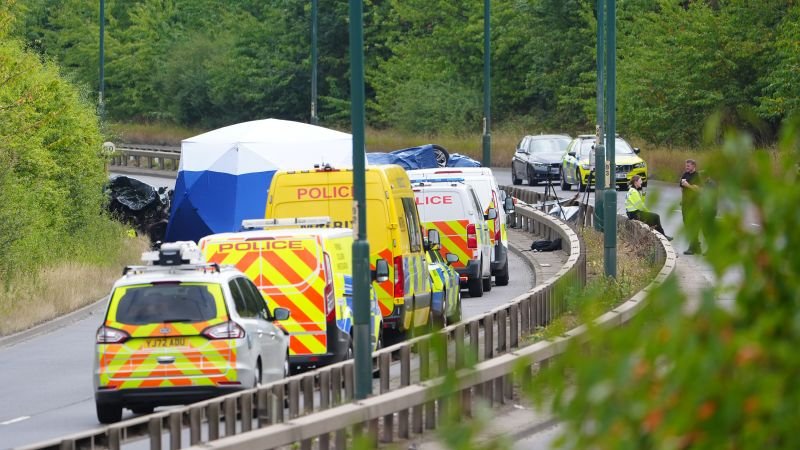
One incident over the weekend saw two police officers and five young people killed near Middlesbrough, northern England after a vehicle traveling on the wrong side of the street collided with a marked police car.
The five occupants of the car, a Volkswagen Passat, were between the ages of 17 and 23, police said. A now-deleted TikTok account believed to belong to one of the teenagers who died in the crash includes a video, posted in March 2025, of him and four other young people involved in what appears to be a police car chase, according to the BBC.
Another video shared by the same profile appears to show a speedometer with a reading of 100mph (160kph), the BBC said.
There were swift tributes to the courage of the two police officers who were killed, named as Matthew Blades, aged 37, and Tom Clough, aged 38.
Police said later Monday they had arrested 12 people as part of a probe into criminal activity which occurred prior to the crash. Several reports were received about two vehicles being driven dangerously, including one which was said to be “ramming properties,” police said.
On Monday, British Defence Minister Luke Pollard called on social media firms to remove content which shows risky driving, including cars traveling “down the wrong side of the roads.”
“There’s lots of content online on social media platforms of people celebrating dangerous driving, celebrating driving inappropriately on our roads, down the wrong side of the roads, behaving incredibly badly,” Pollard told the BBC.
“We’ve already spoken to those companies as a government, telling them that we’ll use the powers in the Online Safety Act” to ensure dangerous content is taken down, Pollard said, referring to legislation in the UK which mandates tech companies to protect users from illegal and harmful content.
British Prime Minister Andy Burnham later said people who share footage glorifying dangerous driving are “doing something that’s truly reprehensible.”
In response to the latest crash, social media giant TikTok said it was closely monitoring any online content related to the incident and is removing videos and accounts that break the company’s rules.
The website of Meta, which owns Facebook and Instagram, says content which promotes “high-risk viral challenges” is removed, while imagery depicting reckless driving that could lead to life-threatening injuries or death is restricted for under 18s, “except if shared in fictional or professional settings.”
The incident near Middlesbrough is not isolated, with local officials discussing the dangers of the social media trend in the context of several other deadly car crashes.
Earlier in August, five teenagers were killed in a two-vehicle collision in Ireland after driving a car the wrong way down a motorway. Three women and a boy, who were in the second vehicle, were hospitalized with serious injuries.
The head of Irish police, Garda Commissioner Justin Kelly, said the incident showed how “irresponsible and dangerous driving on the wrong side of the motorway is,” while saying his thoughts were with those injured.
“What makes this reckless behaviour even more appalling is that in some cases it is being done for social media likes regardless of the potentially devastating impact it might have on innocent people and themselves,” Kelly said at the time.
Also, earlier this month, Irish police made an appeal for witnesses after a car carrying eight boys collided head-on with another vehicle while travelling northbound on the southbound carriageway of a motorway near Dublin, resulting in serious injury.
The true extent of the social media trend remains unclear, but Irish broadcaster RTÉ said Monday that 62 incidents of people driving the wrong way down motorways have been recorded so far this year in Ireland, citing the body which oversees Ireland’s roads and public transport networks, 32% more than in the same period last year.
Reckless driving is not a new behavior, but it can now be “recorded and broadcast to millions for views, for likes, and for followers. So, the danger becomes the content,” said Mary Aiken, a professor of cyberpsychology from Capital Technology University in Washington, DC.
Aiken told CNN she believes the act of recording the risky driving creates a “perceived distance from real-world danger” for the driver. “I believe that what they’re doing starts to feel like a game or a live performance, and the likes, the views and the follower counts provide visible and immediate social rewards,” she said.
She said it should be “extremely straightforward” for social media companies to take down content which glorifies this “criminal and high-risk behavior.”
TikTok said it removes content which glorifies violence or promotes crimes using a range of techniques, including human moderation, detection technologies and user reporting.
Between January and March of this year, the company said that of the content it removed for violating its policies on violent and criminal behavior, 99.1% was taken down before it was reported to them.
While Matt Storey, the police commissioner for Cleveland where the Middlesbrough crash occurred, said it was too early to comment on the cause of the collision, he stated that any filming while driving was “absolutely ridiculous” and “idiotic.”
“It is a worrying situation if that’s becoming more prevalent because it is incredibly dangerous,” he told BBC Radio 4.
Pollard added that he wanted to see the outcome of the police investigation before he can “understand what precisely happened in the tragedy here.”
In tributes to the officers killed, released by police, Clough’s family said he was a “hero” who was “willing to help anyone for any reason,” while Blades’ wife described him as “an adored son and brother, a perfect son-in-law and the most fun uncle.”




Responses