
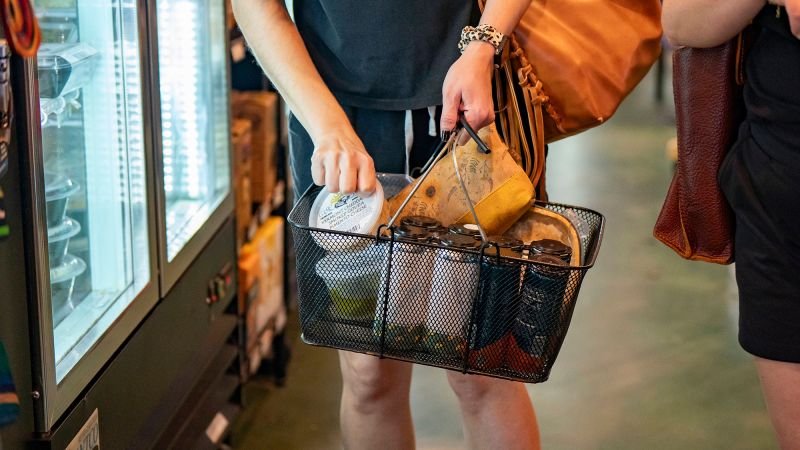
US consumers reined in their spending in July as inflation remained stubbornly high, new Commerce Department data showed Wednesday.
Consumer spending, when adjusted for inflation, was flat from the month prior, a sharp slowdown from a 0.4% gain in June, according to the report.
The Personal Consumption Expenditures price index – the gauge used by the Federal Reserve for its 2% target inflation rate – rose 0.2% from June, keeping the annual rate at 3.7%, the report showed.
Economists were expecting the PCE price index to increase 0.1% from the month before and for the annual rate to slow to 3.6%, according to FactSet estimates.
When stripping out volatile energy and food prices, the “core” PCE index rose 0.2% on a monthly basis and was up 3.3% from a year ago.
The PCE price index is part of the Commerce Department’s monthly Personal Income and Outlays report, which includes comprehensive data on how Americans earn, spend and save.
The July spending pullback among US consumers coincided with a padding of their household coffers: The saving rate, which fell to a four-year low of 2.6% in June, perked up in July to 3%.
Solid income gains helped buffer those savings last month. After-tax income grew by 0.4%, the strongest gain since January (a month where incomes are typically boosted by Social Security increases and start-of-year wage adjustments).
When not adjusting for inflation, spending rose 0.2% from June, an increase driven entirely by services – particularly in the areas of financial services and insurance, healthcare, housing and utilities, Commerce Department data showed.
Most discretionary purchases dropped off from June (with the exception of restaurant spending, which picked up 4.6%). Goods-related spending fell the most for categories such as gasoline, vehicles, home furnishings and non-durable goods.
Part of the goods-related declines can be attributed to Amazon moving its popular Prime Day sale up to June. The shift of Prime Day (and competing promotions from other retailers) factored heavily into the 0.6% decline in US retail sales reported earlier this month.
Consumer spending, on the aggregate, has remained fairly resilient this year in the face of headwinds including a war-driven energy price spike, a tepid labor market and the compounding effects of five-plus years of higher-than-normal inflation.
With tax refunds drying up and inflation outpacing wage growth for a couple of months now, those gains could slip the back half of the year.
Dan North, senior economist with Allianz Trade, said the 0.6% drop in July retail sales could suggest that consumers are taking a breather.
“It makes me wonder if, finally, consumers are saying, ‘You know, let’s step back for a moment; we’re uncertain about this war; inflation’s still sticky; I hate the economy to start with; my income growth is not great; let’s just take a break for a little bit,’” he said in an interview with CNN.
Still, despite the stall-out in July, spending could continue to drive overall economic gains in the coming months, Kathy Bostjancic, chief economist with Nationwide Financial, told CNN.
A separate report released Wednesday showed that durable goods shipments increased rapidly in July, indicating that business investment should remain strong as well, she said.
“The combination of this consumer data and investment data suggest that GDP growth could be at least 3% or higher for the third quarter,” she said. “That’s an indication the real economy is still running quite solid, frankly.”
Inflation, however, remains a problem.
Prices rose a touch more than expected in July. That kept the annual rate of inflation at 3.7%, the third-highest rate in as many years.
Food prices dipped slightly in July and energy prices dropped as well. However, most other areas of inflation remained “pretty sticky,” Bostjancic said.
“The sources of inflation are tariffs, which are pushing up goods prices; AI spending, which is pushing up chips and other AI-related equipment; and also energy, which came off in the most recent month but is still a concern with elevated gasoline prices,” she said.
The latest data could provide some fodder for Federal Reserve members weighing a potential rate hike, she said. The US central bank has kept its benchmark rate unchanged so far this year but has left the door open for a hike as inflation remains elevated.
The Fed’s next interest-rate meeting isn’t until mid-September; as such, Chairman Kevin Warsh’s address Friday at the annual economic symposium in Jackson Hole, Wyoming, will be closely watched.
In addition to Friday’s speech, a slew of labor market data next week will be critical to assess the economy’s continued health, Bostjancic said.
“Embedded in our assumption that the economy continues to chug along is the idea that private employment growth remains solid, because, ultimately, that’s what determines spending power,” she said.




Responses