
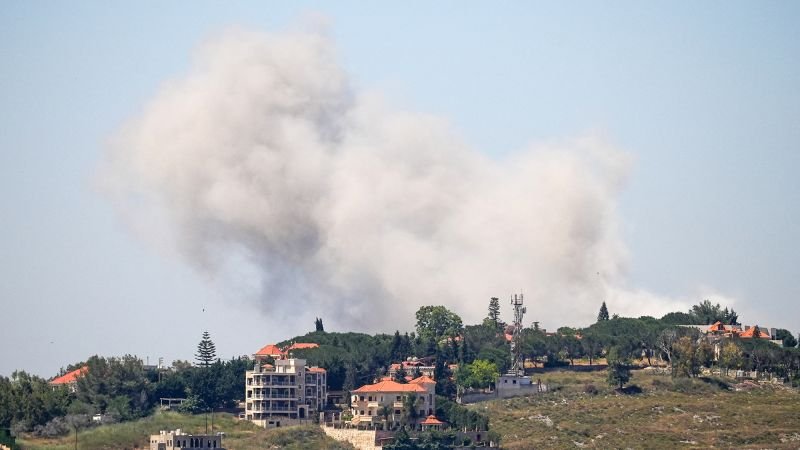
• Fresh strikes in Lebanon: Israeli forces and Hezbollah fighters launched strikes just hours after Israel and Lebanon agreed to implement a ceasefire — hinging on an end to Hezbollah attacks — on Wednesday. Hezbollah is not party to the deal, and the leader of the Iran-backed militant group has rejected the pact.
• US-Iran talks: President Donald Trump said Thursday he would be open to meeting with Iran’s new supreme leader if there’s an agreement to end the war. He also claimed “progress has been made” in ending the fighting in Lebanon.
• Rebuke from US lawmakers: The House passed a resolution yesterday to limit Trump’s war powers in Iran, a significant rebuke to the president and his handling of the conflict.
33 Posts
The US State Department reminded Americans throughout the Middle East “of the continued need for caution” given ongoing tensions in the region.
The reminder, posted Thursday on X and in security alerts from regional US embassies, comes as the US and Iran have continued to trade attacks even as Secretary of State Marco Rubio has asserted the war is “over.”
Iranian strikes on Kuwait on Wednesday injured dozens and killed one person.
It encouraged US citizens “to monitor the news for breaking developments.”
President Donald Trump said Thursday he would be open to meeting with Iran’s new supreme leader if there’s an agreement to end the war.
“I don’t want to meet. But if I did meet, I’d be honored to meet him. I’d like to see if we make a deal, but if we make a deal, it’s possible that I would meet him. I’d be okay with it,” Trump told reporters in the Oval Office.
Asked whether such a meeting could take place in the United States, Trump said “I haven’t really heard too much about it. I didn’t suggest it, but some people have suggested it.”
Trump said he’d be respectful in any meeting with the supreme leader.
“I would say I’m not his favorite person, but with that being said, he’s probably a professional,” Trump said, adding that “in some circles he has a very good reputation, actually.”
Energy Secretary Chris Wright sought Thursday to deflect criticism over rising gas prices, arguing that Democratic policies were more to blame for the higher costs than the war in Iran.
Wright did not specify which Democratic policies were contributing to higher gas prices, which have climbed steadily higher since the US first struck Iran more than three months ago. The attack prompted the Iranian regime to effectively close the Strait of Hormuz, cutting off access to a significant percentage of the world’s oil supply.
Despite the price squeeze, President Donald Trump has indicated he’s willing to draw out negotiations in an effort to force Iran to make greater concessions and ensure that the nation cannot pursue a nuclear weapon.
“If you want to call it a war, if you want to call it a military operation, you cannot let Iran have a nuclear weapon, and everybody agrees to that,” Trump said during the same event at the Oval Office.
President Donald Trump said “progress has been made” in ending the fighting in Lebanon, after the leader of the militant group Hezbollah rejected the ceasefire agreement reached between the Lebanese government and Israel.
However, Israeli forces and Hezbollah fighters launched strikes just hours after Israel and Lebanon agreed to implement a ceasefire. The ceasefire is contingent on an end to Hezbollah attacks, per a statement released Wednesday following the latest round of US-mediated talks.
The conflict is “interconnected with Iran,” Trump said Thursday, in which both sides have issued contradictory messages about the status of peace talks.
President Donald Trump, asked today if Iran killing US troops that would cross a redline, said that it would be a good reason to restart the war.
Remember: Iranian and US officials have issued contradictory messages over the status of their ceasefire. Trump insisted yesterday a deal could be reached “this weekend,” but Iran’s foreign minister said there’s been no “significant process.”
An Israeli soldier was killed by a Hezbollah anti-tank missile in southern Lebanon on Thursday afternoon, according to the Israeli military, on the first day of the latest US-brokered ceasefire.
The Israel Defense Forces (IDF) identified the soldier as 21-year-old Capt. Eitan Shmuel Lemberg. He is the first Israeli soldier killed in Lebanon since the new ceasefire went into effect early Thursday morning (local time).
Since the start of the war with Iran three months ago, 28 Israeli soldiers have been killed in southern Lebanon or along the border. Fifteen of those were killed since the previous ceasefire went into effect in mid-April. A civilian contractor was also killed.
A fragile ceasefire between the Lebanese and Israeli governments is being tested, as Israeli forces and Hezbollah exchange strikes just hours after the deal was struck.
The ceasefire hinged on an end to Hezbollah attacks, but the Iran-backed militant group was not party to the deal, and its leader has rejected the pact.
Meanwhile, Tehran and Washington have issued contradictory messages over the status of their own ceasefire discussions.
We’re tracking the latest developments in the region:
Hezbollah defiant: The paramilitary group’s leader, Naim Qassem, said the terms of the “imaginary ceasefire” would amount to a “surrender,” with Hezbollah being required to stop fighting and withdraw from southern Lebanon while allowing Israel to “continue its aggression.”
Iran weighs in on Israeli offensive: Brig. Gen. Esmail Qaani called on Israel to “withdraw to the positions it held before the start of the 40-day war” in early March, according to the semi-official Iranian news agency Tasnim. The conflict in Lebanon has been among the key impediments to US-Iran peace efforts.
On the ground: Hezbollah targeted Israeli troops operating in southern Lebanon on Thursday, while strikes crossing into northern Israel appeared to decline. Meanwhile, the United Nations Interim Force in Lebanon is investigating a mortar strike that killed a member of its peacekeeping force and injured two others near southern Lebanon’s Marjayoun.
EU pledges support for ceasefire: The European Union has approved an additional 100 million euros (around $116 million) in aid to the Lebanese army in an effort to strengthen the latest fragile ceasefire.
Kuwait airport attack: US Secretary of State Marco Rubio met with the Kuwaiti foreign minister and “condemned Iran’s outrageous and unacceptable” attack targeting the country’s international airport, the US State Department said. The damage to Kuwait’s airport was caused by an Iranian Shahed drone, a weapons expert told CNN.
Strait of Hormuz fees: Iran says it will seek to impose service fees for ships crossing the Strait of Hormuz in exchange for ensuring the vessels’ security, as opposed to transit tolls.
CNN’s Sarah Tamimi, Charbel Mallo, Aida Karimi, Nadeen Ebrahim, Gianluca Mezzofiore, Sana Noor Haq, Dana Karni, Oren Liebermann, Caitlin Danaher and Zeena Saifi contributed to this report.
Russian President Vladimir Putin said he hopes a solution to the Iran conflict can be agreed upon by all parties and that his country stands ready to help if needed.
“We are ready to provide assistance like we did in 2015,” he said at the St. Petersburg Economic International Forum on Thursday.
Russia was a major player in the 2015 Iran nuclear deal, in which it took the bulk of enriched uranium out of Iran.
“We did that before and we are ready to do this now,” Putin said, reiterating Russia’s offer to take Iran’s enriched uranium. “We have good, trusting relations with Iran.”
He said that the uranium should be subject to the control of the International Atomic Energy Agency (IAEA) and that the global community, including the US and Israel, should be be part of the process in getting rid of it.
US Secretary of State Marco Rubio, during a meeting Thursday with the Kuwaiti foreign minister, “condemned Iran’s outrageous and unacceptable attacks targeting Kuwait International Airport and other parts of the country,” a readout from the US State Department said.
Rubio “expressed condolences for those killed and injured in that attack,” the readout said, noting that the US stands “with the Kuwaiti people during this difficult time.”
The meeting between Rubio and Sheikh Jarrah Jaber Al-Ahmad Al Sabah at the US State Department comes a day after one person was killed and 63 others were injured in strikes, including in what Kuwaiti authorities said was an Iranian drone strike on the airport. Iran claimed on Thursday that damage to the airport was caused by a malfunctioning US Patriot missile.
Rubio reiterated to his counterpart that the US is committed “to Kuwait’s security, to ensuring that Iran never acquires a nuclear weapon, and restoration of freedom of navigation through the Strait of Hormuz.”
Rubio’s sentiments of condemnation and support stand in stark contrast to remarks made by US President Donald Trump suggesting that Iran was “provoked” into the attacks on the US’ Gulf ally.
“Some people would say they were slightly provoked, because we took a strong action for a different reason, so they were reciprocating that,” Trump said in remarks in the Oval Office.
Hezbollah launches targeted Israeli troops operating in southern Lebanon on the first day of a fragile ceasefire brokered by the United States, while attacks on northern Israel appeared to decline.
The Israel Defense Forces (IDF) said “suspicious aerial targets” landed near troops in southern Lebanon on Thursday without causing any injuries. The IDF attempted to intercept the projectiles, which triggered missile and rocket alerts in northern Israel.
A few hours later, the IDF said Hezbollah launched rockets at Israeli forces in southern Lebanon. One rocket was intercepted, the IDF said, while an additional rocket landed near Israeli troops.
A spokesperson for the IDF told CNN that Hezbollah had not launched an attack that crossed into Israel on Thursday. Sirens warning of incoming fire sounded several times in northern Israel on Thursday, but the IDF said it was the result of interceptor launches or projectiles in southern Lebanon.
On a visit to the town of Shlomi in northern Israel on Thursday, Prime Minister Benjamin Netanyahu said he was committed to the security of communities along the border with Lebanon. Netanyahu did not explicitly mention the ceasefire agreement, but he did say of diplomacy that “one must navigate, but ultimately insist on our matters wisely, being flexible where possible and very firm where necessary.”
Remember: Hezbollah, a paramilitary group backed by Iran, was not party to the ceasefire deal reached by the Israeli and Lebanese governments and has rejected the pact.
Iran says it will seek to impose service fees for ships crossing the Strait of Hormuz in exchange for ensuring the vessels’ security, as opposed to transit tolls.
Iran “is not seeking to collect passage fees, transit duties, or transit rights payments,” the country’s Deputy Foreign Minister Kazem Gharibabadi said in an interview with the semi-official Iranian outlet Mehr on Thursday.
Instead, the country will seek compensation for services carried out alongside Oman, including navigation assistance, search and rescue, security and safety services, and environmental cleanup services in the event of pollution, the official said.
The strategic waterway “lies entirely within the territorial waters of Iran and Oman,” Gharibabadi added, saying those governments have sovereignty over the strait “under international law and the law of the sea.”
The deputy foreign minister said the arrangements being drafted will be consistent with international law, but acknowledged “they will not be 100% pleasing to some countries.”
Status of US-Iran talks: Gharibabadi said “considerable progress” has been made on the draft text of a peace proposal with the US, but declined to outline a timeline for the potential deal.
“I truly cannot give you a timeframe at this point … We will finalize a text that is capable of serving and securing our interests,” he said.
This post has been updated with Gharibabadi’s comments on peace talks.
The great-grandson of the founder of the Islamic Republic struck a defiant tone in an interview with CNN on Thursday, saying Iran shouldn’t compromise on its demands to end the war.
Tehran has, “no reason to back down from our position,” Seyyed Ahmad Khomeini, the great grandson of the regime’s first Supreme Leader, Ruhollah Khomeini, told CNN at an event in Tehran province.
“From now on, you should be asking us how we could be willing to trust the United States again,” Khomeini said. “Then we will tell you what the Americans must do this time.”
Ruhollah Khomeini led the 1979 Islamic Revolution that deposed Iran’s Western-backed monarch, the shah, and went on to brand the United States the “Great Satan” and Israel the “Little Satan.”
The young Khomeini, who doesn’t hold an official government position in Iran, made the remarks at the main ceremony commemorating his great grandfather’s death 37 years ago. This year’s event prominently featured references to the US-Israeli war against Iran, with many of the participants calling for retribution, some waving red flags with the word “revenge” written on them in Persian.
While advocating a hard line against the US, Ahmad Khomeini, himself a public figure in Iran, did not reject the ongoing negotiations to end the conflict.
“We never had enmity toward the American people that would require improving relations with them. Our enmity has been with American politicians, and it will remain so. Nothing can erase that,” Khomeini added.
Editor’s note: CNN operates in Iran only with the permission of the government but maintains full editorial control of its reports.
The European Union (EU) has approved an additional 100 million euros (around $116 million) in aid to the Lebanese army in an effort to strengthen the latest fragile ceasefire.
“The best way to reduce the threat posed by Hezbollah is to strengthen the Lebanese state, empower its institutions, and restore its monopoly on the use of force,” EU foreign affairs chief Kaja Kallas said in a post on X.
Under the first ceasefire agreement between Israel and Hezbollah in November 2024, the Lebanese government vowed to implement a more rigorous supervision of Hezbollah’s movements south of the country’s Litani river, with the Lebanese Armed Forces (LAF) tasked with disarming the militant group.
Lebanon has been struggling due to severe economic collapse, and the military had long pleaded that it lacked the funding and equipment to fully assert control in the south of the country.
Children in southern Lebanon are becoming withdrawn, restless and overwhelmed by fear, several parents told the NGO CARE International, as strikes between Israel and Hezbollah continue amid efforts to revive a ceasefire.
Fatima, a mother of three from the south, recalled her kids — aged 6, 8 and 12 — displaying “alarming signs of severe trauma,” impeding their “emotional well-being” and “ability to learn, play, and develop,” in testimony shared Thursday by the organization, which has a presence in Lebanon.
Another parent, Samah, described her son, aged 10, as “so overwhelmed by fear and anxiety from the constant airstrikes that he now bites his fingers until they bleed.”
The Israeli campaign in Lebanon following projectiles fired by Hezbollah into southern Israel in March has eviscerated colorful neighborhoods, uprooted 1.5 million people from their homes and razed patches of agricultural land. Israeli, Lebanese and US officials have repeatedly announced extensions to a frail truce first announced by the White House on April 16.
But Lebanese health workers say they have witnessed repeated bloodshed, as emergency crews struggle to offer relief to residents under fire. More than 1,100 people have been killed in Lebanon since April 17, the Lebanese health ministry said Monday. About 770,000 children in Lebanon are “highly distressed,” the UN’s children’s agency (UNICEF) said on Wednesday, citing “repeated exposure to violence, loss and displacement.”
One father in the south, Marwan, said he was unable to sleep because he can no longer provide for his family, including his children, who are aged 9, 13 and 16. “I used to help others when they needed it,” Marwan said, according to CARE International. “Now I am the one asking for help.”
Lebanese militant group Hezbollah rejected the ceasefire agreement reached between the Lebanese government and Israel on Wednesday as a “roadmap to exterminate a segment of the Lebanese people and enslave the rest.”
Hezbollah leader Naim Qassem said the “imaginary ceasefire” that requires the group to stop fighting and withdraw from southern Lebanon while allowing Israel to “continue its aggression” would amount to “a surrender, defeat and achieving the enemy’s goals.”
He called on the Lebanese government to halt direct negotiations with Israel, calling them a “farce and insult.”
The agreement reached between Israel and the Lebanese government in Washington, DC, on Wednesday calls for a “complete cessation” of Hezbollah fire and the group’s withdrawal from southern Lebanon. Israel’s defense minister hailed the agreement and said the Israeli military would “continue its fire and operations on the ground” and have a “continued presence in the security zone in Lebanon… without the return of the population.”
Qassem said Hezbollah wouldn’t participate in a truce that allows Israel to continue fighting.
“We are concerned only with a comprehensive end of the aggression through a ceasefire and an Israeli withdrawal,” he said. “As long as the occupation remains, the resistance will continue.”
Amid the ongoing economic fallout sparked by the Iran war, Saudi Arabia’s minister of energy said today that greater “stabilization” of the global energy sector is needed to avert further financial losses.
The minister said his country owes it to every Saudi citizen that “no matter what severe situation we’re going through, we have to challenge this environment and still continue attending to our own ambitions.”
The United States will be informed of the Lebanese position immediately upon receiving responses from relevant Lebanese parties including Hezbollah, said Lebanese President Joseph Aoun on Thursday.
“The United States will determine the date and mechanism for implementing the ceasefire, which may begin 24 hours after being notified of agreement and the provision of necessary guarantees,” the statement released by the Lebanese Presidency stated on X.
US President Donald Trump will be the direct guarantor for the implementation, Aoun told journalists, as he commended the Lebanese envoy’s efforts, saying that envoy Simon Karam insisted on not moving to discuss any other topic before settling on a comprehensive ceasefire.
Israeli Defense minister, Israel Katz, said Israel’s military would continue its operations as well as its continued presence in some zones of Lebanon without the return of the population.
On Pilot zones, the presidency indicated that Lebanon suggested that the zones start from Zawtar al-Sharqiyah and Zawtar al-Gharbiyah in Nabatieh district of the south, along with Yohmor and Beaufort Castle due to their symbolic importance.
Following two days of negotiations between the Lebanese and Israeli delegation, both parties reached a ceasefire deal on Wednesday contingent on “a complete cessation” of Hezbollah fire and the removal of all Hezbollah operatives from southern Lebanon.
The Lebanese president said the points reached in the negotiations “constitute the last opportunity to enter into a final and comprehensive ceasefire.”
Israel and Hezbollah traded strikes early Thursday local time, hours after the announcement of a ceasefire between Lebanon and Israel, according to local media reports.
Senior Iranian officials leveled up criticism over Israel swelling a military campaign in Lebanon this week, as parallel discussions to end violence in the region press on.
A top military commander, Brig. Gen. Esmail Qaani, warned Israel must “withdraw to the positions it held before the start of the 40-day war” in early March, when hostilities between Israel and the Iran-backed militant group Hezbollah.
“Supporting the resistance in Lebanon is the duty of all of us,” Qaani, the commander of the elite Quds Force branch of Iran’s Islamic Revolutionary Guard Corps (IRGC), said, according to the semi-official agency, Tasnim.
The IRGC emphasized that stance in a separate statement on Thursday, cautioning that Israel “must immediately stop its attacks on the Lebanese people, withdraw without delay” and “recognize Lebanon’s territorial integrity,” Tasnim reported.
On Monday, Iran’s diplomatic lead, Mohammad Bagher Ghlibaf, insisted “if the Israeli aggression against Lebanon continues” Tehran would “halt the path of negotiations.” He threatened “direct confrontation with the enemy,” in a post on X
Iran’s Foreign Minister Abbas Araghchi also declared, “The ceasefire between Iran and the US is unequivocally a ceasefire on all fronts, including Lebanon,” days before threatening retaliation if Israel strikes the Lebanese capital, Beirut.
US President Donald Trump has voiced his frustration over Israel’s campaign in Lebanon as a seed of contention among Iranian authorities. Israeli, Lebanese and US government officials repeatedly stated truce extensions to a frail deal first announced in mid-April – which Hezbollah is not party to. Both Israel and Hezbollah have launched attacks since then.
It comes as Israeli forces pushed deeper into Lebanon on Sunday beyond a stretch of occupied land towards Beaufort Castle, a high-lying fortress near the city of Nabatiyeh.
Over the weekend, troops seized the Crusader-era castle for the first time since Israel occupied Lebanon from 1982 to 2000. On Monday, Israel’s Prime Minister Benjamin Netanyahu maintained the military would keep striking southern Lebanon “as planned.”
The damage to Kuwait’s international airport on Wednesday was caused by an Iranian Shahed drone, said a weapons expert who spoke to CNN.
N.R. Jenzen-Jones, a munitions specialist and director of the research company Armament Research Services (ARES), said the “video footage of the incident shows a munition of a shape and size consistent with an Iranian Shahed-136 series OWA UAV striking the terminal building.”
“The blast effects are also consistent with those expected from this weapon,” he said.
Video shared by Kuwait’s aviation authority on Thursday showed what Kuwaiti authorities said was an Iranian drone striking the airport on Wednesday. The footage shows the moment of impact inside and outside the airport, with large flames breaking out.
Jenzen-Jones added that images of the recovered munition also appear to “show an Iranian-made MD550 engine, as commonly fitted to the Shahed-136 series of one-way attack UAVs.”
“These engines are often recovered relatively intact,” he said, referring to video released by Kuwaiti authorities of an officer carrying debris.
Iranian officials on Thursday disputed that Tehran was responsible for the attack, despite American and Kuwaiti assertions that the projectile was an Iranian drone.
Brigadier General Hossein Mohbi, spokesperson for the Islamic Revolution Guards Corps (IRGC), said the damage “was caused by a malfunction of US-made Patriot missile defense systems, not by Iranian missile strikes,” according to the state news agency IRNA.
The US Central Command (CENTCOM) responded by saying Iran’s claim was “totally FALSE,” adding that “Iran struck the civilian airport with drones in a deliberate, calculated, and unjustified attack.”
Kuwaiti authorities said one person was killed and 63 others were injured following strikes.
This post has been updated with additional information.
One peacekeeper with the United Nations Interim Force (UNIFIL) in Lebanon has died and two others were injured after a mortar shell struck their position near Southern Lebanon’s Marjayoun, the organization said on Thursday.
“Soon after the incident that happened late last night, the critically injured peacekeeper was flown to a hospital in Beirut where he succumbed to his wounds,” UNIFIL said in its statement.
UNIFIL announced it is investigating the incident’s details but indicated that it has detected an increasingly high number of trajectories and impacts in South Lebanon.
UNIFIL’s statement did not say who carried out the mortar attack.
The Israel Defense Forces (IDF) said “an examination of the launch trajectory clearly indicates” that Hezbollah was responsible for the deadly fire. The IDF said the launch came from the area of Al-Qatrani, which is approximately 6 kilometers (4 miles) from the UN post.
After another round of negotiations, Israel and Lebanon agreed to implement a ceasefire contingent on a cessation of Hezbollah fire and the removal of Hezbollah operatives from southern Lebanon.
This story has been updated with additional developments.
• Fresh strikes in Lebanon: Israeli forces and Hezbollah fighters launched strikes just hours after Israel and Lebanon agreed to implement a ceasefire — hinging on an end to Hezbollah attacks — on Wednesday. Hezbollah is not party to the deal, and the leader of the Iran-backed militant group has rejected the pact.
• US-Iran talks: President Donald Trump said Thursday he would be open to meeting with Iran’s new supreme leader if there’s an agreement to end the war. He also claimed “progress has been made” in ending the fighting in Lebanon.
• Rebuke from US lawmakers: The House passed a resolution yesterday to limit Trump’s war powers in Iran, a significant rebuke to the president and his handling of the conflict.
The US State Department reminded Americans throughout the Middle East “of the continued need for caution” given ongoing tensions in the region.
The reminder, posted Thursday on X and in security alerts from regional US embassies, comes as the US and Iran have continued to trade attacks even as Secretary of State Marco Rubio has asserted the war is “over.”
Iranian strikes on Kuwait on Wednesday injured dozens and killed one person.
It encouraged US citizens “to monitor the news for breaking developments.”
President Donald Trump said Thursday he would be open to meeting with Iran’s new supreme leader if there’s an agreement to end the war.
“I don’t want to meet. But if I did meet, I’d be honored to meet him. I’d like to see if we make a deal, but if we make a deal, it’s possible that I would meet him. I’d be okay with it,” Trump told reporters in the Oval Office.
Asked whether such a meeting could take place in the United States, Trump said “I haven’t really heard too much about it. I didn’t suggest it, but some people have suggested it.”
Trump said he’d be respectful in any meeting with the supreme leader.
“I would say I’m not his favorite person, but with that being said, he’s probably a professional,” Trump said, adding that “in some circles he has a very good reputation, actually.”
Energy Secretary Chris Wright sought Thursday to deflect criticism over rising gas prices, arguing that Democratic policies were more to blame for the higher costs than the war in Iran.
Wright did not specify which Democratic policies were contributing to higher gas prices, which have climbed steadily higher since the US first struck Iran more than three months ago. The attack prompted the Iranian regime to effectively close the Strait of Hormuz, cutting off access to a significant percentage of the world’s oil supply.
Despite the price squeeze, President Donald Trump has indicated he’s willing to draw out negotiations in an effort to force Iran to make greater concessions and ensure that the nation cannot pursue a nuclear weapon.
“If you want to call it a war, if you want to call it a military operation, you cannot let Iran have a nuclear weapon, and everybody agrees to that,” Trump said during the same event at the Oval Office.
President Donald Trump said “progress has been made” in ending the fighting in Lebanon, after the leader of the militant group Hezbollah rejected the ceasefire agreement reached between the Lebanese government and Israel.
However, Israeli forces and Hezbollah fighters launched strikes just hours after Israel and Lebanon agreed to implement a ceasefire. The ceasefire is contingent on an end to Hezbollah attacks, per a statement released Wednesday following the latest round of US-mediated talks.
The conflict is “interconnected with Iran,” Trump said Thursday, in which both sides have issued contradictory messages about the status of peace talks.
President Donald Trump, asked today if Iran killing US troops that would cross a redline, said that it would be a good reason to restart the war.
Remember: Iranian and US officials have issued contradictory messages over the status of their ceasefire. Trump insisted yesterday a deal could be reached “this weekend,” but Iran’s foreign minister said there’s been no “significant process.”
An Israeli soldier was killed by a Hezbollah anti-tank missile in southern Lebanon on Thursday afternoon, according to the Israeli military, on the first day of the latest US-brokered ceasefire.
The Israel Defense Forces (IDF) identified the soldier as 21-year-old Capt. Eitan Shmuel Lemberg. He is the first Israeli soldier killed in Lebanon since the new ceasefire went into effect early Thursday morning (local time).
Since the start of the war with Iran three months ago, 28 Israeli soldiers have been killed in southern Lebanon or along the border. Fifteen of those were killed since the previous ceasefire went into effect in mid-April. A civilian contractor was also killed.
A fragile ceasefire between the Lebanese and Israeli governments is being tested, as Israeli forces and Hezbollah exchange strikes just hours after the deal was struck.
The ceasefire hinged on an end to Hezbollah attacks, but the Iran-backed militant group was not party to the deal, and its leader has rejected the pact.
Meanwhile, Tehran and Washington have issued contradictory messages over the status of their own ceasefire discussions.
We’re tracking the latest developments in the region:
Hezbollah defiant: The paramilitary group’s leader, Naim Qassem, said the terms of the “imaginary ceasefire” would amount to a “surrender,” with Hezbollah being required to stop fighting and withdraw from southern Lebanon while allowing Israel to “continue its aggression.”
Iran weighs in on Israeli offensive: Brig. Gen. Esmail Qaani called on Israel to “withdraw to the positions it held before the start of the 40-day war” in early March, according to the semi-official Iranian news agency Tasnim. The conflict in Lebanon has been among the key impediments to US-Iran peace efforts.
On the ground: Hezbollah targeted Israeli troops operating in southern Lebanon on Thursday, while strikes crossing into northern Israel appeared to decline. Meanwhile, the United Nations Interim Force in Lebanon is investigating a mortar strike that killed a member of its peacekeeping force and injured two others near southern Lebanon’s Marjayoun.
EU pledges support for ceasefire: The European Union has approved an additional 100 million euros (around $116 million) in aid to the Lebanese army in an effort to strengthen the latest fragile ceasefire.
Kuwait airport attack: US Secretary of State Marco Rubio met with the Kuwaiti foreign minister and “condemned Iran’s outrageous and unacceptable” attack targeting the country’s international airport, the US State Department said. The damage to Kuwait’s airport was caused by an Iranian Shahed drone, a weapons expert told CNN.
Strait of Hormuz fees: Iran says it will seek to impose service fees for ships crossing the Strait of Hormuz in exchange for ensuring the vessels’ security, as opposed to transit tolls.
CNN’s Sarah Tamimi, Charbel Mallo, Aida Karimi, Nadeen Ebrahim, Gianluca Mezzofiore, Sana Noor Haq, Dana Karni, Oren Liebermann, Caitlin Danaher and Zeena Saifi contributed to this report.
Russian President Vladimir Putin said he hopes a solution to the Iran conflict can be agreed upon by all parties and that his country stands ready to help if needed.
“We are ready to provide assistance like we did in 2015,” he said at the St. Petersburg Economic International Forum on Thursday.
Russia was a major player in the 2015 Iran nuclear deal, in which it took the bulk of enriched uranium out of Iran.
“We did that before and we are ready to do this now,” Putin said, reiterating Russia’s offer to take Iran’s enriched uranium. “We have good, trusting relations with Iran.”
He said that the uranium should be subject to the control of the International Atomic Energy Agency (IAEA) and that the global community, including the US and Israel, should be be part of the process in getting rid of it.
US Secretary of State Marco Rubio, during a meeting Thursday with the Kuwaiti foreign minister, “condemned Iran’s outrageous and unacceptable attacks targeting Kuwait International Airport and other parts of the country,” a readout from the US State Department said.
Rubio “expressed condolences for those killed and injured in that attack,” the readout said, noting that the US stands “with the Kuwaiti people during this difficult time.”
The meeting between Rubio and Sheikh Jarrah Jaber Al-Ahmad Al Sabah at the US State Department comes a day after one person was killed and 63 others were injured in strikes, including in what Kuwaiti authorities said was an Iranian drone strike on the airport. Iran claimed on Thursday that damage to the airport was caused by a malfunctioning US Patriot missile.
Rubio reiterated to his counterpart that the US is committed “to Kuwait’s security, to ensuring that Iran never acquires a nuclear weapon, and restoration of freedom of navigation through the Strait of Hormuz.”
Rubio’s sentiments of condemnation and support stand in stark contrast to remarks made by US President Donald Trump suggesting that Iran was “provoked” into the attacks on the US’ Gulf ally.
“Some people would say they were slightly provoked, because we took a strong action for a different reason, so they were reciprocating that,” Trump said in remarks in the Oval Office.
Hezbollah launches targeted Israeli troops operating in southern Lebanon on the first day of a fragile ceasefire brokered by the United States, while attacks on northern Israel appeared to decline.
The Israel Defense Forces (IDF) said “suspicious aerial targets” landed near troops in southern Lebanon on Thursday without causing any injuries. The IDF attempted to intercept the projectiles, which triggered missile and rocket alerts in northern Israel.
A few hours later, the IDF said Hezbollah launched rockets at Israeli forces in southern Lebanon. One rocket was intercepted, the IDF said, while an additional rocket landed near Israeli troops.
A spokesperson for the IDF told CNN that Hezbollah had not launched an attack that crossed into Israel on Thursday. Sirens warning of incoming fire sounded several times in northern Israel on Thursday, but the IDF said it was the result of interceptor launches or projectiles in southern Lebanon.
On a visit to the town of Shlomi in northern Israel on Thursday, Prime Minister Benjamin Netanyahu said he was committed to the security of communities along the border with Lebanon. Netanyahu did not explicitly mention the ceasefire agreement, but he did say of diplomacy that “one must navigate, but ultimately insist on our matters wisely, being flexible where possible and very firm where necessary.”
Remember: Hezbollah, a paramilitary group backed by Iran, was not party to the ceasefire deal reached by the Israeli and Lebanese governments and has rejected the pact.
Iran says it will seek to impose service fees for ships crossing the Strait of Hormuz in exchange for ensuring the vessels’ security, as opposed to transit tolls.
Iran “is not seeking to collect passage fees, transit duties, or transit rights payments,” the country’s Deputy Foreign Minister Kazem Gharibabadi said in an interview with the semi-official Iranian outlet Mehr on Thursday.
Instead, the country will seek compensation for services carried out alongside Oman, including navigation assistance, search and rescue, security and safety services, and environmental cleanup services in the event of pollution, the official said.
The strategic waterway “lies entirely within the territorial waters of Iran and Oman,” Gharibabadi added, saying those governments have sovereignty over the strait “under international law and the law of the sea.”
The deputy foreign minister said the arrangements being drafted will be consistent with international law, but acknowledged “they will not be 100% pleasing to some countries.”
Status of US-Iran talks: Gharibabadi said “considerable progress” has been made on the draft text of a peace proposal with the US, but declined to outline a timeline for the potential deal.
“I truly cannot give you a timeframe at this point … We will finalize a text that is capable of serving and securing our interests,” he said.
This post has been updated with Gharibabadi’s comments on peace talks.
The great-grandson of the founder of the Islamic Republic struck a defiant tone in an interview with CNN on Thursday, saying Iran shouldn’t compromise on its demands to end the war.
Tehran has, “no reason to back down from our position,” Seyyed Ahmad Khomeini, the great grandson of the regime’s first Supreme Leader, Ruhollah Khomeini, told CNN at an event in Tehran province.
“From now on, you should be asking us how we could be willing to trust the United States again,” Khomeini said. “Then we will tell you what the Americans must do this time.”
Ruhollah Khomeini led the 1979 Islamic Revolution that deposed Iran’s Western-backed monarch, the shah, and went on to brand the United States the “Great Satan” and Israel the “Little Satan.”
The young Khomeini, who doesn’t hold an official government position in Iran, made the remarks at the main ceremony commemorating his great grandfather’s death 37 years ago. This year’s event prominently featured references to the US-Israeli war against Iran, with many of the participants calling for retribution, some waving red flags with the word “revenge” written on them in Persian.
While advocating a hard line against the US, Ahmad Khomeini, himself a public figure in Iran, did not reject the ongoing negotiations to end the conflict.
“We never had enmity toward the American people that would require improving relations with them. Our enmity has been with American politicians, and it will remain so. Nothing can erase that,” Khomeini added.
Editor’s note: CNN operates in Iran only with the permission of the government but maintains full editorial control of its reports.
The European Union (EU) has approved an additional 100 million euros (around $116 million) in aid to the Lebanese army in an effort to strengthen the latest fragile ceasefire.
“The best way to reduce the threat posed by Hezbollah is to strengthen the Lebanese state, empower its institutions, and restore its monopoly on the use of force,” EU foreign affairs chief Kaja Kallas said in a post on X.
Under the first ceasefire agreement between Israel and Hezbollah in November 2024, the Lebanese government vowed to implement a more rigorous supervision of Hezbollah’s movements south of the country’s Litani river, with the Lebanese Armed Forces (LAF) tasked with disarming the militant group.
Lebanon has been struggling due to severe economic collapse, and the military had long pleaded that it lacked the funding and equipment to fully assert control in the south of the country.
Children in southern Lebanon are becoming withdrawn, restless and overwhelmed by fear, several parents told the NGO CARE International, as strikes between Israel and Hezbollah continue amid efforts to revive a ceasefire.
Fatima, a mother of three from the south, recalled her kids — aged 6, 8 and 12 — displaying “alarming signs of severe trauma,” impeding their “emotional well-being” and “ability to learn, play, and develop,” in testimony shared Thursday by the organization, which has a presence in Lebanon.
Another parent, Samah, described her son, aged 10, as “so overwhelmed by fear and anxiety from the constant airstrikes that he now bites his fingers until they bleed.”
The Israeli campaign in Lebanon following projectiles fired by Hezbollah into southern Israel in March has eviscerated colorful neighborhoods, uprooted 1.5 million people from their homes and razed patches of agricultural land. Israeli, Lebanese and US officials have repeatedly announced extensions to a frail truce first announced by the White House on April 16.
But Lebanese health workers say they have witnessed repeated bloodshed, as emergency crews struggle to offer relief to residents under fire. More than 1,100 people have been killed in Lebanon since April 17, the Lebanese health ministry said Monday. About 770,000 children in Lebanon are “highly distressed,” the UN’s children’s agency (UNICEF) said on Wednesday, citing “repeated exposure to violence, loss and displacement.”
One father in the south, Marwan, said he was unable to sleep because he can no longer provide for his family, including his children, who are aged 9, 13 and 16. “I used to help others when they needed it,” Marwan said, according to CARE International. “Now I am the one asking for help.”
Lebanese militant group Hezbollah rejected the ceasefire agreement reached between the Lebanese government and Israel on Wednesday as a “roadmap to exterminate a segment of the Lebanese people and enslave the rest.”
Hezbollah leader Naim Qassem said the “imaginary ceasefire” that requires the group to stop fighting and withdraw from southern Lebanon while allowing Israel to “continue its aggression” would amount to “a surrender, defeat and achieving the enemy’s goals.”
He called on the Lebanese government to halt direct negotiations with Israel, calling them a “farce and insult.”
The agreement reached between Israel and the Lebanese government in Washington, DC, on Wednesday calls for a “complete cessation” of Hezbollah fire and the group’s withdrawal from southern Lebanon. Israel’s defense minister hailed the agreement and said the Israeli military would “continue its fire and operations on the ground” and have a “continued presence in the security zone in Lebanon… without the return of the population.”
Qassem said Hezbollah wouldn’t participate in a truce that allows Israel to continue fighting.
“We are concerned only with a comprehensive end of the aggression through a ceasefire and an Israeli withdrawal,” he said. “As long as the occupation remains, the resistance will continue.”
Amid the ongoing economic fallout sparked by the Iran war, Saudi Arabia’s minister of energy said today that greater “stabilization” of the global energy sector is needed to avert further financial losses.
The minister said his country owes it to every Saudi citizen that “no matter what severe situation we’re going through, we have to challenge this environment and still continue attending to our own ambitions.”
The United States will be informed of the Lebanese position immediately upon receiving responses from relevant Lebanese parties including Hezbollah, said Lebanese President Joseph Aoun on Thursday.
“The United States will determine the date and mechanism for implementing the ceasefire, which may begin 24 hours after being notified of agreement and the provision of necessary guarantees,” the statement released by the Lebanese Presidency stated on X.
US President Donald Trump will be the direct guarantor for the implementation, Aoun told journalists, as he commended the Lebanese envoy’s efforts, saying that envoy Simon Karam insisted on not moving to discuss any other topic before settling on a comprehensive ceasefire.
Israeli Defense minister, Israel Katz, said Israel’s military would continue its operations as well as its continued presence in some zones of Lebanon without the return of the population.
On Pilot zones, the presidency indicated that Lebanon suggested that the zones start from Zawtar al-Sharqiyah and Zawtar al-Gharbiyah in Nabatieh district of the south, along with Yohmor and Beaufort Castle due to their symbolic importance.
Following two days of negotiations between the Lebanese and Israeli delegation, both parties reached a ceasefire deal on Wednesday contingent on “a complete cessation” of Hezbollah fire and the removal of all Hezbollah operatives from southern Lebanon.
The Lebanese president said the points reached in the negotiations “constitute the last opportunity to enter into a final and comprehensive ceasefire.”
Israel and Hezbollah traded strikes early Thursday local time, hours after the announcement of a ceasefire between Lebanon and Israel, according to local media reports.
Senior Iranian officials leveled up criticism over Israel swelling a military campaign in Lebanon this week, as parallel discussions to end violence in the region press on.
A top military commander, Brig. Gen. Esmail Qaani, warned Israel must “withdraw to the positions it held before the start of the 40-day war” in early March, when hostilities between Israel and the Iran-backed militant group Hezbollah.
“Supporting the resistance in Lebanon is the duty of all of us,” Qaani, the commander of the elite Quds Force branch of Iran’s Islamic Revolutionary Guard Corps (IRGC), said, according to the semi-official agency, Tasnim.
The IRGC emphasized that stance in a separate statement on Thursday, cautioning that Israel “must immediately stop its attacks on the Lebanese people, withdraw without delay” and “recognize Lebanon’s territorial integrity,” Tasnim reported.
On Monday, Iran’s diplomatic lead, Mohammad Bagher Ghlibaf, insisted “if the Israeli aggression against Lebanon continues” Tehran would “halt the path of negotiations.” He threatened “direct confrontation with the enemy,” in a post on X
Iran’s Foreign Minister Abbas Araghchi also declared, “The ceasefire between Iran and the US is unequivocally a ceasefire on all fronts, including Lebanon,” days before threatening retaliation if Israel strikes the Lebanese capital, Beirut.
US President Donald Trump has voiced his frustration over Israel’s campaign in Lebanon as a seed of contention among Iranian authorities. Israeli, Lebanese and US government officials repeatedly stated truce extensions to a frail deal first announced in mid-April – which Hezbollah is not party to. Both Israel and Hezbollah have launched attacks since then.
It comes as Israeli forces pushed deeper into Lebanon on Sunday beyond a stretch of occupied land towards Beaufort Castle, a high-lying fortress near the city of Nabatiyeh.
Over the weekend, troops seized the Crusader-era castle for the first time since Israel occupied Lebanon from 1982 to 2000. On Monday, Israel’s Prime Minister Benjamin Netanyahu maintained the military would keep striking southern Lebanon “as planned.”
The damage to Kuwait’s international airport on Wednesday was caused by an Iranian Shahed drone, said a weapons expert who spoke to CNN.
N.R. Jenzen-Jones, a munitions specialist and director of the research company Armament Research Services (ARES), said the “video footage of the incident shows a munition of a shape and size consistent with an Iranian Shahed-136 series OWA UAV striking the terminal building.”
“The blast effects are also consistent with those expected from this weapon,” he said.
Video shared by Kuwait’s aviation authority on Thursday showed what Kuwaiti authorities said was an Iranian drone striking the airport on Wednesday. The footage shows the moment of impact inside and outside the airport, with large flames breaking out.
Jenzen-Jones added that images of the recovered munition also appear to “show an Iranian-made MD550 engine, as commonly fitted to the Shahed-136 series of one-way attack UAVs.”
“These engines are often recovered relatively intact,” he said, referring to video released by Kuwaiti authorities of an officer carrying debris.
Iranian officials on Thursday disputed that Tehran was responsible for the attack, despite American and Kuwaiti assertions that the projectile was an Iranian drone.
Brigadier General Hossein Mohbi, spokesperson for the Islamic Revolution Guards Corps (IRGC), said the damage “was caused by a malfunction of US-made Patriot missile defense systems, not by Iranian missile strikes,” according to the state news agency IRNA.
The US Central Command (CENTCOM) responded by saying Iran’s claim was “totally FALSE,” adding that “Iran struck the civilian airport with drones in a deliberate, calculated, and unjustified attack.”
Kuwaiti authorities said one person was killed and 63 others were injured following strikes.
This post has been updated with additional information.
One peacekeeper with the United Nations Interim Force (UNIFIL) in Lebanon has died and two others were injured after a mortar shell struck their position near Southern Lebanon’s Marjayoun, the organization said on Thursday.
“Soon after the incident that happened late last night, the critically injured peacekeeper was flown to a hospital in Beirut where he succumbed to his wounds,” UNIFIL said in its statement.
UNIFIL announced it is investigating the incident’s details but indicated that it has detected an increasingly high number of trajectories and impacts in South Lebanon.
UNIFIL’s statement did not say who carried out the mortar attack.
The Israel Defense Forces (IDF) said “an examination of the launch trajectory clearly indicates” that Hezbollah was responsible for the deadly fire. The IDF said the launch came from the area of Al-Qatrani, which is approximately 6 kilometers (4 miles) from the UN post.
After another round of negotiations, Israel and Lebanon agreed to implement a ceasefire contingent on a cessation of Hezbollah fire and the removal of Hezbollah operatives from southern Lebanon.
This story has been updated with additional developments.





Responses