
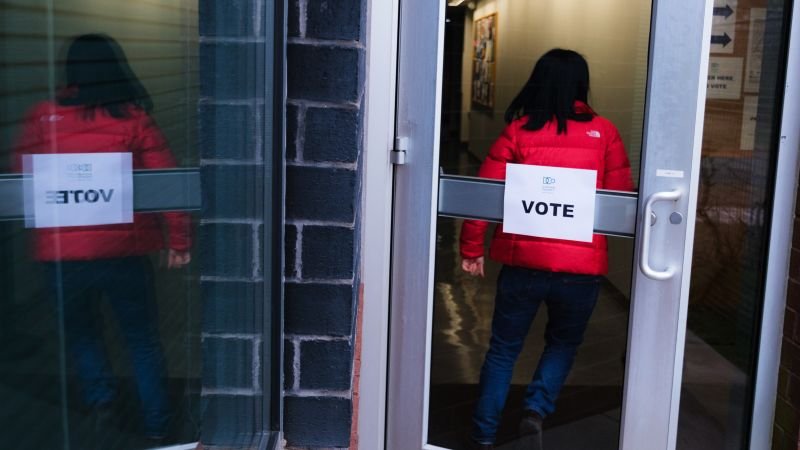
North Carolina has a history of nail-biter elections. And a series of changes enacted by Republicans could be critical in this year’s midterms, including in a marquee Senate race viewed by Democrats as a pickup opportunity.
Since the 2024 election, the state has sharply curtailed Sunday voting, imposed new restrictions on how mail-in ballots are processed, and placed Republicans in control of elections boards after the legislature stripped power from the Democratic governor.
President Donald Trump and his allies are mounting a sweeping campaign that attempts to reshape how this year’s midterm elections are conducted. While many of Trump’s federal proposals – including the SAVE America Act and an executive order on which ballots will be delivered – won’t move forward this fall, North Carolina is among the states that have changed its elections in ways that worry Democrats and left-leaning advocates.
“The newly reconstituted and Republican-dominated State Board of Elections has waged a campaign to silence many North Carolinians at the ballot box,” Sam Chan, a spokesperson for former Gov. Roy Cooper, said in a statement. Cooper is running against Republican Michael Whatley for the seat held by retiring GOP Sen. Thom Tillis.
Political observers say even small changes that affect partisan turnout could help decide contests – from a pair of competitive US House races and a high-stakes state Supreme Court election to more local battles that will determine whether Republicans retain their supermajority in the state Senate.
A fight over the outcome of a previous state Supreme Court race between Democratic incumbent Justice Allison Riggs and North Carolina Court of Appeals Judge Jefferson Griffin, a Republican, dragged on for six months before Griffin conceded last year.
Riggs retained the seat by just 734 votes.
Two years ago, Shia Rozier says it took her about seven minutes to walk from her dorm room at North Carolina Agriculture & Technical State University to a polling place on the school’s campus to cast a ballot in the presidential race. This year, she said, the closest early voting location for most students is a 45-minute walk away.
“I think they’re scared,” Rozier said of opponents. “If we do go vote in numbers, I think some people’s seats will be up for grabs, and they’re trying to eliminate that.”
Republicans have pushed back on the criticism, saying voters in North Carolina will have a record number of early voting locations this fall and ample opportunities to cast their ballots in the midterms.
“We disagree with the characterization that reasonable election safeguards and administrative decisions amount to voter suppression,” the North Carolina state GOP said in a statement.
“What we’ve seen in North Carolina is a bunch of angry Democrats who don’t like that Republicans now have a part of election governance,” said Dallas Woodhouse, a former executive director of the state’s Republican Party who was involved in shaping early voting rules at the state auditor’s office.
North Carolina’s state elections board made its last move just hours before counties started sending out absentee ballots.
It voted on September 4 to direct election officials not to count absentee ballots returned with the inner envelope unsealed. The board also limited to “near relatives” and legal guardians the people allowed to drop off a mail ballot on behalf of most voters.
If a voter cannot correct deficiencies with a ballot, it will be “spoiled,” or canceled, and a new one reissued. Critics say that will lead to votes being tossed out on technical grounds.
Republicans said they acted to guarantee the election’s integrity.
“It’s a ballot security issue to make sure that the voter’s will and intent is being followed through,” one of the GOP board members, Stacy “Four” Eggers, said before the vote.
Only about 5% of the 5.7 million North Carolinians who cast ballots in the 2024 general election voted by mail. But Democrats in the state are more likely to use the method than Republicans are, state data show.
As of Tuesday, Democrats had requested roughly 42% of the 67,990 absentee-by-mail ballots, according to election records. A little more than 17% went to Republicans, and about 40% to unaffiliated voters.
In a statement, North Carolina’s Democratic Gov. Josh Stein called the board’s absentee ballot directive “a slap in the face to voters.”
Jason Tyson, a spokesman for the state elections board, said it’s “certainly within the governor’s purview and auspices to make his feelings known” but he said the state board is focused on helping county officials and ensuring “our elections are secure.”
In North Carolina’s 1st District, Democratic Rep. Don Davis already faces an uphill reelection battle after state lawmakers redrew the congressional map to create a more GOP-friendly seat.
Now, there’s no Sunday voting in any county in the district, according to an analysis by Christopher Cooper, a political scientist at Western Carolina University.
Hours and locations for early voting have shifted around the state. Just 17 counties will allow early voting on Sundays this year, down from 40 in 2022, Cooper’s analysis found.
State officials note the number of early voting sites available has grown to a record 367 for a midterm election and up from 359 during the 2022 midterms.
In eliminating Sunday voting options, county election board members argued that those hours were underutilized or strained limited resources. At least one Republican cited religious objections.
“By having Sunday voting, we are requiring people to work on the Lord’s Day, and I do believe that the downfall of this country will be contingent on what we do with God,” said Matt Longworth, a Republican who serves on the election board in rural Anson County, southeast of Charlotte.
Roughly 45% of Anson County’s voting-age population is Black, Census figures show.
The widespread rollback of Sunday voting across the state “spells an intentional assault on the Black vote,” said Marcus Bass, executive director of the North Carolina Black Alliance, which has helped groups organize Souls to the Polls events.
In counties without Sunday voting, he said, faith communities are working on other opportunities, including encouraging voting tied to Wednesday night gatherings for Bible study.
Traditionally in North Carolina, the governor’s party has held the reins on election administration.
But in a lame-duck session after the 2024 election, Republicans in the state legislature used their-then veto-proof majority to strip Stein, the incoming governor, of the power to appoint members of North Carolina’s five-member state elections board. The legislature transferred that authority to state Auditor Dave Boliek, a Republican whose job is to monitor North Carolina’s finances.
Republicans, through Boliek’s appointing authority, now also control the majorities on each of North Carolina’s 100 county election boards after years of Democratic majorities at the state and local level. (On Wednesday, a state appellate court ruled 2-1 to uphold the legislature’s decision to strip Stein of the appointment powers.)
Earlier this year, Bill Thompson, the Republican chairman of the Jackson County Election Board in western North Carolina, said publicly that he felt “pressure” from the auditor’s office to reject a plan for an early voting site on the campus of Western Carolina University in favor of one at a community recreation center, according to minutes of the board meeting and local news coverage.
Woodhouse, the former state Republican Party executive director, resigned from the auditor’s office earlier this year, following multiple disclosures of him giving specific guidance to local Republican board members on early voting locations and days.
In the case of Jackson County, for instance, Woodhouse urged Thompson to “stand strong” against efforts to add the voting location on the Western Carolina campus at the expense of the rec center, according to text messages obtained by American Oversight, a left-leaning government watchdog group.
The campus polling location, Woodhouse argued in his texts, was new and untested and would introduce “unfamiliarity and uncertainty” into the November election.
At the county level, Thompson was the sole “no” vote against the campus location. (In the end, the state board, which resolves any disagreements among county board members on early voting procedures, signed off on both the rec center and the campus sites.)
Woodhouse said he worked hard to preserve generous access to early voting, which runs for 17 days, while also seeking to spread voting locations throughout counties.
“The Democrat boards have been in charge for so long, we wanted to make sure rural and suburban voters were also getting ample opportunities,” he said. “That obviously coincided with potential partisan interests, but Republicans have a right to vote, too.”
Randy Brechbiel, a spokesman for the auditor, called the criticism of the office’s actions “partisan, political noise.”
“North Carolinians are highly confident in our state’s elections, and there are more early voting sites and more early voting hours in 2026 than the last comparable midterm election in 2022,” he said in an email.
Jeff Carmon, a Democrat who has served on the state elections board since 2019, said the participation of the state auditor’s office in hyper-local election decisions “creates the appearance of impropriety.”
“I’ve never seen this kind of involvement from the appointing authority,” he said.
All year long, students from North Carolina Agriculture & Technical State University, the largest historically Black college in the state, have trekked to state and county election board meetings to advocate for an early voting location on campus.
At the county level, four of the five Guilford County Election Board members, including a Democrat, approved a plan that did not include the campus site. The state board affirmed that decision.
Election officials say there’s no history of early voting on the campus during midterm elections, so students technically have not seen their voting access curtailed.
But Rozier, one of the students leading the campaign, argued that practices in past midterms shouldn’t govern what happens in this fall’s election.
Rozier, 22, said she and others active in a student group called Protect Ours NC won’t be deterred from voting this fall. They are now raising funds ahead of the October 15 start of early voting to hire shuttle buses to ferry students to the nearest polling place.
“We won’t be able to make changes around voting without voting,” Rozier said.
CNN’s Dianne Gallagher and Renee Rigdon contributed to this report.




Responses