
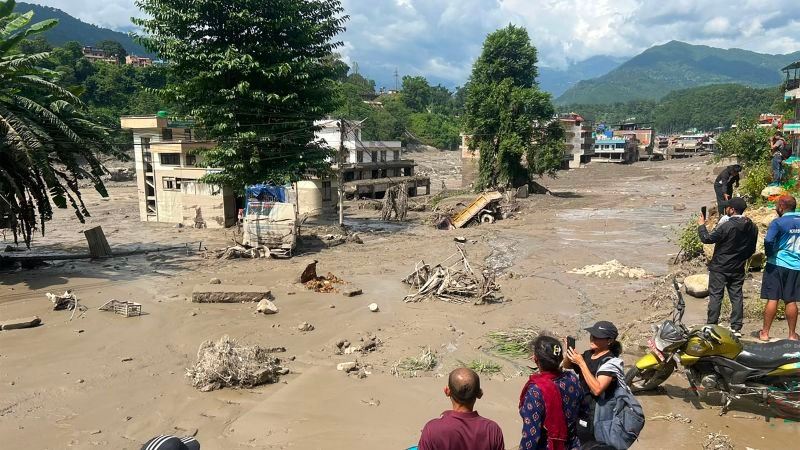
• Many feared dead: Catastrophic flash flooding has hit China and Nepal, with more than 150 people confirmed killed and the death toll likely to rise. Hundreds of tourists, including at least 47 Americans, are reported to be missing.
• Widespread damage: Dramatic footage shows a torrent of water hitting the Nepal-China border and villages submerged. Helicopters have been winching stranded people from rooftops. A mudslide hit China’s Gyirong port, prompting Chinese leader Xi Jinping to urge “all-out” search efforts.
• What caused the devastation? A powerful landslide blocked the Bhote Koshi river, sending a torrent of water downstream from China to Nepal. A group of scientists believe a glacier may have broken off and fallen into the valley below, which triggered or at least compounded the effect of the landslide.
35 Posts
Hundreds of people are believed to be missing in Nepal following the devastating flash floods, including 341 foreign nationals according to the Associated Press citing a Nepali official. Here’s what we know:
United States: At least 47 people from the US are among the missing, the AP reports citing citing Nepal tourism board spokesperson Sunil Sharma. CNN has reached out to Nepal’s tourism board for comment. Earlier, a State Department spokesperson said it was aware of Americans impacted by the floods in Nepal and that it was closely monitoring the situation. The spokesperson did not provide details on the number or contition of the US citizens impacted.
India: Sharma said at least 133 missing foreign nationals were from India on pilgrimage to Mount Kailash in Tibet, a sacred site for Hindus, AP reports. CNN is reaching out to the Indian government.
Russia: The Russian embassy in Nepal said contact was lost with at least four Russian citizens in the disaster zone. The embassy added that search and rescue operations are underway but that weather conditions and communications disruptions are hampering efforts.
Portugal: Portugal’s Honorary Consul in Nepal Rajendra Kumar Khetan told CNN he has received notice of two missing Portuguese citizens so far.
South Korea: At least nine South Koreans are missing according to the country’s foreign ministry.
Italy: At least 90 Italians in the affected area are unaccounted for, the country’s foreign ministry said.
Ukraine: At least one Ukrainian has possibly gone missing and contact with another has been lost, the foreign ministry said. Ukraine’s foreign ministry has said its embassies in India and China have reached out to relevant authorities for more information about Ukrainian citizens possibly affected. At this time, there is no information to suggest Ukrainian citizens are among the dead or injured, the foreign ministry said.
CNN’s Victoria Butenko, Gawon Bae and Barbie Latza Nadeau contributed reporting.
It will take weeks to establish the exact causes of the flooding, but a team of international scientists believes a huge chunk of glacier sheared off and fell into the valley below.
“What is hard to reconcile is the gargantuan volumes of water that we see in these, these absolutely horrific videos,” said Daniel Shugar, a geologist at the University of California, who’s part of the group.
Their theory is that a rock landslide happened at the same time as the glacier broke, creating a rapidly moving mix of ice and rock, which cascaded down the mountain. As it tumbled down, it also picked up sediment that was already water-logged because it’s monsoon season, which contributed to the massive wall of water.
At least 157 people have died in the flash floods that hit Nepal, according to the country’s police in a post on X. At least 41 people have been hospitalized.
Hundreds more are unaccounted for as search and rescue efforts continue.
Chinese state media earlier reported that at least three people are dead and more than 250 are missing. Emergency responders told state media that they are using excavators to clear a path through thick layers of mud and debris in heavily-affected Gyirong county in China’s Tibet Autonomous Region.
Video shows flooding overwhelming the Gyirong border crossing between China and Nepal. The crossing is popular with religious pilgrims heading to and from Mount Kailash.
A prominent Indian guru says that at least 77 people in a pilgrimage group led by his organization are missing after being caught in a destructive flash flood at a Chinese border port.
Jagadish Vasudev, who goes by the spiritual name Sadhguru, said in a post on X that a group of 77 pilgrims coming back from Mount Kailash in Tibet were at a border station in Gyirong, China when the flood swept through.
Mount Kailash is revered in Hinduism, Buddhism, Jainism and Bon, a Tibetan religion, and Sadhguru’s Isha Foundation advertises numerous Kailash trips per year.
Video from the Gyirong border port, a major land border crossing between China and Nepal, showed people fleeing before a wall of muddy water rushes over the entire building.
At 8:37 a.m. local time, shaking in the region was initially reported by US Geological Survey as a 4.4 magnitude earthquake along the Nepal-China border, north of Kathmandu.
Around the same time, an “avalanche” of ice and rock — more like a landslide in this case — tore down a mountainside and into the Lhende Khola River, a tributary of the Bhote Koshi River, which flows from China into Nepal, often through deep gorges.
USGS later clarified that the shaking was not an earthquake, but rather caused by this exceptionally powerful landslide itself, which registered as the equivalent of a magnitude 5.2 earthquake.
The US State Department “is aware of Americans impacted by the floods in Nepal and is closely tracking the situation,” a spokesperson said on Wednesday.
The spokesperson did not provide details on the number or condition of US citizens impacted by the devastating floods.
“Department of State staff in Washington, DC, and Kathmandu are monitoring the situation and are in touch with the Government of Nepal,” they said. “The United States stands ready to provide assistance.”
On the ground, the US embassy “is working closely with local tour agencies and local authorities to assist Americans in the affected areas,” the spokesperson said.
They encouraged US citizens there “to monitor local news, follow the emergency instructions provided by local authorities” and enroll in the State Department’s traveler program “to receive important emergency information.”
Citizens who need urgent assistance are instructed to call the US embassy at +977-1-423-4000. For local search-and-rescue assistance, call Nepal’s disaster hotline at 1234, they said.
Europe is ready to mobilise assistance after “devastating floods” in Nepal and China earlier today, European Commission President Ursula von der Leyen said, as the death toll rises in both nations.
The EU chief said Copernicus, the European Union’s satellite service, has been “activated to help map the affected areas in Nepal and support the response on the ground.”
“We stand ready to mobilise further European assistance,” she added.
CNN’s Ally Barnard contributed reporting.
India is sending 10 metric tons of humanitarian aid and “essential medicines” to Nepal in the aftermath of Wednesday’s devastating flash floods, India’s External Affairs Minister Subrahmanyam Jaishankar said in a post on X.
“Our thoughts are with the bereaved families and all those affected,” Jaishankar wrote. “In face of this challenge, India stands with Nepal and its people.”
The International Federation of Red Cross and Red Crescent Societies (IFRC) also said it is sending $1.2 million in emergency funding to the Nepal Red Cross in response to the flooding.
Meanwhile, the World Health Organization (WHO) in Nepal said it had dispatched emergency medical supplies to affected communities, including medicines and tents.
“My greatest respect and gratitude for the selfless first responders doing the search and rescue and providing care during this difficult time,” WHO Director-General Dr. Tedros Adhanom Ghebreyesus posted on X.
CNN’s Billy Stockwell contributed reporting.
At least nine South Koreans are missing after catastrophic flooding along the China-Nepal border, according to South Korea’s Foreign Ministry.
All nine are employees of two South Korean energy companies participating in the construction of a hydroelectric power plant along Nepal’s Trishuli River, the Foreign Ministry said in a statement.
The ministry added that the South Korean government is sending a joint response team to Nepal on Thursday to take care of Korean nationals there.
The heavily-affected Rasuwa municipality in Nepal hosts numerous hydropower projects on the Trishuli River. Earlier, Nepali state media reported that 60 employees of a different hydropower installation were missing after the flooding caused “severe damage” to their construction site.
Chinese responders are still working to clear roads in Tibet’s hard-hit Gyirong county to get rescue operations underway, with efforts complicated by ongoing rain, a local military official told Chinese state broadcaster CCTV.
“Right now, the various loaders and excavators are being used to clear a path,” Chen Xi, of the Gyirong Border Defense Company of Tibet’s Shigatse Military sub-command, told CCTV Wednesday evening. Chen noted some units were standing by at a command center due to the risk of landslides.
“The mountain slopes around us could collapse at any time, because the road runs along steep cliffs, and … there may also be a risk of another mudslide,” Chen said.
Rescue teams are dealing with a thick layer of mud from the debris flow that swept through the area earlier. An eyewitness cited by CCTV described mud that was more than 1.5 meters thick (roughly five feet) in places.
Teams are trying to get to Gyirong border port, which video show was engulfed by an explosive mudslide this morning. Chen told CCTV that, thus far, attempts to get in touch with people inside the port had been unsuccessful.
A rescue team reached one of the townships within Gyirong county at 5pm this evening and were working to access other areas. Gyirong county has a permanent population of less than 20,000 residents, but that figure may not take into account construction personnel or other migrant workers.
Chinese authorities on Wednesday evening announced three deaths and more than 200 people missing.
As of 8 pm Wednesday evening, authorities had dispatched some 600 firefighters, with search and rescue dogs, life detectors, inflatable boats and other rescue equipment for rescue and disposal, state media said.
China has allocated roughly $17 million in natural disaster relief funds for immediate rescue and relief efforts.
Flash floods in Nepal and a mudslide in Tibet have caused widespread devastation, with hundreds missing after floodwater swept through riverside settlements in the north of Nepal, leaving destruction in its wake.
At least 95 people have died in the disaster, Nepali police said earlier today, but that toll is expected to rise once the waters recede and the true extent of the damage becomes clear. Three people have been killed in Tibet and 265 others are missing, Chinese authorities just reported.
Here’s what we know.
At 8:37 a.m. local time, a 4.4 magnitude earthquake was reported by US Geological Survey to have struck along the Nepal-China border, north of Kathmandu.
Around the same time, an “avalanche” of ice and rock — more like a landslide in this case — tore down a mountainside and into the Lhende Khola River, a tributary of the Bhote Koshi River, which flows from China into Nepal, often through deep gorges.
Whether the quake triggered a landslide, or the earthquake-like shaking was caused by the landslide itself, is still being investigated, but a group of scientists investigating the causes believes it was the latter.
This landslide likely “released a sudden surge downstream,” said Saswata Sanyal, of the International Centre for Integrated Mountain Development in Kathmandu, a regional climate organization.
Videos have shown the devastation unleashed by the powerful floodwaters which swept off the mountains. A major land border crossing between China and Nepal was completely overwhelmed in less than a minute, with a mudslide appearing to wipe out everything in its path, engulfing those trying to flee.
Elsewhere, footage shows torrential flood water tearing through Bidur, a town about 50 kilometers (31 miles) northwest of Nepal’s capital Kathmandu, bursting the banks of a river, causing multi-storey buildings to collapse and washing away a bridge.
At least 95 people have been killed, police in Nepal’s Bagmati province said earlier today, but that is not a true indicator of the destruction. Almost 400 travelers, including hundreds of foreign nationals, have been reported missing in Nepal, the country’s tourism board said. Italy’s foreign ministry say 90 Italians in the area are missing. And 60 employees of an under-construction hydropower project in northern Nepal are also missing, according to Nepali state media.
Three people have been killed in Tibet and 265 others are missing, Chinese authorities said earlier today.
Rescue helicopters are struggling to land in the affected areas because the floodwaters are so high, Nepali authorities said earlier today, according to Reuters. However, the Nepali army posted videos of helicopters hovering just above the floodwater and buildings, so that people could clamber to safety.
China has mobilized multiple agencies to respond to the disaster in Tibet, with Chinese state media saying the top leadership quickly guided the response to the disaster, suggesting the potential severity of impact.
CNN’s Billy Stockwell, Oliver Sherwood, Laura Paddison, Ross Adkin and Simone McCarthy contributed reporting.
We’ve just had the first confirmation of fatalities in China.
Chinese state broadcaster CCTV reported Wednesday evening that the landslide in Gyirong county, Tibet had killed three people, with 265 others remaining missing.
The assessment was based on a “preliminary verification,” with the exact number of casualties still being further verified, the report said.
The toll in Nepal currently stands at 95, police say.
The cause of Nepal’s devastating flooding is not yet clear but initial reports suggest an earthquake triggered an avalanche of ice and rock.
This avalanche likely “blocked the (Bhotekoshi River) and released a sudden surge downstream,” said Saswata Sanyal, of the International Centre for Integrated Mountain Development (ICIMOD) in Kathmandu, a regional climate organization. “These are cascading hazards,” he added, what happens in the icy mountains can quickly flood towns downstream.
While avalanches can be caused by a number of factors, climate change often plays a role, scientists say. Nepal, in the rapidly-warming Himalayan region, is home to thousands of glaciers which are melting and destabilizing as temperatures rise.
Ice loss rates from glaciers across the Hindu Kush Himalaya, a region which includes Nepal, have doubled since 2000, according to recent research, with enormous risks for the nearly 2 million people who live downstream of them.
Nepal is particularly vulnerable to “glacial lake outbursts,” sometimes described as inland tsunamis, where the pools of water formed by melting glaciers become so full that they burst their banks, sending water and debris cascading down steep mountainsides.
A similar flood in the same region last year was traced to a glacial lake outburst in neighbouring Tibet, but experts cannot yet tell what, if any role, an outburst may have played in the current devastating flooding.
New drone footage shows floodwaters sweeping through towns in central Nepal, leaving devastation in their wake.
In the video, captured by Indian news agency ANI, waters can be seen rushing through the district of Nuwakot. Multiple buildings along the riverbank also appear to have been submerged in mud.
Located in Nepal’s Bagmati province, Nuwakot is one of the areas hardest hit by the flash flooding. Known for its hilltop fortresses and ancient temples, Nuwakot lies roughly 35-45 miles northwest of Nepal’s capital, Kathmandu.
A helicopter pilot who witnessed Wednesday’s deadly flash flood from the air near the China-Nepal border said he estimated the waves to be “as high as five to six meters.”
But within seconds, the pilot saw dark flood waters with “debris hurtling down and mixing with fresh water.”
“We could see water waves as high as five to six meters … We started circling around villages there and could see big trees along with a few vehicles being swept away,” he said. “It was a very scary situation. We even tried to chase the flood for a while just to assess the damage unfolding.”
He concluded by saying he had never witnessed the power of nature “unfold like this.”
Watch the scenes of devastation he captured from the air here:
The devastating flash flooding to hit Nepal will be a test for the country’s young rapper-turned-prime minister who took office just five months ago following a Gen-Z led movement against corruption and nepotism that swept away establishment political parties.
Balen Shah, 36, was sworn in in March on a promise to clean up national politics and address widespread grievances at the lack of opportunities for young people in Nepal, which relies on remittances sent home by migrant workers for around a quarter of its GDP.
He will likely have to work with Nepal’s giant southern neighbor India, as well as China, its neighbor to the north and which has also been badly hit by the floods.
That will require a deft touch. Shah has previously made headlines for his fiercely nationalist and provocative posture towards both countries.
During his time as Kathmandu mayor in 2023, Shah canceled a scheduled trip to China after Beijing released a new standard map that did not acknowledge Nepal’s updated 2020 political map, which included some disputed Himalayan territories, local media reported.
CNN’s Rhea Mogul contributed reporting
The death toll in Nepal has risen to at least 31 after a powerful flash flood struck near the country’s border with China, according to local police in Bagmati province.
Hundreds more are unaccounted for as search and rescue efforts ramp up.
Chinese state media also warned earlier of “major casualties” in Tibet, but no official casualty figures there have so far been released.
People have clambered into helicopters from roof terraces and been winched up from the mud left behind by the floodwater, videos posted by the Nepali Army show.
Some of those rescued are covered in mud and appear injured after being battered by the flood, one video shows.
Another shows someone climbing into a helicopter, stepping from a roof terrace, onto the landing gear and then into the cockpit, after appearing to take off their t-shirt to wave and attract the aircraft’s attention.
Security camera footage shows the shocking moment flood water crashes through the Nepal-China border area, with people seen running away as the water appears to wipe out everything in its path.
Local police in Nepal said at least 17 people have been killed in the country, but there are fears the toll will rise. Officials in China also said they fear “major casualties” in Tibet too.
We’re starting to get some international reaction after a deadly flash flood swept through villages near the China-Nepal border.
Here is how the international community is responding:
The US Embassy in Nepal said it was “deeply saddened” by the loss of life caused by the flood, which struck the country’s Rasuwa district. “We extend our sincere condolences to the families and loved ones of those who lost their lives, and our thoughts are with all those affected by this disaster,” the embassy posted on X.
The embassy also called on US citizens to “avoid” affected areas. “US citizens in Rasuwa, Nuwakot, Dhading, Gorkha, Chitwan and Tanahun should stay away from riverbanks and low-lying areas, seek higher ground, and follow local instructions,” it said.
South Korean President Lee Jae Myung ordered an “all-out” rescue effort in response to the violent flood, according to his spokesperson. Lee asked the South Korean government to “prioritize the life and safety of the Korean people,” while cooperating with the Nepali government and local authorities, his spokesperson said.
Indian Prime Minister Narendra Modi said the people of India stand in solidarity with their “sisters and brothers in Nepal at this difficult time.” India is ready to provide “all possible humanitarian assistance” to the country, he posted on X.
CNN’s Gawon Bae contributed reporting.
• Many feared dead: Catastrophic flash flooding has hit China and Nepal, with more than 150 people confirmed killed and the death toll likely to rise. Hundreds of tourists, including at least 47 Americans, are reported to be missing.
• Widespread damage: Dramatic footage shows a torrent of water hitting the Nepal-China border and villages submerged. Helicopters have been winching stranded people from rooftops. A mudslide hit China’s Gyirong port, prompting Chinese leader Xi Jinping to urge “all-out” search efforts.
• What caused the devastation? A powerful landslide blocked the Bhote Koshi river, sending a torrent of water downstream from China to Nepal. A group of scientists believe a glacier may have broken off and fallen into the valley below, which triggered or at least compounded the effect of the landslide.
Hundreds of people are believed to be missing in Nepal following the devastating flash floods, including 341 foreign nationals according to the Associated Press citing a Nepali official. Here’s what we know:
United States: At least 47 people from the US are among the missing, the AP reports citing citing Nepal tourism board spokesperson Sunil Sharma. CNN has reached out to Nepal’s tourism board for comment. Earlier, a State Department spokesperson said it was aware of Americans impacted by the floods in Nepal and that it was closely monitoring the situation. The spokesperson did not provide details on the number or contition of the US citizens impacted.
India: Sharma said at least 133 missing foreign nationals were from India on pilgrimage to Mount Kailash in Tibet, a sacred site for Hindus, AP reports. CNN is reaching out to the Indian government.
Russia: The Russian embassy in Nepal said contact was lost with at least four Russian citizens in the disaster zone. The embassy added that search and rescue operations are underway but that weather conditions and communications disruptions are hampering efforts.
Portugal: Portugal’s Honorary Consul in Nepal Rajendra Kumar Khetan told CNN he has received notice of two missing Portuguese citizens so far.
South Korea: At least nine South Koreans are missing according to the country’s foreign ministry.
Italy: At least 90 Italians in the affected area are unaccounted for, the country’s foreign ministry said.
Ukraine: At least one Ukrainian has possibly gone missing and contact with another has been lost, the foreign ministry said. Ukraine’s foreign ministry has said its embassies in India and China have reached out to relevant authorities for more information about Ukrainian citizens possibly affected. At this time, there is no information to suggest Ukrainian citizens are among the dead or injured, the foreign ministry said.
CNN’s Victoria Butenko, Gawon Bae and Barbie Latza Nadeau contributed reporting.
It will take weeks to establish the exact causes of the flooding, but a team of international scientists believes a huge chunk of glacier sheared off and fell into the valley below.
“What is hard to reconcile is the gargantuan volumes of water that we see in these, these absolutely horrific videos,” said Daniel Shugar, a geologist at the University of California, who’s part of the group.
Their theory is that a rock landslide happened at the same time as the glacier broke, creating a rapidly moving mix of ice and rock, which cascaded down the mountain. As it tumbled down, it also picked up sediment that was already water-logged because it’s monsoon season, which contributed to the massive wall of water.
At least 157 people have died in the flash floods that hit Nepal, according to the country’s police in a post on X. At least 41 people have been hospitalized.
Hundreds more are unaccounted for as search and rescue efforts continue.
Chinese state media earlier reported that at least three people are dead and more than 250 are missing. Emergency responders told state media that they are using excavators to clear a path through thick layers of mud and debris in heavily-affected Gyirong county in China’s Tibet Autonomous Region.
Video shows flooding overwhelming the Gyirong border crossing between China and Nepal. The crossing is popular with religious pilgrims heading to and from Mount Kailash.
A prominent Indian guru says that at least 77 people in a pilgrimage group led by his organization are missing after being caught in a destructive flash flood at a Chinese border port.
Jagadish Vasudev, who goes by the spiritual name Sadhguru, said in a post on X that a group of 77 pilgrims coming back from Mount Kailash in Tibet were at a border station in Gyirong, China when the flood swept through.
Mount Kailash is revered in Hinduism, Buddhism, Jainism and Bon, a Tibetan religion, and Sadhguru’s Isha Foundation advertises numerous Kailash trips per year.
Video from the Gyirong border port, a major land border crossing between China and Nepal, showed people fleeing before a wall of muddy water rushes over the entire building.
At 8:37 a.m. local time, shaking in the region was initially reported by US Geological Survey as a 4.4 magnitude earthquake along the Nepal-China border, north of Kathmandu.
Around the same time, an “avalanche” of ice and rock — more like a landslide in this case — tore down a mountainside and into the Lhende Khola River, a tributary of the Bhote Koshi River, which flows from China into Nepal, often through deep gorges.
USGS later clarified that the shaking was not an earthquake, but rather caused by this exceptionally powerful landslide itself, which registered as the equivalent of a magnitude 5.2 earthquake.
The US State Department “is aware of Americans impacted by the floods in Nepal and is closely tracking the situation,” a spokesperson said on Wednesday.
The spokesperson did not provide details on the number or condition of US citizens impacted by the devastating floods.
“Department of State staff in Washington, DC, and Kathmandu are monitoring the situation and are in touch with the Government of Nepal,” they said. “The United States stands ready to provide assistance.”
On the ground, the US embassy “is working closely with local tour agencies and local authorities to assist Americans in the affected areas,” the spokesperson said.
They encouraged US citizens there “to monitor local news, follow the emergency instructions provided by local authorities” and enroll in the State Department’s traveler program “to receive important emergency information.”
Citizens who need urgent assistance are instructed to call the US embassy at +977-1-423-4000. For local search-and-rescue assistance, call Nepal’s disaster hotline at 1234, they said.
Europe is ready to mobilise assistance after “devastating floods” in Nepal and China earlier today, European Commission President Ursula von der Leyen said, as the death toll rises in both nations.
The EU chief said Copernicus, the European Union’s satellite service, has been “activated to help map the affected areas in Nepal and support the response on the ground.”
“We stand ready to mobilise further European assistance,” she added.
CNN’s Ally Barnard contributed reporting.
India is sending 10 metric tons of humanitarian aid and “essential medicines” to Nepal in the aftermath of Wednesday’s devastating flash floods, India’s External Affairs Minister Subrahmanyam Jaishankar said in a post on X.
“Our thoughts are with the bereaved families and all those affected,” Jaishankar wrote. “In face of this challenge, India stands with Nepal and its people.”
The International Federation of Red Cross and Red Crescent Societies (IFRC) also said it is sending $1.2 million in emergency funding to the Nepal Red Cross in response to the flooding.
Meanwhile, the World Health Organization (WHO) in Nepal said it had dispatched emergency medical supplies to affected communities, including medicines and tents.
“My greatest respect and gratitude for the selfless first responders doing the search and rescue and providing care during this difficult time,” WHO Director-General Dr. Tedros Adhanom Ghebreyesus posted on X.
CNN’s Billy Stockwell contributed reporting.
At least nine South Koreans are missing after catastrophic flooding along the China-Nepal border, according to South Korea’s Foreign Ministry.
All nine are employees of two South Korean energy companies participating in the construction of a hydroelectric power plant along Nepal’s Trishuli River, the Foreign Ministry said in a statement.
The ministry added that the South Korean government is sending a joint response team to Nepal on Thursday to take care of Korean nationals there.
The heavily-affected Rasuwa municipality in Nepal hosts numerous hydropower projects on the Trishuli River. Earlier, Nepali state media reported that 60 employees of a different hydropower installation were missing after the flooding caused “severe damage” to their construction site.
Chinese responders are still working to clear roads in Tibet’s hard-hit Gyirong county to get rescue operations underway, with efforts complicated by ongoing rain, a local military official told Chinese state broadcaster CCTV.
“Right now, the various loaders and excavators are being used to clear a path,” Chen Xi, of the Gyirong Border Defense Company of Tibet’s Shigatse Military sub-command, told CCTV Wednesday evening. Chen noted some units were standing by at a command center due to the risk of landslides.
“The mountain slopes around us could collapse at any time, because the road runs along steep cliffs, and … there may also be a risk of another mudslide,” Chen said.
Rescue teams are dealing with a thick layer of mud from the debris flow that swept through the area earlier. An eyewitness cited by CCTV described mud that was more than 1.5 meters thick (roughly five feet) in places.
Teams are trying to get to Gyirong border port, which video show was engulfed by an explosive mudslide this morning. Chen told CCTV that, thus far, attempts to get in touch with people inside the port had been unsuccessful.
A rescue team reached one of the townships within Gyirong county at 5pm this evening and were working to access other areas. Gyirong county has a permanent population of less than 20,000 residents, but that figure may not take into account construction personnel or other migrant workers.
Chinese authorities on Wednesday evening announced three deaths and more than 200 people missing.
As of 8 pm Wednesday evening, authorities had dispatched some 600 firefighters, with search and rescue dogs, life detectors, inflatable boats and other rescue equipment for rescue and disposal, state media said.
China has allocated roughly $17 million in natural disaster relief funds for immediate rescue and relief efforts.
Flash floods in Nepal and a mudslide in Tibet have caused widespread devastation, with hundreds missing after floodwater swept through riverside settlements in the north of Nepal, leaving destruction in its wake.
At least 95 people have died in the disaster, Nepali police said earlier today, but that toll is expected to rise once the waters recede and the true extent of the damage becomes clear. Three people have been killed in Tibet and 265 others are missing, Chinese authorities just reported.
Here’s what we know.
At 8:37 a.m. local time, a 4.4 magnitude earthquake was reported by US Geological Survey to have struck along the Nepal-China border, north of Kathmandu.
Around the same time, an “avalanche” of ice and rock — more like a landslide in this case — tore down a mountainside and into the Lhende Khola River, a tributary of the Bhote Koshi River, which flows from China into Nepal, often through deep gorges.
Whether the quake triggered a landslide, or the earthquake-like shaking was caused by the landslide itself, is still being investigated, but a group of scientists investigating the causes believes it was the latter.
This landslide likely “released a sudden surge downstream,” said Saswata Sanyal, of the International Centre for Integrated Mountain Development in Kathmandu, a regional climate organization.
Videos have shown the devastation unleashed by the powerful floodwaters which swept off the mountains. A major land border crossing between China and Nepal was completely overwhelmed in less than a minute, with a mudslide appearing to wipe out everything in its path, engulfing those trying to flee.
Elsewhere, footage shows torrential flood water tearing through Bidur, a town about 50 kilometers (31 miles) northwest of Nepal’s capital Kathmandu, bursting the banks of a river, causing multi-storey buildings to collapse and washing away a bridge.
At least 95 people have been killed, police in Nepal’s Bagmati province said earlier today, but that is not a true indicator of the destruction. Almost 400 travelers, including hundreds of foreign nationals, have been reported missing in Nepal, the country’s tourism board said. Italy’s foreign ministry say 90 Italians in the area are missing. And 60 employees of an under-construction hydropower project in northern Nepal are also missing, according to Nepali state media.
Three people have been killed in Tibet and 265 others are missing, Chinese authorities said earlier today.
Rescue helicopters are struggling to land in the affected areas because the floodwaters are so high, Nepali authorities said earlier today, according to Reuters. However, the Nepali army posted videos of helicopters hovering just above the floodwater and buildings, so that people could clamber to safety.
China has mobilized multiple agencies to respond to the disaster in Tibet, with Chinese state media saying the top leadership quickly guided the response to the disaster, suggesting the potential severity of impact.
CNN’s Billy Stockwell, Oliver Sherwood, Laura Paddison, Ross Adkin and Simone McCarthy contributed reporting.
We’ve just had the first confirmation of fatalities in China.
Chinese state broadcaster CCTV reported Wednesday evening that the landslide in Gyirong county, Tibet had killed three people, with 265 others remaining missing.
The assessment was based on a “preliminary verification,” with the exact number of casualties still being further verified, the report said.
The toll in Nepal currently stands at 95, police say.
The cause of Nepal’s devastating flooding is not yet clear but initial reports suggest an earthquake triggered an avalanche of ice and rock.
This avalanche likely “blocked the (Bhotekoshi River) and released a sudden surge downstream,” said Saswata Sanyal, of the International Centre for Integrated Mountain Development (ICIMOD) in Kathmandu, a regional climate organization. “These are cascading hazards,” he added, what happens in the icy mountains can quickly flood towns downstream.
While avalanches can be caused by a number of factors, climate change often plays a role, scientists say. Nepal, in the rapidly-warming Himalayan region, is home to thousands of glaciers which are melting and destabilizing as temperatures rise.
Ice loss rates from glaciers across the Hindu Kush Himalaya, a region which includes Nepal, have doubled since 2000, according to recent research, with enormous risks for the nearly 2 million people who live downstream of them.
Nepal is particularly vulnerable to “glacial lake outbursts,” sometimes described as inland tsunamis, where the pools of water formed by melting glaciers become so full that they burst their banks, sending water and debris cascading down steep mountainsides.
A similar flood in the same region last year was traced to a glacial lake outburst in neighbouring Tibet, but experts cannot yet tell what, if any role, an outburst may have played in the current devastating flooding.
New drone footage shows floodwaters sweeping through towns in central Nepal, leaving devastation in their wake.
In the video, captured by Indian news agency ANI, waters can be seen rushing through the district of Nuwakot. Multiple buildings along the riverbank also appear to have been submerged in mud.
Located in Nepal’s Bagmati province, Nuwakot is one of the areas hardest hit by the flash flooding. Known for its hilltop fortresses and ancient temples, Nuwakot lies roughly 35-45 miles northwest of Nepal’s capital, Kathmandu.
A helicopter pilot who witnessed Wednesday’s deadly flash flood from the air near the China-Nepal border said he estimated the waves to be “as high as five to six meters.”
But within seconds, the pilot saw dark flood waters with “debris hurtling down and mixing with fresh water.”
“We could see water waves as high as five to six meters … We started circling around villages there and could see big trees along with a few vehicles being swept away,” he said. “It was a very scary situation. We even tried to chase the flood for a while just to assess the damage unfolding.”
He concluded by saying he had never witnessed the power of nature “unfold like this.”
Watch the scenes of devastation he captured from the air here:
The devastating flash flooding to hit Nepal will be a test for the country’s young rapper-turned-prime minister who took office just five months ago following a Gen-Z led movement against corruption and nepotism that swept away establishment political parties.
Balen Shah, 36, was sworn in in March on a promise to clean up national politics and address widespread grievances at the lack of opportunities for young people in Nepal, which relies on remittances sent home by migrant workers for around a quarter of its GDP.
He will likely have to work with Nepal’s giant southern neighbor India, as well as China, its neighbor to the north and which has also been badly hit by the floods.
That will require a deft touch. Shah has previously made headlines for his fiercely nationalist and provocative posture towards both countries.
During his time as Kathmandu mayor in 2023, Shah canceled a scheduled trip to China after Beijing released a new standard map that did not acknowledge Nepal’s updated 2020 political map, which included some disputed Himalayan territories, local media reported.
CNN’s Rhea Mogul contributed reporting
The death toll in Nepal has risen to at least 31 after a powerful flash flood struck near the country’s border with China, according to local police in Bagmati province.
Hundreds more are unaccounted for as search and rescue efforts ramp up.
Chinese state media also warned earlier of “major casualties” in Tibet, but no official casualty figures there have so far been released.
People have clambered into helicopters from roof terraces and been winched up from the mud left behind by the floodwater, videos posted by the Nepali Army show.
Some of those rescued are covered in mud and appear injured after being battered by the flood, one video shows.
Another shows someone climbing into a helicopter, stepping from a roof terrace, onto the landing gear and then into the cockpit, after appearing to take off their t-shirt to wave and attract the aircraft’s attention.
Security camera footage shows the shocking moment flood water crashes through the Nepal-China border area, with people seen running away as the water appears to wipe out everything in its path.
Local police in Nepal said at least 17 people have been killed in the country, but there are fears the toll will rise. Officials in China also said they fear “major casualties” in Tibet too.
We’re starting to get some international reaction after a deadly flash flood swept through villages near the China-Nepal border.
Here is how the international community is responding:
The US Embassy in Nepal said it was “deeply saddened” by the loss of life caused by the flood, which struck the country’s Rasuwa district. “We extend our sincere condolences to the families and loved ones of those who lost their lives, and our thoughts are with all those affected by this disaster,” the embassy posted on X.
The embassy also called on US citizens to “avoid” affected areas. “US citizens in Rasuwa, Nuwakot, Dhading, Gorkha, Chitwan and Tanahun should stay away from riverbanks and low-lying areas, seek higher ground, and follow local instructions,” it said.
South Korean President Lee Jae Myung ordered an “all-out” rescue effort in response to the violent flood, according to his spokesperson. Lee asked the South Korean government to “prioritize the life and safety of the Korean people,” while cooperating with the Nepali government and local authorities, his spokesperson said.
Indian Prime Minister Narendra Modi said the people of India stand in solidarity with their “sisters and brothers in Nepal at this difficult time.” India is ready to provide “all possible humanitarian assistance” to the country, he posted on X.
CNN’s Gawon Bae contributed reporting.





Responses