
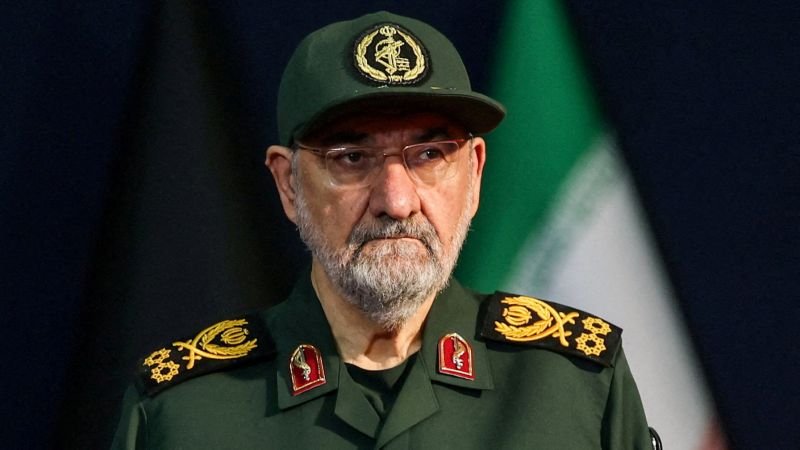
• Economic squeeze: Iran’s top security chief Mohsen Rezaei has vowed to “neutralize the economic war” with the US ahead of ramped-up sanctions on Tehran that the Trump administration is expected to detail Monday.
• Hormuz threat: Rezeai also threatened to halt oil flow out of the Strait of Hormuz should any neighboring countries join the US’ economic crackdown. Some oil companies have developed new tactics to enable their tankers to pass undetected through the waterway.
• Fractures in Tehran: However, there are signs of growing differences within the Iranian leadership. President Masoud Pezeshkian said Tehran “cannot continue with war forever” and he defended the agreement reached with the US in June, despite the supreme leader’s purported misgivings.
16 Posts
Iran “cannot continue with war forever,” its president, Masoud Pezeshkian, has said amid signs of growing differences within the Iranian leadership over negotiations with the United States.
During two appearances in Tehran on Sunday, Pezeshkian defended the memorandum of understanding that Iran reached with the United States in June, despite the purported misgivings of Iran’s Supreme Leader Mojtaba Khamenei.
“One day, a decision must be made to save the country from the state of ‘neither war nor peace’,” Pezeshkian said.
Pezeshkian said that all those who were directly involved in the negotiations believed that the memorandum was the best way forward.
“By implementing this memorandum, we can resolve the problems with logic and dignity,” he said, in remarks reported by state news agency IRNA.
The agreement collapsed last month.
The Iranian president has frequently warned of the economic and social consequences of the conflict with the United States, sometimes putting him at odds with more hardline figures in the leadership.
“We must stand with the people. If we cannot serve them and convince them that we all belong to the same land and country, then even if we possess the greatest military power, we will be defeated,” he said Sunday.
The government was trying with all its strength to “steer inflation, public problems, people’s livelihoods, people’s jobs, people’s future, and people’s lives towards dignity and pride.”
Pezeshkian was joined during one appearance by Ayatollah Seyyed Hassan Khomeini, grandson of Ruhollah Khomeini, the founder of the Islamic Republic.
“Sometimes, a wise compromise can achieve more than hundreds of wars,” Khomeini said.
Commentators see a growing debate among the leadership on how to handle the conflict with the United States, with some implying that Iran should now negotiate from a position of strength before its economic crisis worsens further – and hardliners in the security apparatus continuing to reject dialogue.
One of the most powerful figures in Iran has said that the US’ campaign of maximum economic pressure will fail.
Iran’s Supreme National Security Council head Mohsin Rezaei also warned Iran’s neighbors during an interview with Iranian state media that cooperation with the US will prompt Iran to “target their interests.”
If you’re just joining us, here’s the latest:
Rezaei further threatened Iran would “not allow a single drop of oil” to flow through the Strait of Hormuz if US collaboration is actioned.
Pakistan’s Field Marshal Asim Munir will visit Tehran tomorrow and is expected to hold talks with senior Iranian officials, state media reported.
Iranian President Masoud Pezeshkian said his country is in a “full-scale war,” acknowledging economic difficulties as a ramp up of US sanctions looms.
And UK energy companies are on alert after hackers believed to be affiliated with the Iranian regime temporarily shut down a small-scale energy generator last month.
CNN’s Tim Lister, Aida Karimi, Laura Sharman, Xiaoqian Lin and Eyad Kourdi contributed reporting.
An Iranian news site has released undated footage of Supreme Leader Mojtaba Khamenei, who has not been seen in public since he was appointed to the role following his father’s death earlier this year.
The short clip of what is likely archive footage released by the Rokna news site shows Mojtaba sitting at a table, reviewing documents and appearing to engage in conversation. It’s unclear who he is speaking to.
Earlier this month, Iranian state media shared another undated video of Mojtaba giving a religious lesson to a group of men, apparently taken before the war.
Iran has released statements attributed to Mojtaba, but the leader’s absence from public life has raised questions about his health and physical condition.
It is understood that he sustained serious injuries in the US-Israeli attack that killed his father and predecessor Ali Khamenei at the beginning of the conflict. Speculation about the extent of Mojtaba’s injuries was further fuelled by his apparent absence from his father’s funeral events last month.
Iran has insisted that security considerations are the primary reason for Mojtaba’s failure to appear publicly.
British energy companies are on alert after hackers believed to be affiliated with the Iranian regime temporarily shut down a small-scale energy generator last month, The Sunday Telegraph reported.
The plant, which has not been identified for security reasons, was forced to close for four days because of the infiltration, the report said.
Britain’s Department for Energy Security and Net Zero has written to energy companies with advice in response to the attack.
On Sunday, a government spokesperson said Britain’s energy system was “highly resilient” and stressed the attack had posed no threat to the wider system.
Iran has long been accused of carrying out cyber-attacks that have caused power outages and breached sensitive government data globally, including by Turkey in 2015, and Israel in 2022.
The head of Britain’s National Cyber Security Centre revealed earlier this year that three-quarters of cyber-attacks on critical infrastructure could be traced back to hostile state actors.
More now from the head of Iran’s Supreme National Security Council, Mohsin Rezaei, in his interview with Iranian state media.
Rezaei had an uncompromising message for Iran’s neighbors.
“If they start such an action, we will not allow a single drop of oil to pass through the Persian Gulf.”
He also threatened that Iran would target alternative routes used to export oil from the Gulf. Saudi Arabia and the United Arab Emirates have expanded such routes to export their oil via ports in the Red Sea and Gulf of Oman.
Rezaei has essentially presented an ultimatum to the Gulf states that participation in US economic pressure could increasingly be treated by Tehran as part of the broader confrontation, according to analyst Hamidreza Azizi at the Clingendael Institute in the Netherlands.
“There appear to be two distinct elements to the emerging doctrine: preemption, aimed at preventing a perceived threat from materializing; and disproportionate retaliation, aimed at raising the cost of any attack that does occur,” Azizi noted in a post on X.
Azizi also hinted at different approaches being taken within Iran to the increasing US pressure and Trump’s economic warfare.
One of the most powerful figures in Iran has said that the US campaign of maximum economic pressure will fail — in a further sign that Iran’s hardline leadership is unwilling to compromise despite a deepening economic crisis.
Rezaei’s remarks are another indication of the control exerted by Tehran’s hardliners and their growing readiness to adopt a more offensive posture.
“We will see changes in the conduct of the war, in diplomacy, and in political and social affairs, and new capabilities will be brought into play,” he added.
Rezaei, who is an adviser to Iran’s supreme leader, Mojtaba Khamanei, said Iran will not yield to US pressure, adding the Strait of Hormuz will remain closed until Washington meets its commitments.
Shipping data suggests that more crude oil is leaving the Gulf via a southern route close to the coast with Oman, a threat to the leverage Iran has exercised in recent months.
Rezaei was a senior commander during the war with Iraq in the 1980s — a foundational moment in the creation of the Islamic Republic. He was named as the new security chief this month in what was seen as a shift to a more aggressive approach to that under the late supreme leader.
In his comments, the most substantial since taking on the new role, Rezaei also claimed the US’ attack on Iran had encouraged countries to seek protection by acquiring nuclear weapons.
Around 35 million years ago, the Arabian tectonic plate began colliding with its Eurasian counterpart.
This caused the prehistoric Tethys Ocean, which once separated the supercontinents of Laurasia and Gondwana, to shrink.
Laurasia would later morph into North America, Europe and parts of Asia, while Gondwana fragmented into South America, Africa, Antarctica, Australia and India.
But the ancient sea did not disappear entirely, for a remnant of it survives today, in the form of the Strait of Hormuz.
Experts say the geological process that created the critical waterway — the flashpoint in the US’ war with Iran – is the very same process which gave the region its oil riches in the first place.
According to National Geographic, as the Arabian plate began to move further under the Eurasian plate, the two plates crumpled together, creating the Zagros Mountains — an impressive stretch of peaks that still exist in Iran. The weight of these mountains depressed part of the Arabian plate, causing the strait to form.
For hundreds of millions of years before the Arabian plate collided into Eurasia, it sat below sea level, providing the perfect environment for crude oil to form, according to National Geographic.
That is because when animals and plants in marine environments die, their remains fall to the bottom of the seabed, slotting between layers of silt and sand. Then, over millions of years and under intense heat and pressure, these remains morph into what we call crude oil.
“You can have the most powerful military the world has ever seen but standing in its way will be nature,” said Tim Marshall, author of best-selling book “Prisoners of Geography,” testifying to the strategic importance of the strait.
“No wonder the Assyrians called the Persian Gulf ‘The Bitter Sea’,” he wrote in March.
As we’ve been reporting, Iran’s security chief has threatened to halt oil flow out of the Strait of Hormuz, according to state-affiliated Press TV.
Mohsen Rezaei, the secretary of Iran’s Supreme National Security Council, threatened to shut down all traffic through the critical waterway should any neighboring countries enter the US’ expected economic crackdown.
A narrow waterway that bypasses Iran and Oman, the Strait of Hormuz is the main route for shipping crude from oil-rich countries such as Saudi Arabia and Kuwait to the rest of the world.
The strait has remained a major flashpoint since it was effectively closed by Tehran following airstrikes by the US and Israel on February 28.
Iran controls the strait’s northern side. About 20 million barrels of oil, or about one-fifth of daily global production, used to flow through the strait every day, according to the US Energy Information Administration, which calls the channel a “critical oil chokepoint.”
The strait also carries about one-fifth of global trade in liquefied natural gas, largely from Qatar. Some producers, including Saudi Arabia and the United Arab Emirates, have found alternative routes for their exports.
Pakistan’s Field Marshal Asim Munir will visit Tehran on Monday, according to Iranian state-run Islamic Republic News Agency (IRNA), which cited Iran’s Foreign Ministry spokesperson Esmaeil Baghaei.
Munir is expected to hold talks with senior Iranian officials on bilateral cooperation and diplomatic efforts for peace and security in the region, reported IRNA.
CNN has reached out to the Pakistani army for comment.
Some context: Pakistan has emerged as a key mediator between Tehran and Washington during the conflict, relaying respective peace proposals and counterproposals between the two warring parties.
Munir — who US President Donald Trump has called his “favorite field marshal” — led Pakistan’s mediation efforts.
Iran’s President Masoud Pezeshkian said the country is in a “full-scale war” and acknowledged the country’s economic difficulties as the US prepares to ramp up sanctions on it.
“We are apologetic that these problems exist, as we find ourselves in a full-scale economic, military, and security war,” Iranian state media IRNA reported Pezeshkian as saying on Sunday.
“As the government, we are seeking with all our being to steer inflation, public problems, people’s livelihoods, people’s jobs, people’s future, and people’s lives towards dignity and pride,” he added.
Iran, already drained by years of sanctions and grappling with the strains of war, is now facing another test as US President Donald Trump threatens to further squeeze its economy. Treasury Secretary Scott Bessent earlier pledged economic measures that have “never been seen” against Tehran.
US Treasury Secretary Scott Bessent will hold a news conference Monday after pledging to apply measures that have “never been seen” on Iran. And US President Donald Trump has threatened an “economic D-Day” against Iran.
The US has been imposing sanctions on Iran since 1979, after the US embassy in Tehran was seized following the Iranian Revolution, according to the US State Department.
A Congressional Research Service (CRS) report on US sanctions on Iran says they were used to “deter, constrain, and encourage change in the adversarial behavior of the Iranian regime.”
“US sanctions on Iran are arguably the most extensive and comprehensive set of sanctions that the United States maintains on any country,” the report says.
The financial penalties are wide-ranging, banning nearly all US trade with Iran, blocking Iranian government assets in the country and prohibiting foreign assistance and arms sales, the report outlines.
In 2013, the Department of the Treasury’s Office of Foreign Assets Control said that the US could sell food, medicine, and medical devices to Iran.
According to the CRS report, the US is also allowed to provide telecommunications equipment to Iranians to help them circumvent the Iranian regime’s attempts at cutting off internet access.
A cultural faultline in Iran has re-emerged in recent months amid the turmoil of war and the revamping of the country’s hardline leadership: how and whether to enforce the wearing of the hijab by women.
At the height of the conflict with the United States this year, women without the headscarf were often seen at pro-government gatherings and in state media. The government and internal security forces had bigger issues to deal with.
In one video an unveiled woman carrying an Iranian flag said her husband was in the military, and that she was proud of him.
But in recent weeks, the clamor for restoring a hard line on what conservative clerics and politicians call “public nudity” has grown.
Many Iranian women are openly flouting the rule – and authorities seem wary of launching a crackdown, for now. The regime appears to have more pressing priorities – presenting the conflict with the United States as an existential struggle, managing the deep economic fall-out and reorganizing the security apparatus under the leadership of Mojtaba Khamenei.
As the war with Iran drags on, the US has been increasingly threatening economic tactics to exert pressure on Tehran. US Treasury Secretary Scott Bessent pledged economic measures that have “never been seen” last week and President Donald Trump promised an “ECONOMIC D-DAY.”
The US has been employing sanctions against Iran for almost 50 years, and it’s not clear what measures Trump and Bessent might take. Trump made contradictory statements about the status of talks earlier in the week, and the status of negotiations remains unclear.
Catch up on the state of the war here:
Trump threatens economic pain: The president said on Truth Social this week that the US would begin “the MOST CRUSHING ECONOMIC OPERATION EVER TAKEN AGAINST ANY COUNTRY” but did not offer further details about what measures an operation would entail. Trump also said there would be economic consequences for any “country that allows its financial institutions, businesses, airports, or government entities to provide any type of lifeline to Iran.”
Iran pushes back: Top national security chief Mohsen Rezaei has vowed to “neutralize the economic war” and threatened to halt oil flow through the Strait of Hormuz. A close ally of Iran’s supreme leader said Trump’s recent rhetoric stems from “desperation”, Iranian semi-official media reported.
Bessent to hold news conference: US Treasury Secretary Scott Bessent is scheduled to hold a news conference at 2 p.m. ET on Monday as the Trump administration ramps up its economic threats against Tehran.
Prices in the US: The war is also putting economic pressure on the US, but Trump dismissed those effects, calling the conflict “a little detour” as he blamed inflation on Democrats and promised gas prices will soon come down.
Latest in the strait: Iran has granted permission to a number of Iraqi oil tankers to pass through the Strait of Hormuz, the Reuters news agency reported today, citing the Iranian state-run Islamic Republic News Agency. Shipping traffic through the strait remains well below pre-war levels, but the number of ships crossing the strait rose 27% in the past week, according to a CNN analysis.
CNN’s Laura Sharman, Xiaoqian Lin, Betsy Klein, Adam Pourahmadi, Catherine Nicholls, Billy Stockwell and Valey Arya contributed reporting.
Tehran’s security chief vowed to “neutralize the economic war” with the United States and threatened to halt oil flow out of the Strait of Hormuz, Iran’s state-affiliated Press TV reported.
Iran is allowing a number of Iraqi oil tankers to pass through the Strait of Hormuz, in the latest example of Tehran granting selective access to the vital waterway.
However, Rezaei, the secretary of Iran’s Supreme National Security Council, threatened to shut down all traffic if any of Iran’s neighboring countries enter President Donald Trump’s economic war.
Rezaei said Iran has shipped 70 million barrels of oil “in the past one or two months alone,” suggesting that was despite the US blockade of Iranian ports that resumed in mid July.
Meanwhile, the US Department of Energy said oil traffic through the Strait of Hormuz has averaged between 8 million and 9 million barrels per day as ships attempt “dark transits” through the waterway.
Aided by the US Navy, oil companies have chartered tankers to turn their transponders off and shuttle oil out of the Persian Gulf, through the Strait of Hormuz, to the Gulf of Oman, where they offload their crude to waiting tankers owned by their customers and then head back through the strait.
Oil tankers have developed new tactics for passing through the Strait of Hormuz. Greek-owned supertanker Kiku has been seen going dark, turning off its AIS transponders and traveling at night to go undetected. Watch CNN’s David Goldman explain more in the video below:
US President Donald Trump on Friday described the war with Iran as “a little detour,” as he blamed inflation on Democrats and promised gas prices will soon come down.
Speaking at Sen. Darline Graham’s campaign rally in South Carolina, he said: “Look, it’s a Friday night. We have plenty of time, right? What the hell do I have to do? Go back, bomb Iran a little bit more?”
The national average gas price is up nearly $1 from a year ago.
Refineries are facing a perfect storm of war and export restrictions, which is limiting how much crude oil they can turn into gasoline, jet fuel and diesel for the global economy.
Trump also said he views the Strait of Hormuz as an “American territory.”
He has previously said he plans to declare the Strait of Hormuz a US territory after “we finish defeating Iran,” adding that would happen “pretty soon.”
• Economic squeeze: Iran’s top security chief Mohsen Rezaei has vowed to “neutralize the economic war” with the US ahead of ramped-up sanctions on Tehran that the Trump administration is expected to detail Monday.
• Hormuz threat: Rezeai also threatened to halt oil flow out of the Strait of Hormuz should any neighboring countries join the US’ economic crackdown. Some oil companies have developed new tactics to enable their tankers to pass undetected through the waterway.
• Fractures in Tehran: However, there are signs of growing differences within the Iranian leadership. President Masoud Pezeshkian said Tehran “cannot continue with war forever” and he defended the agreement reached with the US in June, despite the supreme leader’s purported misgivings.
Iran “cannot continue with war forever,” its president, Masoud Pezeshkian, has said amid signs of growing differences within the Iranian leadership over negotiations with the United States.
During two appearances in Tehran on Sunday, Pezeshkian defended the memorandum of understanding that Iran reached with the United States in June, despite the purported misgivings of Iran’s Supreme Leader Mojtaba Khamenei.
“One day, a decision must be made to save the country from the state of ‘neither war nor peace’,” Pezeshkian said.
Pezeshkian said that all those who were directly involved in the negotiations believed that the memorandum was the best way forward.
“By implementing this memorandum, we can resolve the problems with logic and dignity,” he said, in remarks reported by state news agency IRNA.
The agreement collapsed last month.
The Iranian president has frequently warned of the economic and social consequences of the conflict with the United States, sometimes putting him at odds with more hardline figures in the leadership.
“We must stand with the people. If we cannot serve them and convince them that we all belong to the same land and country, then even if we possess the greatest military power, we will be defeated,” he said Sunday.
The government was trying with all its strength to “steer inflation, public problems, people’s livelihoods, people’s jobs, people’s future, and people’s lives towards dignity and pride.”
Pezeshkian was joined during one appearance by Ayatollah Seyyed Hassan Khomeini, grandson of Ruhollah Khomeini, the founder of the Islamic Republic.
“Sometimes, a wise compromise can achieve more than hundreds of wars,” Khomeini said.
Commentators see a growing debate among the leadership on how to handle the conflict with the United States, with some implying that Iran should now negotiate from a position of strength before its economic crisis worsens further – and hardliners in the security apparatus continuing to reject dialogue.
One of the most powerful figures in Iran has said that the US’ campaign of maximum economic pressure will fail.
Iran’s Supreme National Security Council head Mohsin Rezaei also warned Iran’s neighbors during an interview with Iranian state media that cooperation with the US will prompt Iran to “target their interests.”
If you’re just joining us, here’s the latest:
Rezaei further threatened Iran would “not allow a single drop of oil” to flow through the Strait of Hormuz if US collaboration is actioned.
Pakistan’s Field Marshal Asim Munir will visit Tehran tomorrow and is expected to hold talks with senior Iranian officials, state media reported.
Iranian President Masoud Pezeshkian said his country is in a “full-scale war,” acknowledging economic difficulties as a ramp up of US sanctions looms.
And UK energy companies are on alert after hackers believed to be affiliated with the Iranian regime temporarily shut down a small-scale energy generator last month.
CNN’s Tim Lister, Aida Karimi, Laura Sharman, Xiaoqian Lin and Eyad Kourdi contributed reporting.
An Iranian news site has released undated footage of Supreme Leader Mojtaba Khamenei, who has not been seen in public since he was appointed to the role following his father’s death earlier this year.
The short clip of what is likely archive footage released by the Rokna news site shows Mojtaba sitting at a table, reviewing documents and appearing to engage in conversation. It’s unclear who he is speaking to.
Earlier this month, Iranian state media shared another undated video of Mojtaba giving a religious lesson to a group of men, apparently taken before the war.
Iran has released statements attributed to Mojtaba, but the leader’s absence from public life has raised questions about his health and physical condition.
It is understood that he sustained serious injuries in the US-Israeli attack that killed his father and predecessor Ali Khamenei at the beginning of the conflict. Speculation about the extent of Mojtaba’s injuries was further fuelled by his apparent absence from his father’s funeral events last month.
Iran has insisted that security considerations are the primary reason for Mojtaba’s failure to appear publicly.
British energy companies are on alert after hackers believed to be affiliated with the Iranian regime temporarily shut down a small-scale energy generator last month, The Sunday Telegraph reported.
The plant, which has not been identified for security reasons, was forced to close for four days because of the infiltration, the report said.
Britain’s Department for Energy Security and Net Zero has written to energy companies with advice in response to the attack.
On Sunday, a government spokesperson said Britain’s energy system was “highly resilient” and stressed the attack had posed no threat to the wider system.
Iran has long been accused of carrying out cyber-attacks that have caused power outages and breached sensitive government data globally, including by Turkey in 2015, and Israel in 2022.
The head of Britain’s National Cyber Security Centre revealed earlier this year that three-quarters of cyber-attacks on critical infrastructure could be traced back to hostile state actors.
More now from the head of Iran’s Supreme National Security Council, Mohsin Rezaei, in his interview with Iranian state media.
Rezaei had an uncompromising message for Iran’s neighbors.
“If they start such an action, we will not allow a single drop of oil to pass through the Persian Gulf.”
He also threatened that Iran would target alternative routes used to export oil from the Gulf. Saudi Arabia and the United Arab Emirates have expanded such routes to export their oil via ports in the Red Sea and Gulf of Oman.
Rezaei has essentially presented an ultimatum to the Gulf states that participation in US economic pressure could increasingly be treated by Tehran as part of the broader confrontation, according to analyst Hamidreza Azizi at the Clingendael Institute in the Netherlands.
“There appear to be two distinct elements to the emerging doctrine: preemption, aimed at preventing a perceived threat from materializing; and disproportionate retaliation, aimed at raising the cost of any attack that does occur,” Azizi noted in a post on X.
Azizi also hinted at different approaches being taken within Iran to the increasing US pressure and Trump’s economic warfare.
One of the most powerful figures in Iran has said that the US campaign of maximum economic pressure will fail — in a further sign that Iran’s hardline leadership is unwilling to compromise despite a deepening economic crisis.
Rezaei’s remarks are another indication of the control exerted by Tehran’s hardliners and their growing readiness to adopt a more offensive posture.
“We will see changes in the conduct of the war, in diplomacy, and in political and social affairs, and new capabilities will be brought into play,” he added.
Rezaei, who is an adviser to Iran’s supreme leader, Mojtaba Khamanei, said Iran will not yield to US pressure, adding the Strait of Hormuz will remain closed until Washington meets its commitments.
Shipping data suggests that more crude oil is leaving the Gulf via a southern route close to the coast with Oman, a threat to the leverage Iran has exercised in recent months.
Rezaei was a senior commander during the war with Iraq in the 1980s — a foundational moment in the creation of the Islamic Republic. He was named as the new security chief this month in what was seen as a shift to a more aggressive approach to that under the late supreme leader.
In his comments, the most substantial since taking on the new role, Rezaei also claimed the US’ attack on Iran had encouraged countries to seek protection by acquiring nuclear weapons.
Around 35 million years ago, the Arabian tectonic plate began colliding with its Eurasian counterpart.
This caused the prehistoric Tethys Ocean, which once separated the supercontinents of Laurasia and Gondwana, to shrink.
Laurasia would later morph into North America, Europe and parts of Asia, while Gondwana fragmented into South America, Africa, Antarctica, Australia and India.
But the ancient sea did not disappear entirely, for a remnant of it survives today, in the form of the Strait of Hormuz.
Experts say the geological process that created the critical waterway — the flashpoint in the US’ war with Iran – is the very same process which gave the region its oil riches in the first place.
According to National Geographic, as the Arabian plate began to move further under the Eurasian plate, the two plates crumpled together, creating the Zagros Mountains — an impressive stretch of peaks that still exist in Iran. The weight of these mountains depressed part of the Arabian plate, causing the strait to form.
For hundreds of millions of years before the Arabian plate collided into Eurasia, it sat below sea level, providing the perfect environment for crude oil to form, according to National Geographic.
That is because when animals and plants in marine environments die, their remains fall to the bottom of the seabed, slotting between layers of silt and sand. Then, over millions of years and under intense heat and pressure, these remains morph into what we call crude oil.
“You can have the most powerful military the world has ever seen but standing in its way will be nature,” said Tim Marshall, author of best-selling book “Prisoners of Geography,” testifying to the strategic importance of the strait.
“No wonder the Assyrians called the Persian Gulf ‘The Bitter Sea’,” he wrote in March.
As we’ve been reporting, Iran’s security chief has threatened to halt oil flow out of the Strait of Hormuz, according to state-affiliated Press TV.
Mohsen Rezaei, the secretary of Iran’s Supreme National Security Council, threatened to shut down all traffic through the critical waterway should any neighboring countries enter the US’ expected economic crackdown.
A narrow waterway that bypasses Iran and Oman, the Strait of Hormuz is the main route for shipping crude from oil-rich countries such as Saudi Arabia and Kuwait to the rest of the world.
The strait has remained a major flashpoint since it was effectively closed by Tehran following airstrikes by the US and Israel on February 28.
Iran controls the strait’s northern side. About 20 million barrels of oil, or about one-fifth of daily global production, used to flow through the strait every day, according to the US Energy Information Administration, which calls the channel a “critical oil chokepoint.”
The strait also carries about one-fifth of global trade in liquefied natural gas, largely from Qatar. Some producers, including Saudi Arabia and the United Arab Emirates, have found alternative routes for their exports.
Pakistan’s Field Marshal Asim Munir will visit Tehran on Monday, according to Iranian state-run Islamic Republic News Agency (IRNA), which cited Iran’s Foreign Ministry spokesperson Esmaeil Baghaei.
Munir is expected to hold talks with senior Iranian officials on bilateral cooperation and diplomatic efforts for peace and security in the region, reported IRNA.
CNN has reached out to the Pakistani army for comment.
Some context: Pakistan has emerged as a key mediator between Tehran and Washington during the conflict, relaying respective peace proposals and counterproposals between the two warring parties.
Munir — who US President Donald Trump has called his “favorite field marshal” — led Pakistan’s mediation efforts.
Iran’s President Masoud Pezeshkian said the country is in a “full-scale war” and acknowledged the country’s economic difficulties as the US prepares to ramp up sanctions on it.
“We are apologetic that these problems exist, as we find ourselves in a full-scale economic, military, and security war,” Iranian state media IRNA reported Pezeshkian as saying on Sunday.
“As the government, we are seeking with all our being to steer inflation, public problems, people’s livelihoods, people’s jobs, people’s future, and people’s lives towards dignity and pride,” he added.
Iran, already drained by years of sanctions and grappling with the strains of war, is now facing another test as US President Donald Trump threatens to further squeeze its economy. Treasury Secretary Scott Bessent earlier pledged economic measures that have “never been seen” against Tehran.
US Treasury Secretary Scott Bessent will hold a news conference Monday after pledging to apply measures that have “never been seen” on Iran. And US President Donald Trump has threatened an “economic D-Day” against Iran.
The US has been imposing sanctions on Iran since 1979, after the US embassy in Tehran was seized following the Iranian Revolution, according to the US State Department.
A Congressional Research Service (CRS) report on US sanctions on Iran says they were used to “deter, constrain, and encourage change in the adversarial behavior of the Iranian regime.”
“US sanctions on Iran are arguably the most extensive and comprehensive set of sanctions that the United States maintains on any country,” the report says.
The financial penalties are wide-ranging, banning nearly all US trade with Iran, blocking Iranian government assets in the country and prohibiting foreign assistance and arms sales, the report outlines.
In 2013, the Department of the Treasury’s Office of Foreign Assets Control said that the US could sell food, medicine, and medical devices to Iran.
According to the CRS report, the US is also allowed to provide telecommunications equipment to Iranians to help them circumvent the Iranian regime’s attempts at cutting off internet access.
A cultural faultline in Iran has re-emerged in recent months amid the turmoil of war and the revamping of the country’s hardline leadership: how and whether to enforce the wearing of the hijab by women.
At the height of the conflict with the United States this year, women without the headscarf were often seen at pro-government gatherings and in state media. The government and internal security forces had bigger issues to deal with.
In one video an unveiled woman carrying an Iranian flag said her husband was in the military, and that she was proud of him.
But in recent weeks, the clamor for restoring a hard line on what conservative clerics and politicians call “public nudity” has grown.
Many Iranian women are openly flouting the rule – and authorities seem wary of launching a crackdown, for now. The regime appears to have more pressing priorities – presenting the conflict with the United States as an existential struggle, managing the deep economic fall-out and reorganizing the security apparatus under the leadership of Mojtaba Khamenei.
As the war with Iran drags on, the US has been increasingly threatening economic tactics to exert pressure on Tehran. US Treasury Secretary Scott Bessent pledged economic measures that have “never been seen” last week and President Donald Trump promised an “ECONOMIC D-DAY.”
The US has been employing sanctions against Iran for almost 50 years, and it’s not clear what measures Trump and Bessent might take. Trump made contradictory statements about the status of talks earlier in the week, and the status of negotiations remains unclear.
Catch up on the state of the war here:
Trump threatens economic pain: The president said on Truth Social this week that the US would begin “the MOST CRUSHING ECONOMIC OPERATION EVER TAKEN AGAINST ANY COUNTRY” but did not offer further details about what measures an operation would entail. Trump also said there would be economic consequences for any “country that allows its financial institutions, businesses, airports, or government entities to provide any type of lifeline to Iran.”
Iran pushes back: Top national security chief Mohsen Rezaei has vowed to “neutralize the economic war” and threatened to halt oil flow through the Strait of Hormuz. A close ally of Iran’s supreme leader said Trump’s recent rhetoric stems from “desperation”, Iranian semi-official media reported.
Bessent to hold news conference: US Treasury Secretary Scott Bessent is scheduled to hold a news conference at 2 p.m. ET on Monday as the Trump administration ramps up its economic threats against Tehran.
Prices in the US: The war is also putting economic pressure on the US, but Trump dismissed those effects, calling the conflict “a little detour” as he blamed inflation on Democrats and promised gas prices will soon come down.
Latest in the strait: Iran has granted permission to a number of Iraqi oil tankers to pass through the Strait of Hormuz, the Reuters news agency reported today, citing the Iranian state-run Islamic Republic News Agency. Shipping traffic through the strait remains well below pre-war levels, but the number of ships crossing the strait rose 27% in the past week, according to a CNN analysis.
CNN’s Laura Sharman, Xiaoqian Lin, Betsy Klein, Adam Pourahmadi, Catherine Nicholls, Billy Stockwell and Valey Arya contributed reporting.
Tehran’s security chief vowed to “neutralize the economic war” with the United States and threatened to halt oil flow out of the Strait of Hormuz, Iran’s state-affiliated Press TV reported.
Iran is allowing a number of Iraqi oil tankers to pass through the Strait of Hormuz, in the latest example of Tehran granting selective access to the vital waterway.
However, Rezaei, the secretary of Iran’s Supreme National Security Council, threatened to shut down all traffic if any of Iran’s neighboring countries enter President Donald Trump’s economic war.
Rezaei said Iran has shipped 70 million barrels of oil “in the past one or two months alone,” suggesting that was despite the US blockade of Iranian ports that resumed in mid July.
Meanwhile, the US Department of Energy said oil traffic through the Strait of Hormuz has averaged between 8 million and 9 million barrels per day as ships attempt “dark transits” through the waterway.
Aided by the US Navy, oil companies have chartered tankers to turn their transponders off and shuttle oil out of the Persian Gulf, through the Strait of Hormuz, to the Gulf of Oman, where they offload their crude to waiting tankers owned by their customers and then head back through the strait.
Oil tankers have developed new tactics for passing through the Strait of Hormuz. Greek-owned supertanker Kiku has been seen going dark, turning off its AIS transponders and traveling at night to go undetected. Watch CNN’s David Goldman explain more in the video below:
US President Donald Trump on Friday described the war with Iran as “a little detour,” as he blamed inflation on Democrats and promised gas prices will soon come down.
Speaking at Sen. Darline Graham’s campaign rally in South Carolina, he said: “Look, it’s a Friday night. We have plenty of time, right? What the hell do I have to do? Go back, bomb Iran a little bit more?”
The national average gas price is up nearly $1 from a year ago.
Refineries are facing a perfect storm of war and export restrictions, which is limiting how much crude oil they can turn into gasoline, jet fuel and diesel for the global economy.
Trump also said he views the Strait of Hormuz as an “American territory.”
He has previously said he plans to declare the Strait of Hormuz a US territory after “we finish defeating Iran,” adding that would happen “pretty soon.”



Responses