
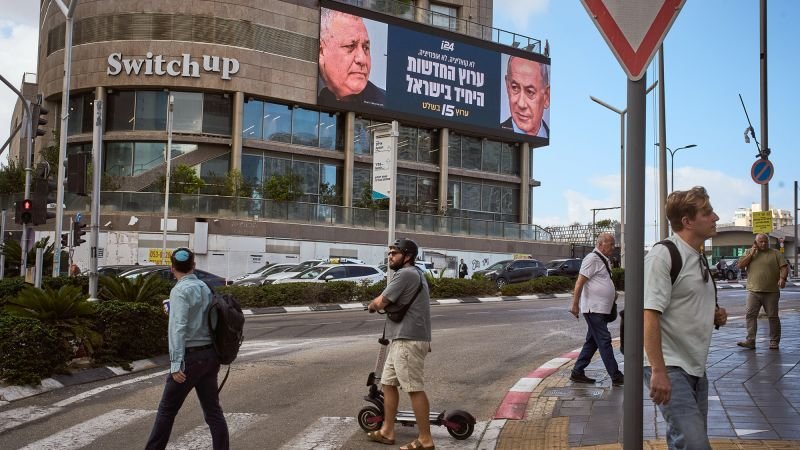
• Voting is underway in an election seen as one of the most important in Israel’s history and a referendum on Prime Minister Benjamin Netanyahu’s leadership since the October 7, 2023 attacks.
• Opinion polls suggest the race will be too close to call, likely failing to produce a clear winner. The latest polling shows Netanyahu in a tight race against Gadi Eisenkot, a former military chief.
• No single party has ever won a 61-seat majority in Israel’s 120-member parliament, or Knesset. Instead, governments are formed through alliances, which can take weeks or even months to form.
Updates
(10)
Israeli Prime Minister Benjamin Netanyahu – leader of the Likud party – and his wife Sara Netanyahu just cast their votes at a polling station in Jerusalem. Already Israel’s longest-serving prime minister, Netanyahu is running for a record seventh term.
“It’s a very moving and fateful moment. My wife and I are impressed. … We really know what’s on the line, and because I can’t say things explicitly, I will say vote correctly,” Netanyahu said on Tuesday as he placed his vote in the ballot box. “That’s what we’re doing for the future of the State of Israel.”
Israel’s election is set to be a test of Prime Minister Benjamin Netanyahu’s leadership and of his ability to form a coalition, a professor on Israel studies told CNN.
“The key to his political longevity is that he is the master of coalition making and putting together a coalition, which can be a very complicated process. He’s shown time and again, even when he’s actually not received the largest number of seats in the parliament, he’s still been able to end up as prime minister,” said Dov Waxman, director of the UCLA Y&S Nazarian Center for Israel Studies.
For many voters, the election is a chance to make a decision who should lead the country in conflict and demand accountability over October 7 security and intelligence failures
“Although this is in many ways a referendum on Netanyahu’s leadership, Israelis aren’t actually voting for or against Netanyahu or for his main rival,” Waxman told CNN’s Elex Michaelson.
Israel’s far-right Finance Minister Bezalel Smotrich, leader of the Religious Zionist Party, has just cast his vote at a polling station in Kedumim settlement, in the occupied West Bank.
Far-right National Security Minister Itamar Ben Gvir, chairman of the ultranationalist Otzma Yehudit party, also just voted in the occupied West Bank settlement of Kiryat Arba.
Smotrich and Ben Gvir – both key members of Prime Minister Benjamin Netanyahu’s government – have drawn intense international scrutiny for their far-right policies in relation to Palestinians and Arab citizens. Both leaders have made the push to rebuild Jewish settlements in Gaza and the expansion of settlements in the occupied West Bank into central issues of their campaign.
CNN’s Tal Shalev contributed to this post.
Benjamin Netanyahu has already secured his record in Israeli political history: He is the longest-serving prime minister, notching up roughly 19 years across three periods in office.
In 2019, he surpassed David Ben Gurion, Israel’s founding prime minister, who was in office 13 years and 127 days.
Netanyahu, now 77, was 46 when he first became prime minister in 1996. He held the post for three years before losing power and spending a decade out of office.
In 2009 he made his first comeback, returning to the premiership for 12 consecutive years. In 2021, Naftali Bennett and Yair Lapid succeeded in assembling an alternative governing coalition, but it collapsed after barely a year. Bennett served for one year and 17 days, and Lapid succeeded him for just 181 days, making them the two shortest-serving prime ministers in Israel’s history.
After a brief period in the opposition, Netanyahu made his second comeback, returning to power in December 2022 for his sixth term. His outgoing government also set a record, becoming the first Israeli government to conclude its full term in almost 40 years.
Netanyahu carries another historic distinction. He is the first sitting Israeli prime minister to stand trial for corruption while in office, a legal saga that has shaped his political alliances over the past decade and increased his reliance on far-right and ultra-Orthodox partners, with whom he formed his last coalition.
As Netanyahu seeks a seventh term, the election is once again a referendum on his leadership, but this time he also bears another historic burden. Netanyahu was the sitting prime minister on October 7, 2023, the date of the deadliest security failure in Israel’s history. He is the only top Israeli official who served that day to remain in office.
This election will determine if Netanyahu extends his record-setting tenure, or if another chapter in Israel’s political history begins.
In the first few hours of voting in Israel’s election, voter turnout is the highest it has been in 45 years, according to the country’s Central Elections Committee.
As of 10 a.m. local time, voter turnout stood at 16.68%, the committee said, higher than the turnout at the same hour four years ago, which was 15.9%. It is the highest voter turnout since 1981, the committee said at a morning press conference.
Ofer Kenig, a research fellow at the Israel Democracy Institute, said it showed that Israelis clearly viewed the elections as a pivotal moment, even as he warned it was still too early to draw broad conclusions.
“I think it’s a sign of enthusiasm, of the perception of many Israelis of very significant elections – very crucial elections, Kenig told CNN. But he also urged caution, since the turnout wasn’t dramatically higher yet than the previous election.
“Let’s see how it will develop during the day.”
Even so, far-right Finance Minister Bezalel Smotrich tried to use the figure to drive his own voter base. In a post on X, he claimed, “The high voter turnout figure is a result of exceptional turnout rates in the Arab sector and in left-wing strongholds.”
Outside a polling station in the Jerusalem neighborhood of Katamon, signs for a diverse spectrum of parties decorated the street. From the far-right party of Finance Minister Bezalel Smotrich to the left-wing party of Yair Golan, campaign activists pitched voters one last time before they entered the polling place early Tuesday morning.
Israelis last voted in an election in November 2022 and viewed this as a critical chance to decide the future direction of the country.
“We are a Zionist family who loves the country, and we want as quickly as possible to exercise the right to vote and to feel that we are part of this whole country and are doing good,” Gabi Touboul told CNN.
Shirel, who voted early to avoid the lines said: “We are taking advantage of this day because my daughters came from the corners of the country to make a change, amen!”
At a polling place near the entrance to Jerusalem, signs for Gadi Eisenkot covered fences in the area. As of Tuesday morning, only the far-right Noam party – which polls show is not expected to qualify for the Knesset – also had signs there.
Adam Maayan voted at the polling site early “in order to make a change,” he told CNN.
Family members of those killed and taken hostage on October 7 in 2023 gathered at Hostages Square in Tel Aviv for a minute of silence at 6.29 a.m, marking the moment when Hamas-led gunmen began the attack.
The families, in a statement, reiterated their demand for a state commission of inquiry on the attack and also called on Israelis to “remember the loved ones they lost and to carry their memory” when casting their ballots.
Her daughter Mappel Adam was killed at the Nova music festival, she said.
“Vote responsibility. Vote state commission of inquiry. Vote change. Vote hope.”
In Israel, security and accountability are powerful electoral forces after years of war. But opinion polls suggest the cost of living is also a leading concern for many voters — particularly for younger ones.
According to the latest Channel 12 poll, 21% of Israelis rank the economy and the cost of living as their top priority in the election — ahead of ultra-Orthodox conscription with 17%, the October 7, 2023, security failure at 14% and the war with Iran at 10%.
Despite these figures, the economy has not been a central theme in the campaign — until this weekend, when Netanyahu moved it to the top of the agenda. In an interview with Channel 10 focused on the economy, Netanyahu said Israel should prepare for possible international banking sanctions over Israeli settlements in the West Bank by developing “an economy that can circumvent them.” He said cryptocurrency and blockchain are being considered and that he has requested a plan to deal with it.
The Bank of Israel publicly rejected the idea, saying that “cryptocurrencies cannot serve as a means of circumventing sanctions.”
Netanyahu’s main rivals portrayed his proposal as evidence he expects Israel to become more isolated. Opposition candidate Gadi Eisenkot, who mocked the idea as “BibiCoin,” called it a “threat to national security,” accusing Netanyahu of planning to “dismantle the Israeli economy for generations ahead.”
Israeli Prime Minister Benjamin Netanyahu’s principal opponent in Tuesday’s elections is a relative newcomer to politics. Instead, one of his key electoral advantages boils down to a simple truth: He is not Netanyahu.
Gadi Eisenkot, 66, has spent most of his life in the Israeli military, enlisting in the Golani Brigade in 1978 and rising over a 40-year career to become chief of staff from 2015 to 2019, serving under Netanyahu.
He entered politics in 2022 alongside another former chief of staff, Benny Gantz. After the October 7, 2023, Hamas-led attack on Israel, the two joined Netanyahu’s emergency war cabinet. But they left in June 2024, pointing to the absence of a clear post-war strategy.
Eisenkot is the second of nine children and a father of five. His youngest son, Gal, 25, was killed fighting in Gaza two months into the war.
He has placed that singular promise at the heart of his political mission.
You can read more about the opposition’s strongest candidate here.
Voting has begun in one of Israel’s most significant elections in its history.
Voters are facing a familiar question: Should Benjamin Netanyahu, Israel’s longest-serving prime minister, stay in power?
Nearly every recent election has been a referendum on Netanyahu. This time, many Israelis say the choice is more consequential than ever: not only about who will lead the country, but about where it is heading.
It is the first national vote since the Hamas-led attack of October 7, 2023, the deadliest security failure in Israel’s history, and the wars that followed in Gaza, Lebanon and Iran — conflicts that have mobilized much of the country and subsequently deepened Israel’s international isolation.
For many voters, this is the first chance to pass judgment on the leadership that presided over October 7 failures, and decide who should lead the country in conflict and carry the burden of increased military service.
Netanyahu’s outgoing government — the first in decades to conclude a full four-year term — relied on far-right and ultra-Orthodox partners, who pushed Israel in a more nationalist and religious direction than ever before. He became the first sitting Israeli prime minister to stand trial on corruption charges as his government pursued a judicial overhaul aimed at weakening the Supreme Court and other checks on power. The overhaul effort sparked massive protests in 2023.
At stake in Tuesday’s election is whether Israel keeps moving in the nationalistic, conservative and religious direction — or changes course.
The answer might not be clear for weeks, because of the way Israeli coalitions are built. Polls suggest neither Netanyahu’s bloc nor the opposition is likely to win a majority alone, meaning the vote may launch Israel’s next political crisis rather than settle it.
• Voting is underway in an election seen as one of the most important in Israel’s history and a referendum on Prime Minister Benjamin Netanyahu’s leadership since the October 7, 2023 attacks.
• Opinion polls suggest the race will be too close to call, likely failing to produce a clear winner. The latest polling shows Netanyahu in a tight race against Gadi Eisenkot, a former military chief.
• No single party has ever won a 61-seat majority in Israel’s 120-member parliament, or Knesset. Instead, governments are formed through alliances, which can take weeks or even months to form.
Israeli Prime Minister Benjamin Netanyahu – leader of the Likud party – and his wife Sara Netanyahu just cast their votes at a polling station in Jerusalem. Already Israel’s longest-serving prime minister, Netanyahu is running for a record seventh term.
“It’s a very moving and fateful moment. My wife and I are impressed. … We really know what’s on the line, and because I can’t say things explicitly, I will say vote correctly,” Netanyahu said on Tuesday as he placed his vote in the ballot box. “That’s what we’re doing for the future of the State of Israel.”
Israel’s election is set to be a test of Prime Minister Benjamin Netanyahu’s leadership and of his ability to form a coalition, a professor on Israel studies told CNN.
“The key to his political longevity is that he is the master of coalition making and putting together a coalition, which can be a very complicated process. He’s shown time and again, even when he’s actually not received the largest number of seats in the parliament, he’s still been able to end up as prime minister,” said Dov Waxman, director of the UCLA Y&S Nazarian Center for Israel Studies.
For many voters, the election is a chance to make a decision who should lead the country in conflict and demand accountability over October 7 security and intelligence failures
“Although this is in many ways a referendum on Netanyahu’s leadership, Israelis aren’t actually voting for or against Netanyahu or for his main rival,” Waxman told CNN’s Elex Michaelson.
Israel’s far-right Finance Minister Bezalel Smotrich, leader of the Religious Zionist Party, has just cast his vote at a polling station in Kedumim settlement, in the occupied West Bank.
Far-right National Security Minister Itamar Ben Gvir, chairman of the ultranationalist Otzma Yehudit party, also just voted in the occupied West Bank settlement of Kiryat Arba.
Smotrich and Ben Gvir – both key members of Prime Minister Benjamin Netanyahu’s government – have drawn intense international scrutiny for their far-right policies in relation to Palestinians and Arab citizens. Both leaders have made the push to rebuild Jewish settlements in Gaza and the expansion of settlements in the occupied West Bank into central issues of their campaign.
CNN’s Tal Shalev contributed to this post.
Benjamin Netanyahu has already secured his record in Israeli political history: He is the longest-serving prime minister, notching up roughly 19 years across three periods in office.
In 2019, he surpassed David Ben Gurion, Israel’s founding prime minister, who was in office 13 years and 127 days.
Netanyahu, now 77, was 46 when he first became prime minister in 1996. He held the post for three years before losing power and spending a decade out of office.
In 2009 he made his first comeback, returning to the premiership for 12 consecutive years. In 2021, Naftali Bennett and Yair Lapid succeeded in assembling an alternative governing coalition, but it collapsed after barely a year. Bennett served for one year and 17 days, and Lapid succeeded him for just 181 days, making them the two shortest-serving prime ministers in Israel’s history.
After a brief period in the opposition, Netanyahu made his second comeback, returning to power in December 2022 for his sixth term. His outgoing government also set a record, becoming the first Israeli government to conclude its full term in almost 40 years.
Netanyahu carries another historic distinction. He is the first sitting Israeli prime minister to stand trial for corruption while in office, a legal saga that has shaped his political alliances over the past decade and increased his reliance on far-right and ultra-Orthodox partners, with whom he formed his last coalition.
As Netanyahu seeks a seventh term, the election is once again a referendum on his leadership, but this time he also bears another historic burden. Netanyahu was the sitting prime minister on October 7, 2023, the date of the deadliest security failure in Israel’s history. He is the only top Israeli official who served that day to remain in office.
This election will determine if Netanyahu extends his record-setting tenure, or if another chapter in Israel’s political history begins.
In the first few hours of voting in Israel’s election, voter turnout is the highest it has been in 45 years, according to the country’s Central Elections Committee.
As of 10 a.m. local time, voter turnout stood at 16.68%, the committee said, higher than the turnout at the same hour four years ago, which was 15.9%. It is the highest voter turnout since 1981, the committee said at a morning press conference.
Ofer Kenig, a research fellow at the Israel Democracy Institute, said it showed that Israelis clearly viewed the elections as a pivotal moment, even as he warned it was still too early to draw broad conclusions.
“I think it’s a sign of enthusiasm, of the perception of many Israelis of very significant elections – very crucial elections, Kenig told CNN. But he also urged caution, since the turnout wasn’t dramatically higher yet than the previous election.
“Let’s see how it will develop during the day.”
Even so, far-right Finance Minister Bezalel Smotrich tried to use the figure to drive his own voter base. In a post on X, he claimed, “The high voter turnout figure is a result of exceptional turnout rates in the Arab sector and in left-wing strongholds.”
Outside a polling station in the Jerusalem neighborhood of Katamon, signs for a diverse spectrum of parties decorated the street. From the far-right party of Finance Minister Bezalel Smotrich to the left-wing party of Yair Golan, campaign activists pitched voters one last time before they entered the polling place early Tuesday morning.
Israelis last voted in an election in November 2022 and viewed this as a critical chance to decide the future direction of the country.
“We are a Zionist family who loves the country, and we want as quickly as possible to exercise the right to vote and to feel that we are part of this whole country and are doing good,” Gabi Touboul told CNN.
Shirel, who voted early to avoid the lines said: “We are taking advantage of this day because my daughters came from the corners of the country to make a change, amen!”
At a polling place near the entrance to Jerusalem, signs for Gadi Eisenkot covered fences in the area. As of Tuesday morning, only the far-right Noam party – which polls show is not expected to qualify for the Knesset – also had signs there.
Adam Maayan voted at the polling site early “in order to make a change,” he told CNN.
Family members of those killed and taken hostage on October 7 in 2023 gathered at Hostages Square in Tel Aviv for a minute of silence at 6.29 a.m, marking the moment when Hamas-led gunmen began the attack.
The families, in a statement, reiterated their demand for a state commission of inquiry on the attack and also called on Israelis to “remember the loved ones they lost and to carry their memory” when casting their ballots.
Her daughter Mappel Adam was killed at the Nova music festival, she said.
“Vote responsibility. Vote state commission of inquiry. Vote change. Vote hope.”
In Israel, security and accountability are powerful electoral forces after years of war. But opinion polls suggest the cost of living is also a leading concern for many voters — particularly for younger ones.
According to the latest Channel 12 poll, 21% of Israelis rank the economy and the cost of living as their top priority in the election — ahead of ultra-Orthodox conscription with 17%, the October 7, 2023, security failure at 14% and the war with Iran at 10%.
Despite these figures, the economy has not been a central theme in the campaign — until this weekend, when Netanyahu moved it to the top of the agenda. In an interview with Channel 10 focused on the economy, Netanyahu said Israel should prepare for possible international banking sanctions over Israeli settlements in the West Bank by developing “an economy that can circumvent them.” He said cryptocurrency and blockchain are being considered and that he has requested a plan to deal with it.
The Bank of Israel publicly rejected the idea, saying that “cryptocurrencies cannot serve as a means of circumventing sanctions.”
Netanyahu’s main rivals portrayed his proposal as evidence he expects Israel to become more isolated. Opposition candidate Gadi Eisenkot, who mocked the idea as “BibiCoin,” called it a “threat to national security,” accusing Netanyahu of planning to “dismantle the Israeli economy for generations ahead.”
Israeli Prime Minister Benjamin Netanyahu’s principal opponent in Tuesday’s elections is a relative newcomer to politics. Instead, one of his key electoral advantages boils down to a simple truth: He is not Netanyahu.
Gadi Eisenkot, 66, has spent most of his life in the Israeli military, enlisting in the Golani Brigade in 1978 and rising over a 40-year career to become chief of staff from 2015 to 2019, serving under Netanyahu.
He entered politics in 2022 alongside another former chief of staff, Benny Gantz. After the October 7, 2023, Hamas-led attack on Israel, the two joined Netanyahu’s emergency war cabinet. But they left in June 2024, pointing to the absence of a clear post-war strategy.
Eisenkot is the second of nine children and a father of five. His youngest son, Gal, 25, was killed fighting in Gaza two months into the war.
He has placed that singular promise at the heart of his political mission.
You can read more about the opposition’s strongest candidate here.
Voting has begun in one of Israel’s most significant elections in its history.
Voters are facing a familiar question: Should Benjamin Netanyahu, Israel’s longest-serving prime minister, stay in power?
Nearly every recent election has been a referendum on Netanyahu. This time, many Israelis say the choice is more consequential than ever: not only about who will lead the country, but about where it is heading.
It is the first national vote since the Hamas-led attack of October 7, 2023, the deadliest security failure in Israel’s history, and the wars that followed in Gaza, Lebanon and Iran — conflicts that have mobilized much of the country and subsequently deepened Israel’s international isolation.
For many voters, this is the first chance to pass judgment on the leadership that presided over October 7 failures, and decide who should lead the country in conflict and carry the burden of increased military service.
Netanyahu’s outgoing government — the first in decades to conclude a full four-year term — relied on far-right and ultra-Orthodox partners, who pushed Israel in a more nationalist and religious direction than ever before. He became the first sitting Israeli prime minister to stand trial on corruption charges as his government pursued a judicial overhaul aimed at weakening the Supreme Court and other checks on power. The overhaul effort sparked massive protests in 2023.
At stake in Tuesday’s election is whether Israel keeps moving in the nationalistic, conservative and religious direction — or changes course.
The answer might not be clear for weeks, because of the way Israeli coalitions are built. Polls suggest neither Netanyahu’s bloc nor the opposition is likely to win a majority alone, meaning the vote may launch Israel’s next political crisis rather than settle it.





Responses