
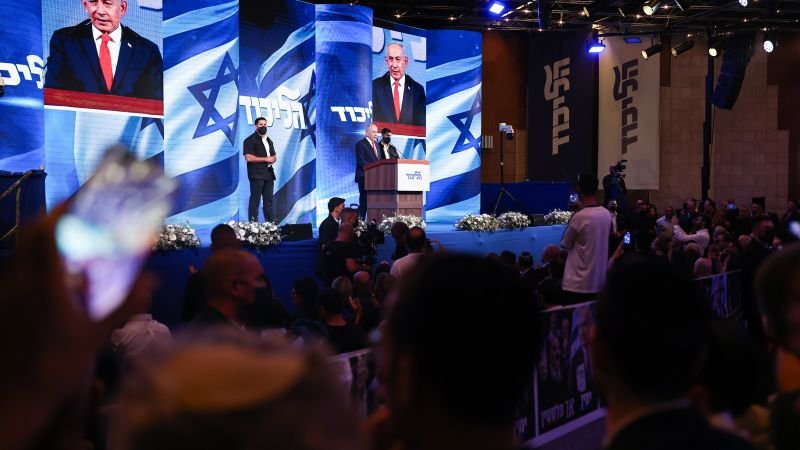
• No clear winner: Israel’s official vote count is now underway. With more than 70% counted, Israel is facing potential political deadlock, with neither Prime Minister Benjamin Netanyahu nor his main rival, ex-military chief Gadi Eisenkot, within reach of the 61 seats needed for a governing majority in the 120-seat parliament, the Knesset.
• Path to power: It’ll take several days to finalize the vote count. The current projections have Netanyahu’s bloc taking 54 seats, a drop from the 68-seat coalition he led in the outgoing Knesset. His Likud party is still set to be the largest single party.
• Complicated route: Parties opposed to Netanyahu have a clear majority, on course for about 65 seats, according to the latest projections. But they are fractured and divided between right, left and center. If they hope to oust Netanyahu, they will likely have to cooperate with the Arab parties, whose voter base saw record turnout.
Updates
(9)
The left-wing Democrats Party – part of the opposition bloc – is saying what no other opposition party has been willing to say so far: to form a government, you must work with the Arab parties.
Prime Minister Benjamin Netanyahu’s right-wing bloc is projected to take 54 seats; the opposition bloc – led by his main rival Gadi Eisenkot— now is expected to take 47 seats. But neither have enough seats to form a majority in the 120-member Israeli Knesset.
That’s where the Arab parties – who are set to hold a record 17 seats – come in.
Democrats leader Yair Golan on Wednesday urged the opposition bloc to work with them – not as a gesture, but because that is the simple political math required to form a government and oust Netanyahu.
“Netanyahu lost. I know how to count to 120,” he said.
Golan is urging other opposition leaders – who have expressed ideological opposition to working with the Arab parties – to overcome their divisions to secure a coalition.
“We have no future here if we don’t stop being afraid. And if we don’t stop with the racism. We must no longer accept Netanyahu’s racist division between Jewish votes and Arab votes,” he said.
Netanyahu has long disparaged the idea of a political partnership with Arab parties, despite reaching out to Mansour Abbas’ Raam party after the 2021 vote. The Arab population makes up 20% of Israel’s population, but Netanyahu has framed any such alliance as a threat.
Speaking on Israeli Army radio on Wednesday, Arab lawmaker Ahmad Tibi said that that “the change bloc can form a government – we are willing to help.”
“Netanyahu won’t be able to form a government,” Tibi said. “The other side can, if they want, if they have courage.”
Tamar Michaelis contributed reporting.
This post has been updated.
The exit polls that flashed on Israeli televisions mark the beginning of a long counting process in which results can shift hours and sometimes days after the polls close. This is because of a voting system known as the double envelopes.
The vast majority of Israeli voters are assigned to specific polling stations – and their ballots are opened and counted the moment polls close. But a group of voters – soldiers, prisoners, hospital patients and staff, diplomats abroad and voters with disabilities – cast their ballot inside a double envelope.
These voters place their anonymous vote in an inner envelope, which is sealed inside an outer envelope with their personal details. The double envelopes are transported to the Central Elections Committee, where staff check each outer envelope against the registered polling stations to verify the voter didn’t vote twice. Only then are the inner envelopes separated and counted.
That verification process takes time. The Central Elections Committee said there are more double envelopes than ever this year. The committee is expecting as many as 650,000 Israelis to vote this way, up from 460,000 in the 2022 elections. The surge is attributed mainly to the large number of military reservists currently deployed and voting away from home. Together they could amount to a game-changing 15 seats that remain uncounted on election night.
The double envelopes historically change the map by 1-2 seats. Because of who votes like this, they tend to impact the ultra-Orthodox and Arab parties. For parties hovering around the 3.25% electoral threshold, they can be decisive.
Election night in Israel ends when all the votes are counted, but that is just the first step. Forming a government runs through the president of the state, who plays a pivotal role in post-election politics.
After the results are finalized, President Isaac Herzog will begin consultations with all the elected parties, asking each of them who they recommend to be prime minister. He then assigns the task of forming a government to the candidate he believes is most likely to secure a 61-seat majority. This is not necessarily the leader of the largest party, but the one he deems has a better path to a coalition.
When election results are clear, the choice can be obvious. If there is no clear winner or a deadlock, the president’s decision can be decisive for coalition negotiations.
After Herzog decides who gets the mandate, the assigned candidate will have 28 days – with a possible 14-day extension – to negotiate with other parties over cabinet posts, budget priorities and policy commitments.
The goal is simple: try to form a government. If that candidate fails, the mandate is passed to another candidate for another four weeks. If he fails as well, the Knesset gets a short window to put forward another candidate, and if it cannot then the country goes to another round of elections.
The current vote count shows neither Prime Minister Benjamin Netanyahu nor his primary rival Gadi Eisenkot with a clear path to a majority, enhancing Herzog’s role in the process even more. With neither side holding a clear majority, he may try to steer the two largest parties to form a unity government. Two weeks before the election, Herzog said he will do everything he can “to establish a stable government” and avoid another election.
It’s 11 a.m. in Jerusalem and more than 70% of the vote has been counted. Here’s the current projections based on the ballots tallied so far:
Prime Minister Benjamin Netanyahu’s right-wing bloc is set to take 54 seats.
The opposition bloc, led by Gadi Eisenkot, now has 47 seats.
Arab parties – Ra’am and the Joint List have 19 seats.
Despite there currently being no clear winner in the Israeli election, several players are claiming that preliminary results indicate success for both their parties and the country.
Here’s a look at what some of the key players are saying:
In a speech, Israel’s Prime Minister Benjamin Netanyahu touted a “decisive majority among the Zionist and Jewish public.” He thanked US President Donald Trump and God for making him Israel’s leader. “We made it against our enemies and we will form the future,” he said.
Gadi Eisenkot, Netanyahu’s main opponent, said that “the public has voted for change,” adding that Netanyahu’s “coalition of failure has lost the people’s trust.” Eisenkot said he would act with “all our power to establish a government,” and his party intends to represent all Israelis.
The Arab Joint List party, one of two major Arab parties, said in a statement: “We can say with confidence: we sent the fascist right-wing government to the dustbin of history.” Party leader Yousef Jabareen commended a strong turnout among the community, saying it was “unprecedented and historic in our Arab society.”
Mansour Abbas, the head of the other major Arab party Raam, said: “We will turn the seats we won into a new reality in the country.” He said that the “record-breaking electoral achievement” is because the current Israeli government “neglected the Israeli Arab community.”
Israeli Prime Minister Benjamin Netanyahu’s principal opponent in the elections is a relative newcomer to politics. Instead, one of his key electoral advantages boils down to a simple truth: He is not Netanyahu.
Gadi Eisenkot, 66, has spent most of his life in the Israeli military, enlisting in the Golani Brigade in 1978 and rising over a 40-year career to become chief of staff from 2015 to 2019, serving under Netanyahu.
He entered politics in 2022 alongside another former chief of staff, Benny Gantz. After the October 7, 2023, Hamas-led attack on Israel, the two joined Netanyahu’s emergency war cabinet. But they left in June 2024, pointing to the absence of a clear post-war strategy.
Eisenkot is the second of nine children and a father of five. His youngest son, Gal, 25, was killed fighting in Gaza two months into the war.
He has placed that singular promise at the heart of his political mission.
You can read more about the opposition’s strongest candidate here.
US President Donald Trump said early Wednesday he hadn’t yet spoken to Israeli Prime Minister Benjamin Netanyahu, but seemed optimistic about his performance in the election as the vote count is underway.
Just over a week before the polls opened in Israel, Trump called Netanyahu a “Great Warrior Prime Minister” in a Truth Social post, offering his “Complete and Total Endorsement.”
Exit polls so far suggest Netanyahu’s bloc lost its majority in the Knesset — though it is narrowly in the lead over the opposition. Trump suggested that the exit polls might be wrong, however.
“He might be winning, or tied,” he said. “It’s a little bit early, but I’m hearing that in Israel, top people are saying, ‘Wow,’ he did a lot better than people thought.”
The final result could be “a stalemate or a win – but we’ll find out,” he added.
Supporters of Israel’s Arab Joint List party celebrated at its election headquarters in Nazareth, with Arab parties projected to gain a record number of seats from Tuesday’s election.
Party leader Yousef Jabareen commended a strong turnout among the community, saying it was “unprecedented and historic in our Arab society.” Arab voters make up about 20% of the Israeli electorate, but have traditionally voted at lower rates than Jewish Israelis.
That voter surge was driven by an urgent desire to dismantle Prime Minister Benjamin Netanyahu’s right-wing coalition, which includes hardline ministers such as Itamar Ben-Gvir and Bezalel Smotrich.
That sentiment was underscored by chants of “Ben-Gvir, go home” at the Joint List election headquarters.
Jabareen said exit polls showed Arab-led parties can “make a difference.”
He vowed to be a “safety net in the face of crime in our society, a safety net in the face of dangerous racism, a safety net in the face of the demolition of homes and entire villages.”
Some context: Entering government could still be tricky for Arab parties. Between them, the Joint List and Raam are projected to secure 17-19 seats in the 120-seat Knessett, their strongest showing in history.
Gadi Eisenkot’s Yashar party is projected to win 21-23 seats.
However, Eisenkot has set conditions for any partner to join his government, including recognizing Israel as a Jewish state and recognizing Hamas as a terrorist organization that must be dismantled, terms most Arab lawmakers are unlikely to accept.
Moreover, two of his opposition allies – Avigdor Lieberman and Naftali Bennett – have ruled out forming a government with the Arab parties altogether.
CNN’s Abeer Salman and Kara Fox contributed reporting.
It’s now Wednesday morning in Israel, and the election – one of the most consequential in years – is over. Next begins the real work of counting votes and forming a government.
It’ll take several days to finalize the vote count, but exit polls indicate Prime Minister Benjamin Netanyahu’s party has taken a blow – though there’s not yet a clear winner with an outright majority.
Here’s what to know:
Netanyahu stumbles: Netanyahu’s bloc of ultra-Orthodox and far-right allies has lost its majority. Projections from the Central Election Committee see Netanyahu’s party collapsing from 68 seats in the Knesset to 56. His Likud party will likely still be the largest single party, but the results represent a crash in public support.
‘Decisive majority’: Speaking in Jerusalem early Wednesday, Netanyahu said the results still showed his bloc had the support of a “decisive majority among the Zionist and Jewish public,” despite the loss in seats. He slammed Arab parties as “anti-Zionist” and rejected the idea of working with them to form a government. He also thanked US President Donald Trump for his support in the war with Iran.
Opposition bloc: Netanyahu’s biggest rival, former military chief Gadi Eisenkot, is narrowly behind, with his bloc projected to secure 48 seats. “The public has voted for change,” he said. But he doesn’t have a clear path to a governing majority yet, either.
Arab parties surge: Arab parties Joint List and Raam are projected to win a record 19 seats – the largest Arab representation ever. They could play a key role in building a coalition to form a new government. But what that could look like remains unclear.
Record turnout: Nearly 5.7 million voters cast their ballot out of approximately 7.3 million eligible voters – meaning a turnout of 77.7%, the highest percentage since 1999, according to the Central Elections Committee.
What’s next: Once the votes are finalized, each elected party will recommend their choice for prime minister to the president, who will select one person to try to form a government – based on who has the best chance of building a viable coalition. The way things look now, that will likely be Eisenkot, who will have four to six weeks to negotiate with other parties and try to cobble together a majority in the Knesset. But he could also fail, and Netanyahu could be given a chance to try. If he fails too, and if the Knesset cannot put forth another candidate, Israel could hold elections all over again.
Why this matters: This election has been widely viewed as a referendum on Netanyahu, and whether Israel keeps moving in the nationalistic, conservative and religious direction – or changes course. For many voters, this is the first chance to pass judgment on the leadership that presided over October 7 failures, and to decide who should lead the country in conflict.
• No clear winner: Israel’s official vote count is now underway. With more than 70% counted, Israel is facing potential political deadlock, with neither Prime Minister Benjamin Netanyahu nor his main rival, ex-military chief Gadi Eisenkot, within reach of the 61 seats needed for a governing majority in the 120-seat parliament, the Knesset.
• Path to power: It’ll take several days to finalize the vote count. The current projections have Netanyahu’s bloc taking 54 seats, a drop from the 68-seat coalition he led in the outgoing Knesset. His Likud party is still set to be the largest single party.
• Complicated route: Parties opposed to Netanyahu have a clear majority, on course for about 65 seats, according to the latest projections. But they are fractured and divided between right, left and center. If they hope to oust Netanyahu, they will likely have to cooperate with the Arab parties, whose voter base saw record turnout.
The left-wing Democrats Party – part of the opposition bloc – is saying what no other opposition party has been willing to say so far: to form a government, you must work with the Arab parties.
Prime Minister Benjamin Netanyahu’s right-wing bloc is projected to take 54 seats; the opposition bloc – led by his main rival Gadi Eisenkot— now is expected to take 47 seats. But neither have enough seats to form a majority in the 120-member Israeli Knesset.
That’s where the Arab parties – who are set to hold a record 17 seats – come in.
Democrats leader Yair Golan on Wednesday urged the opposition bloc to work with them – not as a gesture, but because that is the simple political math required to form a government and oust Netanyahu.
“Netanyahu lost. I know how to count to 120,” he said.
Golan is urging other opposition leaders – who have expressed ideological opposition to working with the Arab parties – to overcome their divisions to secure a coalition.
“We have no future here if we don’t stop being afraid. And if we don’t stop with the racism. We must no longer accept Netanyahu’s racist division between Jewish votes and Arab votes,” he said.
Netanyahu has long disparaged the idea of a political partnership with Arab parties, despite reaching out to Mansour Abbas’ Raam party after the 2021 vote. The Arab population makes up 20% of Israel’s population, but Netanyahu has framed any such alliance as a threat.
Speaking on Israeli Army radio on Wednesday, Arab lawmaker Ahmad Tibi said that that “the change bloc can form a government – we are willing to help.”
“Netanyahu won’t be able to form a government,” Tibi said. “The other side can, if they want, if they have courage.”
Tamar Michaelis contributed reporting.
This post has been updated.
The exit polls that flashed on Israeli televisions mark the beginning of a long counting process in which results can shift hours and sometimes days after the polls close. This is because of a voting system known as the double envelopes.
The vast majority of Israeli voters are assigned to specific polling stations – and their ballots are opened and counted the moment polls close. But a group of voters – soldiers, prisoners, hospital patients and staff, diplomats abroad and voters with disabilities – cast their ballot inside a double envelope.
These voters place their anonymous vote in an inner envelope, which is sealed inside an outer envelope with their personal details. The double envelopes are transported to the Central Elections Committee, where staff check each outer envelope against the registered polling stations to verify the voter didn’t vote twice. Only then are the inner envelopes separated and counted.
That verification process takes time. The Central Elections Committee said there are more double envelopes than ever this year. The committee is expecting as many as 650,000 Israelis to vote this way, up from 460,000 in the 2022 elections. The surge is attributed mainly to the large number of military reservists currently deployed and voting away from home. Together they could amount to a game-changing 15 seats that remain uncounted on election night.
The double envelopes historically change the map by 1-2 seats. Because of who votes like this, they tend to impact the ultra-Orthodox and Arab parties. For parties hovering around the 3.25% electoral threshold, they can be decisive.
Election night in Israel ends when all the votes are counted, but that is just the first step. Forming a government runs through the president of the state, who plays a pivotal role in post-election politics.
After the results are finalized, President Isaac Herzog will begin consultations with all the elected parties, asking each of them who they recommend to be prime minister. He then assigns the task of forming a government to the candidate he believes is most likely to secure a 61-seat majority. This is not necessarily the leader of the largest party, but the one he deems has a better path to a coalition.
When election results are clear, the choice can be obvious. If there is no clear winner or a deadlock, the president’s decision can be decisive for coalition negotiations.
After Herzog decides who gets the mandate, the assigned candidate will have 28 days – with a possible 14-day extension – to negotiate with other parties over cabinet posts, budget priorities and policy commitments.
The goal is simple: try to form a government. If that candidate fails, the mandate is passed to another candidate for another four weeks. If he fails as well, the Knesset gets a short window to put forward another candidate, and if it cannot then the country goes to another round of elections.
The current vote count shows neither Prime Minister Benjamin Netanyahu nor his primary rival Gadi Eisenkot with a clear path to a majority, enhancing Herzog’s role in the process even more. With neither side holding a clear majority, he may try to steer the two largest parties to form a unity government. Two weeks before the election, Herzog said he will do everything he can “to establish a stable government” and avoid another election.
It’s 11 a.m. in Jerusalem and more than 70% of the vote has been counted. Here’s the current projections based on the ballots tallied so far:
Prime Minister Benjamin Netanyahu’s right-wing bloc is set to take 54 seats.
The opposition bloc, led by Gadi Eisenkot, now has 47 seats.
Arab parties – Ra’am and the Joint List have 19 seats.
Despite there currently being no clear winner in the Israeli election, several players are claiming that preliminary results indicate success for both their parties and the country.
Here’s a look at what some of the key players are saying:
In a speech, Israel’s Prime Minister Benjamin Netanyahu touted a “decisive majority among the Zionist and Jewish public.” He thanked US President Donald Trump and God for making him Israel’s leader. “We made it against our enemies and we will form the future,” he said.
Gadi Eisenkot, Netanyahu’s main opponent, said that “the public has voted for change,” adding that Netanyahu’s “coalition of failure has lost the people’s trust.” Eisenkot said he would act with “all our power to establish a government,” and his party intends to represent all Israelis.
The Arab Joint List party, one of two major Arab parties, said in a statement: “We can say with confidence: we sent the fascist right-wing government to the dustbin of history.” Party leader Yousef Jabareen commended a strong turnout among the community, saying it was “unprecedented and historic in our Arab society.”
Mansour Abbas, the head of the other major Arab party Raam, said: “We will turn the seats we won into a new reality in the country.” He said that the “record-breaking electoral achievement” is because the current Israeli government “neglected the Israeli Arab community.”
Israeli Prime Minister Benjamin Netanyahu’s principal opponent in the elections is a relative newcomer to politics. Instead, one of his key electoral advantages boils down to a simple truth: He is not Netanyahu.
Gadi Eisenkot, 66, has spent most of his life in the Israeli military, enlisting in the Golani Brigade in 1978 and rising over a 40-year career to become chief of staff from 2015 to 2019, serving under Netanyahu.
He entered politics in 2022 alongside another former chief of staff, Benny Gantz. After the October 7, 2023, Hamas-led attack on Israel, the two joined Netanyahu’s emergency war cabinet. But they left in June 2024, pointing to the absence of a clear post-war strategy.
Eisenkot is the second of nine children and a father of five. His youngest son, Gal, 25, was killed fighting in Gaza two months into the war.
He has placed that singular promise at the heart of his political mission.
You can read more about the opposition’s strongest candidate here.
US President Donald Trump said early Wednesday he hadn’t yet spoken to Israeli Prime Minister Benjamin Netanyahu, but seemed optimistic about his performance in the election as the vote count is underway.
Just over a week before the polls opened in Israel, Trump called Netanyahu a “Great Warrior Prime Minister” in a Truth Social post, offering his “Complete and Total Endorsement.”
Exit polls so far suggest Netanyahu’s bloc lost its majority in the Knesset — though it is narrowly in the lead over the opposition. Trump suggested that the exit polls might be wrong, however.
“He might be winning, or tied,” he said. “It’s a little bit early, but I’m hearing that in Israel, top people are saying, ‘Wow,’ he did a lot better than people thought.”
The final result could be “a stalemate or a win – but we’ll find out,” he added.
Supporters of Israel’s Arab Joint List party celebrated at its election headquarters in Nazareth, with Arab parties projected to gain a record number of seats from Tuesday’s election.
Party leader Yousef Jabareen commended a strong turnout among the community, saying it was “unprecedented and historic in our Arab society.” Arab voters make up about 20% of the Israeli electorate, but have traditionally voted at lower rates than Jewish Israelis.
That voter surge was driven by an urgent desire to dismantle Prime Minister Benjamin Netanyahu’s right-wing coalition, which includes hardline ministers such as Itamar Ben-Gvir and Bezalel Smotrich.
That sentiment was underscored by chants of “Ben-Gvir, go home” at the Joint List election headquarters.
Jabareen said exit polls showed Arab-led parties can “make a difference.”
He vowed to be a “safety net in the face of crime in our society, a safety net in the face of dangerous racism, a safety net in the face of the demolition of homes and entire villages.”
Some context: Entering government could still be tricky for Arab parties. Between them, the Joint List and Raam are projected to secure 17-19 seats in the 120-seat Knessett, their strongest showing in history.
Gadi Eisenkot’s Yashar party is projected to win 21-23 seats.
However, Eisenkot has set conditions for any partner to join his government, including recognizing Israel as a Jewish state and recognizing Hamas as a terrorist organization that must be dismantled, terms most Arab lawmakers are unlikely to accept.
Moreover, two of his opposition allies – Avigdor Lieberman and Naftali Bennett – have ruled out forming a government with the Arab parties altogether.
CNN’s Abeer Salman and Kara Fox contributed reporting.
It’s now Wednesday morning in Israel, and the election – one of the most consequential in years – is over. Next begins the real work of counting votes and forming a government.
It’ll take several days to finalize the vote count, but exit polls indicate Prime Minister Benjamin Netanyahu’s party has taken a blow – though there’s not yet a clear winner with an outright majority.
Here’s what to know:
Netanyahu stumbles: Netanyahu’s bloc of ultra-Orthodox and far-right allies has lost its majority. Projections from the Central Election Committee see Netanyahu’s party collapsing from 68 seats in the Knesset to 56. His Likud party will likely still be the largest single party, but the results represent a crash in public support.
‘Decisive majority’: Speaking in Jerusalem early Wednesday, Netanyahu said the results still showed his bloc had the support of a “decisive majority among the Zionist and Jewish public,” despite the loss in seats. He slammed Arab parties as “anti-Zionist” and rejected the idea of working with them to form a government. He also thanked US President Donald Trump for his support in the war with Iran.
Opposition bloc: Netanyahu’s biggest rival, former military chief Gadi Eisenkot, is narrowly behind, with his bloc projected to secure 48 seats. “The public has voted for change,” he said. But he doesn’t have a clear path to a governing majority yet, either.
Arab parties surge: Arab parties Joint List and Raam are projected to win a record 19 seats – the largest Arab representation ever. They could play a key role in building a coalition to form a new government. But what that could look like remains unclear.
Record turnout: Nearly 5.7 million voters cast their ballot out of approximately 7.3 million eligible voters – meaning a turnout of 77.7%, the highest percentage since 1999, according to the Central Elections Committee.
What’s next: Once the votes are finalized, each elected party will recommend their choice for prime minister to the president, who will select one person to try to form a government – based on who has the best chance of building a viable coalition. The way things look now, that will likely be Eisenkot, who will have four to six weeks to negotiate with other parties and try to cobble together a majority in the Knesset. But he could also fail, and Netanyahu could be given a chance to try. If he fails too, and if the Knesset cannot put forth another candidate, Israel could hold elections all over again.
Why this matters: This election has been widely viewed as a referendum on Netanyahu, and whether Israel keeps moving in the nationalistic, conservative and religious direction – or changes course. For many voters, this is the first chance to pass judgment on the leadership that presided over October 7 failures, and to decide who should lead the country in conflict.





Responses