
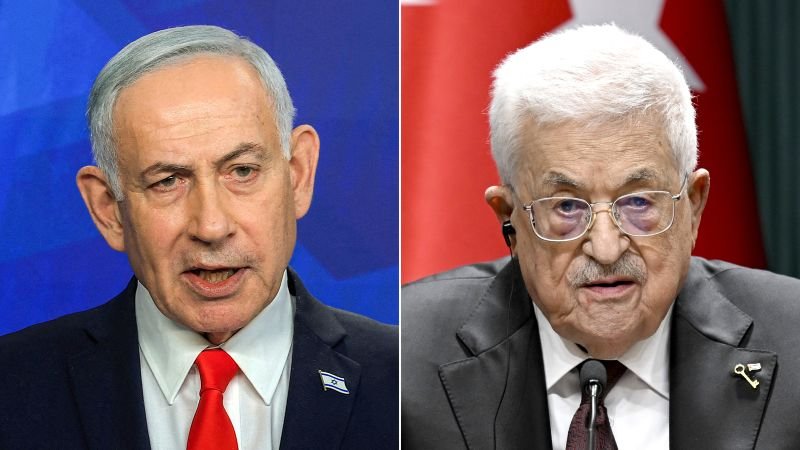
• Palestinian leader speaks: Palestinian Authority President Mahmoud Abbas addressed the United Nations General Assembly via video after again being denied a visa by the Trump administration. He called on global leaders to hold Israel accountable and to ensure the viability of the two-state solution, saying the Palestinian people face “one of the most dangerous times” in their history.
• Netanyahu to make remarks: Israeli Prime Minister Benjamin Netanyahu will speak later in today’s session. His trip to New York is slated to be unusually short, and he will not meet with President Donald Trump while in the US. Several demonstrations are planned during his speech.
• Against backdrop of war: Their speeches come as nearly three years have passed since the October 7, 2023 terror attacks and Israel’s subsequent war against Hamas in Gaza, leading to thousands of deaths and regional instability.
14 Posts
While addressing the UN General Assembly on Thursday, Guyana’s President Mohamed Irfaan Ali urged Venezuela to comply with the upcoming ruling by the International Court of Justice (ICJ) regarding the long-standing territorial dispute between the two countries over the Essequibo region.
The dispute reached the ICJ in May of this year, when two hearings were held in which Guyana and Venezuela presented their arguments concerning the territorial conflict.
“With full respect for international law, Guyana participated in — and encouraged Venezuela to participate in — the ICJ proceedings; now that we have both taken part in the hearings that concluded last May, we urge Venezuela to comply with the upcoming ruling in accordance with its obligations under the UN Charter,” said Ali.
During the May hearings, Venezuela stated that it would not renounce its “historic rights” to the Essequibo, while Guyana indicated that the Venezuelan stance “reflects a strategy to avoid a judicial ruling that might not favor its claims.”
The Essequibo — a territory of approximately 160,000 square kilometers — is the subject of the controversy between the two nations, a tension dating back to the 19th century and the 1899 Arbitral Award, which granted the United Kingdom sovereignty over the entire area currently in dispute.
As a former British colony, Guyana has controlled the area claimed by Venezuela since gaining independence from the United Kingdom in 1966. This territory accounts for roughly two-thirds of the country’s total land area.
ICJ deliberations typically span several months, so a ruling on the dispute is expected by the end of the year.
Palestinian Authority President Mahmoud Abbas called on the international community to ensure the viability of the two-state solution in the face of the ongoing Israeli expansion of settlements in the occupied West Bank and the war in Gaza.
In a pre-recorded speech, Abbas said there was a need to halt Israel’s decision to proceed with E1, an internationally condemned settlement that risks separating dividing the West Bank.
“This requires urgent and responsible intervention by the United Nations Security Council,” Abbas said. Earlier this month, the UK led a group of more than a dozen countries who said they would ban products from Israeli settlements in the West Bank or planned on doing so.
“We have long warned the international community, through the United Nations General Assembly and through the Security Council, that these Israeli policies, in violation of international law, would destroy the two-state solution, and that is what is happening now,” Abbas said. He also warned that Israel was withholding more than $6 billion that should have been transferred to the Palestinian Authority and demanded the release of the money — stopped by Israel’s far-right finance minister — to alleviate financial hardship in the West Bank.
Abbas called for the implementation of the stalled 20-point ceasefire plan brokered under President Donald Trump. He said the Palestinian Authority had undergone the reform measures required by the plan, but the Trump administration has hardly engaged publicly with the Palestinian Authority.
“The Palestinian people will remain on its land. The Palestinian people will not accept displacement and will not disappear. Neither military occupation nor settlement expansion and annexation, nor settler terrorism can be a solution or create lasting security,” Abbas said.
Palestinian Authority President Mahmoud Abbas rejected the Trump administration’s entry visa ban, which has blocked Palestinian Authority officials from attending the UN General Assembly in person, as “unlawful punitive measures.”
Abbas told world leaders that for the second consecutive year, the Palestinian delegation was “denied the entry visas required to reach New York and participate in the meetings of the United Nations General Assembly in person.”
“We reject these unlawful punitive measures, and we reject the accusations and justifications on which they were based,” he said.
Palestinian Authority President Mahmoud Abbas today called on the United Nations General Assembly in New York to hold Israel accountable and to ensure the viability of the two-state solution.
“What is the international community waiting for in order to protect the Palestinian people, ensure their continued presence on their land, end the Israeli occupation and implement the two-state solution on the basis of international legitimacy?” Abbas asked in a pre-recorded speech.
Abbas said the Palestinian people were facing “one of the most dangerous times” in their history after three years of war in Gaza.
“In the Gaza Strip, our people are being subjected at the hands of the Israeli occupation forces to killing, destruction, starvation, attempts at displacement as well as a genocidal war that has created an unprecedented humanitarian catastrophe,” Abbas said.
The Trump administration banned Abbas from entering the United States for the UN General Assembly, forcing the aging leader to speak virtually from Ramallah in the occupied West Bank.
Abbas spoke one day after a “high-level” meeting of the Trump-led Board of Peace, which estimated the reconstruction of Gaza will require $71.4 billion over the next decade. The board laid out a six-month plan to begin rebuilding Gaza, even as it acknowledged the plan can only begin “the moment funding and access allow.”
The Trump administration’s stalled 20-point ceasefire plan from last October called for a reformed Palestinian Authority to take over Gaza in the future. But the US has hardly engaged publicly with the Palestinian Authority since the agreement was put in place 11 months ago. Abbas called on the Trump administration to “lift these sanctions” and “return to dialogue and mutual respect.”
Mahmoud Abbas, president of the Palestinian Authority, is now speaking to the United Nations General Assembly.
The Trump administration denied visas for Abbas and other Palestinian Authority officials again this year, so Abbas is making remarks via video call.
The reconstruction of Gaza after years of war will require $71.4 billion over the next decade, the Trump-led Board of Peace said on the sidelines of the UN General Assembly on Wednesday.
That estimate dwarfs the $4 to $6 billion the UN said would be required to rebuild Gaza after the 50-day war in 2014.
In a “high-level” briefing in which US envoys Steve Witkoff and Jared Kushner spoke, members of the board laid out what they pitched as a plan for the first six months of the recovery of Gaza. The plan involves 66 programs, including humanitarian shelters, diesel generators, and rebuilding hospitals. But the board acknowledged the challenges facing the program in that it can only begin “the moment funding and access allow.”
It’s unclear where the funding for the programs will come from, and the technocratic committee intended to administer Gaza — officially called the National Committee for the Administration of Gaza — has yet to enter the coastal enclave, instead operating from Cairo, Egypt, with virtually no authority over the territory they are supposed to help govern.
In a statement following the briefing, the Board of Peace boasted that its plan would be led by Palestinians.
But 11 months after President Donald Trump unveiled his 20-point ceasefire plan for Gaza, the effort remains stalled.
With Israeli Prime Minister Benjamin Netanyahu set to take the stage today at the United Nations General Assembly, you should know about the latest developments in the occupied West Bank, where settler violence against Palestinians has surged in areas the international community views as part of a future Palestinian state.
What to know about West Bank: Israel captured East Jerusalem and the West Bank in the 1967 war. Both are considered occupied territories under international law, and Israeli settlements there are widely regarded as illegal.
The latest Israel policy: The Israeli government has pushed to advance the internationally condemned E1 settlement project, which divides the West Bank into north and south, making a contiguous Palestinian state virtually impossible. The E1 project also splits East Jerusalem — the envisioned capital of a Palestinian state — from the rest of the territory. In late August, Israel’s Housing Ministry invited bids for the construction of more than 1,200 housing units in E1. The plan aims to create a continuous bloc of Jewish settlements from East Jerusalem to the West Bank. Israel gave final approval for the E1 plan last year, green-lighting more than 3,400 housing units.
While most Israeli settlements are state-run projects, many settler groups have also established dozens of unauthorized outposts in recent years — often through violence and physical force — that eventually secure Israeli government approvals.
Human rights and monitoring groups have said that Netanyahu’s government turns a blind eye to violence, calling it part of a broader ecosystem of “state-supported settler violence.”
International isolation: The United Kingdom, France and Canada announced plans for sanctions on illegal Israeli settlements in the occupied West Bank earlier this month. Nine other Western nations issued a joint letter, saying they would also introduce similar restrictions on trade with settlements illegal under international law — or would work to support European restrictions.
CNN’s Jennifer Hansler, Billy Stockwell and Eyad Kourdi contributed reporting.
The feud between Israeli Prime Minister Benjamin Netanyahu and New York Mayor Zohran Mamdani has flared up once again.
On Tuesday, Netanyahu released a video on social media accusing Mamdani of supporting Hamas and “inciting riots against New York Jews.” Netanyahu said that he would come to the UN General Assembly “to tell the truth about our heroic soldiers, and I’m going to tell the truth about you.” Netanyahu has already used Mamdani as part of his electoral campaign on a billboard that said, “They want Netanyahu to lose. Don’t let them win.”
Mamdani disputed accusations made in the video, saying, “We all know that what the prime minister has said in that video is not true.”
“What we do know to actually be the truth when it comes to the prime minister is that he is the subject of an International Criminal Court arrest warrant for alleged war crimes and crimes against humanity. And as the prime minister, is the architect of a horrific genocide against Palestinians,” Mamdani said during a news conference today.
One day earlier, Mamdani doubled down on his criticism of Netanyahu, calling him a war criminal, even as he acknowledged he did not have the authority to arrest the Israeli leader while he is in New York, something he had promised to do during his mayoral campaign. The International Criminal Court issued an arrest warrant for Netanyahu and other Israeli leaders in 2024, but the US is not a member of the court and had made clear it will not arrest Netanyahu.
Netanyahu and Mamdani have had a long-running and very public rivalry. Netanyahu’s arrival in New York for his UN General Assembly speech is expected to draw protests.
CNN’s Maureen Chowdhury and Gloria Pazmino contributed to this report.
An exchange between Ukrainian President Volodymyr Zelensky and a Russian state journalist on the streets of New York yesterday has been making the rounds on social media.
In the clip, the Russian reporter repeatedly asks Zelensky when he will be going to Moscow next as he makes his way through the streets of New York, flanked by security personnel. The Ukrainian president eventually quips “on a missile” as a reply.
The response quickly caught the attention of Russian media and was addressed by Kremlin spokesperson Dmitry Peskov during his daily briefing on Thursday. When asked by a reporter how he viewed Zelensky’s statement, Peskov said Zelensky “did not refuse to come to Moscow” as Russian media reports had suggested.
It also comes as Ukraine’s foreign minister Andrii Sybiha this week said Ukraine had agreed to carry out a complete and unconditional ceasefire and called on Russia to do the same. On Thursday, Peskov stressed that Russia is very much “open to a peaceful settlement process” but still favored a longer term “peace not a temporary truce.”
The Ukrainian presidency told CNN that the Ukrainian delegation including Zelensky are making their way back to Kyiv after a host of high-level meetings in New York with world leaders including President Donald Trump and UK Prime Minister Andy Burnham.
The leaders of both the Palestinian Authority and Israel are set to deliver remarks at the United Nations General Assembly today, nearly three years since the war in Gaza began.
Hamas’ terror attacks on October 7, 2023, killed over 1,200 people in Israel. Many more were injured or sexually assaulted, and the attack prompted furious retaliation from the Israeli government.
In the years since, more than 70,000 Palestinians have been killed in Israeli attacks on Gaza. Around 1.9 million people in the enclave — or about 90% of the population — have been displaced during the war, according to the United Nations.
Last September, an independent United Nations inquiry concluded that Israel was committing genocide against Palestinians in Gaza, joining a host of other organizations, including the International Association of Genocide Scholars, in making this accusation.
The Israeli government has firmly denied the claim, accusing the UN inquiry’s authors of being Hamas proxies.
After the war began, regional allies of Hamas, including Iran-backed Hezbollah in Lebanon and the Houthis in Yemen, launched attacks on Israel in retaliation for its bombardment of Gaza.
A year of combat in Lebanon ensued, during which Israel killed Hezbollah’s longtime leader, Hassan Nasrallah.
In November 2024, Israel approved a ceasefire deal that required it to withdraw from southern Lebanon, but Israeli forces continued to hold positions beyond the deadline and carried out near-daily strikes, alleging Hezbollah violations of the deal.
A new cycle of violence began after Israel and the US killed Iran’s supreme leader, Ayatollah Ali Khamenei, in an airstrike on Tehran in late February.
At least 8,953 people have been killed and 30,643 have been injured in Israeli attacks on Lebanon since October 8, 2023, the Lebanese Ministry of Public Health said last week.
At least 4,386 of these deaths have occurred since the renewed Israeli campaign in Lebanon began in early March, according to the ministry, which does not distinguish between civilians and combatants in its figures.
CNN’s Kara Fox, Nadeen Ebrahim, Tim Lister, Oren Liebermann and Ibrahim Dahman contributed to this reporting.
Israeli Prime Minister Benjamin Netanyahu is undertaking an unusually brief trip to the United States, slated to land in New York only hours before his Thursday address to the UN General Assembly and departing the same night.
The one-day visit marks a sharp departure from Netanyahu’s typical UN trips, which have historically included multiple days of meetings in New York and Washington, DC. This time, he will not even be staying the night. He is also not scheduled to meet President Donald Trump.
The speech comes roughly a month before Israel’s October elections, and will be broadcast live on domestic primetime TV. A source close to Netanyahu said the schedule was significantly shortened because of the proximity to the elections and Netanyahu’s wish to return quickly for campaign purposes.
The absence of a meeting with is notable, given that it is usually a central feature of Netanyahu’s visits to the US. The two leaders last met in the White House in August, but without any press or cameras.
A source close to Netanyahu attributed the lack of a meeting with Trump to “scheduling constraints” and rejected the notion that it reflects a cooling in their relationship in the aftermath of the Iran war. However, as Trump’s decision to end the Iran war significantly weakened his popularity in Israel, the source said Netanyahu is “uncertain if the president’s support and endorsement will even help him.”
Netanyahu’s trip will reportedly take place under tightened security. The Israeli government aircraft, Wing of Zion, is expected to land in New Jersey and not at one of New York’s airports. Several demonstrations are planned during his speech, including a march from Bryant Park organized by the Palestinian Youth Movement and a protest by UnXeptable, an Israeli anti-government group operating in the US, in New York’s Union Square.
Banned from entering the United States, Palestinian Authority President Mahmoud Abbas will instead deliver his UN General Assembly speech virtually.
For the second straight year, the Trump administration has prohibited Abbas and his delegation from traveling to the United States, forcing the nonagenarian Palestinian to transmit his speech from Ramallah in the occupied West Bank. Abbas is scheduled to speak Wednesday morning, several hours before Israeli Prime Minister Benjamin Netanyahu.
The decision to ban Abbas is all the more striking because the Trump administration allowed Iranian President Masoud Pezeshkian to enter the US, along with his delegation. Throughout the months-long war that the US and Israel launched against Iran in late-February, Iran has attacked and killed US forces in the Middle East, destroyed American military equipment in the region, and hammered US bases.
Meanwhile, under President Donald Trump’s stalled 20-point ceasefire plan for Gaza, a reformed Palestinian Authority is supposed to take over Gaza at some point. In other words, the Palestinian Authority is supposed to be the partner, not Iran.
Yet the US held hours of talks with Iran’s delegation. US envoy Steve Witkoff met with Iranian Foreign Minister Abbas Araghchi for at least two hours this week. The Palestinian Authority will have no chance for such a meeting.
Welcome back to our coverage of all the big developments and speeches at the UN General Assembly today.
We’re expecting speeches from both Israeli Prime Minister Benjamin Netanyahu and Palestinian Authority President Mahmoud Abbas today, though his remarks will be delivered remotely because the Trump administration denied visas to Abbas and other Palestinian officials.
Abbas is the fourth speaker in this morning’s session while Netanyahu, who is making a notably short trip without meeting US President Donald Trump, will speak 17th. In total, 35 countries will speak today as we steadily make our way through all the UN member states during this high-level week when the world’s leaders and top diplomats descend on New York.
However, some of the diplomatic focus will today be pulled away from New York toward Washington DC, where Chinese leader Xi Jinping is making his first state visit to the US since 2015, though few major diplomatic breakthroughs are expected.
The second day of the General Debate of the 81st session of the United Nations General Assembly featured more speeches from world leaders, including addresses from Venezuela’s acting President Delcy Rodríguez, Ukrainian President Volodymyr Zelensky and Iranian President Masoud Pezeshkian.
Here are some highlights:
Venezuela’s acting President Rodríguez said Venezuela will hold elections and transition to a full democracy — but did not specify when — in her address to the UNGA more than eight months after the US captured her predecessor Nicolás Maduro.
Rodríguez thanked US President Donald Trump for “his willingness to resume the path of diplomatic relations and cooperation.”
She also addressed Venezuelans recovering from the devastating earthquakes that shook the country in June, saying: “Let us walk united as one nation that decided, in the wake of pain, to choose hope.”
Iran’s President Pezeshkian told the General Assembly his country will “never bow our head or bend at the knee” to the US.
He said the Iranian people have been “the victims of terrorism,” countering Trump’s speech on Tuesday, where he called the Iranians “terrorists.”
Separately, US Secretary of State Marco Rubio said US-Iran talks on the sidelines of the UNGA did not yield a breakthrough.
In his UNGA speech, Ukrainian President Zelensky called Russian President Vladimir Putin “patient zero,” saying the more freedom he has to act, “the more dangerous the world becomes for everyone else.”
Zelensky later said a Russian attack on Kyiv Wednesday killed at least two people, urging the international community to increase pressure on Russia to end its more than four-year war.
Spain’s Prime Minister Pedro Sánchez called for reforming the UN Security Council to “ensure fair representation for all regions of the world and to end the veto power of permanent members” in his address.
Earlier, Panamanian President José Raúl Mulino also proposed reforming the Security Council to grant permanent membership to countries from Latin America and the Caribbean.
• Palestinian leader speaks: Palestinian Authority President Mahmoud Abbas addressed the United Nations General Assembly via video after again being denied a visa by the Trump administration. He called on global leaders to hold Israel accountable and to ensure the viability of the two-state solution, saying the Palestinian people face “one of the most dangerous times” in their history.
• Netanyahu to make remarks: Israeli Prime Minister Benjamin Netanyahu will speak later in today’s session. His trip to New York is slated to be unusually short, and he will not meet with President Donald Trump while in the US. Several demonstrations are planned during his speech.
• Against backdrop of war: Their speeches come as nearly three years have passed since the October 7, 2023 terror attacks and Israel’s subsequent war against Hamas in Gaza, leading to thousands of deaths and regional instability.
While addressing the UN General Assembly on Thursday, Guyana’s President Mohamed Irfaan Ali urged Venezuela to comply with the upcoming ruling by the International Court of Justice (ICJ) regarding the long-standing territorial dispute between the two countries over the Essequibo region.
The dispute reached the ICJ in May of this year, when two hearings were held in which Guyana and Venezuela presented their arguments concerning the territorial conflict.
“With full respect for international law, Guyana participated in — and encouraged Venezuela to participate in — the ICJ proceedings; now that we have both taken part in the hearings that concluded last May, we urge Venezuela to comply with the upcoming ruling in accordance with its obligations under the UN Charter,” said Ali.
During the May hearings, Venezuela stated that it would not renounce its “historic rights” to the Essequibo, while Guyana indicated that the Venezuelan stance “reflects a strategy to avoid a judicial ruling that might not favor its claims.”
The Essequibo — a territory of approximately 160,000 square kilometers — is the subject of the controversy between the two nations, a tension dating back to the 19th century and the 1899 Arbitral Award, which granted the United Kingdom sovereignty over the entire area currently in dispute.
As a former British colony, Guyana has controlled the area claimed by Venezuela since gaining independence from the United Kingdom in 1966. This territory accounts for roughly two-thirds of the country’s total land area.
ICJ deliberations typically span several months, so a ruling on the dispute is expected by the end of the year.
Palestinian Authority President Mahmoud Abbas called on the international community to ensure the viability of the two-state solution in the face of the ongoing Israeli expansion of settlements in the occupied West Bank and the war in Gaza.
In a pre-recorded speech, Abbas said there was a need to halt Israel’s decision to proceed with E1, an internationally condemned settlement that risks separating dividing the West Bank.
“This requires urgent and responsible intervention by the United Nations Security Council,” Abbas said. Earlier this month, the UK led a group of more than a dozen countries who said they would ban products from Israeli settlements in the West Bank or planned on doing so.
“We have long warned the international community, through the United Nations General Assembly and through the Security Council, that these Israeli policies, in violation of international law, would destroy the two-state solution, and that is what is happening now,” Abbas said. He also warned that Israel was withholding more than $6 billion that should have been transferred to the Palestinian Authority and demanded the release of the money — stopped by Israel’s far-right finance minister — to alleviate financial hardship in the West Bank.
Abbas called for the implementation of the stalled 20-point ceasefire plan brokered under President Donald Trump. He said the Palestinian Authority had undergone the reform measures required by the plan, but the Trump administration has hardly engaged publicly with the Palestinian Authority.
“The Palestinian people will remain on its land. The Palestinian people will not accept displacement and will not disappear. Neither military occupation nor settlement expansion and annexation, nor settler terrorism can be a solution or create lasting security,” Abbas said.
Palestinian Authority President Mahmoud Abbas rejected the Trump administration’s entry visa ban, which has blocked Palestinian Authority officials from attending the UN General Assembly in person, as “unlawful punitive measures.”
Abbas told world leaders that for the second consecutive year, the Palestinian delegation was “denied the entry visas required to reach New York and participate in the meetings of the United Nations General Assembly in person.”
“We reject these unlawful punitive measures, and we reject the accusations and justifications on which they were based,” he said.
Palestinian Authority President Mahmoud Abbas today called on the United Nations General Assembly in New York to hold Israel accountable and to ensure the viability of the two-state solution.
“What is the international community waiting for in order to protect the Palestinian people, ensure their continued presence on their land, end the Israeli occupation and implement the two-state solution on the basis of international legitimacy?” Abbas asked in a pre-recorded speech.
Abbas said the Palestinian people were facing “one of the most dangerous times” in their history after three years of war in Gaza.
“In the Gaza Strip, our people are being subjected at the hands of the Israeli occupation forces to killing, destruction, starvation, attempts at displacement as well as a genocidal war that has created an unprecedented humanitarian catastrophe,” Abbas said.
The Trump administration banned Abbas from entering the United States for the UN General Assembly, forcing the aging leader to speak virtually from Ramallah in the occupied West Bank.
Abbas spoke one day after a “high-level” meeting of the Trump-led Board of Peace, which estimated the reconstruction of Gaza will require $71.4 billion over the next decade. The board laid out a six-month plan to begin rebuilding Gaza, even as it acknowledged the plan can only begin “the moment funding and access allow.”
The Trump administration’s stalled 20-point ceasefire plan from last October called for a reformed Palestinian Authority to take over Gaza in the future. But the US has hardly engaged publicly with the Palestinian Authority since the agreement was put in place 11 months ago. Abbas called on the Trump administration to “lift these sanctions” and “return to dialogue and mutual respect.”
Mahmoud Abbas, president of the Palestinian Authority, is now speaking to the United Nations General Assembly.
The Trump administration denied visas for Abbas and other Palestinian Authority officials again this year, so Abbas is making remarks via video call.
The reconstruction of Gaza after years of war will require $71.4 billion over the next decade, the Trump-led Board of Peace said on the sidelines of the UN General Assembly on Wednesday.
That estimate dwarfs the $4 to $6 billion the UN said would be required to rebuild Gaza after the 50-day war in 2014.
In a “high-level” briefing in which US envoys Steve Witkoff and Jared Kushner spoke, members of the board laid out what they pitched as a plan for the first six months of the recovery of Gaza. The plan involves 66 programs, including humanitarian shelters, diesel generators, and rebuilding hospitals. But the board acknowledged the challenges facing the program in that it can only begin “the moment funding and access allow.”
It’s unclear where the funding for the programs will come from, and the technocratic committee intended to administer Gaza — officially called the National Committee for the Administration of Gaza — has yet to enter the coastal enclave, instead operating from Cairo, Egypt, with virtually no authority over the territory they are supposed to help govern.
In a statement following the briefing, the Board of Peace boasted that its plan would be led by Palestinians.
But 11 months after President Donald Trump unveiled his 20-point ceasefire plan for Gaza, the effort remains stalled.
With Israeli Prime Minister Benjamin Netanyahu set to take the stage today at the United Nations General Assembly, you should know about the latest developments in the occupied West Bank, where settler violence against Palestinians has surged in areas the international community views as part of a future Palestinian state.
What to know about West Bank: Israel captured East Jerusalem and the West Bank in the 1967 war. Both are considered occupied territories under international law, and Israeli settlements there are widely regarded as illegal.
The latest Israel policy: The Israeli government has pushed to advance the internationally condemned E1 settlement project, which divides the West Bank into north and south, making a contiguous Palestinian state virtually impossible. The E1 project also splits East Jerusalem — the envisioned capital of a Palestinian state — from the rest of the territory. In late August, Israel’s Housing Ministry invited bids for the construction of more than 1,200 housing units in E1. The plan aims to create a continuous bloc of Jewish settlements from East Jerusalem to the West Bank. Israel gave final approval for the E1 plan last year, green-lighting more than 3,400 housing units.
While most Israeli settlements are state-run projects, many settler groups have also established dozens of unauthorized outposts in recent years — often through violence and physical force — that eventually secure Israeli government approvals.
Human rights and monitoring groups have said that Netanyahu’s government turns a blind eye to violence, calling it part of a broader ecosystem of “state-supported settler violence.”
International isolation: The United Kingdom, France and Canada announced plans for sanctions on illegal Israeli settlements in the occupied West Bank earlier this month. Nine other Western nations issued a joint letter, saying they would also introduce similar restrictions on trade with settlements illegal under international law — or would work to support European restrictions.
CNN’s Jennifer Hansler, Billy Stockwell and Eyad Kourdi contributed reporting.
The feud between Israeli Prime Minister Benjamin Netanyahu and New York Mayor Zohran Mamdani has flared up once again.
On Tuesday, Netanyahu released a video on social media accusing Mamdani of supporting Hamas and “inciting riots against New York Jews.” Netanyahu said that he would come to the UN General Assembly “to tell the truth about our heroic soldiers, and I’m going to tell the truth about you.” Netanyahu has already used Mamdani as part of his electoral campaign on a billboard that said, “They want Netanyahu to lose. Don’t let them win.”
Mamdani disputed accusations made in the video, saying, “We all know that what the prime minister has said in that video is not true.”
“What we do know to actually be the truth when it comes to the prime minister is that he is the subject of an International Criminal Court arrest warrant for alleged war crimes and crimes against humanity. And as the prime minister, is the architect of a horrific genocide against Palestinians,” Mamdani said during a news conference today.
One day earlier, Mamdani doubled down on his criticism of Netanyahu, calling him a war criminal, even as he acknowledged he did not have the authority to arrest the Israeli leader while he is in New York, something he had promised to do during his mayoral campaign. The International Criminal Court issued an arrest warrant for Netanyahu and other Israeli leaders in 2024, but the US is not a member of the court and had made clear it will not arrest Netanyahu.
Netanyahu and Mamdani have had a long-running and very public rivalry. Netanyahu’s arrival in New York for his UN General Assembly speech is expected to draw protests.
CNN’s Maureen Chowdhury and Gloria Pazmino contributed to this report.
An exchange between Ukrainian President Volodymyr Zelensky and a Russian state journalist on the streets of New York yesterday has been making the rounds on social media.
In the clip, the Russian reporter repeatedly asks Zelensky when he will be going to Moscow next as he makes his way through the streets of New York, flanked by security personnel. The Ukrainian president eventually quips “on a missile” as a reply.
The response quickly caught the attention of Russian media and was addressed by Kremlin spokesperson Dmitry Peskov during his daily briefing on Thursday. When asked by a reporter how he viewed Zelensky’s statement, Peskov said Zelensky “did not refuse to come to Moscow” as Russian media reports had suggested.
It also comes as Ukraine’s foreign minister Andrii Sybiha this week said Ukraine had agreed to carry out a complete and unconditional ceasefire and called on Russia to do the same. On Thursday, Peskov stressed that Russia is very much “open to a peaceful settlement process” but still favored a longer term “peace not a temporary truce.”
The Ukrainian presidency told CNN that the Ukrainian delegation including Zelensky are making their way back to Kyiv after a host of high-level meetings in New York with world leaders including President Donald Trump and UK Prime Minister Andy Burnham.
The leaders of both the Palestinian Authority and Israel are set to deliver remarks at the United Nations General Assembly today, nearly three years since the war in Gaza began.
Hamas’ terror attacks on October 7, 2023, killed over 1,200 people in Israel. Many more were injured or sexually assaulted, and the attack prompted furious retaliation from the Israeli government.
In the years since, more than 70,000 Palestinians have been killed in Israeli attacks on Gaza. Around 1.9 million people in the enclave — or about 90% of the population — have been displaced during the war, according to the United Nations.
Last September, an independent United Nations inquiry concluded that Israel was committing genocide against Palestinians in Gaza, joining a host of other organizations, including the International Association of Genocide Scholars, in making this accusation.
The Israeli government has firmly denied the claim, accusing the UN inquiry’s authors of being Hamas proxies.
After the war began, regional allies of Hamas, including Iran-backed Hezbollah in Lebanon and the Houthis in Yemen, launched attacks on Israel in retaliation for its bombardment of Gaza.
A year of combat in Lebanon ensued, during which Israel killed Hezbollah’s longtime leader, Hassan Nasrallah.
In November 2024, Israel approved a ceasefire deal that required it to withdraw from southern Lebanon, but Israeli forces continued to hold positions beyond the deadline and carried out near-daily strikes, alleging Hezbollah violations of the deal.
A new cycle of violence began after Israel and the US killed Iran’s supreme leader, Ayatollah Ali Khamenei, in an airstrike on Tehran in late February.
At least 8,953 people have been killed and 30,643 have been injured in Israeli attacks on Lebanon since October 8, 2023, the Lebanese Ministry of Public Health said last week.
At least 4,386 of these deaths have occurred since the renewed Israeli campaign in Lebanon began in early March, according to the ministry, which does not distinguish between civilians and combatants in its figures.
CNN’s Kara Fox, Nadeen Ebrahim, Tim Lister, Oren Liebermann and Ibrahim Dahman contributed to this reporting.
Israeli Prime Minister Benjamin Netanyahu is undertaking an unusually brief trip to the United States, slated to land in New York only hours before his Thursday address to the UN General Assembly and departing the same night.
The one-day visit marks a sharp departure from Netanyahu’s typical UN trips, which have historically included multiple days of meetings in New York and Washington, DC. This time, he will not even be staying the night. He is also not scheduled to meet President Donald Trump.
The speech comes roughly a month before Israel’s October elections, and will be broadcast live on domestic primetime TV. A source close to Netanyahu said the schedule was significantly shortened because of the proximity to the elections and Netanyahu’s wish to return quickly for campaign purposes.
The absence of a meeting with is notable, given that it is usually a central feature of Netanyahu’s visits to the US. The two leaders last met in the White House in August, but without any press or cameras.
A source close to Netanyahu attributed the lack of a meeting with Trump to “scheduling constraints” and rejected the notion that it reflects a cooling in their relationship in the aftermath of the Iran war. However, as Trump’s decision to end the Iran war significantly weakened his popularity in Israel, the source said Netanyahu is “uncertain if the president’s support and endorsement will even help him.”
Netanyahu’s trip will reportedly take place under tightened security. The Israeli government aircraft, Wing of Zion, is expected to land in New Jersey and not at one of New York’s airports. Several demonstrations are planned during his speech, including a march from Bryant Park organized by the Palestinian Youth Movement and a protest by UnXeptable, an Israeli anti-government group operating in the US, in New York’s Union Square.
Banned from entering the United States, Palestinian Authority President Mahmoud Abbas will instead deliver his UN General Assembly speech virtually.
For the second straight year, the Trump administration has prohibited Abbas and his delegation from traveling to the United States, forcing the nonagenarian Palestinian to transmit his speech from Ramallah in the occupied West Bank. Abbas is scheduled to speak Wednesday morning, several hours before Israeli Prime Minister Benjamin Netanyahu.
The decision to ban Abbas is all the more striking because the Trump administration allowed Iranian President Masoud Pezeshkian to enter the US, along with his delegation. Throughout the months-long war that the US and Israel launched against Iran in late-February, Iran has attacked and killed US forces in the Middle East, destroyed American military equipment in the region, and hammered US bases.
Meanwhile, under President Donald Trump’s stalled 20-point ceasefire plan for Gaza, a reformed Palestinian Authority is supposed to take over Gaza at some point. In other words, the Palestinian Authority is supposed to be the partner, not Iran.
Yet the US held hours of talks with Iran’s delegation. US envoy Steve Witkoff met with Iranian Foreign Minister Abbas Araghchi for at least two hours this week. The Palestinian Authority will have no chance for such a meeting.
Welcome back to our coverage of all the big developments and speeches at the UN General Assembly today.
We’re expecting speeches from both Israeli Prime Minister Benjamin Netanyahu and Palestinian Authority President Mahmoud Abbas today, though his remarks will be delivered remotely because the Trump administration denied visas to Abbas and other Palestinian officials.
Abbas is the fourth speaker in this morning’s session while Netanyahu, who is making a notably short trip without meeting US President Donald Trump, will speak 17th. In total, 35 countries will speak today as we steadily make our way through all the UN member states during this high-level week when the world’s leaders and top diplomats descend on New York.
However, some of the diplomatic focus will today be pulled away from New York toward Washington DC, where Chinese leader Xi Jinping is making his first state visit to the US since 2015, though few major diplomatic breakthroughs are expected.
The second day of the General Debate of the 81st session of the United Nations General Assembly featured more speeches from world leaders, including addresses from Venezuela’s acting President Delcy Rodríguez, Ukrainian President Volodymyr Zelensky and Iranian President Masoud Pezeshkian.
Here are some highlights:
Venezuela’s acting President Rodríguez said Venezuela will hold elections and transition to a full democracy — but did not specify when — in her address to the UNGA more than eight months after the US captured her predecessor Nicolás Maduro.
Rodríguez thanked US President Donald Trump for “his willingness to resume the path of diplomatic relations and cooperation.”
She also addressed Venezuelans recovering from the devastating earthquakes that shook the country in June, saying: “Let us walk united as one nation that decided, in the wake of pain, to choose hope.”
Iran’s President Pezeshkian told the General Assembly his country will “never bow our head or bend at the knee” to the US.
He said the Iranian people have been “the victims of terrorism,” countering Trump’s speech on Tuesday, where he called the Iranians “terrorists.”
Separately, US Secretary of State Marco Rubio said US-Iran talks on the sidelines of the UNGA did not yield a breakthrough.
In his UNGA speech, Ukrainian President Zelensky called Russian President Vladimir Putin “patient zero,” saying the more freedom he has to act, “the more dangerous the world becomes for everyone else.”
Zelensky later said a Russian attack on Kyiv Wednesday killed at least two people, urging the international community to increase pressure on Russia to end its more than four-year war.
Spain’s Prime Minister Pedro Sánchez called for reforming the UN Security Council to “ensure fair representation for all regions of the world and to end the veto power of permanent members” in his address.
Earlier, Panamanian President José Raúl Mulino also proposed reforming the Security Council to grant permanent membership to countries from Latin America and the Caribbean.





Responses