
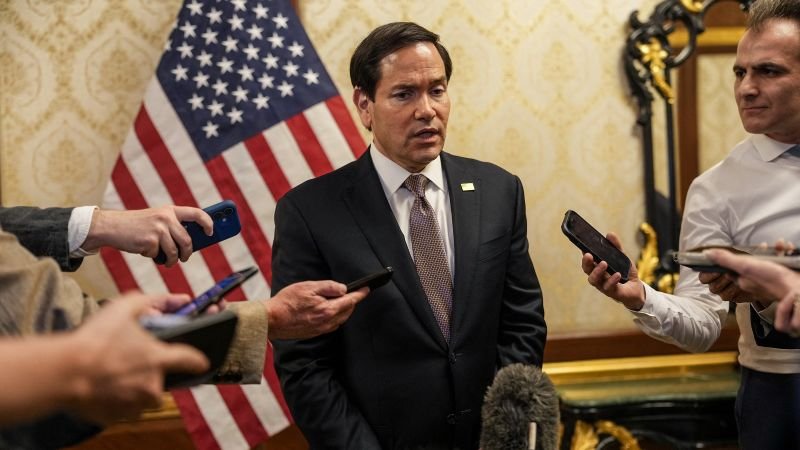
For more than a week, America’s top diplomat was conspicuously quiet about something that would have seemed very much in his wheelhouse: a nascent agreement with Iran.
This led plenty to surmise that Secretary of State Marco Rubio, like many of his fellow conservative foreign policy hawks, might have had misgivings about it.
Well, now Rubio is actually speaking. But his sales pitch sounds quite a bit different from President Donald Trump and Vice President JD Vance.
During visits with Middle Eastern allies to rally support and soothe fears, Rubio has not only avoided forceful affirmations of the controversial memorandum of understanding; he’s also sounded a significantly different tone about the particulars of the MOU and the peace process.
A case in point came Thursday, when Rubio doubled down on his past statements labeling Iran’s leaders as “religious … lunatics.”
“The Iranian system is led by clerics – radical clerics,” Rubio said during a visit to Bahrain. “That’s what it’s always been led by. And that’s what it continues to be led by.”
But the comments came a week after Trump and Vance raised plenty of eyebrows by pitching the Iranians as potentially reformed.
In fact, Trump expressly rejected the idea that its current leaders were “radicalized.”
“We’re dealing with people that I think are very rational people,” Trump said June 16 at the G7 summit in France. “They were nice to deal with. They were strong people, smart people. … But they’re not radicalized, and they’re, you know, looking to help their country.”
Vance, who jumped at the chance to be the face of the agreement, likewise suggested the Iranians might be having second thoughts about nearly five decades of anti-American foreign policy.
“This is a very interesting thing about these negotiations – is you see people, both the hard-liners, but also the more political people, saying our relationship with the United States over the past 47 years has been a mistake. Let’s turn over a new leaf,” Vance said.
State Department spokesman Tommy Pigott disputed that there were inconsistencies in the administration’s messaging, calling it a “tired and fake narrative.”
“Secretary Rubio and the entire administration is 100% in lockstep behind President Trump,” Pigott said. “The president has taken unprecedented action to prevent the Iranian regime from obtaining a nuclear weapon, and because of his leadership, the governments of Lebanon and Israel are holding the highest level talks in decades. The US and the entire world is safer because of these efforts.”
Both Vance and Rubio tempered their comments by emphasizing that things could change and that time would tell what the Iranians’ true intentions are.
But it’s notable that these top two officials — whose 2028 prospects Trump has openly mused about — offered very different takes on Tehran’s leadership.
One of the most curious absences from the MOU was anything about ending Iran’s missile program. This had been one of the Trump administration’s stated goals at the start of the war, but the MOU was silent on it.
Even more curiously, Trump seemed to walk that goal back significantly last week. He said repeatedly that Iran should be allowed to have at least some missiles.
“They have to have some, because other people have some,” Trump said. He added that “missiles aren’t the problem” because “they don’t blow up the planet.”
Trump later added of Iran’s missile program: “In relative proportion, I think it’s OK.”
But Rubio on Wednesday suggested a much tougher line while speaking with Middle Eastern allies who are understandably quite concerned about Iran’s use of those missiles. He said the administration was aligned with those allies and wouldn’t let Iran threaten them.
“We’re not going to do anything that undermines the security of our allies – our longstanding allies in the region,” Rubio said in Kuwait, when asked about Iran’s use of missiles and drones.
Another of the Trump administration’s original goals that wasn’t spelled out in the MOU was ending Iran’s support for proxy groups like Hezbollah and Hamas.
Rubio suggested this week that the MOU was stronger than it might have appeared on that front.
He argued that the agreement’s statement that Iran, the US and their allies would avoid “any hostile action against each other, and will refrain from the threat or use of force against each other” applied to Iran’s support for the proxies. He said a “careful reading” of the MOU demonstrated that.
“You can’t have the end of hostilities and conflicts in the region as long as Iranian proxies are launching missiles and drones from Iraq and are participating in terrorism like Hamas did and like Hezbollah did,” Rubio said Tuesday in Abu Dhabi. “So I do think it’s covered by the MOU.”
Vance offered a version of this same argument last week in an interview with CNN’s Jake Tapper.
He said that that part of the MOU meant that “Iranians have to stop funding violent terrorist organizations, they have to stop funding regional instability.”
But Trump hasn’t been so firm.
In fact, at the G7 last week, Trump seemed to lump the proxy issue in with missiles as something to be dealt with later, as part of what he called “a parallel effort with the Gulf nations to address non-nuclear issues.”
“And we’ll talk also about the terrorist proxies that they have that – we don’t want that to happen,” the president said.
Few issues jeopardize the nascent peace process like ongoing fighting between Israel and Hezbollah in Lebanon.
In the Tuesday press conference in Abu Dhabi, Rubio indicated the peace process there would be distinct from the US-Iran peace process.
“Well, that process is separate,” Rubio said. “It’s separate, because Lebanon is a sovereign country. It has a government. And when it comes to Lebanon and what’s happening inside of Lebanon, we’re going to negotiate a deal directly with the Lebanese government.”
But that’s difficult to square with the MOU and Vance’s explanation of it.
Neither Israel nor the Lebanese government was party to the MOU. But the agreement purported to force US and Iranian “allies” — which would surely include Israel and Hezbollah — to participate in the “immediate and permanent termination of military operations on all fronts, including in Lebanon.”
When asked to explain the Lebanon component of the MOU at a White House briefing last week, Vance suggested it bound Israel and Hezbollah.
“What that means is we expect Hezbollah is not going to be firing rockets and firing drones at the Israelis. And we also expect that the Israelis are not going to be going wild in Lebanon, right?” Vance said. “Both sides have to honor their end of the deal.”
Trump and Vance last week also applied significant pressure on Israel not to retaliate against Hezbollah too hard. They even seemed to not-so-subtly threaten to pull US support for its longtime ally if its military actions ruined the peace process with Iran.
But that stance was problematic with conservative foreign policy hawks, who thought the administration was effectively trying to force Israel not to defend itself against Hezbollah.
So up steps Rubio to smooth things over.
But it’s not clear that his version is actually the administration’s posture.
And as he steps forward to speak out, that’s becoming a trend.
This story has been updated with additional reporting.




Responses