
Humans have grand plans for residing in space, from a new space station under development to a planned base on the moon. Some even hope that one day people can live on Mars. There’s work underway to figure out how to build habitats to support those ambitions.
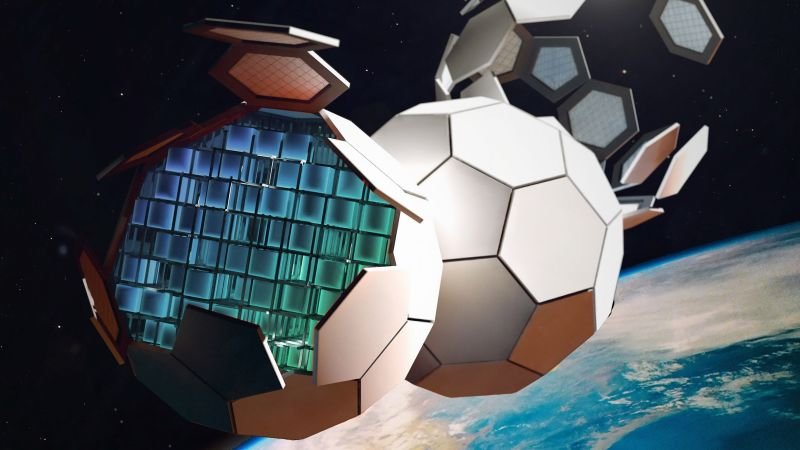
One of the innovations being tested is TESSERAE: magnetic, self-assembling tiles. Invented by Ariel Ekblaw while pursuing her PhD at the Massachusetts Institute of Technology, the tiles can be stacked on top of each other inside a rocket and released in space, where they can autonomously attach to each other — employing electro-permanent magnets, cameras and AI — to create a predetermined shape.
Once they’re latched together, the structure can be pressurized, allowing humans to live inside.
“They can self-assemble into something way bigger than the size of the rocket that they came up in,” said Ekblaw, who is now the founder and CEO of Aurelia Institute, a nonprofit space architecture research and development lab that has further refined the tiles.
That could allow humans to build “science-fiction-worthy, big, grand structures” in space, she added.
Starting in the late 1990s, it took dozens of missions to assemble the International Space Station (ISS), which rockets carried piece-by-piece to low Earth orbit. In space, robotic arms and spacewalking astronauts helped put it together.
Recent years have seen a number of companies developing new kinds of space structures designed to take up minimal space in the rockets that transport them, and testing new construction methods.
In 2016, Bigelow Aerospace sent an inflatable structure to the ISS. It was inflated with 25 short bursts of air over 7 hours, and it remains attached to the ISS today.
Sierra Space has been testing its three-story inflatable habitat, and earlier this year, Max Space, which has a strategic partnership with Voyager Technologies, unveiled new expandable habitat modules. “We need real estate that is scalable and built for how humans will actually live and operate off Earth,” Saleem Miyan, its co-founder and CEO, told Space.com.
Some are trying to reduce the need to bring material to space at all. European Space Agency (ESA) scientists have explored making LEGO-type bricks from meteorite dust and China is investigating how to make bricks with lunar soil.
Sandra Häuplik-Meusburger, an architect and space researcher at the Vienna University of Technology, in Austria, told CNN that there are numerous challenges when it comes to building space habitats — from how to protect humans from radiation, to transporting materials, to how to design spaces “that can work for a long time for different kinds of people.”
Adaptable architecture, like TESSERAE, could be helpful, “so that you can build something and maybe in 20 years you use it for something else,” she added.
The technology’s reconfigurability is one of its key innovations, said Ekblaw. “You could absolutely pop tiles off and pop new tiles on and reconfigure them,” she said.
It’s not just habitats. Some startups are looking at putting data centers and solar farms into space, to take advantage of 24/7 sunlight. Others are hoping to take manufacturing off planet Earth.
“It’s like a gold rush at the moment,” said Häuplik-Meusburger. There is “a lot of interest from a lot of different players.”
TESSERAE — which stands for Tessellated Electromagnetic Space Structures for the Exploration of Reconfigurable, Adaptive Environments — have been tested on a small scale aboard the ISS in 2020 and 2022, with tiles a few inches wide.
In December or January, the latest tiles — which have cameras on their edges to allow the tiles to see each other as they self-assemble — will be put to the test inside the ISS. If all goes well, the tiles will form a ball-shaped structure for the first time said Ekblaw — “maybe the size of a giant beach ball.”
After that, the next test will be handled by Rendezvous Robotics, a spin off from Aurelia Institute, which will help commercialize the technology. On October 28, it announced that it had raised $20 million in funding.
The tiles currently under development by Rendezvous Robotics use electromagnets and are about one to three feet wide. The company is working on scaling up the size, and it plans to do its first demo in 2028, outside the ISS, somewhere in the harsh environment of space. That will involve several tiles self-assembling into a flat shape, said Ekblaw, who is also the co-founder and board chair of Rendezvous Robotics.
Grand infrastructure may be a way off. Ekblaw said that the first realistic use cases for the technology could be large antennas used for telecommunications and solar arrays. Next up, “they may be able to contribute to the future of AI data center build outs in space,” she said. “Basically, anything that’s really big infrastructure in space.”




Responses