
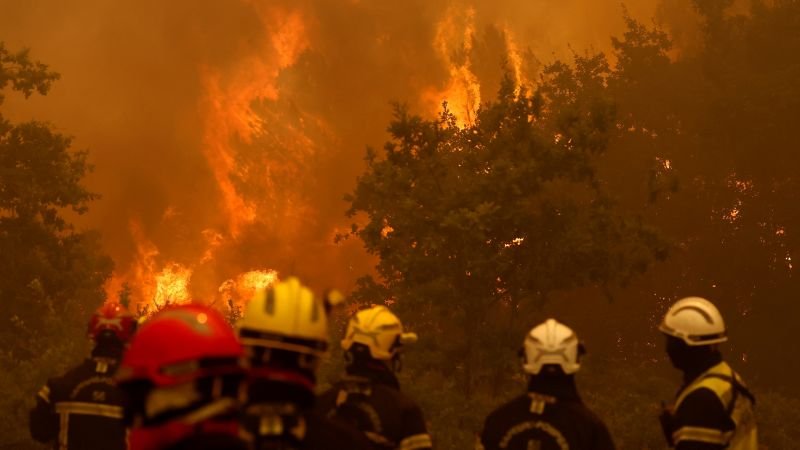
• Wildfires rage: More than 250,000 people have been evacuated in France and Spain as wildfires tear through southwest Europe. At least one person has died in Valencia, Spain, according to local authorities.
• Marathon firefight: France’s prime minister warned the coming hours “may be difficult” as conditions shift on the ground. France deployed a huge military cargo plane and a surge of other resources to battle the flames. In central Spain, crews are working around the clock to address the “totally unprecedented, never-before-seen” emergency.
• Widespread impacts: Elderly evacuees and families with children are among those waiting in shelters for word on when they might return home. The fires have spread thick smoke and disrupted daily life, including at the Tour de France.
• Climate crisis: The fires are fueled by climate change-driven heat waves, which set the stage for fiercer fire seasons.
Track stories like this and get your forecast in the CNN Weather app.
32 Posts
As we’ve been reporting today, the wildfires in parts of Spain and France have been among the most devastating, but they are far from the only blazes burning in Europe right now. Here’s a zoomed-out look at fire activity this week:
The wildfires in Spain have killed one person in the town of Manises, Valencia, according to local authorities.
“Unfortunately, the fire has claimed the life of one person,” the Manises City Council announced in a post on X, adding that it is declaring “two days of official mourning, tomorrow and Monday, as a show of gratitude to Firefighters, Civil Protection, Police, and the Civil Guard.”
The spread of the fire in the town, located on Spain’s eastern coast, occurred around midday on Saturday, local time, and was very rapid due to adverse weather conditions, with winds between 20 and 35 kilometers per hour, according to a statement published this afternoon.
The council said the fire was brought under control about four hours later. Officials expressed their condolences to the victim’s loved ones and thanked emergency services for their “quick response and effort.”
Two hundred thousand people have been evacuated from their homes in France’s Gironde and Landes regions as wildfires continue to burn out of control. Around 7,000 are being sheltered at a massive exhibition center in Bordeaux, which is itself shrouded in smoke carried into the city by shifting winds.
Many of those now sleeping on cots with their children and pets were woken in their homes west of Bordeaux in the early hours of Friday by emergency text alerts on their phones, telling them to evacuate immediately.
They have no prospect of returning home anytime soon.
Sitting beside her young children and dog, Wendy says the worst part is not knowing how long she and her family will have to stay. She told CNN how difficult it has been to remain calm.
Occasionally, a lost child is reunited with their family over the public address system—a reminder of just how vast the exhibition hall is where thousands of families are being sheltered and fed.
At a nearby folding table, Christophe explained how he was first woken by the emergency alert, before police officers climbed over his wall at 6 a.m. and banged on his door. He insisted on checking on his neighbors, both well into their nineties, but, he explained, that took time.
“I had a bag ready,” he said, “but they had nothing prepared, so we had to gather their belongings and their medication because they’re diabetic.”
Christophe is impressed by the logistics of what officials describe as the largest evacuation France has seen since World War II.
“We never knew the war,” he said, “and we’ve had disasters and fires before, but nothing like this.”
Shifting conditions could complicate efforts for firefighters in France.
According to French Prime Minister Sébastien Lecornu, “the forecast has once again become unfavorable” after some relief in the weather overnight and earlier Saturday.
“The coming hours may be difficult,” Lecornu warned in a statement on X.
Here’s what else we learned from the prime minister’s update:
Around 30 wildfires are burning simultaneously in the country, and nearly 100,000 hectares have already burned — “an unprecedented level.”
A total of 1,400 firefighters, 1,500 military personnel and 1,700 internal security forces are working to extinguish fires, protecting people and secure evacuated areas.
About 2.5 million filtering face masks will be distributed to help address health concerns from smoke, with a priority placed on the most vulnerable people and frontline personnel.
Thousands of camp beds have been delivered to shelters for people who had to flee their homes.
Firefighters in the eastern Castellón province of Spain shared video of the leaping flames they’re facing as they work to extinguish one of the blazes ripping through parts of Europe this weekend.
In a post on X, fire officials shared video from the town of La Vall d’Uixó and urged residents not to try to access the area.
As wildfires burn west of Bordeaux, one of France’s most famous wine-producing regions, concerned oenophiles have called wine expert Nicolle Croft to voice concern over the fate of 2026 vintage.
“A lot of people are contacting me from around the world hearing all these terrible stories, but actually the vineyards are not impacted at the moment,” Croft, a tour guide based in Bordeaux, told CNN. “But we’re all very upset because there are people losing homes.”
Croft said at this time of year, the grapes aren’t yet large enough to absorb wildfire smoke – a phenomenon known in winemaking as “smoke taint.”
“We won’t be harvesting until the beginning of September,” Croft said, “so there’s still time.”
Dr. Phil Crews, a winemaker and chemist at the University of California, Santa Cruz, explained that unripe grapes aren’t as vulnerable to smoke taint. Young grapes lack sugars that would otherwise bind with bitter-tasting phenols in wildfire smoke.
“If you don’t have the sugars in the pulp of the grapes,” Crews said, “you don’t have the problem.”
As wildfires rage across parts of France, some people in Bordeaux woke in the middle of the night to evacuation alerts. At an exhibition center here, swaths of evacuees are now sleeping and living on cots. It’s the largest evacuation in France since World War II.
People taking shelter at the center include retirement home evacuees and many families with children.
Several towns in central Spain are evacuating en masse as unprecedented wildfires burn near to the Spanish capital, according to Isabel Díaz Ayuso, president of the Community of Madrid.
Ayuso said that the flames are affecting 50,000 people in the wider Madrid region, and at least 10 communities have evacuated or are in the process of leaving.
“We have two new municipalities that have been affected and will be evacuated: Cadalso de los Vidrios and Rozas de Puerto Real,” Ayuso announced at a press conference from the town of Cenicientos, roughly 60 miles west of the Spanish capital.
Ayuso said that the wildfires have created a “totally unprecedented, never-before-seen” emergency in Spain.
“It leads us to fear much worse situations in the coming hours,” Ayuso warned.
“All the region’s resources are working tirelessly,” Ayuso said, asking the community for “understanding and patience.”
Record-breaking, climate change-driven heat waves have fueled wildfires that are now ripping through parts of Europe.
The blazes have forced hundreds of thousands of evacuations. Firefighters are hoping to make progress today under more favorable weather conditions.
Here’s what we know so far:
Evacuations: Authorities in France have issued evacuation orders for vast swaths of the area between Bordeaux and the Atlantic coast over the last two days. More than 167,000 people have been evacuated in the Gironde region, and another 31,000 people have been told to leave their homes in nearby Landes. In Spain, fires are affecting 50,000 people in the wider Madrid region, and at least 10 communities have evacuated or are in the process of leaving today. The Madrid Deep Space Communications Complex was among the facilities evacuated.
Massive response: French authorities have deployed an enormous military cargo plane to help battle the wildfires, along with a slew of other civilian and military resources and a surge of foreign aid. Spanish Prime Minister Pedro Sánchez said Greece, Italy and Portugal were among the nations sending his country resources and personnel.
What officials are saying: Sánchez visited the site of the wildfires and urged emergency workers to keep up the good work, saying “we have a window of opportunity this weekend” to fight the blaze. French President Emmanuel Macron praised the country’s unity and thanked allies, including the European Commission, for sending help.
Why it’s happening: Europe is experiencing more wildfires than normal this summer after scorching temperatures severely dried out vegetation. The heat came after an abnormally wet winter on the continent, with long-lasting rain and frequent storms contributing to the growth of more plants and brush that now serve as kindling.
CNN’s Issy Ronald, Tim Lister, Sophie Tanno, Allison Chinchar, Angela Fritz, Pierre Bairin contributed reporting.
French President Emmanuel Macron praised the country’s unity, thanking firefighters and foreign partners on Saturday as France battled unprecedented wildfires that have forced mass evacuations in the southwest.
The president thanked security forces and emergency responders fighting the blazes which have spread through Gironde toward the suburbs of Bordeaux, fueled by record-breaking heat waves and dry conditions.
Macron said France has mobilized all available civilian and military resources, including Civil Security aircraft, Canadair water bombers, Dash planes and water-carrying helicopters.
He also thanked Romania, Croatia, Germany, Portugal, Sweden, Switzerland, the Czech Republic and Slovakia for providing assistance.
An abnormally wet winter in Europe — with long-lasting rain and frequent storms in January and February — is likely a factor in the wildfires.
The high moisture during winter would have spurred growth in grasses, brush and other vegetation. Then temperatures turned record-hot in Western Europe in May, just as France and Spain’s precipitation fell off a cliff, leading to drought.
Because the rain stopped at the exact same time temperatures surged, the moist soils dried out at unprecedented speeds. This phenomenon is sometimes referred to as a “flash drought,” or one that takes hold very fast.
Research shows the warming effect of climate pollution has significantly increased the frequency and extent of flash droughts in Europe. The hotter atmosphere acts like a dry sponge that greedily soaks up soil moisture, creating the drought that fuels wildfires.
Raging wildfires have driven more than 250,000 people to evacuate from their homes in France and Spain.
In France, more than 167,000 people have been evacuated in the Gironde region, and another 31,000 people have been told to leave their homes in the nearby Landes region.
In Bordeaux, evacuees can be seen carrying their belongings and resting at shelters:
Europe is experiencing more wildfires than normal this summer after scorching temperatures dried out the vegetation so much that the landscape is like a tinderbox.
If any spark catches, the vegetation is so dry that flames will more easily spread across it. That situation has been compounded by a wet winter that provided new vegetation, meaning there is more potential kindling, too.
This year, the continent has seen far more land burnt than the annual average for the same period, according to data from the European Forest Fire Information System (EFFIS). Still, as of July 22, slightly less land had burnt across the continent than during the same period last year, which was the worst on record.
In France, however, the situation is unprecedented. The country has already recorded more than 300 wildfires this year, compared to an annual average of 93, according to the EFFIS.
The climate crisis is driving hotter, drier weather, which sets the stage for fiercer fire seasons as it parches the landscape, sucking waters from rivers, lakes and soil.
In France, soil moisture is the lowest it has ever been this early in the summer season, and is approaching the lowest levels ever recorded, according to weather service Météo-France.
CNN’s Max Saltman contributed reporting.
After a record-hot summer across many parts of France and Spain, Mother Nature is finally providing some temporary relief.
Bordeaux, France, reached a high temperature Friday in the upper 30s Celsius (near 100 Fahrenheit), but dropped back to the upper 20s Saturday and is expected to be in the mid 20s on Sunday, providing relief to crews battling wildfires across the region.
Winds will also improve, peaking at just 10 to 15 kph (under 10 mph) this weekend, giving crews a generous window to increase fire containment numbers.
There is a chance of rain showers across portions of France and Spain this weekend. While the chances are low, any rainfall that reaches the affected areas could provide additional help in suppressing the fires.
The final stage of this year’s Tour de France has been shortened because of the efforts deployed in tackling the wildfires in southwestern France, organizers have said.
Instead of starting in Thoiry, a town just outside Paris, the peloton will only race the final finishing circuit through central Paris, reducing the pressure on the emergency services, and making the Stage 21 route 44 kilometers shorter, they added.
France’s Interior Ministry has decided to redeploy some of the personnel scheduled to provide security for the Tour de France, race organizers said.
Huge numbers of police officers accompany the riders throughout the Tour de France, securing anywhere between roughly 100 kilometers and 200 kilometers of road almost every day for three weeks.
Some context: This year’s Tour de France has already been affected by the extreme heat experienced across Europe this summer.
Stage 3 was also shortened due to the wildfires which burnt earlier this month and roadside spectators were prohibited from watching the last section of the race.
Local authorities even considered canceling that stage, which would have been unprecedented for the Tour de France, a national institution which has only ever stopped for the World Wars and Covid pandemic.
A French minister reassured tourists and urged them not to cancel their holiday plans to France despite the fierce wildfires burning in the southwest of the country.
Éléonore Caroit, France’s minister for international partnerships, emphasized that most of the country is unaffected by the wildfires.
“But wherever you are, please do be advised as to what might be happening.”
She described the fires as an unprecedented “tragedy,” which is “significantly worse than last year and even 2022, which was the worst year we had had.
“(This is) something we’re seeing in many parts of the world. Remember the wildfires in California, Chile. The climate is changing, we’re having a terrible impact on it,” she added.
“While leaders in the world continue to say climate change doesn’t matter, we’re seeing the concrete effects everywhere. We have to take it seriously.”
Military firefighters battling wildfires in Robledo de Chavela, which is outside of the Spanish capital of Madrid, rescued a calf this morning as wildfires continue to rage.
A firefighter sprayed the animal down with water before rejoining the efforts to put out flames on the ground.
Europe is standing with France and Spain as they battle out-of-control blazes, EU Commission President Ursula von der Leyen said, adding the EU had deployed aircraft from its crisis reserve to both countries.
Five aircraft and two helicopters from the ‘rescEU fleet,’ which is the EU’s strategic crisis reserve, are now deployed in France, and four aircraft are arriving in Spain today, she added.
“My thoughts go to the firefighters bravely battling the flames and to all those who have had to be evacuated,” Von der Leyen said.
Firefighters are battling to contain wildfires which have forced more than 250,000 people to evacuate from their homes in France and Spain.
In Spain, further evacuations have taken place today, taking the total number of people displaced to more than 70,000, said Francisco Martín, the Spanish government’s delegate in Madrid. Even the command post, which had been coordinating the response to the fires, is being evacuated and moved to a new location since it is now under threat, Martín added.
Spain’s Prime Minister Pedro Sánchez visited the site of the wildfires earlier today and said “we have a window of opportunity this weekend” to fight the blaze.
In France, the wildfire tearing across the Gironde region is no longer convective, meaning that it is spreading less quickly, but remains dangerous, authorities said this afternoon. More than 167,000 people have been evacuated in that area, and another 31,000 people have been told to leave their homes in the nearby Landes region too.
French authorities have deployed an enormous military cargo plane, which has been adapted to drop huge amounts of flame retardants from the air, to help firefighting efforts. At least 27 firefighters have been injured fighting these wildfires.
Elsewhere across Europe, which has sweltered under weeks-long, climate change-driven heat waves for weeks, significant wildfires are raging in Scotland and Italy.
Dozens of forest fires are still burning in Sicily, and Italian authorities have mobilized thousands of soldiers, state broadcaster RAI reported. However, most of the 344 fires reported to be burning on Wednesday have since been extinguished, RAI said. Over 160 wildfires have also been recorded in the last day in Calabria.
CNN’s Sophie Tanno, Tim Lister, Oliver Sherwood and Charlie Bell contributed reporting.
People waited in line in their cars to leave the French commune of Saint-Jean-d’Illac due to out-of-control wildfires which are threatening areas west of Bordeaux.
One motorist, who was waiting in the queue with his wife, told Reuters that they were bound for Archachon, a subprefecture in the southwestern French department of Gironde.
“We have to deal with it,” he said. “It’s unimaginable, it’s incredible. But that’s how it is. I think our friends in the government could have done something sooner.”
Another woman said they were headed to the Périgord area in southwestern France. “We have family there… We’ll wake them up at I think 4 a.m..”
“We don’t have any other solution since we haven’t received any other instruction, so we’re going to do that.”
• Wildfires rage: More than 250,000 people have been evacuated in France and Spain as wildfires tear through southwest Europe. At least one person has died in Valencia, Spain, according to local authorities.
• Marathon firefight: France’s prime minister warned the coming hours “may be difficult” as conditions shift on the ground. France deployed a huge military cargo plane and a surge of other resources to battle the flames. In central Spain, crews are working around the clock to address the “totally unprecedented, never-before-seen” emergency.
• Widespread impacts: Elderly evacuees and families with children are among those waiting in shelters for word on when they might return home. The fires have spread thick smoke and disrupted daily life, including at the Tour de France.
• Climate crisis: The fires are fueled by climate change-driven heat waves, which set the stage for fiercer fire seasons.
Track stories like this and get your forecast in the CNN Weather app.
As we’ve been reporting today, the wildfires in parts of Spain and France have been among the most devastating, but they are far from the only blazes burning in Europe right now. Here’s a zoomed-out look at fire activity this week:
The wildfires in Spain have killed one person in the town of Manises, Valencia, according to local authorities.
“Unfortunately, the fire has claimed the life of one person,” the Manises City Council announced in a post on X, adding that it is declaring “two days of official mourning, tomorrow and Monday, as a show of gratitude to Firefighters, Civil Protection, Police, and the Civil Guard.”
The spread of the fire in the town, located on Spain’s eastern coast, occurred around midday on Saturday, local time, and was very rapid due to adverse weather conditions, with winds between 20 and 35 kilometers per hour, according to a statement published this afternoon.
The council said the fire was brought under control about four hours later. Officials expressed their condolences to the victim’s loved ones and thanked emergency services for their “quick response and effort.”
Two hundred thousand people have been evacuated from their homes in France’s Gironde and Landes regions as wildfires continue to burn out of control. Around 7,000 are being sheltered at a massive exhibition center in Bordeaux, which is itself shrouded in smoke carried into the city by shifting winds.
Many of those now sleeping on cots with their children and pets were woken in their homes west of Bordeaux in the early hours of Friday by emergency text alerts on their phones, telling them to evacuate immediately.
They have no prospect of returning home anytime soon.
Sitting beside her young children and dog, Wendy says the worst part is not knowing how long she and her family will have to stay. She told CNN how difficult it has been to remain calm.
Occasionally, a lost child is reunited with their family over the public address system—a reminder of just how vast the exhibition hall is where thousands of families are being sheltered and fed.
At a nearby folding table, Christophe explained how he was first woken by the emergency alert, before police officers climbed over his wall at 6 a.m. and banged on his door. He insisted on checking on his neighbors, both well into their nineties, but, he explained, that took time.
“I had a bag ready,” he said, “but they had nothing prepared, so we had to gather their belongings and their medication because they’re diabetic.”
Christophe is impressed by the logistics of what officials describe as the largest evacuation France has seen since World War II.
“We never knew the war,” he said, “and we’ve had disasters and fires before, but nothing like this.”
Shifting conditions could complicate efforts for firefighters in France.
According to French Prime Minister Sébastien Lecornu, “the forecast has once again become unfavorable” after some relief in the weather overnight and earlier Saturday.
“The coming hours may be difficult,” Lecornu warned in a statement on X.
Here’s what else we learned from the prime minister’s update:
Around 30 wildfires are burning simultaneously in the country, and nearly 100,000 hectares have already burned — “an unprecedented level.”
A total of 1,400 firefighters, 1,500 military personnel and 1,700 internal security forces are working to extinguish fires, protecting people and secure evacuated areas.
About 2.5 million filtering face masks will be distributed to help address health concerns from smoke, with a priority placed on the most vulnerable people and frontline personnel.
Thousands of camp beds have been delivered to shelters for people who had to flee their homes.
Firefighters in the eastern Castellón province of Spain shared video of the leaping flames they’re facing as they work to extinguish one of the blazes ripping through parts of Europe this weekend.
In a post on X, fire officials shared video from the town of La Vall d’Uixó and urged residents not to try to access the area.
As wildfires burn west of Bordeaux, one of France’s most famous wine-producing regions, concerned oenophiles have called wine expert Nicolle Croft to voice concern over the fate of 2026 vintage.
“A lot of people are contacting me from around the world hearing all these terrible stories, but actually the vineyards are not impacted at the moment,” Croft, a tour guide based in Bordeaux, told CNN. “But we’re all very upset because there are people losing homes.”
Croft said at this time of year, the grapes aren’t yet large enough to absorb wildfire smoke – a phenomenon known in winemaking as “smoke taint.”
“We won’t be harvesting until the beginning of September,” Croft said, “so there’s still time.”
Dr. Phil Crews, a winemaker and chemist at the University of California, Santa Cruz, explained that unripe grapes aren’t as vulnerable to smoke taint. Young grapes lack sugars that would otherwise bind with bitter-tasting phenols in wildfire smoke.
“If you don’t have the sugars in the pulp of the grapes,” Crews said, “you don’t have the problem.”
As wildfires rage across parts of France, some people in Bordeaux woke in the middle of the night to evacuation alerts. At an exhibition center here, swaths of evacuees are now sleeping and living on cots. It’s the largest evacuation in France since World War II.
People taking shelter at the center include retirement home evacuees and many families with children.
Several towns in central Spain are evacuating en masse as unprecedented wildfires burn near to the Spanish capital, according to Isabel Díaz Ayuso, president of the Community of Madrid.
Ayuso said that the flames are affecting 50,000 people in the wider Madrid region, and at least 10 communities have evacuated or are in the process of leaving.
“We have two new municipalities that have been affected and will be evacuated: Cadalso de los Vidrios and Rozas de Puerto Real,” Ayuso announced at a press conference from the town of Cenicientos, roughly 60 miles west of the Spanish capital.
Ayuso said that the wildfires have created a “totally unprecedented, never-before-seen” emergency in Spain.
“It leads us to fear much worse situations in the coming hours,” Ayuso warned.
“All the region’s resources are working tirelessly,” Ayuso said, asking the community for “understanding and patience.”
Record-breaking, climate change-driven heat waves have fueled wildfires that are now ripping through parts of Europe.
The blazes have forced hundreds of thousands of evacuations. Firefighters are hoping to make progress today under more favorable weather conditions.
Here’s what we know so far:
Evacuations: Authorities in France have issued evacuation orders for vast swaths of the area between Bordeaux and the Atlantic coast over the last two days. More than 167,000 people have been evacuated in the Gironde region, and another 31,000 people have been told to leave their homes in nearby Landes. In Spain, fires are affecting 50,000 people in the wider Madrid region, and at least 10 communities have evacuated or are in the process of leaving today. The Madrid Deep Space Communications Complex was among the facilities evacuated.
Massive response: French authorities have deployed an enormous military cargo plane to help battle the wildfires, along with a slew of other civilian and military resources and a surge of foreign aid. Spanish Prime Minister Pedro Sánchez said Greece, Italy and Portugal were among the nations sending his country resources and personnel.
What officials are saying: Sánchez visited the site of the wildfires and urged emergency workers to keep up the good work, saying “we have a window of opportunity this weekend” to fight the blaze. French President Emmanuel Macron praised the country’s unity and thanked allies, including the European Commission, for sending help.
Why it’s happening: Europe is experiencing more wildfires than normal this summer after scorching temperatures severely dried out vegetation. The heat came after an abnormally wet winter on the continent, with long-lasting rain and frequent storms contributing to the growth of more plants and brush that now serve as kindling.
CNN’s Issy Ronald, Tim Lister, Sophie Tanno, Allison Chinchar, Angela Fritz, Pierre Bairin contributed reporting.
French President Emmanuel Macron praised the country’s unity, thanking firefighters and foreign partners on Saturday as France battled unprecedented wildfires that have forced mass evacuations in the southwest.
The president thanked security forces and emergency responders fighting the blazes which have spread through Gironde toward the suburbs of Bordeaux, fueled by record-breaking heat waves and dry conditions.
Macron said France has mobilized all available civilian and military resources, including Civil Security aircraft, Canadair water bombers, Dash planes and water-carrying helicopters.
He also thanked Romania, Croatia, Germany, Portugal, Sweden, Switzerland, the Czech Republic and Slovakia for providing assistance.
An abnormally wet winter in Europe — with long-lasting rain and frequent storms in January and February — is likely a factor in the wildfires.
The high moisture during winter would have spurred growth in grasses, brush and other vegetation. Then temperatures turned record-hot in Western Europe in May, just as France and Spain’s precipitation fell off a cliff, leading to drought.
Because the rain stopped at the exact same time temperatures surged, the moist soils dried out at unprecedented speeds. This phenomenon is sometimes referred to as a “flash drought,” or one that takes hold very fast.
Research shows the warming effect of climate pollution has significantly increased the frequency and extent of flash droughts in Europe. The hotter atmosphere acts like a dry sponge that greedily soaks up soil moisture, creating the drought that fuels wildfires.
Raging wildfires have driven more than 250,000 people to evacuate from their homes in France and Spain.
In France, more than 167,000 people have been evacuated in the Gironde region, and another 31,000 people have been told to leave their homes in the nearby Landes region.
In Bordeaux, evacuees can be seen carrying their belongings and resting at shelters:
Europe is experiencing more wildfires than normal this summer after scorching temperatures dried out the vegetation so much that the landscape is like a tinderbox.
If any spark catches, the vegetation is so dry that flames will more easily spread across it. That situation has been compounded by a wet winter that provided new vegetation, meaning there is more potential kindling, too.
This year, the continent has seen far more land burnt than the annual average for the same period, according to data from the European Forest Fire Information System (EFFIS). Still, as of July 22, slightly less land had burnt across the continent than during the same period last year, which was the worst on record.
In France, however, the situation is unprecedented. The country has already recorded more than 300 wildfires this year, compared to an annual average of 93, according to the EFFIS.
The climate crisis is driving hotter, drier weather, which sets the stage for fiercer fire seasons as it parches the landscape, sucking waters from rivers, lakes and soil.
In France, soil moisture is the lowest it has ever been this early in the summer season, and is approaching the lowest levels ever recorded, according to weather service Météo-France.
CNN’s Max Saltman contributed reporting.
After a record-hot summer across many parts of France and Spain, Mother Nature is finally providing some temporary relief.
Bordeaux, France, reached a high temperature Friday in the upper 30s Celsius (near 100 Fahrenheit), but dropped back to the upper 20s Saturday and is expected to be in the mid 20s on Sunday, providing relief to crews battling wildfires across the region.
Winds will also improve, peaking at just 10 to 15 kph (under 10 mph) this weekend, giving crews a generous window to increase fire containment numbers.
There is a chance of rain showers across portions of France and Spain this weekend. While the chances are low, any rainfall that reaches the affected areas could provide additional help in suppressing the fires.
The final stage of this year’s Tour de France has been shortened because of the efforts deployed in tackling the wildfires in southwestern France, organizers have said.
Instead of starting in Thoiry, a town just outside Paris, the peloton will only race the final finishing circuit through central Paris, reducing the pressure on the emergency services, and making the Stage 21 route 44 kilometers shorter, they added.
France’s Interior Ministry has decided to redeploy some of the personnel scheduled to provide security for the Tour de France, race organizers said.
Huge numbers of police officers accompany the riders throughout the Tour de France, securing anywhere between roughly 100 kilometers and 200 kilometers of road almost every day for three weeks.
Some context: This year’s Tour de France has already been affected by the extreme heat experienced across Europe this summer.
Stage 3 was also shortened due to the wildfires which burnt earlier this month and roadside spectators were prohibited from watching the last section of the race.
Local authorities even considered canceling that stage, which would have been unprecedented for the Tour de France, a national institution which has only ever stopped for the World Wars and Covid pandemic.
A French minister reassured tourists and urged them not to cancel their holiday plans to France despite the fierce wildfires burning in the southwest of the country.
Éléonore Caroit, France’s minister for international partnerships, emphasized that most of the country is unaffected by the wildfires.
“But wherever you are, please do be advised as to what might be happening.”
She described the fires as an unprecedented “tragedy,” which is “significantly worse than last year and even 2022, which was the worst year we had had.
“(This is) something we’re seeing in many parts of the world. Remember the wildfires in California, Chile. The climate is changing, we’re having a terrible impact on it,” she added.
“While leaders in the world continue to say climate change doesn’t matter, we’re seeing the concrete effects everywhere. We have to take it seriously.”
Military firefighters battling wildfires in Robledo de Chavela, which is outside of the Spanish capital of Madrid, rescued a calf this morning as wildfires continue to rage.
A firefighter sprayed the animal down with water before rejoining the efforts to put out flames on the ground.
Europe is standing with France and Spain as they battle out-of-control blazes, EU Commission President Ursula von der Leyen said, adding the EU had deployed aircraft from its crisis reserve to both countries.
Five aircraft and two helicopters from the ‘rescEU fleet,’ which is the EU’s strategic crisis reserve, are now deployed in France, and four aircraft are arriving in Spain today, she added.
“My thoughts go to the firefighters bravely battling the flames and to all those who have had to be evacuated,” Von der Leyen said.
Firefighters are battling to contain wildfires which have forced more than 250,000 people to evacuate from their homes in France and Spain.
In Spain, further evacuations have taken place today, taking the total number of people displaced to more than 70,000, said Francisco Martín, the Spanish government’s delegate in Madrid. Even the command post, which had been coordinating the response to the fires, is being evacuated and moved to a new location since it is now under threat, Martín added.
Spain’s Prime Minister Pedro Sánchez visited the site of the wildfires earlier today and said “we have a window of opportunity this weekend” to fight the blaze.
In France, the wildfire tearing across the Gironde region is no longer convective, meaning that it is spreading less quickly, but remains dangerous, authorities said this afternoon. More than 167,000 people have been evacuated in that area, and another 31,000 people have been told to leave their homes in the nearby Landes region too.
French authorities have deployed an enormous military cargo plane, which has been adapted to drop huge amounts of flame retardants from the air, to help firefighting efforts. At least 27 firefighters have been injured fighting these wildfires.
Elsewhere across Europe, which has sweltered under weeks-long, climate change-driven heat waves for weeks, significant wildfires are raging in Scotland and Italy.
Dozens of forest fires are still burning in Sicily, and Italian authorities have mobilized thousands of soldiers, state broadcaster RAI reported. However, most of the 344 fires reported to be burning on Wednesday have since been extinguished, RAI said. Over 160 wildfires have also been recorded in the last day in Calabria.
CNN’s Sophie Tanno, Tim Lister, Oliver Sherwood and Charlie Bell contributed reporting.
People waited in line in their cars to leave the French commune of Saint-Jean-d’Illac due to out-of-control wildfires which are threatening areas west of Bordeaux.
One motorist, who was waiting in the queue with his wife, told Reuters that they were bound for Archachon, a subprefecture in the southwestern French department of Gironde.
“We have to deal with it,” he said. “It’s unimaginable, it’s incredible. But that’s how it is. I think our friends in the government could have done something sooner.”
Another woman said they were headed to the Périgord area in southwestern France. “We have family there… We’ll wake them up at I think 4 a.m..”
“We don’t have any other solution since we haven’t received any other instruction, so we’re going to do that.”





Responses