
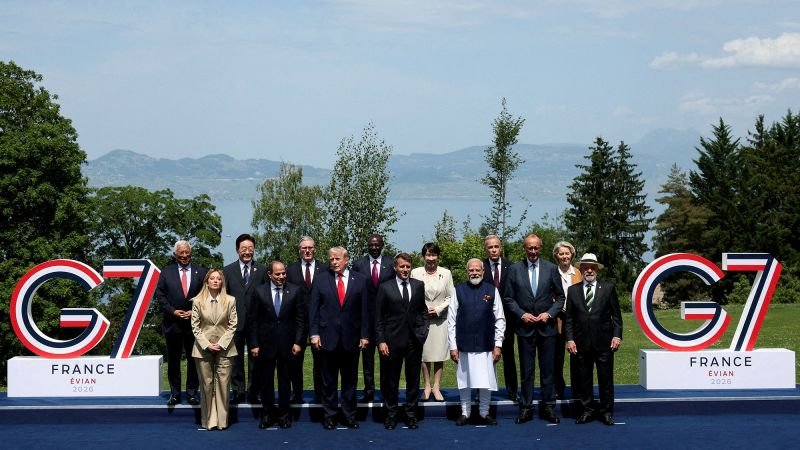
• G7 summit: World leaders have gathered at the G7 summit in Évian-les-Bains, France, where discussions about US President Donald Trump’s agreement with Iran have been “frank,” sources say. Trump spoke with the leaders of three Arab states as well as Ukrainian President Volodymyr Zelensky.
• US-Iran agreement: Trump vowed to publicly release the text of the agreement “in a couple of days,” and even floated reciting the document in front of cameras. He also said he’d send it to Congress for review.
• Lebanon a sticking point: Iran is demanding Israel withdraw from Lebanon as part of the agreement. And Iran’s military warned Israel to expect a “harsh response” if it doesn’t end its campaign against Hezbollah, according to semi-official Fars News Agency. US officials said Monday that Israel’s withdrawal from Lebanon was not part of the agreement.
54 Posts
While US President Donald Trump announced an agreement with Iran, the text has not been released yet, leading to tensions domestically and internationally.
Israel’s request to see the text was rejected by the US, an Israeli source told CNN.
In addition, Vance in an interview to CBS on Monday seemed to tacitly confirm the premise that Iran could be given “access” to a reconstruction fund worth as much as $300 billion.
Some more background: Trump’s national security team met nearly every day to discuss an evolving agreement to end the Iran war, with many concerned that Tehran would not hold up its end of the bargain, administration officials directly involved in the negotiations said.
CIA Director John Ratcliffe and Defense Secretary Pete Hegseth were among the “most pessimistic” about whether the Iranians would honor their commitments to make substantive concessions on their nuclear program, even if they agreed to negotiate on that issue, an official said. Nearly ever senior official, including Vance, Secretary of State Marco Rubio, Trump’s envoys Steve Witkoff and Jared Kushner, raised serious reservations, officials said. They ultimately reached Trump-driven consensus: “We want to get this thing over with,” an administration official directly involved in the talks told CNN.
US officials are also downplaying the significance of the specific language in the document. They described the text of the agreement as incredibly vague, mainly intended to create a more favorable environment for the highly technical, in-person talks to come. It is also aimed at providing Iran the ability to sell it politically to their internal audience, they added. The agreement doesn’t reflect critical back-channel commitments Iran has made to the US, which they argued gave them more confidence in signing on to the arrangement.
Senate Minority Leader Chuck Schumer demanded today that the Trump administration brief top congressional leaders, known as the Gang of Eight, on the agreement and provide briefings for the rest of Congress as well.
CNN’s Christopher Lamb, Morgan Rimmer, Max Saltman, Morgan Leason, Tal Shalev and Alejandra Jaramillo contributed to this report.
Iran successfully exported its first crude oil shipments in two months after Washington and Iran reached an agreement to end the US naval blockade, according to maritime intelligence company TankerTrackers.
Citing tracking data verified with satellite imagery of the vessels, the company said at least two National Iranian Tanker Company supertankers had sailed past the US naval blockade line, carrying 3.8 million barrels of crude oil.
It comes after the US and Iran announced a framework agreement designed to end the US blockade of Iranian ports.
US President Donald Trump said Monday that the Strait of Hormuz had been reopened under the terms of the agreement, but later revised the timeline, saying the strait would reopen after a formal signing ceremony in Geneva on Friday.
Group of Seven leaders declared “unwavering support for Ukraine,” including agreeing to increase the delivery of air defense assistance to Kyiv and to step up economic pressure on Russia — noteworthy commitments for President Donald Trump to have signed off on.
The leaders’ statement on geopolitical issues, released by the Élysée, says they committed to strengthening Russian sanctions, “including those on the oil and gas sectors.”
“We consider this the right moment to proceed with additional measures, as President Trump has delivered a deal that we support in reopening the Strait of Hormuz,” the statement continues.
On Iran, the leaders said they “support” the agreement reached between Washington and Tehran and “are ready to contribute to its implementation,” while calling for a “a robust and comprehensive diplomatic follow-on agreement.”
The leaders also said they supported Lebanon’s efforts to disarm Hezbollah “through an immediate robust ceasefire.” And in Gaza, they said they’d increase humanitarian and reconstruction efforts.
In the Indo-Pacific, the leaders said they opposed “any unilateral attempts to change the status quo, in particular by force or coercion, in the East and South China Seas and across the Taiwan Strait.”
The Trump administration wants Iran to clear the mines it is said to have placed in the Strait of Hormuz, but an expert says the task is expected to be challenging for Tehran.
A document of White House talking points on the memorandum of understanding states that “Iran does the de-mining and clears every obstacle” in the critical waterway.
A senior US administration official told reporters Monday that the United States expects operations in the strait to “return to normal pretty quickly, definitely within 30 days, once they’ve committed to get rid of all the mines.”
Scott Savitz, a senior engineer at RAND, told CNN that Iran is “very good at mining, but mining countermeasures is a fundamentally different kind of operation, so it’s unclear how good they are.”
“It’s very technically complex. It’s more likely that [Iran] have some sonar capabilities and some ability to perhaps sweep” but almost certainly not identify the precise locations of mines, he said.
The senior official said Monday that if the Iranians are “not moving quick enough,” the US “could help them with the disposition” of the mines, because “we know where all the mines are at this point.”
“There’s a couple we can get rid of if they’re prioritized; that should open up … a bunch of more lanes,” the official said.
Pope Leo XIV praised the agreement between the US and Iran on Tuesday, saying he hoped it would mean “that the war really is over, and that we can move forward.”
“There will still be several points to settle, but it is always better to do so through dialogue, through negotiations, and not by returning to war,” the pope added. “I hope that it truly is a solution to the war, that the war really is over, and that we can move forward.”
The pope has been one of the most prominent critics of the US-Israeli war with Iran. He has rebuked leaders for using religious language to justify the conflict and said that Christ “does not listen to the prayers of those who wage war, but rejects them.”
Canadian Prime Minister Mark Carney said he has seen the agreement between the United States and Iran and said that it is a “game changer.”
The framework is a 60-day ceasefire that sets out what will happen moving forward, he said.
Hear what else Carney had to say about the agreement:
The Senate failed to advance a resolution on Tuesday aimed at limiting President Donald Trump’s war powers by requiring congressional approval for any further military action in Iran.
The push to bring the bill to the Senate floor failed 47-48. Democratic Sen. John Fetterman voted against advancing it, while GOP Sens. Rand Paul, Bill Cassidy, Lisa Murkowski and Susan Collins joined Democrats’ effort.
This was the Senate’s ninth vote on an Iran war powers measure this year. While most of the efforts brought by Democrats have failed, one measure advanced last month 50-47, with Paul, Collins, Murkowski and Cassidy voting with Democrats. However, several Republican senators were absent that day.
Democratic Sen. Tim Kaine, who has been a staunch supporter of curbing Trump’s war powers in Iran and beyond, told reporters Monday that the preliminary agreement between Iran and the US was all the more reason for Congress to assert its constitutional power.
“I think it’s a good time to have the vote to say, ‘Hey, if we’re really in a period of maybe some stability here, let’s not just allow it to start up again without Congress being involved in that decision,’” he said.
Senate Majority Leader John Thune said he has not yet been briefed on the details of the agreement with Iran, even as GOP Sen. Roger Marshall noted that Vice President JD Vance held a conference call with “several senators” on Monday. However, many senators in both parties have said that Congress would have to weigh in and even vote on any final deal with Iran, if one materializes.
Senate Minority Leader Chuck Schumer demanded Tuesday that the Trump administration brief top congressional leaders, known as the Gang of Eight, on the US agreement with Iran and provide briefings for the rest of Congress as well.
Schumer also called on President Donald Trump to “immediately tell the American people whatever is in his so-called deal. He needs to stop keeping America in the dark.”
The Democratic leader also noted that the Senate will vote this afternoon on a measure aimed at restricting Trump’s war powers in Iran for the ninth time this year.
Iran’s military headquarters warned Israel on Tuesday to end its campaign against Hezbollah in Lebanon, according to a statement published by the semi-official Fars News Agency.
If Israel does not “put an end to its aggression in southern Lebanon, it should expect a harsh response from the powerful armed forces of the Islamic Republic of Iran,” reads the statement, which Fars attributed to Iran’s top joint military command, the Khatam al-Anbiya Central Headquarters.
Iran and Pakistan have both insisted that the agreement between Iran and the US requires Israel to cease hostilities, and hours before the agreement was announced, US President Donald Trump publicly called on Israel to stop its attacks in Lebanon.
However, a senior US official has said that the agreement does not require Israel to withdraw from the country, and Israel has refused to end its military campaign against the Iranian-backed Lebanese militant group.
Vice President JD Vance said Tuesday that the US has not released text of the highly anticipated peace agreement with Iran because officials needed to “sequence this in the right way.”
“There are some delicate diplomatic things going on where the Iranians, and not just the Iranians, but some of our mediators — the Pakistanis and the Qataris — have asked us to sequence this in the right way,” Vance said on the Megyn Kelly show, adding that he doesn’t “fully understand” the reasoning behind the secrecy.
“There are sensitivities that exist in the Arab and Muslim world that we’re trying to be responsive to,” Vance continued.
Conservative foreign policy hawks have been demanding to see the text. They are openly worried that the initial peace agreement will closely resemble the one signed under the Obama administration in 2015, which they derided as too weak.
It remains unclear what US concessions will be made in the agreement. Vance reiterated Tuesday that the text of the memorandum of understanding would be released “at the very latest” on Friday.
Israel asked the US to see the text of the Iran agreement and was rejected, an Israeli source tells CNN, leaving a key US ally in the dark about a deal that’s already being widely criticized.
The source said part of the reason the request was turned down was because the Trump administration feared Prime Minister Benjamin Netanyahu would leak the agreement before it was officially released.
Israel’s i24 News was first to report the request and subsequent rejection. A US official called the report “not accurate” and said “the United States has remained in close coordination with our regional partners, including Israel, throughout the negotiations.” CNN has reached out to the Israeli Prime Minister’s Office for comment.
On Monday evening, Netanyahu held a news conference in which he hardly addressed the agreement in his eight-minute opening statement. When asked afterward, Netanyahu said he and President Donald Trump “do not always see eye to eye.”
He also said, “We still do not know what the agreement will be.”
Vice President JD Vance suggested Tuesday that the US could walk away if future negotiations with Iran collapse, arguing that Washington is in a strong position following the recently announced memorandum of understanding between the two countries.
“Now, if they comply with this deal, I think it’s much better for the United States, and it’s going to be much better for Iran,” Vance said on “The Megyn Kelly Show.”
He added: “But if they don’t comply with the deal, the straits are still open, we’ve still done incredible damage to their nuclear program, and it’s really, you know, we can get on with our lives as a country.”
Vance’s comments came hours after President Donald Trump said the next phase of negotiations with Iran would be “easier” than the talks that led to the current agreement, signaling optimism about the path ahead despite lingering questions over the details.
Vice President JD Vance defended President Donald Trump’s comments on loving inflation in an appearance on The View, while assuring that the president “knows that a lot of Americans are struggling.”
“What he said is that he loves the fact that the inflation is going to come down when this war is over,” Vance said, as the hosts pushed back.
“That’s not what he said,” Joy Behar said. “Are you his interpreter, or are you his vice president?”
“People were asking about the inflation, they were asking about the affordability problem, which again is very real. And what he said is, I love the inflation because it’s going to come down when the war is over,” Vance said.
Trump told reporters last week: “I love the inflation. No, I love it, the numbers were great.” He added later, when he was asked about inflation again: “When the war is over? It’s coming down. It’s going to come down like a rock.”
The president has repeatedly argued that inflation and gas prices will come down quickly once the war with Iran ends. The latest inflation numbers showed that in May, inflation rose to a three-year high of 4.2%.
Vance conceded that the administration has more work to do on the economy, including on gas prices, which he said are “way too high right now,” though he touted new investments and factory construction that he says will pay off “over the long haul.”
President Donald Trump is meeting world leaders at the Group of Seven summit in France, where talks of a US-Iran agreement are top of mind.
Sources said discussions about the agreement have been “frank.”
Meanwhile, Trump has vowed to publicly release the text of the agreement with Iran “in a couple of days” and even floated reciting the entire document in front of cameras.
Get up to speed on the latest here:
In a bilateral meeting with the emir of Qatar, Trump claimed the next phase of negotiations with Iran would be “easier” than the initial round that led to the recently announced memorandum of understanding. He also expressed his frustration with Israeli Prime Minister Benjamin Netanyahu, telling reporters he needed to be “more responsible with respect to Lebanon.”
Trump committed to sending the eventual text of his agreement with Iran to Congress for review, even though he said that had not crossed his mind originally.
Iranian Foreign Minister Abbas Araghchi said Tehran sees the war in Lebanon as “linked and interdependent” with the conflict between the US and Iran. Therefore, he said, any agreement to end the war must include Lebanon.
Meanwhile, mediators in US-Iran talks are discussing nonaggression pacts, non-state armed groups and nuclear issues with Iran, according to Qatar.
Multiple officials have also spoken about a potential $300 billion fund that would be intended for the reconstruction of Iran, but who would pay this vast amount — and when — remains unclear. Trump has denied the fund plan.
Restrictions on shipping through the Strait of Hormuz have been eased, with a small number of vessels allowed to pass ahead of the formal signing of the US-Iran agreement, Iran’s deputy foreign minister told state-controlled broadcaster Islamic Republic of Iran Broadcasting (IRIB).
Separately, Trump said that he would meet with Ukrainian President Volodymyr Zelensky later today, encouraging Russia to agree to a deal that would end its war. Earlier, Zelensky said “everyone” at the G7 summit agreed to help his country strengthen its air defenses. Zelensky made securing more air defense capabilities one of the priorities of his trip to France.
CNN’s Kevin Liptak, Aida Karimi, Nadeen Ebrahim, Oliver Sherwood, Mustafa Qadri, Kit Maher, Sarah Tamimi, Niamh Kennedy and Ivana Kottasová contributed to this report.
US intelligence agencies have recently assessed that Iran can effectively shut down access to the Strait of Hormuz at will from now on, meaning the country’s regime has acquired a powerful new ability to hurt the global economy as a result of the war, according to three sources familiar with the findings.
Regardless of the framework agreement that is due to be formally signed on Friday to open the key waterway as a prelude to nuclear talks, Iran proved it can shut off access to the strait during the current conflict, and US intelligence assessments suggest that could happen again.
Iran has similarly learned it can leverage targeted strikes against the energy infrastructure of the Persian Gulf’s Arab countries after doing so to great effect during the war, a second source familiar with the assessments said.
CNN has approached the White House and the Office of the Director of National Intelligence for comment.
One of the main reasons Iran believes it can continue to weaponize the strait is it retains a significant portion of its arsenal, including missiles, drones, missile launchers and hundreds of small fast boats that continue to harass shippers attempting to transit the waterway and can be used to lay mines.
Iran has also been rebuilding its military industrial base faster than the US anticipated and has already begun new drone production, CNN has reported.
Read more on this story in our full article here.
At least four people were killed amid separate Israeli strikes in Lebanon on Tuesday, according to Lebanese state media.
The Israeli military struck the southern Lebanese town of Mayfadoun three times, the National News Agency (NNA) reported. The drone strikes came around 4:45 p.m., striking Mayfadoun’s town square.
NNA also reported an attack on a vehicle in Choukine, a town adjacent to Mayfadoun. The outlet also said that a drone dropped a “sound bomb” on Haddatha, a town roughly 13 miles southeast of the two other towns. Four young men were reportedly injured in the strike.
CNN has reached out to the Israeli military for comment on the strikes.
Separately, the Israel Defense Forces (IDF) said in a statement that it had struck a rocket launcher after intercepting several projectiles from Lebanon earlier on Tuesday. The military added that it had “identified a suspicious vehicle in the area where IDF soldiers are operating in southern Lebanon and fired a warning shot toward it, and later conducted a strike in the area to remove the threat.”
Earlier today, Iranian Foreign Minister Abbas Araghchi warned that the wider war between the US and Iran will not end unless Israel withdraws from Lebanon as a condition of the agreement announced over the weekend. Locals who had previously evacuated due to Israeli strikes had even begun returning to their villages after the announcement on Sunday.
However, a senior US official has said that an Israeli withdrawal is not part of the agreement with Iran. Israeli officials, including Prime Minister Benjamin Netanyahu, have said that Israel intends to continue its military campaign.
This post has been updated with new information from the Israeli military.
Senate Majority Leader John Thune said he has not been briefed – nor asked for a briefing – on the US-Iran agreement, even as several senators have spoken with the vice president about it.
“I haven’t yet, but my assumption is, as the week wears on, and we get closer to whenever the public release of this is going to happen. But I mean, there isn’t text out there yet,” Thune told reporters.
He added, “We will get briefed when the text is available, I assume.”
The Republican leader said Congress has requested the Iran MOU from the Trump administration. “We’re trying to get it, yeah,” he told reporters.
GOP Sen. Roger Marshall, however, said Vice President JD Vance spoke with several senators yesterday. Afterward, Marshall posted on X that the agreement was a “win for America.”
“We had a great conference call, and again, I think the emphasis is, number one, is Iran will never have a nuclear weapon and the Strait of Hormuz is going to be open, most importantly,” he told reporters this morning.
This post has been updated with additional details.
Oil futures continue to plunge as traders bet on a rapid reopening of the Strait of Hormuz following the diplomatic breakthrough between the United States and Iran.
Brent crude, the world benchmark, tumbled as much as 4.3% to $79.61 a barrel on Tuesday.
It’s the first time Brent has traded below $80 since March 3, days after the war with Iran started. Brent has now plunged by 37% from its intraday peak of $126.41 on April 30.
West Texas Intermediate (WTI), the US benchmark, tumbled 4% to $77.60 a barrel in recent trading.
Although some key details about the US-Iran framework remain unclear, the diplomatic milestone has already caused some Wall Street banks to sharply dial back their warnings of high oil prices.
Citigroup told clients on Monday that the US-Iran framework is a “big deal” that should allow Strait of Hormuz flows to resume “relatively quickly,” returning to normal by mid-to-late July.
Citi slashed its oil price forecasts for the rest of the year, projecting $75 a barrel and $70 in the third and fourth quarters, respectively. That’s down from the bank’s prior call of $110 and $90.
Likewise, Goldman Sachs told clients Monday night it now expects Persian Gulf exports to normalize to pre-war levels by the end of July, up from its prior forecast of the end of August. Goldman expects Brent to average $80 a barrel in the fourth quarter, down from $90 previously.
However, Goldman Sachs also cautions that the risks to oil prices are still “tilted to the upside,” warning that Brent could top $130 a barrel if the Strait of Hormuz remains disrupted.
Iran is demanding Israel withdraw from Lebanon as part of the agreement Tehran has struck with the United States.
Speaking to ambassadors and heads of foreign diplomatic missions and international organizations in Tehran, Iranian Foreign Minister Abbas Araghchi said that Tehran sees the war in Lebanon as “linked and interdependent” with the conflict between the US and Iran.
Therefore, he said, any agreement to end the war must include Lebanon.
“From the first day, the Islamic Republic of Iran considered the end of the war in Lebanon to be one of the requirements for ending the war with Iran,” Araghchi said. Iran sees the agreement as one between “United States and Israel on one side and on the other side, Iran and Hezbollah,” he added.
“Without the withdrawal of Israeli forces from the territories they occupied during this war, the termination of the war will not be complete,” he said.
US officials said Monday that Israel’s withdrawal from Lebanon was not part of the agreement. Israeli officials, including Prime Minister Benjamin Netanyahu, said the country’s military would not be withdrawing from southern Lebanon.
US President Donald Trump has at times grown frustrated with Netanyahu, believing that Israel’s attacks against Hezbollah in Lebanon made any deal with Iran harder to reach.
Speaking at the Group of Seven summit in France on Tuesday, Trump said Netanyahu “has to be more responsible with respect to Lebanon.”
Ukrainian President Volodymyr Zelensky said “everyone” at the Group of Seven summit agreed to help his country strengthen its air defenses.
Zelensky made securing more air defense capabilities one of the priorities of his trip to France — and speaking after his first batch of meetings on Tuesday afternoon, he said he was positive about the outcomes.
“This is a big challenge really because the production is not so big as our needs. The production is in the United States. I raised the topic of licenses. I addressed it to President Trump. We need licenses to produce missiles,” Zelensky told Reuters.
Zelensky said his suggestion was received positively by his American counterpart, adding: “I hope when President Trump is positive, it’s yes.”
Russia is attempting to overwhelm Ukraine’s air defenses by launching hundreds of drones and dozens of missiles at a time, as often as several times a week.
While Ukraine has made major technological advances in the ways it combats Russian attacks, it is still dependent on Western systems when it comes to shooting down Russia’s most advanced missiles.
Ukraine has secured number of US-made Patriot air defense systems, the crème de la crème of anti-missile weapons, from its Western allies, but it is chronically short of missiles for them.
This shortage was made significantly worse by the war in the Middle East after some of the supplies originally meant for Kyiv were diverted to the Persian Gulf. Securing a license to produce Patriot missiles would be a huge win for Ukraine.
The US has not commented on the suggestion.
• G7 summit: World leaders have gathered at the G7 summit in Évian-les-Bains, France, where discussions about US President Donald Trump’s agreement with Iran have been “frank,” sources say. Trump spoke with the leaders of three Arab states as well as Ukrainian President Volodymyr Zelensky.
• US-Iran agreement: Trump vowed to publicly release the text of the agreement “in a couple of days,” and even floated reciting the document in front of cameras. He also said he’d send it to Congress for review.
• Lebanon a sticking point: Iran is demanding Israel withdraw from Lebanon as part of the agreement. And Iran’s military warned Israel to expect a “harsh response” if it doesn’t end its campaign against Hezbollah, according to semi-official Fars News Agency. US officials said Monday that Israel’s withdrawal from Lebanon was not part of the agreement.
While US President Donald Trump announced an agreement with Iran, the text has not been released yet, leading to tensions domestically and internationally.
Israel’s request to see the text was rejected by the US, an Israeli source told CNN.
In addition, Vance in an interview to CBS on Monday seemed to tacitly confirm the premise that Iran could be given “access” to a reconstruction fund worth as much as $300 billion.
Some more background: Trump’s national security team met nearly every day to discuss an evolving agreement to end the Iran war, with many concerned that Tehran would not hold up its end of the bargain, administration officials directly involved in the negotiations said.
CIA Director John Ratcliffe and Defense Secretary Pete Hegseth were among the “most pessimistic” about whether the Iranians would honor their commitments to make substantive concessions on their nuclear program, even if they agreed to negotiate on that issue, an official said. Nearly ever senior official, including Vance, Secretary of State Marco Rubio, Trump’s envoys Steve Witkoff and Jared Kushner, raised serious reservations, officials said. They ultimately reached Trump-driven consensus: “We want to get this thing over with,” an administration official directly involved in the talks told CNN.
US officials are also downplaying the significance of the specific language in the document. They described the text of the agreement as incredibly vague, mainly intended to create a more favorable environment for the highly technical, in-person talks to come. It is also aimed at providing Iran the ability to sell it politically to their internal audience, they added. The agreement doesn’t reflect critical back-channel commitments Iran has made to the US, which they argued gave them more confidence in signing on to the arrangement.
Senate Minority Leader Chuck Schumer demanded today that the Trump administration brief top congressional leaders, known as the Gang of Eight, on the agreement and provide briefings for the rest of Congress as well.
CNN’s Christopher Lamb, Morgan Rimmer, Max Saltman, Morgan Leason, Tal Shalev and Alejandra Jaramillo contributed to this report.
Iran successfully exported its first crude oil shipments in two months after Washington and Iran reached an agreement to end the US naval blockade, according to maritime intelligence company TankerTrackers.
Citing tracking data verified with satellite imagery of the vessels, the company said at least two National Iranian Tanker Company supertankers had sailed past the US naval blockade line, carrying 3.8 million barrels of crude oil.
It comes after the US and Iran announced a framework agreement designed to end the US blockade of Iranian ports.
US President Donald Trump said Monday that the Strait of Hormuz had been reopened under the terms of the agreement, but later revised the timeline, saying the strait would reopen after a formal signing ceremony in Geneva on Friday.
Group of Seven leaders declared “unwavering support for Ukraine,” including agreeing to increase the delivery of air defense assistance to Kyiv and to step up economic pressure on Russia — noteworthy commitments for President Donald Trump to have signed off on.
The leaders’ statement on geopolitical issues, released by the Élysée, says they committed to strengthening Russian sanctions, “including those on the oil and gas sectors.”
“We consider this the right moment to proceed with additional measures, as President Trump has delivered a deal that we support in reopening the Strait of Hormuz,” the statement continues.
On Iran, the leaders said they “support” the agreement reached between Washington and Tehran and “are ready to contribute to its implementation,” while calling for a “a robust and comprehensive diplomatic follow-on agreement.”
The leaders also said they supported Lebanon’s efforts to disarm Hezbollah “through an immediate robust ceasefire.” And in Gaza, they said they’d increase humanitarian and reconstruction efforts.
In the Indo-Pacific, the leaders said they opposed “any unilateral attempts to change the status quo, in particular by force or coercion, in the East and South China Seas and across the Taiwan Strait.”
The Trump administration wants Iran to clear the mines it is said to have placed in the Strait of Hormuz, but an expert says the task is expected to be challenging for Tehran.
A document of White House talking points on the memorandum of understanding states that “Iran does the de-mining and clears every obstacle” in the critical waterway.
A senior US administration official told reporters Monday that the United States expects operations in the strait to “return to normal pretty quickly, definitely within 30 days, once they’ve committed to get rid of all the mines.”
Scott Savitz, a senior engineer at RAND, told CNN that Iran is “very good at mining, but mining countermeasures is a fundamentally different kind of operation, so it’s unclear how good they are.”
“It’s very technically complex. It’s more likely that [Iran] have some sonar capabilities and some ability to perhaps sweep” but almost certainly not identify the precise locations of mines, he said.
The senior official said Monday that if the Iranians are “not moving quick enough,” the US “could help them with the disposition” of the mines, because “we know where all the mines are at this point.”
“There’s a couple we can get rid of if they’re prioritized; that should open up … a bunch of more lanes,” the official said.
Pope Leo XIV praised the agreement between the US and Iran on Tuesday, saying he hoped it would mean “that the war really is over, and that we can move forward.”
“There will still be several points to settle, but it is always better to do so through dialogue, through negotiations, and not by returning to war,” the pope added. “I hope that it truly is a solution to the war, that the war really is over, and that we can move forward.”
The pope has been one of the most prominent critics of the US-Israeli war with Iran. He has rebuked leaders for using religious language to justify the conflict and said that Christ “does not listen to the prayers of those who wage war, but rejects them.”
Canadian Prime Minister Mark Carney said he has seen the agreement between the United States and Iran and said that it is a “game changer.”
The framework is a 60-day ceasefire that sets out what will happen moving forward, he said.
Hear what else Carney had to say about the agreement:
The Senate failed to advance a resolution on Tuesday aimed at limiting President Donald Trump’s war powers by requiring congressional approval for any further military action in Iran.
The push to bring the bill to the Senate floor failed 47-48. Democratic Sen. John Fetterman voted against advancing it, while GOP Sens. Rand Paul, Bill Cassidy, Lisa Murkowski and Susan Collins joined Democrats’ effort.
This was the Senate’s ninth vote on an Iran war powers measure this year. While most of the efforts brought by Democrats have failed, one measure advanced last month 50-47, with Paul, Collins, Murkowski and Cassidy voting with Democrats. However, several Republican senators were absent that day.
Democratic Sen. Tim Kaine, who has been a staunch supporter of curbing Trump’s war powers in Iran and beyond, told reporters Monday that the preliminary agreement between Iran and the US was all the more reason for Congress to assert its constitutional power.
“I think it’s a good time to have the vote to say, ‘Hey, if we’re really in a period of maybe some stability here, let’s not just allow it to start up again without Congress being involved in that decision,’” he said.
Senate Majority Leader John Thune said he has not yet been briefed on the details of the agreement with Iran, even as GOP Sen. Roger Marshall noted that Vice President JD Vance held a conference call with “several senators” on Monday. However, many senators in both parties have said that Congress would have to weigh in and even vote on any final deal with Iran, if one materializes.
Senate Minority Leader Chuck Schumer demanded Tuesday that the Trump administration brief top congressional leaders, known as the Gang of Eight, on the US agreement with Iran and provide briefings for the rest of Congress as well.
Schumer also called on President Donald Trump to “immediately tell the American people whatever is in his so-called deal. He needs to stop keeping America in the dark.”
The Democratic leader also noted that the Senate will vote this afternoon on a measure aimed at restricting Trump’s war powers in Iran for the ninth time this year.
Iran’s military headquarters warned Israel on Tuesday to end its campaign against Hezbollah in Lebanon, according to a statement published by the semi-official Fars News Agency.
If Israel does not “put an end to its aggression in southern Lebanon, it should expect a harsh response from the powerful armed forces of the Islamic Republic of Iran,” reads the statement, which Fars attributed to Iran’s top joint military command, the Khatam al-Anbiya Central Headquarters.
Iran and Pakistan have both insisted that the agreement between Iran and the US requires Israel to cease hostilities, and hours before the agreement was announced, US President Donald Trump publicly called on Israel to stop its attacks in Lebanon.
However, a senior US official has said that the agreement does not require Israel to withdraw from the country, and Israel has refused to end its military campaign against the Iranian-backed Lebanese militant group.
Vice President JD Vance said Tuesday that the US has not released text of the highly anticipated peace agreement with Iran because officials needed to “sequence this in the right way.”
“There are some delicate diplomatic things going on where the Iranians, and not just the Iranians, but some of our mediators — the Pakistanis and the Qataris — have asked us to sequence this in the right way,” Vance said on the Megyn Kelly show, adding that he doesn’t “fully understand” the reasoning behind the secrecy.
“There are sensitivities that exist in the Arab and Muslim world that we’re trying to be responsive to,” Vance continued.
Conservative foreign policy hawks have been demanding to see the text. They are openly worried that the initial peace agreement will closely resemble the one signed under the Obama administration in 2015, which they derided as too weak.
It remains unclear what US concessions will be made in the agreement. Vance reiterated Tuesday that the text of the memorandum of understanding would be released “at the very latest” on Friday.
Israel asked the US to see the text of the Iran agreement and was rejected, an Israeli source tells CNN, leaving a key US ally in the dark about a deal that’s already being widely criticized.
The source said part of the reason the request was turned down was because the Trump administration feared Prime Minister Benjamin Netanyahu would leak the agreement before it was officially released.
Israel’s i24 News was first to report the request and subsequent rejection. A US official called the report “not accurate” and said “the United States has remained in close coordination with our regional partners, including Israel, throughout the negotiations.” CNN has reached out to the Israeli Prime Minister’s Office for comment.
On Monday evening, Netanyahu held a news conference in which he hardly addressed the agreement in his eight-minute opening statement. When asked afterward, Netanyahu said he and President Donald Trump “do not always see eye to eye.”
He also said, “We still do not know what the agreement will be.”
Vice President JD Vance suggested Tuesday that the US could walk away if future negotiations with Iran collapse, arguing that Washington is in a strong position following the recently announced memorandum of understanding between the two countries.
“Now, if they comply with this deal, I think it’s much better for the United States, and it’s going to be much better for Iran,” Vance said on “The Megyn Kelly Show.”
He added: “But if they don’t comply with the deal, the straits are still open, we’ve still done incredible damage to their nuclear program, and it’s really, you know, we can get on with our lives as a country.”
Vance’s comments came hours after President Donald Trump said the next phase of negotiations with Iran would be “easier” than the talks that led to the current agreement, signaling optimism about the path ahead despite lingering questions over the details.
Vice President JD Vance defended President Donald Trump’s comments on loving inflation in an appearance on The View, while assuring that the president “knows that a lot of Americans are struggling.”
“What he said is that he loves the fact that the inflation is going to come down when this war is over,” Vance said, as the hosts pushed back.
“That’s not what he said,” Joy Behar said. “Are you his interpreter, or are you his vice president?”
“People were asking about the inflation, they were asking about the affordability problem, which again is very real. And what he said is, I love the inflation because it’s going to come down when the war is over,” Vance said.
Trump told reporters last week: “I love the inflation. No, I love it, the numbers were great.” He added later, when he was asked about inflation again: “When the war is over? It’s coming down. It’s going to come down like a rock.”
The president has repeatedly argued that inflation and gas prices will come down quickly once the war with Iran ends. The latest inflation numbers showed that in May, inflation rose to a three-year high of 4.2%.
Vance conceded that the administration has more work to do on the economy, including on gas prices, which he said are “way too high right now,” though he touted new investments and factory construction that he says will pay off “over the long haul.”
President Donald Trump is meeting world leaders at the Group of Seven summit in France, where talks of a US-Iran agreement are top of mind.
Sources said discussions about the agreement have been “frank.”
Meanwhile, Trump has vowed to publicly release the text of the agreement with Iran “in a couple of days” and even floated reciting the entire document in front of cameras.
Get up to speed on the latest here:
In a bilateral meeting with the emir of Qatar, Trump claimed the next phase of negotiations with Iran would be “easier” than the initial round that led to the recently announced memorandum of understanding. He also expressed his frustration with Israeli Prime Minister Benjamin Netanyahu, telling reporters he needed to be “more responsible with respect to Lebanon.”
Trump committed to sending the eventual text of his agreement with Iran to Congress for review, even though he said that had not crossed his mind originally.
Iranian Foreign Minister Abbas Araghchi said Tehran sees the war in Lebanon as “linked and interdependent” with the conflict between the US and Iran. Therefore, he said, any agreement to end the war must include Lebanon.
Meanwhile, mediators in US-Iran talks are discussing nonaggression pacts, non-state armed groups and nuclear issues with Iran, according to Qatar.
Multiple officials have also spoken about a potential $300 billion fund that would be intended for the reconstruction of Iran, but who would pay this vast amount — and when — remains unclear. Trump has denied the fund plan.
Restrictions on shipping through the Strait of Hormuz have been eased, with a small number of vessels allowed to pass ahead of the formal signing of the US-Iran agreement, Iran’s deputy foreign minister told state-controlled broadcaster Islamic Republic of Iran Broadcasting (IRIB).
Separately, Trump said that he would meet with Ukrainian President Volodymyr Zelensky later today, encouraging Russia to agree to a deal that would end its war. Earlier, Zelensky said “everyone” at the G7 summit agreed to help his country strengthen its air defenses. Zelensky made securing more air defense capabilities one of the priorities of his trip to France.
CNN’s Kevin Liptak, Aida Karimi, Nadeen Ebrahim, Oliver Sherwood, Mustafa Qadri, Kit Maher, Sarah Tamimi, Niamh Kennedy and Ivana Kottasová contributed to this report.
US intelligence agencies have recently assessed that Iran can effectively shut down access to the Strait of Hormuz at will from now on, meaning the country’s regime has acquired a powerful new ability to hurt the global economy as a result of the war, according to three sources familiar with the findings.
Regardless of the framework agreement that is due to be formally signed on Friday to open the key waterway as a prelude to nuclear talks, Iran proved it can shut off access to the strait during the current conflict, and US intelligence assessments suggest that could happen again.
Iran has similarly learned it can leverage targeted strikes against the energy infrastructure of the Persian Gulf’s Arab countries after doing so to great effect during the war, a second source familiar with the assessments said.
CNN has approached the White House and the Office of the Director of National Intelligence for comment.
One of the main reasons Iran believes it can continue to weaponize the strait is it retains a significant portion of its arsenal, including missiles, drones, missile launchers and hundreds of small fast boats that continue to harass shippers attempting to transit the waterway and can be used to lay mines.
Iran has also been rebuilding its military industrial base faster than the US anticipated and has already begun new drone production, CNN has reported.
Read more on this story in our full article here.
At least four people were killed amid separate Israeli strikes in Lebanon on Tuesday, according to Lebanese state media.
The Israeli military struck the southern Lebanese town of Mayfadoun three times, the National News Agency (NNA) reported. The drone strikes came around 4:45 p.m., striking Mayfadoun’s town square.
NNA also reported an attack on a vehicle in Choukine, a town adjacent to Mayfadoun. The outlet also said that a drone dropped a “sound bomb” on Haddatha, a town roughly 13 miles southeast of the two other towns. Four young men were reportedly injured in the strike.
CNN has reached out to the Israeli military for comment on the strikes.
Separately, the Israel Defense Forces (IDF) said in a statement that it had struck a rocket launcher after intercepting several projectiles from Lebanon earlier on Tuesday. The military added that it had “identified a suspicious vehicle in the area where IDF soldiers are operating in southern Lebanon and fired a warning shot toward it, and later conducted a strike in the area to remove the threat.”
Earlier today, Iranian Foreign Minister Abbas Araghchi warned that the wider war between the US and Iran will not end unless Israel withdraws from Lebanon as a condition of the agreement announced over the weekend. Locals who had previously evacuated due to Israeli strikes had even begun returning to their villages after the announcement on Sunday.
However, a senior US official has said that an Israeli withdrawal is not part of the agreement with Iran. Israeli officials, including Prime Minister Benjamin Netanyahu, have said that Israel intends to continue its military campaign.
This post has been updated with new information from the Israeli military.
Senate Majority Leader John Thune said he has not been briefed – nor asked for a briefing – on the US-Iran agreement, even as several senators have spoken with the vice president about it.
“I haven’t yet, but my assumption is, as the week wears on, and we get closer to whenever the public release of this is going to happen. But I mean, there isn’t text out there yet,” Thune told reporters.
He added, “We will get briefed when the text is available, I assume.”
The Republican leader said Congress has requested the Iran MOU from the Trump administration. “We’re trying to get it, yeah,” he told reporters.
GOP Sen. Roger Marshall, however, said Vice President JD Vance spoke with several senators yesterday. Afterward, Marshall posted on X that the agreement was a “win for America.”
“We had a great conference call, and again, I think the emphasis is, number one, is Iran will never have a nuclear weapon and the Strait of Hormuz is going to be open, most importantly,” he told reporters this morning.
This post has been updated with additional details.
Oil futures continue to plunge as traders bet on a rapid reopening of the Strait of Hormuz following the diplomatic breakthrough between the United States and Iran.
Brent crude, the world benchmark, tumbled as much as 4.3% to $79.61 a barrel on Tuesday.
It’s the first time Brent has traded below $80 since March 3, days after the war with Iran started. Brent has now plunged by 37% from its intraday peak of $126.41 on April 30.
West Texas Intermediate (WTI), the US benchmark, tumbled 4% to $77.60 a barrel in recent trading.
Although some key details about the US-Iran framework remain unclear, the diplomatic milestone has already caused some Wall Street banks to sharply dial back their warnings of high oil prices.
Citigroup told clients on Monday that the US-Iran framework is a “big deal” that should allow Strait of Hormuz flows to resume “relatively quickly,” returning to normal by mid-to-late July.
Citi slashed its oil price forecasts for the rest of the year, projecting $75 a barrel and $70 in the third and fourth quarters, respectively. That’s down from the bank’s prior call of $110 and $90.
Likewise, Goldman Sachs told clients Monday night it now expects Persian Gulf exports to normalize to pre-war levels by the end of July, up from its prior forecast of the end of August. Goldman expects Brent to average $80 a barrel in the fourth quarter, down from $90 previously.
However, Goldman Sachs also cautions that the risks to oil prices are still “tilted to the upside,” warning that Brent could top $130 a barrel if the Strait of Hormuz remains disrupted.
Iran is demanding Israel withdraw from Lebanon as part of the agreement Tehran has struck with the United States.
Speaking to ambassadors and heads of foreign diplomatic missions and international organizations in Tehran, Iranian Foreign Minister Abbas Araghchi said that Tehran sees the war in Lebanon as “linked and interdependent” with the conflict between the US and Iran.
Therefore, he said, any agreement to end the war must include Lebanon.
“From the first day, the Islamic Republic of Iran considered the end of the war in Lebanon to be one of the requirements for ending the war with Iran,” Araghchi said. Iran sees the agreement as one between “United States and Israel on one side and on the other side, Iran and Hezbollah,” he added.
“Without the withdrawal of Israeli forces from the territories they occupied during this war, the termination of the war will not be complete,” he said.
US officials said Monday that Israel’s withdrawal from Lebanon was not part of the agreement. Israeli officials, including Prime Minister Benjamin Netanyahu, said the country’s military would not be withdrawing from southern Lebanon.
US President Donald Trump has at times grown frustrated with Netanyahu, believing that Israel’s attacks against Hezbollah in Lebanon made any deal with Iran harder to reach.
Speaking at the Group of Seven summit in France on Tuesday, Trump said Netanyahu “has to be more responsible with respect to Lebanon.”
Ukrainian President Volodymyr Zelensky said “everyone” at the Group of Seven summit agreed to help his country strengthen its air defenses.
Zelensky made securing more air defense capabilities one of the priorities of his trip to France — and speaking after his first batch of meetings on Tuesday afternoon, he said he was positive about the outcomes.
“This is a big challenge really because the production is not so big as our needs. The production is in the United States. I raised the topic of licenses. I addressed it to President Trump. We need licenses to produce missiles,” Zelensky told Reuters.
Zelensky said his suggestion was received positively by his American counterpart, adding: “I hope when President Trump is positive, it’s yes.”
Russia is attempting to overwhelm Ukraine’s air defenses by launching hundreds of drones and dozens of missiles at a time, as often as several times a week.
While Ukraine has made major technological advances in the ways it combats Russian attacks, it is still dependent on Western systems when it comes to shooting down Russia’s most advanced missiles.
Ukraine has secured number of US-made Patriot air defense systems, the crème de la crème of anti-missile weapons, from its Western allies, but it is chronically short of missiles for them.
This shortage was made significantly worse by the war in the Middle East after some of the supplies originally meant for Kyiv were diverted to the Persian Gulf. Securing a license to produce Patriot missiles would be a huge win for Ukraine.
The US has not commented on the suggestion.





Responses