
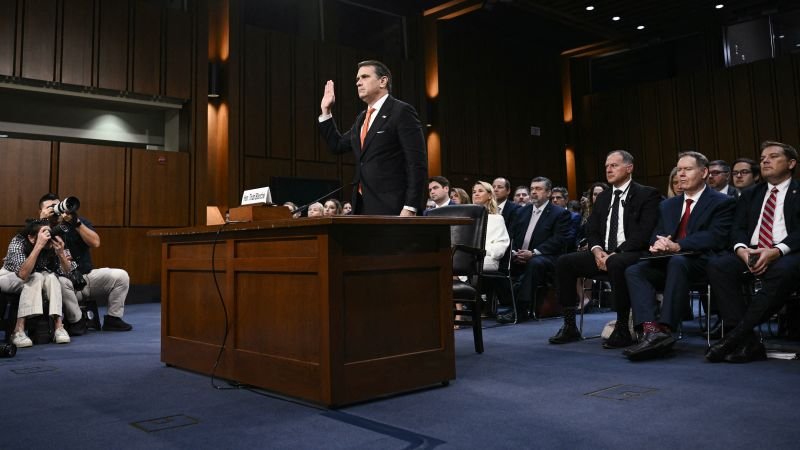
• Key nomination hearing: Todd Blanche, President Donald Trump’s nominee to be attorney general, is facing a high-stakes Judiciary Committee hearing. In his opening, Blanche argued he is “restoring American trust” in the Justice Department.
• Defends handling of Epstein files: Blanche acknowledged there were some errors in the vetting of Epstein files that were released to the public, but defended his handling of the case.
• GOP’s thin majority: Blanche’s confirmation isn’t assured. Sen. Lindsey Graham’s sudden death left the Judiciary Committee Republicans with just one vote to lose, a razor-thin margin of error.
• Other nominees: Jay Clayton, the president’s nominee for director of national intelligence, and Erica Schwartz, Trump’s pick to lead the US Centers for Disease Control and Prevention, are facing questions at separate confirmation hearings.
30 Posts
Dr. Erica Schwartz, President Donald Trump’s nominee to lead the US Centers for Disease Control and Prevention, expressed enthusiastic support for the “Make America Healthy Again” movement during a Senate confirmation hearing on Wednesday.
US Health and Human Services Secretary Robert F. Kennedy Jr. popularized the MAHA movement during his presidential campaign, calling for reforms to cut down artificial ingredients in foods, reduce medical prescriptions and restrict environmental toxins.
“I am all in on the ‘Make America Healthy Again’ agenda,” Schwartz told senators on the Health, Education, Labor, and Pensions committee.
Schwartz cited Kennedy-led changes to include nutrition education in medical schools, reintroduce fitness tests in schools and remove artificial food dyes from products.
“I am fully committed, if I am confirmed as a CDC director, to continue focusing on this ‘Make America Healthy Again,’ ” she said. “I’m all about looking at those upstream effects, looking at those things that we can prevent diseases and continue to make America healthy.”
Schwartz was less committal when asked by senators about changes to vaccine policy, telling Sen. Maggie Hassan that ending campaigns for flu vaccination was a “hypothetical” scenario.
During his confirmation hearing, acting Attorney General Todd Blanche called President Donald Trump’s decision to pardon those involved in the January 6, 2021 attack on the US Capitol “generous,” but added that he had not celebrated the pardons.
“Would you say that you are proud of President Trump’s decision to pardon individuals who assaulted law enforcement?” Democratic Sen. Chris Coons asked.
Blanche responded that past comments he made had been misconstrued by others to suggest he had praised Trump’s blanket pardons.
“I wasn’t celebrating it,” Blanche said. “I was merely stating a fact, which is that the January 6th defendants did receive a very generous pardon or commutation from President Trump.”
Blanche also accused Whitehouse of lying when he made a series of accusations, including that Blanche had personally hired a man who participated in the attack. (The person no longer works for the Justice Department after resigning in April.)
“Almost everything the senator just said — and he’s protected, he’s allowed to lie — but almost everything he just said was absolutely false,” Blanche said. “Starting with the fact that I have never said that any sort of violence against law enforcement is appropriate.”
Acting Attorney General Todd Blanche said Wednesday that Trump could not legally run for a third term as president.
“Is President Trump, just as a simple matter of constitutional law, eligible to run for another term as president in 2028,” Sen. Chris Coons, a Delaware Democrat, asked.
Blanche responded, “I don’t believe he is, no.”
Trump has joked about running for a third term before, including during a July 4 speech in which he said, “I won’t do that because I don’t want any controversy.”
Blanche previously served as Trump’s personal attorney during before becoming deputy attorney general and being nominated to be attorney general.
Four of President Donald Trump’s choices for senior administration posts fielded questions from senators at confirmation hearings this morning.
Todd Blanche, Trump’s nominee to be attorney general, is facing a high-stakes Judiciary Committee hearing.
Jay Clayton, the president’s nominee for director of national intelligence, is appearing before the Senate intelligence committee
Erica Schwartz, Trump’s choice for leading the Center for Disease Control and Sean Kaufman, whom the president picked to lead Health and Human Service’s Administration for Strategic Preparedness and Response, are also testifying before senators.
If you’re just joining us, here’s what you need to know:
Blanche:
In his opening statement to the Senate Judiciary Committee Blanche argued he is “restoring American trust” in the Justice Department.
He said the controversial anti-weaponization fund is “dead” and is not “moving forward.”
Blanche dodged a question about what his department’s strategy is in litigation challenging federal rules that allow women to receive abortion pills through the mail.
He defended the DOJ’s efforts to release the Epstein files, saying that while there were some redaction issues, those were addressed and corrected.
Clayton:
So far, Clayton has faced question regarding a series of controversial subpoenas to New York Times reporters last week. He told senators that he followed a “consultative process” with career prosecutors in his office before issuing the subpoenas.
Clayton, who is currently the US attorney for the Southern District of New York, is likely to face questions from Democrats on the Senate intelligence committee tied to Trump’s continued push to question the integrity of US elections.
Schwartz and Kaufman:
So far, both the Republican and Democratic leaders of the Senate HELP committee have pressed Schwartz on her vaccine views amid eroding American trust in immunizations. Meanwhile, Kaufman sought to distance himself from past statements he’s made questioning the safety and effectiveness of vaccines, particularly the Covid-19 vaccines.
Schwartz, a former deputy surgeon general, was chosen after a monthslong search for a leader that would stabilize the CDC after a tumultuous time. She is likely to face questions about ongoing disease outbreaks and shakeups at the public health agency.
CNN’s Hannah Rabinowitz, Holmes Lybrand, Sean Lyngaas, Morgan Rimmer and Sarah Owermohle contributed to this report.
This post has been updated with additional information.
When Democratic Sen. Sheldon Whitehouse asked acting Attorney General Todd Blanche whether he would “put up” with FBI Director Kash Patel if appointed as attorney general, Blanche replied that the line of questioning was “extraordinarily obnoxious.”
“How long do you intend to put up with that Kash Patel character?” Whitehouse asked, before listing out a bevy of accusations against the FBI director.
Blanche quickly replied: “That’s an extraordinarily obnoxious question, senator. And I have full faith in Director Patel and the work that he’s doing every day.”
“Great. You get to own that,” Whitehouse said before moving on.
Patel has long refuted accusations that he has misused FBI funds or resources, noting that FBI directors are required by Congress to travel on a government plane and not commercial airlines.
Jay Clayton, President Donald Trump’s nominee to be director of national intelligence, wouldn’t say during a testy confirmation hearing Wednesday whether voter fraud was a problem in the US and avoided a clear answer on who won the 2020 presidential election.
“Is there a problem of voter fraud in this country?” asked Senator Angus King, an independent from Maine who caucuses with the Democrats.
“I don’t think we can say definitively whether there is or is not until we have better processes,” Clayton responded.
“I would love for the American people to have incredible confidence in the integrity of our elections,” said Clayton, who is currently the US attorney for the Southern District of New York.
“I would too, and I would appreciate this administration would cease undermining that confidence,” King responded.
Clayton said “the audit trail that we have available for our elections in a number of places is not the kind of audit trail that you would expect in something that is this important.”
The fact is that the vast majority of votes cast in US elections have a paper record associated with them, allowing for regular audits of elections. Though cases of voter fraud do exist, experts say there is no evidence of widespread fraud in recent elections.
King was also visibly frustrated after Clayton repeatedly declined to say whether Joe Biden won the 2020 election; Clayton would only say that Biden was certified as the winner.
Later in the hearing, Democratic Senator Mark Kelly of Arizona, followed up.
“Can you tell me why Joe Biden was certified as the winner of the 2020 election?” Kelly asked Clayton.
“I’m going back to my constitutional law here … I don’t want to continue to have a debate about this, but I believe he had the most electoral votes,” Clayton said.
The answers will do little to allay fears from Democrats — and election officials from both parties — that, if confirmed, Clayton could pursue Trump’s agenda of questioning the results of past and future elections, as former director of national intelligence Tulsi Gabbard did.
Acting Attorney General Todd Blanche told senators he believed the Trump administration’s settlement with Live Nation and Ticketmaster earlier this year “was good for consumers.”
When the settlement was announced earlier this year, just a week into trial, DOJ officials claimed the settlement would provide consumers with more options and bring down prices, while states suing the company continued — and ultimately won — their lawsuit.
When pressed on whether the White House was involved in the settlement, Blanche said he did not know but noted the Justice Department works “at times closely with White House Counsel on certain issues.”
The settlement allowed Live Nation and Ticketmaster to remain as one company, avoiding demands from some of the more than 30 states suing the company that the business be broken up.
While Live Nation offered to disperse a $280 million settlement fund to each state that signs onto the settlement, several states including New York and California refused, saying they were not content with the terms of the agreement. A jury sided with the states, saying the company was a monopoly and overcharged fans.
Both the Republican and Democratic leaders of the Senate HELP committee pressed the nominee to lead the US Centers for Disease Control and Prevention on her vaccine views amid eroding American trust in immunizations.
HELP Chairman Bill Cassidy, a Republican from Louisiana, repeatedly asked Dr. Erica Schwartz if she would be free to independently make decisions and remove political appointees. Cassidy referenced Schwartz’s predecessor, Dr. Susan Monarez, who was ousted after less than a month. Monarez told the committee last year that she was fired for refusing to rubberstamp US Health and Human Services Secretary Robert F. Kennedy Jr’s vaccine policies, which Kennedy denies.
Schwartz hedged in her responses, leading Cassidy to press her further.
“We need a CDC director that will actually stand up to crazy, stupid things being said that undermine faith in immunization. Are you the person?” he asked.
Schwartz said “Chairman, I have always stood up for what is right and what is true, and I believe that I will continue to do that. You have my assurances that I will do that. I will never betray the science, ever.”
Sen. Bernie Sanders, Democrats’ ranking member on the committee, continued the vaccine questions, pushing Schwartz on the debunked theory that immunizations cause autism.
Schwartz said we do not know what causes autism, before saying she accepts evidence that vaccines are not the cause. But she was noncommittal when Sanders asked whether she would remove language on the CDC website suggesting that, saying she would look into it.
Sanders also asked if Schwartz would commit to tell Congress if Kennedy or the administration asked her “to implement policies that are unscientific and could harm the health and well-being of the American people.”
The nominee said “I do not think that the secretary or the president would ask me to do something like that.”
Acting Attorney General Todd Blanche said Wednesday that the controversial anti-weaponization fund is “dead.”
“The weaponization fund is dead. It’s not moving forward,” Blanche said.
His comments came under pointed questioning from Republican Sen. John Cornyn of Texas, who pushed Blanche to explain how the fund and tax agreement came to be, and to what extent the president and his family can evade related prosecutions.
The extraordinary protections came to be because of a lawsuit that Trump, his family and his business brought against IRS over the leak of their tax information, Blanche said. Trump’s private attorneys agreed to drop the case and enter into an agreement with the Justice Department that established the tax provision and the fund.
A federal judge recently castigated the initial lawsuit that led to the fund and a tax audit immunity provision for Trump and his family as an effort to “manipulate the judicial process.”
The tax addendum — which is the only part of the agreement between Trump’s personal attorneys and the Justice Department still stands — “binds only the IRS and by extension the Treasury” from investigating the president and others named in the lawsuit for potential crimes that happened before it was signed.
Blanche claimed he didn’t discuss the settlement with Trump, his former private client. Trump used outside lawyers, who he also did not speak to, Blanche said.
Cornyn is one of the key Republican senators who Blanche will need to have the support of, and who has been noncommittal publicly.
In his opening statement before the Senate HELP committee, Sean Kaufman sought to distance himself from past statements he’s made questioning the safety and effectiveness of vaccines, particularly the Covid-19 vaccines.
“I have seen first hand the life-saving impact of vaccines. Let me be clear: Vaccines save lives. They are safe and effective, and remain one of the most important tools in public health for preventing infectious diseases and protecting the American people,” Kaufman said.
President Donald Trump has nominated Kaufman to serve as the assistant secretary of preparedness and response for the US Department of Health and Human Services. The main duties involve preparing for disasters and emergencies. They oversee the nation’s emergency medical supplies, known as the Strategic National Stockpile.
Kaufman makes vaccine advocates nervous because a part of his job as ASPR would be to order vaccines and make sure the nation had adequate supply in case of outbreaks.
Kaufman was a critic of many public health measures put into place during the Covid-19 pandemic, including vaccine mandates, social distancing and masks.
In 2022, Kaufman said he would “rather perish” than have any of his three children receive a Covid-19 vaccine where the benefits clearly outweight the risks.
“Is that a true statement?” Sen. Bernie Sanders asked. “Yes, it is,” Kaufman replied.
Sanders reminded him that in 2021, Trump called the Covid-19 vaccines one of the greatest achievements of mankind.
“Were you right, or was President Trump right?” Sanders asked.
Kaufman replied that he felt both statements were right. He said his children were tested an had antibodies to Covid-19, so wouldn’t have benefitted from the vaccines. Older adults, he felt, did benefit from the vaccines.
He added that all three of his children have received the infant dose of the hepatitis B vaccine.
Jay Clayton, the US Attorney for the Southern District of New York, told Senate lawmakers this morning that he followed a “consultative process” with career prosecutors in his office before issuing a series of controversial subpoenas to New York Times reporters last week.
Clayton was speaking during his confirmation hearing to lead the US intelligence community.
The subpoenas followed the publication of an article about the president’s use of a jet from the Qatari government as Air Force One.
“We followed the processes that we are required to follow,” Clayton told Democratic Sen. Ron Wyden of Oregon. He declined to go into further detail, citing an “ongoing national security investigation.”
He said that he had “respect for the role of the press” and would discuss with the committee “our efforts in all cases to limit to the greatest extent possible any intrusion into the operation of the free press.”
President Donald Trump’s third nominee to lead the US Centers for Disease Control and Prevention, Dr. Erica Schwartz, faces Senate confirmation in a hearing Wednesday morning.
Schwartz, a former deputy surgeon general and retired US Coast Guard officer, was chosen after a monthslong search for a leader that would stabilize the CDC after a tumultuous time. She is likely to face questions about her views on vaccines, ongoing disease outbreaks and shakeups at the public health agency.
Senators on the Health, Education, Labor and Pensions Committee have also grilled previous nominees — such as Schwartz’s predecessor in the CDC role, Dr. Susan Monarez — about pushing back on US Health and Human Services Secretary Robert F. Kennedy Jr.’s changes to vaccine policies.
The CDC nominee is joined by Sean Kaufman, whom Trump picked to lead HHS’s Administration for Strategic Preparedness and Response. Kaufman, a former CDC official and biosafety consultant, rejoined the CDC as a global health adviser last year. He has opposed Covid-19 vaccine requirements and questioned the safety of hepatitis B vaccines, as Stat first reported.
HELP Chairman Bill Cassidy seemed to reference those comments in his opening remarks on Wednesday.
“You have said that you hate the CDC,” he said to Kaufman. “You’re going to be involved with ASPR, yet you hate the CDC. I mean, like what in the heck’s going on there?”
Acting Attorney General Todd Blanche dodged a question about what his department’s strategy is in litigation challenging federal rules that allow women to receive abortion pills through the mail.
Though Blanche said President Donald Trump “is the most pro-life president in history” he declined to provide Senate Judiciary Committee Chairman Chuck Grassley with details about how lawyers working under him would respond to a major lawsuit challenging the federal rules, which were implemented during the Biden administration.
Instead, he acknowledged that the US Food and Drug Administration was undertaking a review of whether such drugs are “actually safe or not.” That ongoing review had previously led the department to ask the judge overseeing the case to put the litigation on hold for now — a request he granted.
But questions have remained about whether the department would fully defend the Biden-era regulations, which have allowed women in states with strict abortion bans to terminate pregnancies via telehealth visits and abortion pills received through the mail.
For now, broad access to the pills has remained intact thanks to an order from the Supreme Court this spring.
Acting Attorney General Todd Blanche said Wednesday that the controversial anti-weaponization fund is “dead.”
“The weaponization fund is dead. It’s not moving forward,” Blanche said.
His comments came under questioning from Republican Sen. John Cornyn of Texas who has repeatedly challenged Blanche on the now-defunct fund as well as a related tax immunity agreement for Trump and his family.
Cornyn is one of the key Republican senators who Blanche will need to have the support of, and who has been noncommittal publicly.
“There’s so much unusual about this,” Cornyn said.
Sen. Bill Cassidy, a Republican from Louisiana, took his opportunity Wednesday morning to question the Trump administration’s vaccine policies and their public health impact.
Cassidy, who chairs the Senate Committee on Health, Education, Labor and Pensions, began a hearing to confirm nominees to lead the US Centers for Disease Control and Prevention and the Administration for Preparedness and Response with concerns about Americans’ eroding trust in vaccines.
“There is misinformation all over the place, including that hepatitis B vaccine can cause autism,” he said. “It is absurd and is undermining trust.”
Cassidy has regularly sparred with US Health and Human Services Secretary Robert F. Kennedy Jr. about his vaccine rhetoric, particularly a push to delay hepatitis B vaccination recommendations from infancy to 12 years of age. Cassidy is a physician who specializes in liver disease, including treating people with hepatitis.
Yet Cassidy avoided laying blame, saying instead that trust in public health agencies had fallen before the health secretary and President Donald Trump took office.
“So I can’t say we can point a finger at any one thing, but I will say the agencies you seek to lead are integral to the United States public health and medical preparedness and response capabilities,” Cassidy said.
Cassidy’s divisions with Kennedy fueled ire with the “Make America Healthy Again” movement, while Trump supporters turned against the senator because he voted for impeachment in the president’s first term. Cassidy lost his primary to Rep. Julia Letlow, whom Trump endorsed, this June.
Wednesday’s hearing, on the confirmation of Dr. Erica Schwartz as US Centers for Disease Control and Prevention Director and Sean Kaufman to lead the Administration for Preparedness and Response, will be his first since Cassidy lost the nomination to retain his seat.
In April, the senator applauded Schwartz’s nomination but questioned Kennedy about whether she would be able to make decisions free of influence from political appointees who “worked to undermine trust in immunizations.” The previous CDC director said she was ousted when she refused to rubberstamp Kennedy’s decisions.
“Your characterization of political appointees is wrong,” Kennedy told Cassidy. “And the CDC director will have that power,” Kennedy said.
During the first line of questioning, acting Attorney General Todd Blanche forcefully defended the Justice Department’s efforts to release the Epstein files, saying that while there were some redaction issues, those were addressed and corrected.
Blanche also claimed that the documents were released because of the Trump administration’s dedication to transparency.
Democratic Sen. Dick Durbin later pressed Blanche, noting that Congress had passed a law mandating DOJ to release files and information related to Epstein.
“We were prohibited by law from producing those documents,” Blanche retorted.
Blanche also stressed that while there was no current evidence to prosecute additional people in the Epstein case, “If we learn of new material we will most certainly review it.”
“We will never not talk to victims,” Blanche said, or prosecute “anybody that committed any crimes against any of these women.”
“There are no closed investigations,” Blanche added. “If we learn today, if we learn next week, if we learn next month that there’s an individual that we can investigate, indict, and prosecute out of the Epstein files, you better believe that we will.”
Sen. Mark Warner, the top Democrat on the Senate Intelligence Committee, warned that he has tough questions for Jay Clayton ahead of Clayton’s confirmation hearing to be Director of National Intelligence, particularly related to ensuring the intelligence apparatus is kept independent from political pressure from the administration.
“I’ve got some tough questions for him. The most important being, can he maintain the independence of the intelligence community?” he told reporters.
Warner expressed concern that President Donald Trump could weaponize the intelligence community during elections.
“I’ve been talking for months and months on end about election security concerns. That appears to be the president’s focus tomorrow night,” he said, referring to a speech Trump is set to make Thursday evening.
Warner added, “Donald Trump is obsessed by the fact that he lost in 2020 and can’t get over it, but I do feel that you could see attempt to manipulate information, and where that heads. And if we don’t have an intelligence community that’s willing to speak truth to power, then the whole value of that community goes really down the drain.”
However, Warner is eager to rid the Office of the Director of National Intelligence of Acting Director Bill Pulte. “The sooner Pulte is gone, the safer the country will be,” he said, noting that a key intelligence gathering authority will not be reauthorized until Pulte is out.
Former special counsel Jack Smith obtained messages sent by lawmakers to White House officials’ phones during his investigation into efforts to overturn the 2020 election, Judiciary Committee Chairman Chuck Grassley said during his opening remarks Wednesday.
“Smith’s team subpoenaed the National Archives in June 2023. That subpoena sought text messages from cell phones connected to Trump White House staffers,” the Iowa Republican said.
“Smith’s operation cut corners and blew through constitutional stop signs,” Grassley said. “Jack Smith’s operation was a runaway political train that improperly obtained congressional information.”
But Grassley, who criticized the prosecutors’ work and called for more investigation of the special counsel team, hasn’t been clear on how he believed Smith’s team may not have followed the law.
The protections around members of Congress wouldn’t normally result in the Justice Department screening White House records before prosecutors can review them.
And the Justice Department said in a letter that its filter team was reviewing the records for attorney-client communications, which wouldn’t be captured in text messages between White House officials and members of Congress.
The fresh criticism comes as Republicans have continued attacking Smith for accessing information from lawmakers around the time Trump and his allies attempted to reverse the 2020 election results.
The Smith investigation ultimately took in attorney-client and confidential White House communications, as well as messages between White House officials and members of Congress, through several rounds of court proceedings in an efforts to access text messages before and on January 6, 2021, in the prosecution of Trump.
Smith previously testified in a videotaped deposition and in a public hearing before the House Judiciary Committee. Smith’s representatives have said he’d be willing to testify to the Judiciary Committee as well, but hasn’t been called.
In his opening statement to the Senate Judiciary Committee on Wednesday, Attorney General nominee Todd Blanche argued he is “restoring American trust” in the Justice Department.
The idea is core to the division between supporters and critics of President Donald Trump: whether the government was weaponized against him, or whether he is using the seat of power to go after his own detractors and political foes.
While Blanche’s opening remarks did not touch on some of the department’s most controversial actions under his leadership, including high-profile indictments and the now-defunct anti-weaponization fund, he acknowledged that “members of this Committee on both sides have fair questions about the hard debates of this past year, and I welcome them.”
He did, however, give details on some the department’s cornerstone issues under the Trump administration like fighting violent crime, stopping drug cartels and prosecuting fraud. Blanche will highlight partnerships between federal, state and local officials who are “all pulling in the same direction.”
“None of this is a Republican or Democrat issue,” Blanche said. “Every senator here has constituents who just want to be safe.”
While he is often thought of for his work as Trump’s personal attorney while he was out of office, Blanche plans to discuss his history as a prosecutor, saying: “I rose through the ranks of the department as a line prosecutor, then a division chief, then as of last year, deputy Attorney General, and now acting Attorney General.”
“I did not take that path for a title,” Blanche told senators. “I took it to make a difference for American families and the towns they call home.”
President Donald Trump’s pick for director of national intelligence, Jay Clayton, is set to face questions from lawmakers Wednesday morning as part of an already-contentious nomination process.
A June 17 Senate confirmation hearing for Clayton was abruptly cancelled after Trump criticized the legislative body for not approving federal election legislation he has championed, among other issues.
Clayton, who is currently the US attorney for the Southern District of New York, is likely to face questions during the rescheduled hearing from Democrats on the Senate intelligence committee tied to Trump’s continued push to question the integrity of US elections. The now-former director of national intelligence, Tulsi Gabbard, proved willing to pursue Trump’s false claims of election fraud, making highly unusual moves for a spy chief such as observing the execution of an FBI search warrant related to the 2020 election.
Bill Pulte, the housing agency executive who replaced Gabbard on an acting basis, also has been tasked by Trump to pursue his election claims.
Pulte “may find out some things about the rigged elections … I think he wants to do it very much,” Trump told reporters last month.
As a US attorney, Clayton has more national security experience than Pulte, experience that is a prerequisite for permanently taking the intelligence job as written into the law that created the office.
Clayton has also raised election issues in recent weeks.
The director of national intelligence’s role in election security includes keeping the president and other policymakers apprised of foreign threats to US elections. The director’s office typically pools intelligence from the CIA, National Security Agency and other spy agencies about election influence campaigns from Russia, China, Iran and elsewhere. Before Trump took office, the director of national intelligence had never played a hands-on — and domestic-focused — role in elections.
• Key nomination hearing: Todd Blanche, President Donald Trump’s nominee to be attorney general, is facing a high-stakes Judiciary Committee hearing. In his opening, Blanche argued he is “restoring American trust” in the Justice Department.
• Defends handling of Epstein files: Blanche acknowledged there were some errors in the vetting of Epstein files that were released to the public, but defended his handling of the case.
• GOP’s thin majority: Blanche’s confirmation isn’t assured. Sen. Lindsey Graham’s sudden death left the Judiciary Committee Republicans with just one vote to lose, a razor-thin margin of error.
• Other nominees: Jay Clayton, the president’s nominee for director of national intelligence, and Erica Schwartz, Trump’s pick to lead the US Centers for Disease Control and Prevention, are facing questions at separate confirmation hearings.
Dr. Erica Schwartz, President Donald Trump’s nominee to lead the US Centers for Disease Control and Prevention, expressed enthusiastic support for the “Make America Healthy Again” movement during a Senate confirmation hearing on Wednesday.
US Health and Human Services Secretary Robert F. Kennedy Jr. popularized the MAHA movement during his presidential campaign, calling for reforms to cut down artificial ingredients in foods, reduce medical prescriptions and restrict environmental toxins.
“I am all in on the ‘Make America Healthy Again’ agenda,” Schwartz told senators on the Health, Education, Labor, and Pensions committee.
Schwartz cited Kennedy-led changes to include nutrition education in medical schools, reintroduce fitness tests in schools and remove artificial food dyes from products.
“I am fully committed, if I am confirmed as a CDC director, to continue focusing on this ‘Make America Healthy Again,’ ” she said. “I’m all about looking at those upstream effects, looking at those things that we can prevent diseases and continue to make America healthy.”
Schwartz was less committal when asked by senators about changes to vaccine policy, telling Sen. Maggie Hassan that ending campaigns for flu vaccination was a “hypothetical” scenario.
During his confirmation hearing, acting Attorney General Todd Blanche called President Donald Trump’s decision to pardon those involved in the January 6, 2021 attack on the US Capitol “generous,” but added that he had not celebrated the pardons.
“Would you say that you are proud of President Trump’s decision to pardon individuals who assaulted law enforcement?” Democratic Sen. Chris Coons asked.
Blanche responded that past comments he made had been misconstrued by others to suggest he had praised Trump’s blanket pardons.
“I wasn’t celebrating it,” Blanche said. “I was merely stating a fact, which is that the January 6th defendants did receive a very generous pardon or commutation from President Trump.”
Blanche also accused Whitehouse of lying when he made a series of accusations, including that Blanche had personally hired a man who participated in the attack. (The person no longer works for the Justice Department after resigning in April.)
“Almost everything the senator just said — and he’s protected, he’s allowed to lie — but almost everything he just said was absolutely false,” Blanche said. “Starting with the fact that I have never said that any sort of violence against law enforcement is appropriate.”
Acting Attorney General Todd Blanche said Wednesday that Trump could not legally run for a third term as president.
“Is President Trump, just as a simple matter of constitutional law, eligible to run for another term as president in 2028,” Sen. Chris Coons, a Delaware Democrat, asked.
Blanche responded, “I don’t believe he is, no.”
Trump has joked about running for a third term before, including during a July 4 speech in which he said, “I won’t do that because I don’t want any controversy.”
Blanche previously served as Trump’s personal attorney during before becoming deputy attorney general and being nominated to be attorney general.
Four of President Donald Trump’s choices for senior administration posts fielded questions from senators at confirmation hearings this morning.
Todd Blanche, Trump’s nominee to be attorney general, is facing a high-stakes Judiciary Committee hearing.
Jay Clayton, the president’s nominee for director of national intelligence, is appearing before the Senate intelligence committee
Erica Schwartz, Trump’s choice for leading the Center for Disease Control and Sean Kaufman, whom the president picked to lead Health and Human Service’s Administration for Strategic Preparedness and Response, are also testifying before senators.
If you’re just joining us, here’s what you need to know:
Blanche:
In his opening statement to the Senate Judiciary Committee Blanche argued he is “restoring American trust” in the Justice Department.
He said the controversial anti-weaponization fund is “dead” and is not “moving forward.”
Blanche dodged a question about what his department’s strategy is in litigation challenging federal rules that allow women to receive abortion pills through the mail.
He defended the DOJ’s efforts to release the Epstein files, saying that while there were some redaction issues, those were addressed and corrected.
Clayton:
So far, Clayton has faced question regarding a series of controversial subpoenas to New York Times reporters last week. He told senators that he followed a “consultative process” with career prosecutors in his office before issuing the subpoenas.
Clayton, who is currently the US attorney for the Southern District of New York, is likely to face questions from Democrats on the Senate intelligence committee tied to Trump’s continued push to question the integrity of US elections.
Schwartz and Kaufman:
So far, both the Republican and Democratic leaders of the Senate HELP committee have pressed Schwartz on her vaccine views amid eroding American trust in immunizations. Meanwhile, Kaufman sought to distance himself from past statements he’s made questioning the safety and effectiveness of vaccines, particularly the Covid-19 vaccines.
Schwartz, a former deputy surgeon general, was chosen after a monthslong search for a leader that would stabilize the CDC after a tumultuous time. She is likely to face questions about ongoing disease outbreaks and shakeups at the public health agency.
CNN’s Hannah Rabinowitz, Holmes Lybrand, Sean Lyngaas, Morgan Rimmer and Sarah Owermohle contributed to this report.
This post has been updated with additional information.
When Democratic Sen. Sheldon Whitehouse asked acting Attorney General Todd Blanche whether he would “put up” with FBI Director Kash Patel if appointed as attorney general, Blanche replied that the line of questioning was “extraordinarily obnoxious.”
“How long do you intend to put up with that Kash Patel character?” Whitehouse asked, before listing out a bevy of accusations against the FBI director.
Blanche quickly replied: “That’s an extraordinarily obnoxious question, senator. And I have full faith in Director Patel and the work that he’s doing every day.”
“Great. You get to own that,” Whitehouse said before moving on.
Patel has long refuted accusations that he has misused FBI funds or resources, noting that FBI directors are required by Congress to travel on a government plane and not commercial airlines.
Jay Clayton, President Donald Trump’s nominee to be director of national intelligence, wouldn’t say during a testy confirmation hearing Wednesday whether voter fraud was a problem in the US and avoided a clear answer on who won the 2020 presidential election.
“Is there a problem of voter fraud in this country?” asked Senator Angus King, an independent from Maine who caucuses with the Democrats.
“I don’t think we can say definitively whether there is or is not until we have better processes,” Clayton responded.
“I would love for the American people to have incredible confidence in the integrity of our elections,” said Clayton, who is currently the US attorney for the Southern District of New York.
“I would too, and I would appreciate this administration would cease undermining that confidence,” King responded.
Clayton said “the audit trail that we have available for our elections in a number of places is not the kind of audit trail that you would expect in something that is this important.”
The fact is that the vast majority of votes cast in US elections have a paper record associated with them, allowing for regular audits of elections. Though cases of voter fraud do exist, experts say there is no evidence of widespread fraud in recent elections.
King was also visibly frustrated after Clayton repeatedly declined to say whether Joe Biden won the 2020 election; Clayton would only say that Biden was certified as the winner.
Later in the hearing, Democratic Senator Mark Kelly of Arizona, followed up.
“Can you tell me why Joe Biden was certified as the winner of the 2020 election?” Kelly asked Clayton.
“I’m going back to my constitutional law here … I don’t want to continue to have a debate about this, but I believe he had the most electoral votes,” Clayton said.
The answers will do little to allay fears from Democrats — and election officials from both parties — that, if confirmed, Clayton could pursue Trump’s agenda of questioning the results of past and future elections, as former director of national intelligence Tulsi Gabbard did.
Acting Attorney General Todd Blanche told senators he believed the Trump administration’s settlement with Live Nation and Ticketmaster earlier this year “was good for consumers.”
When the settlement was announced earlier this year, just a week into trial, DOJ officials claimed the settlement would provide consumers with more options and bring down prices, while states suing the company continued — and ultimately won — their lawsuit.
When pressed on whether the White House was involved in the settlement, Blanche said he did not know but noted the Justice Department works “at times closely with White House Counsel on certain issues.”
The settlement allowed Live Nation and Ticketmaster to remain as one company, avoiding demands from some of the more than 30 states suing the company that the business be broken up.
While Live Nation offered to disperse a $280 million settlement fund to each state that signs onto the settlement, several states including New York and California refused, saying they were not content with the terms of the agreement. A jury sided with the states, saying the company was a monopoly and overcharged fans.
Both the Republican and Democratic leaders of the Senate HELP committee pressed the nominee to lead the US Centers for Disease Control and Prevention on her vaccine views amid eroding American trust in immunizations.
HELP Chairman Bill Cassidy, a Republican from Louisiana, repeatedly asked Dr. Erica Schwartz if she would be free to independently make decisions and remove political appointees. Cassidy referenced Schwartz’s predecessor, Dr. Susan Monarez, who was ousted after less than a month. Monarez told the committee last year that she was fired for refusing to rubberstamp US Health and Human Services Secretary Robert F. Kennedy Jr’s vaccine policies, which Kennedy denies.
Schwartz hedged in her responses, leading Cassidy to press her further.
“We need a CDC director that will actually stand up to crazy, stupid things being said that undermine faith in immunization. Are you the person?” he asked.
Schwartz said “Chairman, I have always stood up for what is right and what is true, and I believe that I will continue to do that. You have my assurances that I will do that. I will never betray the science, ever.”
Sen. Bernie Sanders, Democrats’ ranking member on the committee, continued the vaccine questions, pushing Schwartz on the debunked theory that immunizations cause autism.
Schwartz said we do not know what causes autism, before saying she accepts evidence that vaccines are not the cause. But she was noncommittal when Sanders asked whether she would remove language on the CDC website suggesting that, saying she would look into it.
Sanders also asked if Schwartz would commit to tell Congress if Kennedy or the administration asked her “to implement policies that are unscientific and could harm the health and well-being of the American people.”
The nominee said “I do not think that the secretary or the president would ask me to do something like that.”
Acting Attorney General Todd Blanche said Wednesday that the controversial anti-weaponization fund is “dead.”
“The weaponization fund is dead. It’s not moving forward,” Blanche said.
His comments came under pointed questioning from Republican Sen. John Cornyn of Texas, who pushed Blanche to explain how the fund and tax agreement came to be, and to what extent the president and his family can evade related prosecutions.
The extraordinary protections came to be because of a lawsuit that Trump, his family and his business brought against IRS over the leak of their tax information, Blanche said. Trump’s private attorneys agreed to drop the case and enter into an agreement with the Justice Department that established the tax provision and the fund.
A federal judge recently castigated the initial lawsuit that led to the fund and a tax audit immunity provision for Trump and his family as an effort to “manipulate the judicial process.”
The tax addendum — which is the only part of the agreement between Trump’s personal attorneys and the Justice Department still stands — “binds only the IRS and by extension the Treasury” from investigating the president and others named in the lawsuit for potential crimes that happened before it was signed.
Blanche claimed he didn’t discuss the settlement with Trump, his former private client. Trump used outside lawyers, who he also did not speak to, Blanche said.
Cornyn is one of the key Republican senators who Blanche will need to have the support of, and who has been noncommittal publicly.
In his opening statement before the Senate HELP committee, Sean Kaufman sought to distance himself from past statements he’s made questioning the safety and effectiveness of vaccines, particularly the Covid-19 vaccines.
“I have seen first hand the life-saving impact of vaccines. Let me be clear: Vaccines save lives. They are safe and effective, and remain one of the most important tools in public health for preventing infectious diseases and protecting the American people,” Kaufman said.
President Donald Trump has nominated Kaufman to serve as the assistant secretary of preparedness and response for the US Department of Health and Human Services. The main duties involve preparing for disasters and emergencies. They oversee the nation’s emergency medical supplies, known as the Strategic National Stockpile.
Kaufman makes vaccine advocates nervous because a part of his job as ASPR would be to order vaccines and make sure the nation had adequate supply in case of outbreaks.
Kaufman was a critic of many public health measures put into place during the Covid-19 pandemic, including vaccine mandates, social distancing and masks.
In 2022, Kaufman said he would “rather perish” than have any of his three children receive a Covid-19 vaccine where the benefits clearly outweight the risks.
“Is that a true statement?” Sen. Bernie Sanders asked. “Yes, it is,” Kaufman replied.
Sanders reminded him that in 2021, Trump called the Covid-19 vaccines one of the greatest achievements of mankind.
“Were you right, or was President Trump right?” Sanders asked.
Kaufman replied that he felt both statements were right. He said his children were tested an had antibodies to Covid-19, so wouldn’t have benefitted from the vaccines. Older adults, he felt, did benefit from the vaccines.
He added that all three of his children have received the infant dose of the hepatitis B vaccine.
Jay Clayton, the US Attorney for the Southern District of New York, told Senate lawmakers this morning that he followed a “consultative process” with career prosecutors in his office before issuing a series of controversial subpoenas to New York Times reporters last week.
Clayton was speaking during his confirmation hearing to lead the US intelligence community.
The subpoenas followed the publication of an article about the president’s use of a jet from the Qatari government as Air Force One.
“We followed the processes that we are required to follow,” Clayton told Democratic Sen. Ron Wyden of Oregon. He declined to go into further detail, citing an “ongoing national security investigation.”
He said that he had “respect for the role of the press” and would discuss with the committee “our efforts in all cases to limit to the greatest extent possible any intrusion into the operation of the free press.”
President Donald Trump’s third nominee to lead the US Centers for Disease Control and Prevention, Dr. Erica Schwartz, faces Senate confirmation in a hearing Wednesday morning.
Schwartz, a former deputy surgeon general and retired US Coast Guard officer, was chosen after a monthslong search for a leader that would stabilize the CDC after a tumultuous time. She is likely to face questions about her views on vaccines, ongoing disease outbreaks and shakeups at the public health agency.
Senators on the Health, Education, Labor and Pensions Committee have also grilled previous nominees — such as Schwartz’s predecessor in the CDC role, Dr. Susan Monarez — about pushing back on US Health and Human Services Secretary Robert F. Kennedy Jr.’s changes to vaccine policies.
The CDC nominee is joined by Sean Kaufman, whom Trump picked to lead HHS’s Administration for Strategic Preparedness and Response. Kaufman, a former CDC official and biosafety consultant, rejoined the CDC as a global health adviser last year. He has opposed Covid-19 vaccine requirements and questioned the safety of hepatitis B vaccines, as Stat first reported.
HELP Chairman Bill Cassidy seemed to reference those comments in his opening remarks on Wednesday.
“You have said that you hate the CDC,” he said to Kaufman. “You’re going to be involved with ASPR, yet you hate the CDC. I mean, like what in the heck’s going on there?”
Acting Attorney General Todd Blanche dodged a question about what his department’s strategy is in litigation challenging federal rules that allow women to receive abortion pills through the mail.
Though Blanche said President Donald Trump “is the most pro-life president in history” he declined to provide Senate Judiciary Committee Chairman Chuck Grassley with details about how lawyers working under him would respond to a major lawsuit challenging the federal rules, which were implemented during the Biden administration.
Instead, he acknowledged that the US Food and Drug Administration was undertaking a review of whether such drugs are “actually safe or not.” That ongoing review had previously led the department to ask the judge overseeing the case to put the litigation on hold for now — a request he granted.
But questions have remained about whether the department would fully defend the Biden-era regulations, which have allowed women in states with strict abortion bans to terminate pregnancies via telehealth visits and abortion pills received through the mail.
For now, broad access to the pills has remained intact thanks to an order from the Supreme Court this spring.
Acting Attorney General Todd Blanche said Wednesday that the controversial anti-weaponization fund is “dead.”
“The weaponization fund is dead. It’s not moving forward,” Blanche said.
His comments came under questioning from Republican Sen. John Cornyn of Texas who has repeatedly challenged Blanche on the now-defunct fund as well as a related tax immunity agreement for Trump and his family.
Cornyn is one of the key Republican senators who Blanche will need to have the support of, and who has been noncommittal publicly.
“There’s so much unusual about this,” Cornyn said.
Sen. Bill Cassidy, a Republican from Louisiana, took his opportunity Wednesday morning to question the Trump administration’s vaccine policies and their public health impact.
Cassidy, who chairs the Senate Committee on Health, Education, Labor and Pensions, began a hearing to confirm nominees to lead the US Centers for Disease Control and Prevention and the Administration for Preparedness and Response with concerns about Americans’ eroding trust in vaccines.
“There is misinformation all over the place, including that hepatitis B vaccine can cause autism,” he said. “It is absurd and is undermining trust.”
Cassidy has regularly sparred with US Health and Human Services Secretary Robert F. Kennedy Jr. about his vaccine rhetoric, particularly a push to delay hepatitis B vaccination recommendations from infancy to 12 years of age. Cassidy is a physician who specializes in liver disease, including treating people with hepatitis.
Yet Cassidy avoided laying blame, saying instead that trust in public health agencies had fallen before the health secretary and President Donald Trump took office.
“So I can’t say we can point a finger at any one thing, but I will say the agencies you seek to lead are integral to the United States public health and medical preparedness and response capabilities,” Cassidy said.
Cassidy’s divisions with Kennedy fueled ire with the “Make America Healthy Again” movement, while Trump supporters turned against the senator because he voted for impeachment in the president’s first term. Cassidy lost his primary to Rep. Julia Letlow, whom Trump endorsed, this June.
Wednesday’s hearing, on the confirmation of Dr. Erica Schwartz as US Centers for Disease Control and Prevention Director and Sean Kaufman to lead the Administration for Preparedness and Response, will be his first since Cassidy lost the nomination to retain his seat.
In April, the senator applauded Schwartz’s nomination but questioned Kennedy about whether she would be able to make decisions free of influence from political appointees who “worked to undermine trust in immunizations.” The previous CDC director said she was ousted when she refused to rubberstamp Kennedy’s decisions.
“Your characterization of political appointees is wrong,” Kennedy told Cassidy. “And the CDC director will have that power,” Kennedy said.
During the first line of questioning, acting Attorney General Todd Blanche forcefully defended the Justice Department’s efforts to release the Epstein files, saying that while there were some redaction issues, those were addressed and corrected.
Blanche also claimed that the documents were released because of the Trump administration’s dedication to transparency.
Democratic Sen. Dick Durbin later pressed Blanche, noting that Congress had passed a law mandating DOJ to release files and information related to Epstein.
“We were prohibited by law from producing those documents,” Blanche retorted.
Blanche also stressed that while there was no current evidence to prosecute additional people in the Epstein case, “If we learn of new material we will most certainly review it.”
“We will never not talk to victims,” Blanche said, or prosecute “anybody that committed any crimes against any of these women.”
“There are no closed investigations,” Blanche added. “If we learn today, if we learn next week, if we learn next month that there’s an individual that we can investigate, indict, and prosecute out of the Epstein files, you better believe that we will.”
Sen. Mark Warner, the top Democrat on the Senate Intelligence Committee, warned that he has tough questions for Jay Clayton ahead of Clayton’s confirmation hearing to be Director of National Intelligence, particularly related to ensuring the intelligence apparatus is kept independent from political pressure from the administration.
“I’ve got some tough questions for him. The most important being, can he maintain the independence of the intelligence community?” he told reporters.
Warner expressed concern that President Donald Trump could weaponize the intelligence community during elections.
“I’ve been talking for months and months on end about election security concerns. That appears to be the president’s focus tomorrow night,” he said, referring to a speech Trump is set to make Thursday evening.
Warner added, “Donald Trump is obsessed by the fact that he lost in 2020 and can’t get over it, but I do feel that you could see attempt to manipulate information, and where that heads. And if we don’t have an intelligence community that’s willing to speak truth to power, then the whole value of that community goes really down the drain.”
However, Warner is eager to rid the Office of the Director of National Intelligence of Acting Director Bill Pulte. “The sooner Pulte is gone, the safer the country will be,” he said, noting that a key intelligence gathering authority will not be reauthorized until Pulte is out.
Former special counsel Jack Smith obtained messages sent by lawmakers to White House officials’ phones during his investigation into efforts to overturn the 2020 election, Judiciary Committee Chairman Chuck Grassley said during his opening remarks Wednesday.
“Smith’s team subpoenaed the National Archives in June 2023. That subpoena sought text messages from cell phones connected to Trump White House staffers,” the Iowa Republican said.
“Smith’s operation cut corners and blew through constitutional stop signs,” Grassley said. “Jack Smith’s operation was a runaway political train that improperly obtained congressional information.”
But Grassley, who criticized the prosecutors’ work and called for more investigation of the special counsel team, hasn’t been clear on how he believed Smith’s team may not have followed the law.
The protections around members of Congress wouldn’t normally result in the Justice Department screening White House records before prosecutors can review them.
And the Justice Department said in a letter that its filter team was reviewing the records for attorney-client communications, which wouldn’t be captured in text messages between White House officials and members of Congress.
The fresh criticism comes as Republicans have continued attacking Smith for accessing information from lawmakers around the time Trump and his allies attempted to reverse the 2020 election results.
The Smith investigation ultimately took in attorney-client and confidential White House communications, as well as messages between White House officials and members of Congress, through several rounds of court proceedings in an efforts to access text messages before and on January 6, 2021, in the prosecution of Trump.
Smith previously testified in a videotaped deposition and in a public hearing before the House Judiciary Committee. Smith’s representatives have said he’d be willing to testify to the Judiciary Committee as well, but hasn’t been called.
In his opening statement to the Senate Judiciary Committee on Wednesday, Attorney General nominee Todd Blanche argued he is “restoring American trust” in the Justice Department.
The idea is core to the division between supporters and critics of President Donald Trump: whether the government was weaponized against him, or whether he is using the seat of power to go after his own detractors and political foes.
While Blanche’s opening remarks did not touch on some of the department’s most controversial actions under his leadership, including high-profile indictments and the now-defunct anti-weaponization fund, he acknowledged that “members of this Committee on both sides have fair questions about the hard debates of this past year, and I welcome them.”
He did, however, give details on some the department’s cornerstone issues under the Trump administration like fighting violent crime, stopping drug cartels and prosecuting fraud. Blanche will highlight partnerships between federal, state and local officials who are “all pulling in the same direction.”
“None of this is a Republican or Democrat issue,” Blanche said. “Every senator here has constituents who just want to be safe.”
While he is often thought of for his work as Trump’s personal attorney while he was out of office, Blanche plans to discuss his history as a prosecutor, saying: “I rose through the ranks of the department as a line prosecutor, then a division chief, then as of last year, deputy Attorney General, and now acting Attorney General.”
“I did not take that path for a title,” Blanche told senators. “I took it to make a difference for American families and the towns they call home.”
President Donald Trump’s pick for director of national intelligence, Jay Clayton, is set to face questions from lawmakers Wednesday morning as part of an already-contentious nomination process.
A June 17 Senate confirmation hearing for Clayton was abruptly cancelled after Trump criticized the legislative body for not approving federal election legislation he has championed, among other issues.
Clayton, who is currently the US attorney for the Southern District of New York, is likely to face questions during the rescheduled hearing from Democrats on the Senate intelligence committee tied to Trump’s continued push to question the integrity of US elections. The now-former director of national intelligence, Tulsi Gabbard, proved willing to pursue Trump’s false claims of election fraud, making highly unusual moves for a spy chief such as observing the execution of an FBI search warrant related to the 2020 election.
Bill Pulte, the housing agency executive who replaced Gabbard on an acting basis, also has been tasked by Trump to pursue his election claims.
Pulte “may find out some things about the rigged elections … I think he wants to do it very much,” Trump told reporters last month.
As a US attorney, Clayton has more national security experience than Pulte, experience that is a prerequisite for permanently taking the intelligence job as written into the law that created the office.
Clayton has also raised election issues in recent weeks.
The director of national intelligence’s role in election security includes keeping the president and other policymakers apprised of foreign threats to US elections. The director’s office typically pools intelligence from the CIA, National Security Agency and other spy agencies about election influence campaigns from Russia, China, Iran and elsewhere. Before Trump took office, the director of national intelligence had never played a hands-on — and domestic-focused — role in elections.





Responses