
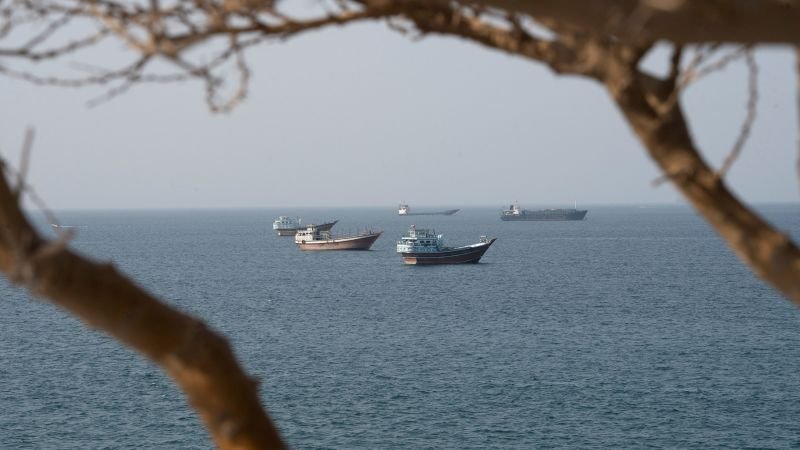
• UAE breaks with Iran: The United Arab Emirates said it is suspending all trade with Iran “until further notice” after two ballistic missiles that were “targeting maritime navigation” fell into the sea, a Foreign Ministry official said. Iran denied firing the missiles.
• Economic squeeze: Global oil prices remain high as US-Iran peace talks stall, with the blockage of the Strait of Hormuz causing a fuel supply crisis. Iran’s Foreign Ministry says the US blockade of Iranian ports has contributed to goods shortages and price increases.
• NATO on Iran: The military alliance said it is prepared to “address any threat,” in response to reports that Iran is considering attacking US military targets in Europe if President Donald Trump ramps up the war.
20 Posts
Yemen’s Iran-backed Houthis claimed today to have targeted eight Saudi oil tankers since late July, when the militant group declared a maritime blockade on Saudi shipping, the Houthi-run Saba news agency said.
Saba also reported the group said it sunk two military landing ships near Mokha – which it claimed were transporting Saudi weapons – as well as more than ten warships belonging to Saudi forces, without providing evidence.
CNN cannot independently verify the group’s claims, and there has been no immediate comment from Saudi authorities.
Some context: Clashes have intensified in recent weeks near the Bab al-Mandeb strait, a key maritime chokepoint at the southern end of the Red Sea, after the Houthis declared a blockade on ships from Saudi Arabia, the main backer of Yemeni government forces.
The Houthi group said Monday it had attacked what it described as a Saudi military landing ship and four escort vessels in the Red Sea off the coast of Yemen’s port city of Mokha, after a weekend of escalation in the region.
NATO is prepared to “address any threat,” an official from the alliance told CNN today, in response to reports that Iran is considering attacking US military targets in Europe if US President Donald Trump ramps up the war.
The Financial Times reported today that Iran has weighed attacking US military targets in Europe should Trump escalate the conflict, citing people close to the regime.
In response, the NATO official said the military alliance is “prepared to address any threat and will always do what is necessary to defend all allies.”
Here’s a closer look at the alliance:
Remember: The North Atlantic Treaty Organization was established in 1949 after World War II, and its purpose is to “secure a lasting peace in Europe and North America, based on its member countries’ common values of individual liberty, democracy, human rights and the rule of law,” according to its website.
The alliance’s “most fundamental principle” is what it calls “collective defense,” meaning that if one NATO member country is attacked, the alliance considers it an attack on every NATO country.
This collective defense, described under Article 5 of the North Atlantic Treaty, is triggered when a member country comes under “armed attack” and that country requests collective action as a response.
Article 6 of the treaty “imposes geographic limitations on the scope of NATO’s mutual assistance obligation, primarily limiting it to the North Atlantic area north of the Tropic of Cancer.”
The first and only time Article 5 has been invoked was in the aftermath of the September 11, 2001, attacks on the US. As a result, NATO allies joined the invasion of Afghanistan.
CNN’s Billy Stockwell contributed to this reporting.
Iraq’s parliament speaker called on Iran to grant Iraqi oil exports going through the Strait of Hormuz “special status” in a meeting with his Iranian counterpart on Wednesday, according to the state-run Iraqi News Agency.
Traffic on the critical waterway, through which one-fifth of global crude oil typically flows, has reduced to a trickle since the war started in February.
Speaker of the Council of Representatives of Iraq Haibat al-Halbousi made the suggestion in a meeting with Iran’s Parliament Speaker Mohammad Bagher Ghalibaf in Baghdad, during a visit which the Iranian official said would strengthen the “internal and shared security of both countries.”
Earlier Wednesday, Ghalibaf praised the “unbreakable” bond between the people of Iraq and Iran ahead of his departure to the country, Iranian state media reported.
He also advocated for deep relations and security ties between regional Islamic countries, “so that sustainable economic cooperation can develop, and the Islamic Republic of Iran is ready for this.”
Tensions have heightened across the Middle East, with Israel carrying out a widely-condemned strike on Syria, US President Donald Trump threatening Oman, and the United Arab Emirates suspending all trade and financial transactions with Iran “until further notice.”
Here’s the latest so far today:
Turkey has condemned Israel’s strike on a Syrian air base, after Israeli Prime Minister Benjamin Netanyahu said it took place because of what he asserted was an imminent deployment of Turkish troops to the facility.
NATO has said it is prepared to “address any threat,” in response to reports that Iran is considering attacking US military targets in Europe if Trump ramps up the war.
Oil prices are hovering above $90 a barrel, as talks between Iran and the United States remain at an impasse. Brent crude, the global oil benchmark, is now trading at its highest level in almost a month.
Iranian Foreign Minister Abbas Araghchi said the US’ maritime blockade of Iranian ports has contributed to “shortages in some areas” and price increases in the country.
Meanwhile, Iran’s parliament speaker Mohammad Bagher Ghalibaf praised the “unbreakable” bond between the people of Iraq and Iran ahead of his departure to Baghdad today, according to Iranian state media.
CNN’s Mostafa Salem, Gul Tuysuz, Billy Stockwell, Hanna Ziady, Aida Karimi and Lucas Lilieholm contributed to this reporting.
US President Donald Trump threatened earlier this week to attack Oman if it interferes with US efforts in the Strait of Hormuz.
“If Oman gets in the way, we’ll bomb the shit out of them,” Trump said in an interview with Fox News on Monday, as Tehran said that talks with Muscat over the vital waterway were ongoing.
Oman, a historic US ally, has attempted to act as a mediator between the US and Iran both before and during the conflict, notably hosting nuclear negotiations between Tehran and Washington before the war broke out in February.
The day before the US and Israel attacked Iran on February 28, Omani Foreign Minister Badr Albusaidi said that Iran had agreed not to stockpile enriched uranium, meaning it would never have enough material to create a nuclear weapon if it reached a deal with the US.
The next day, after the US-Israeli strikes, Albusaidi said he was “dismayed” that “active and serious negotiations” between the US and Iran had “yet again been undermined.”
In March, Albusaidi called the war with Iran the Trump administration’s “greatest miscalculation.” Days later, he posted on X: “Whatever your view of Iran, this war is not of their making.”
In the months since, Oman has worked with Iran to draft protocols for reopening the Strait of Hormuz.
In May, Trump threatened Oman for the first time, saying that the country “will behave just like everybody else, or we’ll have to blow ‘em up.”
Weeks later, a senior US administration official told reporters that Oman was “duplicitous” during negotiating efforts with Iran — so they “threw them out” of the mediation role.
CNN’s Alejandra Jaramillo, Nadeen Ebrahim, Mostafa Salem, Haley Britzky, Jennifer Hansler, Antoinette Radford, Jessie Yeung, Sarah El Sirgany, Billy Stockwell, Mohammed Tawfeeq and Aaron Blake contributed to this reporting.
Meanwhile, Turkey has condemned an Israeli strike on a Syrian air base, after Prime Minister Benjamin Netanyahu said it took place because of what he asserted was an imminent deployment of Turkish troops to the facility.
In response, the Turkish government called Netanyahu’s claims “untenable,” and said they were intended to “legitimise Israel’s unlawful airstrikes targeting Syria’s sovereignty and territorial integrity.”
Tuesday’s strike on the site, close to Aleppo, sparked criticism from the Trump administration, with US envoy on Syria, Tom Barrack, calling it an “unnecessary escalation.”
Netanyahu meanwhile said Israel warned Syria that “such a deployment would pose a threat to Israel’s security.”
Turkey pointed to the upcoming October elections in Israel as a reason for Netanyahu’s actions.
The Turkish government added that it would continue to cooperate with the Syrian government “on a legitimate basis for the establishment of peace, stability, and prosperity.”
CNN’s Tal Shalev and Oren Liebermann contributed reporting.
US President Donald Trump claimed earlier this week that his administration had established a direct backchannel with Iran’s Islamic Revolutionary Guard Corps (IRGC). He then contradicted this yesterday, when he said that “there are no talks or conversations going on” with Iran.
An IRGC spokesperson also denied Trump’s claim on Monday.
The IRGC has propped up the Iranian regime for decades. It is tasked both with combating enemies abroad and stamping out protests at home.
Here’s what to know about the elite wing of the Iranian military:
The IRGC exists to “guard” the theocracy. After Iran’s last monarch was deposed in 1979, various paramilitary groups that helped hasten his downfall coalesced into the IRGC. It resisted initial attempts to be incorporated into the regular army and cemented its power during its deployment in the Iran-Iraq War in the 1980s.
Today, it is the most powerful branch of Iran’s military, independent of the regular army. Comprising between 150,000 and 190,000 troops, it has an army, navy, air force and intelligence wing, and has also become enmeshed throughout Iran’s civilian economy.
The Quds Force is an expeditionary unit made up of the IRGC’s most elite fighters. It was originally tasked with foreign operations, starting with Hezbollah in Lebanon. The force has since supported several non-state actors in the Middle East, from Hamas in Gaza to the Houthis in Yemen and even the Taliban in Afghanistan during the 1990s.
The Basij – another of the IRGC’s five branches – operates like the police: visible, street-level, domestic. Meaning “mobilization” in Farsi, the Basij is a volunteer group which plucks members from across the country, often from poorer, more conservative backgrounds. It is tasked with propping up the regime at home and enforcing Islamic morality among the public.
CNN’s Alejandra Jaramillo contributed to this reporting.
NATO said today it is prepared to “address any threat” in response to reports that Iran is considering attacking US military targets in Europe if President Donald Trump ramps up the war.
In March, four suspected Iranian ballistic munitions heading toward Turkey were neutralized by NATO defenses. Iran denied at the time that it launched the missiles. Cyprus was also targeted by drone attacks in March.
The Financial Times reported on Wednesday that Iran has weighed attacking US military targets in Europe should Trump escalate the war, citing people close to the regime.
In response, the NATO official said the military alliance is “prepared to address any threat and will always do what is necessary to defend all allies.”
Oil prices are once again uncomfortably high, but the bigger problem is lurking just beneath the surface.
What initially began as an oil supply shock caused by the Strait of Hormuz blockage is morphing into a fuel supply crisis.
Refineries face a perfect combination of war and export restrictions, which is limiting how much crude oil they can turn into the gasoline, jet fuel and diesel that powers the global economy.
A key measure of refining profitability, known as the diesel crack spread, skyrocketed to $102 a barrel on Monday for the first time ever, nearly tripling pre-war levels. Diesel crack spread measures how much refiners can earn on each barrel of crude they turn into diesel.
Supplies of fuel remain historically tight because three of the four global refining hubs are in severe distress.
Refineries in the Middle East have been attacked during the Iran war. And the refineries that are unscathed have had trouble shipping because of the standoff in the Strait of Hormuz, where Iran and the United States are battling for control.
Read the full story here.
The United Arab Emirates, a major trading partner of Iran, is suspending all trade and financial transactions with the Islamic Republic “until further notice,” Foreign Ministry spokeswoman Afra Al Hameli said on X.
“In light of regional escalations that undermine regional and international peace and security, all trade, commercial exchanges, and financial transactions with Iran have been halted until further notice,” the UAE’s Foreign Ministry said in a statement on late Tuesday.
The statement was issued after the UAE said that two ballistic missiles that were “targeting maritime navigation” fell into the sea. Iran denied firing missiles.
The UAE is one of Iran’s largest commercial partners, ranking second only to China. Trade between the two countries had been expanding even as the US continued tightening sanctions on the regime.
Last week, vessels belonging to the UAE’s state oil company were targeted by Iran while transiting the Strait of Hormuz, the UAE’s state news agency said.
After the US and Israel launched a war on Iran in February, Tehran responded by firing salvos of missiles and drones at the region’s US allies. The UAE was the most attacked of all Washington’s allies, including Israel.
Oil prices are hovering above $90 a barrel, as talks between Iran and the United States remain at an impasse.
Brent crude, the global oil benchmark, gained 1.3% to trade at $92.20 a barrel shortly after 5 a.m. ET. WTI, the US benchmark, rose by a similar margin to trade at $85.24 a barrel.
Brent is now trading at its highest level in almost a month, as traders price in a prolonged disruption to oil flows through the Strait of Hormuz.
Iran’s parliamentary speaker, Mohammad Bagher Ghalibaf, said Tuesday that Hormuz would remain shut until the US meets conditions of the Memorandum of Understanding agreed in June, which include lifting the blockade of Iranian ports, removing oil sanctions, and unfreezing Iranian assets.
US President Donald Trump, meanwhile, said no talks were underway or scheduled with Tehran.
Those comments “led to growing pessimism that the Strait of Hormuz would reopen anytime soon, and we saw oil prices move up throughout the futures curve,” Deutsche Bank analysts wrote in a note Wednesday. Brent futures contracts for deliveries a year from now hit a two-month high, they added.
Iranian Foreign Minister Abbas Araghchi said the United States’ maritime blockade of Iranian ports has contributed to “shortages in some areas” and price increases in the country.
Araghchi said the war and the US blockade made it “considerably more difficult” to import goods into the country, adding that this was “nevertheless accomplished and we genuinely managed to meet the country’s needs.”
His comments were aired after Iranian state-affiliated media said earlier this week that many working-class families in the country are unable to afford basic food items, with inflation rates reaching “alarming levels.”
Iran’s economy was in a poor state before the war too, with dire economic conditions a key driving factor behind the anti-regime demonstrations which kicked off in the Iranian capital Tehran in 2025.
Araghchi said in the interview that, due to the US maritime blockade, Iran obtained some essential goods via neighboring countries using “overland routes and other channels.”
The US military has released footage of the aircraft carrier USS George Washington transiting the Strait of Malacca between Malaysia and Indonesia and conducting flight operations in the Indian Ocean.
The time lapse video, which the military said was recorded on August 13, shows the deck of the warship as it travels through one of the world’s busiest waterways.
The George Washington is en route to the Middle East to relieve the troubled USS Abraham Lincoln, which has been at sea for an extended deployment due to the Iran war, raising concerns among lawmakers and military families.
A sailor went overboard earlier this month off of the Abraham Lincoln, three US officials told CNN, amid reports of worsening mental health for crew members on the ship.
Additional footage from the military purported to show aircraft conducting night flight operations aboard the George Washington on Tuesday in the Indian Ocean.
The vessel’s rotation to the Middle East leaves the US without an aircraft carrier in the Pacific theater.
Read about being aboard the USS Abraham Lincoln here.
Iran’s parliament speaker Mohammad Bagher Ghalibaf praised the “unbreakable” bond between the people of Iraq and Iran ahead of his departure to Baghdad on Wednesday, according to Iranian state media.
“Our neighborly relationship is based on brotherhood, even in the most difficult times, resistance against foreign interference, and a belief in a shared destiny for both countries,” Press TV reported.
Ghalibaf said the visit would strengthen the “internal and shared security of both countries.”
The visit comes at a tense moment for the region with the framework diplomatic agreement between the US and Iran, which was meant to end the war, expiring Monday and no resolution to the conflict in sight.
Iraq has frequently been caught in the crossfire between the US and Iran, including in Trump’s first term when he ordered the assassination of Qasem Soleimani at the Baghdad International Airport.
The US military and Saudi Arabian forces said they conducted joint strikes against Iran-backed militias in Iraq in late July, in response to attacks on US forces and Saudi oil facilities.
Some powerful militias within Iraq’s security forces have close ties to Iran’s Islamic Revolutionary Guard Corps and form part of Tehran’s “Axis of Resistance” in the region, along with groups such as Hezbollah in Lebanon, Hamas in Gaza and the Houthis in Yemen. These Tehran-backed groups have frequently launched attacks against the US and its allies in the Middle East.
Iran’s hardline leadership is devising and promoting its own strategy for continued confrontation with Washington.
The strategy emphasizes “offensive operations” as well as defensive action to neutralize enemy threats, according to one Iranian official.
The more assertive stance comes as a US-Iran agreement intended to end the war, the Memorandum of Understanding, expires with control of the Strait of Hormuz still in dispute.
Iran’s military leaders believe they are in a strong position to extract concessions from the US and can further adapt Iran’s weapons systems to bridge the gap with their more powerful adversaries, according to analysts.
It also likely means greater mobilization of Iran’s allies in Yemen, Iraq and elsewhere.
The starting gun for the new posture in Tehran sounded with decrees reorganizing Iran’s security leadership last week issued in the name of Supreme Leader Mojtaba Khamenei.
Read the full story here.
Negotiations to end the war between the US and Iran remain at an impasse, after President Donald Trump said that no talks are taking place or scheduled, and maintained that the US maritime blockade of its foe remains in effect.
Meanwhile, Iranian Parliament Speaker Mohammad Bagher Ghalibaf accused the US of “squeezing” Tehran for concessions. “Americans think squeezing Iran harder will win concessions that were never part of the agreement,” he said.
Here are the latest headlines:
Control of Hormuz: Iran is losing significant control of the Strait of Hormuz, data shows. More than 80% of vessel transits through the strait over the past two weeks have taken the Omani route – a UN-authorized shipping channel that Iran vehemently opposes – according to tracking firm Kpler. Commercial vessel traffic through the strait remains low.
Oman-Iran talks: Qatar has voiced support for ongoing efforts between Oman and Iran to reach an agreement over the strait, despite Trump’s threat to attack Oman if it interferes with efforts in the strategic waterway. A regional source told CNN that an agreement and a middle ground will be reached in the next couple of days.
Map wars: Iranian diplomats in India posted a map of the United States with California highlighted under the text “NEW TERRITORY OF ISLAMIC REPUBLIC OF IRAN.” It was in response to Trump’s social media post showing the Strait of Hormuz as “New US Territory,” after Iran reiterated key demands for its reopening.
Missiles launched: Air defense forces in the United Arab Emirates detected two ballistic missiles launched toward the country from Iran on Tuesday, the UAE Defense Ministry said. Iran foreign ministry spokesperson Esmaeil Baghaei rejected the claim as “unfounded,” state media reported.
In the region: Hamas and Palestinian Islamic Jihad accused Israel of undermining the stalled peace process in Gaza after an airstrike killed at least six people in the embattled enclave Tuesday. Meanwhile, Israeli Prime Minister Benjamin Netanyahu acknowledged an Israeli strike on a military airport in northwestern Syria, which the US earlier condemned as an “unnecessary escalation.”
Hamas and Palestinian Islamic Jihad accused Israel of undermining the stalled peace process in Gaza after an airstrike killed at least six people in the embattled enclave Tuesday.
Leaders of the militant groups criticised the strike in a statement saying it was “in clear defiance of the mediators’ efforts to solidify the ceasefire agreement and ensure its implementation,” and called for stepped-up efforts to “put an end to these violations and compel the occupation to cease them completely.”
The Israel Defense Forces said it had “struck several Hamas commanders” in the attack. A Hamas source told CNN that the targeted group was a noncombat logistical support team whose members were working on a plan for collecting and storing weapons under the latest ceasefire agreement.
A 13-year-old boy and his father were among those killed, and more than a dozen other people were injured, medical officials at Gaza’s al-Shifa Hospital said.
The Israeli strike was launched one day after US President Donald Trump’s envoy Jared Kushner pressed Prime Minister Benjamin Netanyahu to restrain Israel’s near-daily attacks in Gaza, which have killed more than 1,200 people since a nominal ceasefire took effect in October. Kushner urged Netanyahu to “not create obstacles” to a long-stalled ceasefire plan. In an interview with Fox News on Monday, Trump also said Israel should stop striking Gaza.
Iranian diplomats in India have responded to Donald Trump’s statement claiming the Strait of Hormuz as new US territory, posting a map of the United States with California highlighted under the text “NEW TERRITORY OF ISLAMIC REPUBLIC OF IRAN.”
While the post by Tehran’s consulate in Hyderabad is clearly tongue-in-cheek, California is home to the largest population of Iranian immigrants in the US, according to the Migration Policy Institute. The majority live in the Los Angeles area, with many Persian residents referring to the city as “Tehrangeles,” in a portmanteau of Tehran and Los Angeles.
Opinions among the diaspora have been divided by the US-Israel war against Iran, with some hoping it will lead to the fall of the current government and others wary that it will backfire.
Iranian Parliament Speaker Mohammad Bagher Ghalibaf accused the US of trying to force more concessions from Iran.
The official also said that Treasury Secretary Scott Bessent and US Defense Secretary Pete Hegseth are “way out of their league.”
“Stop waiting for the clown crew to pull a rabbit out of their hat and clean up the mess you made,” Ghalibaf said.
Last week, Bessent said the US would apply measures to Iran that have “never been seen.” US President Donald Trump has also indicated that he plans to apply more economic pressure on Tehran.
As scuppered talks between Tehran and Washington roil the region, we’re getting information about an Israeli strike Tuesday on a Syrian air base near Idlib — an attack that sparked sharp criticism from the Trump administration.
Breaking hours of silence, Prime Minister Benjamin Netanyahu acknowledged an Israeli strike on a military airport in northwestern Syria that was condemned earlier by the US as an “unnecessary escalation.”
Netanyahu said Israel struck the base because of what he asserted was an imminent deployment of Turkish troops to the facility near Aleppo. He said that Israel and Syria, which have no formal relations but have engaged in talks under the auspices of the Trump administration, had a “status quo in security matters.”
In a statement on X, he said Syria risked this arrangement with the potential deployment of Turkish troops to the Abu al-Duhur base.
Netanyahu has been openly critical of Turkey and its president, Recep Tayyip Erdogan, with whom he has been engaged in a long-running public feud. Netanyahu has accused Erdogan of supporting Hamas and has opposed the sale of US-made F-35 fighter jets to Ankara, while Turkish officials have called Israel “a burden that humanity can no longer bear.”
Earlier Tuesday as reports emerged of airstrikes targeting the Abu al-Duhur military airport, US envoy Tom Barrack said, “We are deeply concerned that the confirmed Israeli airstrikes on Abu al-Duhur Airbase constitute an unnecessary escalation that does not advance regional stability.”
He added that Washington was encouraging all parties to prioritize “logical discourse” over further military incidents.
• UAE breaks with Iran: The United Arab Emirates said it is suspending all trade with Iran “until further notice” after two ballistic missiles that were “targeting maritime navigation” fell into the sea, a Foreign Ministry official said. Iran denied firing the missiles.
• Economic squeeze: Global oil prices remain high as US-Iran peace talks stall, with the blockage of the Strait of Hormuz causing a fuel supply crisis. Iran’s Foreign Ministry says the US blockade of Iranian ports has contributed to goods shortages and price increases.
• NATO on Iran: The military alliance said it is prepared to “address any threat,” in response to reports that Iran is considering attacking US military targets in Europe if President Donald Trump ramps up the war.
Yemen’s Iran-backed Houthis claimed today to have targeted eight Saudi oil tankers since late July, when the militant group declared a maritime blockade on Saudi shipping, the Houthi-run Saba news agency said.
Saba also reported the group said it sunk two military landing ships near Mokha – which it claimed were transporting Saudi weapons – as well as more than ten warships belonging to Saudi forces, without providing evidence.
CNN cannot independently verify the group’s claims, and there has been no immediate comment from Saudi authorities.
Some context: Clashes have intensified in recent weeks near the Bab al-Mandeb strait, a key maritime chokepoint at the southern end of the Red Sea, after the Houthis declared a blockade on ships from Saudi Arabia, the main backer of Yemeni government forces.
The Houthi group said Monday it had attacked what it described as a Saudi military landing ship and four escort vessels in the Red Sea off the coast of Yemen’s port city of Mokha, after a weekend of escalation in the region.
NATO is prepared to “address any threat,” an official from the alliance told CNN today, in response to reports that Iran is considering attacking US military targets in Europe if US President Donald Trump ramps up the war.
The Financial Times reported today that Iran has weighed attacking US military targets in Europe should Trump escalate the conflict, citing people close to the regime.
In response, the NATO official said the military alliance is “prepared to address any threat and will always do what is necessary to defend all allies.”
Here’s a closer look at the alliance:
Remember: The North Atlantic Treaty Organization was established in 1949 after World War II, and its purpose is to “secure a lasting peace in Europe and North America, based on its member countries’ common values of individual liberty, democracy, human rights and the rule of law,” according to its website.
The alliance’s “most fundamental principle” is what it calls “collective defense,” meaning that if one NATO member country is attacked, the alliance considers it an attack on every NATO country.
This collective defense, described under Article 5 of the North Atlantic Treaty, is triggered when a member country comes under “armed attack” and that country requests collective action as a response.
Article 6 of the treaty “imposes geographic limitations on the scope of NATO’s mutual assistance obligation, primarily limiting it to the North Atlantic area north of the Tropic of Cancer.”
The first and only time Article 5 has been invoked was in the aftermath of the September 11, 2001, attacks on the US. As a result, NATO allies joined the invasion of Afghanistan.
CNN’s Billy Stockwell contributed to this reporting.
Iraq’s parliament speaker called on Iran to grant Iraqi oil exports going through the Strait of Hormuz “special status” in a meeting with his Iranian counterpart on Wednesday, according to the state-run Iraqi News Agency.
Traffic on the critical waterway, through which one-fifth of global crude oil typically flows, has reduced to a trickle since the war started in February.
Speaker of the Council of Representatives of Iraq Haibat al-Halbousi made the suggestion in a meeting with Iran’s Parliament Speaker Mohammad Bagher Ghalibaf in Baghdad, during a visit which the Iranian official said would strengthen the “internal and shared security of both countries.”
Earlier Wednesday, Ghalibaf praised the “unbreakable” bond between the people of Iraq and Iran ahead of his departure to the country, Iranian state media reported.
He also advocated for deep relations and security ties between regional Islamic countries, “so that sustainable economic cooperation can develop, and the Islamic Republic of Iran is ready for this.”
Tensions have heightened across the Middle East, with Israel carrying out a widely-condemned strike on Syria, US President Donald Trump threatening Oman, and the United Arab Emirates suspending all trade and financial transactions with Iran “until further notice.”
Here’s the latest so far today:
Turkey has condemned Israel’s strike on a Syrian air base, after Israeli Prime Minister Benjamin Netanyahu said it took place because of what he asserted was an imminent deployment of Turkish troops to the facility.
NATO has said it is prepared to “address any threat,” in response to reports that Iran is considering attacking US military targets in Europe if Trump ramps up the war.
Oil prices are hovering above $90 a barrel, as talks between Iran and the United States remain at an impasse. Brent crude, the global oil benchmark, is now trading at its highest level in almost a month.
Iranian Foreign Minister Abbas Araghchi said the US’ maritime blockade of Iranian ports has contributed to “shortages in some areas” and price increases in the country.
Meanwhile, Iran’s parliament speaker Mohammad Bagher Ghalibaf praised the “unbreakable” bond between the people of Iraq and Iran ahead of his departure to Baghdad today, according to Iranian state media.
CNN’s Mostafa Salem, Gul Tuysuz, Billy Stockwell, Hanna Ziady, Aida Karimi and Lucas Lilieholm contributed to this reporting.
US President Donald Trump threatened earlier this week to attack Oman if it interferes with US efforts in the Strait of Hormuz.
“If Oman gets in the way, we’ll bomb the shit out of them,” Trump said in an interview with Fox News on Monday, as Tehran said that talks with Muscat over the vital waterway were ongoing.
Oman, a historic US ally, has attempted to act as a mediator between the US and Iran both before and during the conflict, notably hosting nuclear negotiations between Tehran and Washington before the war broke out in February.
The day before the US and Israel attacked Iran on February 28, Omani Foreign Minister Badr Albusaidi said that Iran had agreed not to stockpile enriched uranium, meaning it would never have enough material to create a nuclear weapon if it reached a deal with the US.
The next day, after the US-Israeli strikes, Albusaidi said he was “dismayed” that “active and serious negotiations” between the US and Iran had “yet again been undermined.”
In March, Albusaidi called the war with Iran the Trump administration’s “greatest miscalculation.” Days later, he posted on X: “Whatever your view of Iran, this war is not of their making.”
In the months since, Oman has worked with Iran to draft protocols for reopening the Strait of Hormuz.
In May, Trump threatened Oman for the first time, saying that the country “will behave just like everybody else, or we’ll have to blow ‘em up.”
Weeks later, a senior US administration official told reporters that Oman was “duplicitous” during negotiating efforts with Iran — so they “threw them out” of the mediation role.
CNN’s Alejandra Jaramillo, Nadeen Ebrahim, Mostafa Salem, Haley Britzky, Jennifer Hansler, Antoinette Radford, Jessie Yeung, Sarah El Sirgany, Billy Stockwell, Mohammed Tawfeeq and Aaron Blake contributed to this reporting.
Meanwhile, Turkey has condemned an Israeli strike on a Syrian air base, after Prime Minister Benjamin Netanyahu said it took place because of what he asserted was an imminent deployment of Turkish troops to the facility.
In response, the Turkish government called Netanyahu’s claims “untenable,” and said they were intended to “legitimise Israel’s unlawful airstrikes targeting Syria’s sovereignty and territorial integrity.”
Tuesday’s strike on the site, close to Aleppo, sparked criticism from the Trump administration, with US envoy on Syria, Tom Barrack, calling it an “unnecessary escalation.”
Netanyahu meanwhile said Israel warned Syria that “such a deployment would pose a threat to Israel’s security.”
Turkey pointed to the upcoming October elections in Israel as a reason for Netanyahu’s actions.
The Turkish government added that it would continue to cooperate with the Syrian government “on a legitimate basis for the establishment of peace, stability, and prosperity.”
CNN’s Tal Shalev and Oren Liebermann contributed reporting.
US President Donald Trump claimed earlier this week that his administration had established a direct backchannel with Iran’s Islamic Revolutionary Guard Corps (IRGC). He then contradicted this yesterday, when he said that “there are no talks or conversations going on” with Iran.
An IRGC spokesperson also denied Trump’s claim on Monday.
The IRGC has propped up the Iranian regime for decades. It is tasked both with combating enemies abroad and stamping out protests at home.
Here’s what to know about the elite wing of the Iranian military:
The IRGC exists to “guard” the theocracy. After Iran’s last monarch was deposed in 1979, various paramilitary groups that helped hasten his downfall coalesced into the IRGC. It resisted initial attempts to be incorporated into the regular army and cemented its power during its deployment in the Iran-Iraq War in the 1980s.
Today, it is the most powerful branch of Iran’s military, independent of the regular army. Comprising between 150,000 and 190,000 troops, it has an army, navy, air force and intelligence wing, and has also become enmeshed throughout Iran’s civilian economy.
The Quds Force is an expeditionary unit made up of the IRGC’s most elite fighters. It was originally tasked with foreign operations, starting with Hezbollah in Lebanon. The force has since supported several non-state actors in the Middle East, from Hamas in Gaza to the Houthis in Yemen and even the Taliban in Afghanistan during the 1990s.
The Basij – another of the IRGC’s five branches – operates like the police: visible, street-level, domestic. Meaning “mobilization” in Farsi, the Basij is a volunteer group which plucks members from across the country, often from poorer, more conservative backgrounds. It is tasked with propping up the regime at home and enforcing Islamic morality among the public.
CNN’s Alejandra Jaramillo contributed to this reporting.
NATO said today it is prepared to “address any threat” in response to reports that Iran is considering attacking US military targets in Europe if President Donald Trump ramps up the war.
In March, four suspected Iranian ballistic munitions heading toward Turkey were neutralized by NATO defenses. Iran denied at the time that it launched the missiles. Cyprus was also targeted by drone attacks in March.
The Financial Times reported on Wednesday that Iran has weighed attacking US military targets in Europe should Trump escalate the war, citing people close to the regime.
In response, the NATO official said the military alliance is “prepared to address any threat and will always do what is necessary to defend all allies.”
Oil prices are once again uncomfortably high, but the bigger problem is lurking just beneath the surface.
What initially began as an oil supply shock caused by the Strait of Hormuz blockage is morphing into a fuel supply crisis.
Refineries face a perfect combination of war and export restrictions, which is limiting how much crude oil they can turn into the gasoline, jet fuel and diesel that powers the global economy.
A key measure of refining profitability, known as the diesel crack spread, skyrocketed to $102 a barrel on Monday for the first time ever, nearly tripling pre-war levels. Diesel crack spread measures how much refiners can earn on each barrel of crude they turn into diesel.
Supplies of fuel remain historically tight because three of the four global refining hubs are in severe distress.
Refineries in the Middle East have been attacked during the Iran war. And the refineries that are unscathed have had trouble shipping because of the standoff in the Strait of Hormuz, where Iran and the United States are battling for control.
Read the full story here.
The United Arab Emirates, a major trading partner of Iran, is suspending all trade and financial transactions with the Islamic Republic “until further notice,” Foreign Ministry spokeswoman Afra Al Hameli said on X.
“In light of regional escalations that undermine regional and international peace and security, all trade, commercial exchanges, and financial transactions with Iran have been halted until further notice,” the UAE’s Foreign Ministry said in a statement on late Tuesday.
The statement was issued after the UAE said that two ballistic missiles that were “targeting maritime navigation” fell into the sea. Iran denied firing missiles.
The UAE is one of Iran’s largest commercial partners, ranking second only to China. Trade between the two countries had been expanding even as the US continued tightening sanctions on the regime.
Last week, vessels belonging to the UAE’s state oil company were targeted by Iran while transiting the Strait of Hormuz, the UAE’s state news agency said.
After the US and Israel launched a war on Iran in February, Tehran responded by firing salvos of missiles and drones at the region’s US allies. The UAE was the most attacked of all Washington’s allies, including Israel.
Oil prices are hovering above $90 a barrel, as talks between Iran and the United States remain at an impasse.
Brent crude, the global oil benchmark, gained 1.3% to trade at $92.20 a barrel shortly after 5 a.m. ET. WTI, the US benchmark, rose by a similar margin to trade at $85.24 a barrel.
Brent is now trading at its highest level in almost a month, as traders price in a prolonged disruption to oil flows through the Strait of Hormuz.
Iran’s parliamentary speaker, Mohammad Bagher Ghalibaf, said Tuesday that Hormuz would remain shut until the US meets conditions of the Memorandum of Understanding agreed in June, which include lifting the blockade of Iranian ports, removing oil sanctions, and unfreezing Iranian assets.
US President Donald Trump, meanwhile, said no talks were underway or scheduled with Tehran.
Those comments “led to growing pessimism that the Strait of Hormuz would reopen anytime soon, and we saw oil prices move up throughout the futures curve,” Deutsche Bank analysts wrote in a note Wednesday. Brent futures contracts for deliveries a year from now hit a two-month high, they added.
Iranian Foreign Minister Abbas Araghchi said the United States’ maritime blockade of Iranian ports has contributed to “shortages in some areas” and price increases in the country.
Araghchi said the war and the US blockade made it “considerably more difficult” to import goods into the country, adding that this was “nevertheless accomplished and we genuinely managed to meet the country’s needs.”
His comments were aired after Iranian state-affiliated media said earlier this week that many working-class families in the country are unable to afford basic food items, with inflation rates reaching “alarming levels.”
Iran’s economy was in a poor state before the war too, with dire economic conditions a key driving factor behind the anti-regime demonstrations which kicked off in the Iranian capital Tehran in 2025.
Araghchi said in the interview that, due to the US maritime blockade, Iran obtained some essential goods via neighboring countries using “overland routes and other channels.”
The US military has released footage of the aircraft carrier USS George Washington transiting the Strait of Malacca between Malaysia and Indonesia and conducting flight operations in the Indian Ocean.
The time lapse video, which the military said was recorded on August 13, shows the deck of the warship as it travels through one of the world’s busiest waterways.
The George Washington is en route to the Middle East to relieve the troubled USS Abraham Lincoln, which has been at sea for an extended deployment due to the Iran war, raising concerns among lawmakers and military families.
A sailor went overboard earlier this month off of the Abraham Lincoln, three US officials told CNN, amid reports of worsening mental health for crew members on the ship.
Additional footage from the military purported to show aircraft conducting night flight operations aboard the George Washington on Tuesday in the Indian Ocean.
The vessel’s rotation to the Middle East leaves the US without an aircraft carrier in the Pacific theater.
Read about being aboard the USS Abraham Lincoln here.
Iran’s parliament speaker Mohammad Bagher Ghalibaf praised the “unbreakable” bond between the people of Iraq and Iran ahead of his departure to Baghdad on Wednesday, according to Iranian state media.
“Our neighborly relationship is based on brotherhood, even in the most difficult times, resistance against foreign interference, and a belief in a shared destiny for both countries,” Press TV reported.
Ghalibaf said the visit would strengthen the “internal and shared security of both countries.”
The visit comes at a tense moment for the region with the framework diplomatic agreement between the US and Iran, which was meant to end the war, expiring Monday and no resolution to the conflict in sight.
Iraq has frequently been caught in the crossfire between the US and Iran, including in Trump’s first term when he ordered the assassination of Qasem Soleimani at the Baghdad International Airport.
The US military and Saudi Arabian forces said they conducted joint strikes against Iran-backed militias in Iraq in late July, in response to attacks on US forces and Saudi oil facilities.
Some powerful militias within Iraq’s security forces have close ties to Iran’s Islamic Revolutionary Guard Corps and form part of Tehran’s “Axis of Resistance” in the region, along with groups such as Hezbollah in Lebanon, Hamas in Gaza and the Houthis in Yemen. These Tehran-backed groups have frequently launched attacks against the US and its allies in the Middle East.
Iran’s hardline leadership is devising and promoting its own strategy for continued confrontation with Washington.
The strategy emphasizes “offensive operations” as well as defensive action to neutralize enemy threats, according to one Iranian official.
The more assertive stance comes as a US-Iran agreement intended to end the war, the Memorandum of Understanding, expires with control of the Strait of Hormuz still in dispute.
Iran’s military leaders believe they are in a strong position to extract concessions from the US and can further adapt Iran’s weapons systems to bridge the gap with their more powerful adversaries, according to analysts.
It also likely means greater mobilization of Iran’s allies in Yemen, Iraq and elsewhere.
The starting gun for the new posture in Tehran sounded with decrees reorganizing Iran’s security leadership last week issued in the name of Supreme Leader Mojtaba Khamenei.
Read the full story here.
Negotiations to end the war between the US and Iran remain at an impasse, after President Donald Trump said that no talks are taking place or scheduled, and maintained that the US maritime blockade of its foe remains in effect.
Meanwhile, Iranian Parliament Speaker Mohammad Bagher Ghalibaf accused the US of “squeezing” Tehran for concessions. “Americans think squeezing Iran harder will win concessions that were never part of the agreement,” he said.
Here are the latest headlines:
Control of Hormuz: Iran is losing significant control of the Strait of Hormuz, data shows. More than 80% of vessel transits through the strait over the past two weeks have taken the Omani route – a UN-authorized shipping channel that Iran vehemently opposes – according to tracking firm Kpler. Commercial vessel traffic through the strait remains low.
Oman-Iran talks: Qatar has voiced support for ongoing efforts between Oman and Iran to reach an agreement over the strait, despite Trump’s threat to attack Oman if it interferes with efforts in the strategic waterway. A regional source told CNN that an agreement and a middle ground will be reached in the next couple of days.
Map wars: Iranian diplomats in India posted a map of the United States with California highlighted under the text “NEW TERRITORY OF ISLAMIC REPUBLIC OF IRAN.” It was in response to Trump’s social media post showing the Strait of Hormuz as “New US Territory,” after Iran reiterated key demands for its reopening.
Missiles launched: Air defense forces in the United Arab Emirates detected two ballistic missiles launched toward the country from Iran on Tuesday, the UAE Defense Ministry said. Iran foreign ministry spokesperson Esmaeil Baghaei rejected the claim as “unfounded,” state media reported.
In the region: Hamas and Palestinian Islamic Jihad accused Israel of undermining the stalled peace process in Gaza after an airstrike killed at least six people in the embattled enclave Tuesday. Meanwhile, Israeli Prime Minister Benjamin Netanyahu acknowledged an Israeli strike on a military airport in northwestern Syria, which the US earlier condemned as an “unnecessary escalation.”
Hamas and Palestinian Islamic Jihad accused Israel of undermining the stalled peace process in Gaza after an airstrike killed at least six people in the embattled enclave Tuesday.
Leaders of the militant groups criticised the strike in a statement saying it was “in clear defiance of the mediators’ efforts to solidify the ceasefire agreement and ensure its implementation,” and called for stepped-up efforts to “put an end to these violations and compel the occupation to cease them completely.”
The Israel Defense Forces said it had “struck several Hamas commanders” in the attack. A Hamas source told CNN that the targeted group was a noncombat logistical support team whose members were working on a plan for collecting and storing weapons under the latest ceasefire agreement.
A 13-year-old boy and his father were among those killed, and more than a dozen other people were injured, medical officials at Gaza’s al-Shifa Hospital said.
The Israeli strike was launched one day after US President Donald Trump’s envoy Jared Kushner pressed Prime Minister Benjamin Netanyahu to restrain Israel’s near-daily attacks in Gaza, which have killed more than 1,200 people since a nominal ceasefire took effect in October. Kushner urged Netanyahu to “not create obstacles” to a long-stalled ceasefire plan. In an interview with Fox News on Monday, Trump also said Israel should stop striking Gaza.
Iranian diplomats in India have responded to Donald Trump’s statement claiming the Strait of Hormuz as new US territory, posting a map of the United States with California highlighted under the text “NEW TERRITORY OF ISLAMIC REPUBLIC OF IRAN.”
While the post by Tehran’s consulate in Hyderabad is clearly tongue-in-cheek, California is home to the largest population of Iranian immigrants in the US, according to the Migration Policy Institute. The majority live in the Los Angeles area, with many Persian residents referring to the city as “Tehrangeles,” in a portmanteau of Tehran and Los Angeles.
Opinions among the diaspora have been divided by the US-Israel war against Iran, with some hoping it will lead to the fall of the current government and others wary that it will backfire.
Iranian Parliament Speaker Mohammad Bagher Ghalibaf accused the US of trying to force more concessions from Iran.
The official also said that Treasury Secretary Scott Bessent and US Defense Secretary Pete Hegseth are “way out of their league.”
“Stop waiting for the clown crew to pull a rabbit out of their hat and clean up the mess you made,” Ghalibaf said.
Last week, Bessent said the US would apply measures to Iran that have “never been seen.” US President Donald Trump has also indicated that he plans to apply more economic pressure on Tehran.
As scuppered talks between Tehran and Washington roil the region, we’re getting information about an Israeli strike Tuesday on a Syrian air base near Idlib — an attack that sparked sharp criticism from the Trump administration.
Breaking hours of silence, Prime Minister Benjamin Netanyahu acknowledged an Israeli strike on a military airport in northwestern Syria that was condemned earlier by the US as an “unnecessary escalation.”
Netanyahu said Israel struck the base because of what he asserted was an imminent deployment of Turkish troops to the facility near Aleppo. He said that Israel and Syria, which have no formal relations but have engaged in talks under the auspices of the Trump administration, had a “status quo in security matters.”
In a statement on X, he said Syria risked this arrangement with the potential deployment of Turkish troops to the Abu al-Duhur base.
Netanyahu has been openly critical of Turkey and its president, Recep Tayyip Erdogan, with whom he has been engaged in a long-running public feud. Netanyahu has accused Erdogan of supporting Hamas and has opposed the sale of US-made F-35 fighter jets to Ankara, while Turkish officials have called Israel “a burden that humanity can no longer bear.”
Earlier Tuesday as reports emerged of airstrikes targeting the Abu al-Duhur military airport, US envoy Tom Barrack said, “We are deeply concerned that the confirmed Israeli airstrikes on Abu al-Duhur Airbase constitute an unnecessary escalation that does not advance regional stability.”
He added that Washington was encouraging all parties to prioritize “logical discourse” over further military incidents.





Responses