
• Status of diplomacy: Qatar’s prime minister visited Tehran on Thursday and met with Iranian Foreign Minister Abbas Araghchi to discuss the emerging Strait of Hormuz agreement between Oman and Tehran to establish a temporary shipping route. This follows Pakistani and Omani officials visiting Iran this week. Meanwhile, the White House said there are no negotiations happening between the US and Iran right now.
• Threat of sanctions: President Donald Trump remained vague Friday when asked about his campaign to choke off Iran’s economy, refusing to say whether he planned to sanction Chinese banks or if he’d discussed the matter with foreign counterparts.
• Naval deployment: USS Theodore Roosevelt will embark in the coming weeks to the Middle East and is expected to be deployed for at least seven months, officials said. This comes as the US Navy faces strain from the on-going war and global commitments.
• US pressure: President Donald Trump claims the financial strength of the US will move the country “toward a very big victory” over Iran, adding that he does not believe Iran’s supreme leader is dead.
16 Posts
President Donald Trump remained vague Friday when asked about his campaign to choke off Iran’s economy, refusing to say whether he planned to sanction Chinese banks or if he’d discussed the matter with foreign counterparts.
The administration announced earlier this week Operation Economic Outcast, which threatened tough new sanctions on Iran’s trading partners if they didn’t cut off ties to Tehran.
But the administration stopped short of putting in place any new measures, and so far hasn’t listed any major financial institutions from China — Iran’s largest trading partner — as being subject to US sanctions.
Trump bristled when asked why he wasn’t applying new sanctions on Chinese banks doing business with Tehran.
“Who said I’m not? You don’t know if I’m doing it,” he said. “I don’t have to announce everything, do I?”
Later, asked which world leaders he’d discussed the pressure campaign with, Trump suggested it wasn’t on his agenda, even though Treasury Secretary Scott Bessent said Monday that Trump was placing calls to foreign counterparts “with specific requests to cease their interactions with the regime.”
“There’s not a lot to speak to. We don’t want to speak to them,” Trump said Thursday. “We’re not looking to meet or anything.”
Qatar’s Prime Minister and Foreign Minister Sheikh Mohammed bin Abdulrahman Al Thani met a series of senior Iranian officials in Tehran on Thursday, as regional mediators intensified efforts to ease tensions surrounding the US-Iran conflict and the future of the Strait of Hormuz.
Here’s a recap of what we know so far about the talks:
During a meeting with Iranian Parliament Speaker Mohammad Bagher Ghalibaf, the two discussed regional developments and efforts to reduce tensions and create conditions for the resumption of dialogue, according to Qatar’s Foreign Ministry in a statement.
Also during the talks, Ghalibaf, Iran’s top negotiator, criticized the Trump administration, accusing it of making decisions based on inaccurate information and undermining regional stability, according to Iran’s semi-official Tasnim news agency.
Iranian President Masoud Pezeshkian also told the Qatari official that Tehran seeks recognition of what he described as the Iranian people’s legal rights and would not yield to pressure or coercion.
Qatar has emerged as a key mediator in efforts to reduce tensions between Tehran and Washington, and has also voiced support for ongoing diplomatic talks between Oman and Iran aimed at establishing a temporary joint shipping corridor and clearing mines to reopen the critical Strait of Hormuz. Earlier today, the White House said there are no negotiations happening between the US and Iran right now.
Iran said that 40% of the damaged capacity of the South Pars gas field has been restored, according to the semi-official news agency Fars – adding, however, that it will take at least two years to rebuild the facility attacked by Israel this year.
“With the tools we have, we managed to restore about 40% of the damaged capacity. However, the damage that has been inflicted is very severe. It will definitely take at least 2 years of work just for those sites to be rebuilt,” Iran’s deputy oil minister, Ahmad Zeraatkar, told Fars on Thursday.
Iranian officials have acknowledged the desruptions to energy exports that are vital for government finances, but have sought to play them down.
Zeraatkar said that by targeting energy, the US and Israel seek to curtail the government’s ability to provide for the public.
Earlier this week, Iranian Oil Minister Mohsen Paknejad acknowledged that oil sales have “decreased to some extent” during the US blockade, but said they have “continued” nonetheless.
South Pars is part of the world’s largest natural gas reserves, located offshore in the Persian Gulf. It is shared between Iran and Qatar, which calls its part of it the North Field.
In March, an Israeli strike on Iranian facilities in the South Pars gas field marked a significant escalation in the war, prompting a furious Iran to attack major energy facilities of its Gulf neighbors, sending oil prices surging, and leading US President Donald Trump to threaten to “blow up” South Pars if Iran didn’t stop.
White House press secretary Karoline Leavitt said Thursday there are no negotiations happening between the US and Iran right now.
The press secretary said the US is focused on putting economic pressure on Iran, an effort the White House has dubbed “Operation Economic Outcast.” She added that the president “continues to retain all options on the table.”
“We’ve had Operation Epic Fury to destroy their military. Now we have Operation Economic Outcast to destroy their economy,” Leavitt added.
Last week, Trump said his administration had established a direct backchannel with Iran’s Islamic Revolutionary Guard Corps, which the IRGC later denied.
Billy Stockwell and Aida Karimi contributed to this post.
Qatari Prime Minister Sheikh Mohammed bin Jassim Al Thani visited Iran on Thursday, where he met with Foreign Minister Abbas Araghchi and discussed the emerging Hormuz agreement between Oman and Iran.
The officials discussed the “temporary joint shipping corridor” between Tehran and Oman through the Strait of Hormuz, according to a Qatari foreign ministry statement posted on X. They also discussed regional developments, along with efforts to “deescalate and create conditions for dialogue,” the statement said.
The meeting also addressed efforts to demine the strait, as part of Iran and Oman’s proposal to clear mines from the waterway.
Iran and Oman have outlined a proposal to establish a temporary shipping corridor through the Strait of Hormuz after weeks of negotiations over the strategic waterway, which has become a key issue in stalled US-Iran discussions.
They discussed a “phased framework” for a joint project to create a temporary shipping route through the Strait of Hormuz. Oman’s foreign minister said he was “hopeful” the two countries would soon formalize the arrangement.
Qatar has mediated the US-Iran conflict along with Pakistan.
The aircraft carrier USS Theodore Roosevelt and its company of 5,000 will embark in the coming weeks on what is expected to be at least a seven-month deployment to the Middle East, officials said Wednesday. This comes as the US Navy faces strain from the war and global commitments.
President Donald Trump claims the financial strength of the US will move the country “toward a very big victory” adding that he does not believe Iran’s supreme leader is dead.
Global oil prices fell for a third day in a row on Wednesday after Iran and Oman announced a yet-to-be-finalized effort to establish a temporary shipping route through the Strait of Hormuz. Setting up the new route would involve the two countries attempting to “clear mines” from parts of waterway, they said.
Iran’s Revolutionary Guards spokesperson said Wednesday: “agreements were reached regarding each country’s share of the Strait’s waters” and revenues, but claimed that the US is obstructing that agreement process, causing delays, according to the semi-official news agency Tasnim.
Here’s what else you need to know:
Oil prices drop: Brent futures, the global benchmark, declined Wednesday 3% to trade at almost $86 a barrel shortly before 6 a.m. ET while WTI, the US benchmark, dropped 2.8% to $80 a barrel.
Diplomacy: Qatar’s prime minister will visit Tehran on Thursday to discuss the Strait of Hormuz as well as ways to de-escalate tensions, the Qatar foreign ministry said.
Iran’s defense capabilities: Iran is expanding its defense capabilities, according to one Iranian army commander, after much equipment was degraded earlier in the war. Tehran is “producing new systems and equipment, all relying entirely on Iranian knowledge and expertise,” the commander claimed.
Iran’s foreign media bill: Iran’s parliament has made a first move toward approving a bill that would criminalize communications with foreign media outlets. But some Iranian politicians oppose the bill.
CNN’s Nadeen Ebrahim, Todd Symons and Anna Cooban contributed to this post.
As Washington launches its latest plan to cripple Iran’s economy, the Islamic Republic has threatened a regional and global response designed to raise the stakes for the United States and the world.
In a news conference on Monday, Treasury Secretary Scott Bessent announced that the US will target a complex network built by Iran over years to allow its entities to evade Washington’s wide-ranging sanctions. The move comes after six months of a war launched by the US and Israel that has since reached a stalemate amid a lack of diplomatic resolution.
The sweeping secondary sanctions unveiled by Bessent include penalties for Iranian trade partners in sectors that the Islamic Republic uses to prop its economy, such as digital assets, technology and shipping. But the much-anticipated announcement of Trump’s “economic D-Day” measures left many underwhelmed after Washington decided to hold off on imposing major new measures, instead focusing largely on expanding and stepping up enforcement of existing sanctions, while warning that stricter penalties could follow for countries that did not cut ties.
Instead of succumbing to the threats, Iran is touting its ability to inflict reciprocal pain, warning of expanded strikes on regional oil producers and European countries, and even teasing the weaponization of its nuclear program.
Read more: ‘We will retaliate like an earthquake’: How Iran could respond to Trump’s economic ‘D-Day’
The aircraft carrier USS Theodore Roosevelt and its company of 5,000 will embark in the coming weeks on what is expected to be at least a seven-month deployment to the Middle East, top Navy officials said Wednesday.
“They know they’re going to be there longer than seven months. Their [commanding officer] is giving them eight months to plan on,” John Perryman, the master chief petty officer of the Navy, said Wednesday, USNI News reported.
The move will come as the Navy deals with the fallout from the recent deployment of the USS Abraham Lincoln to the region that saw it spend more than 250 days at sea without a port call.
That lengthy deployment raised concerns about the mental health of sailors, including reports of at least one going overboard, as well as reports of low supplies aboard the 100,000-ton warship.
The Lincoln was relieved by the USS George Washington last week, and it is expected to make a port call in Thailand in the coming days, according to several news reports.
The Roosevelt is expected to relieve the George Washington, USNI reported. The carrier USS George H.W. Bush is also operating in the Middle East region.
Perryman, the Navy’s top enlisted sailor, spoke to reporters alongside Chief of Naval Operations Adm. Daryl Caudle at Naval Support Activity Hampton Roads in Virginia on Wednesday.
Caudle acknowledged the stress the Iran war has put on the US fleet and said the service would try to put more certainty into deployment times, but combat demands can make that difficult.
“I would prefer, you know, seven-month deployments. I typically am not a big fan of extensions, and I push back hard on that. But the enemy gets a vote,” USNI quoted Caudle as saying.
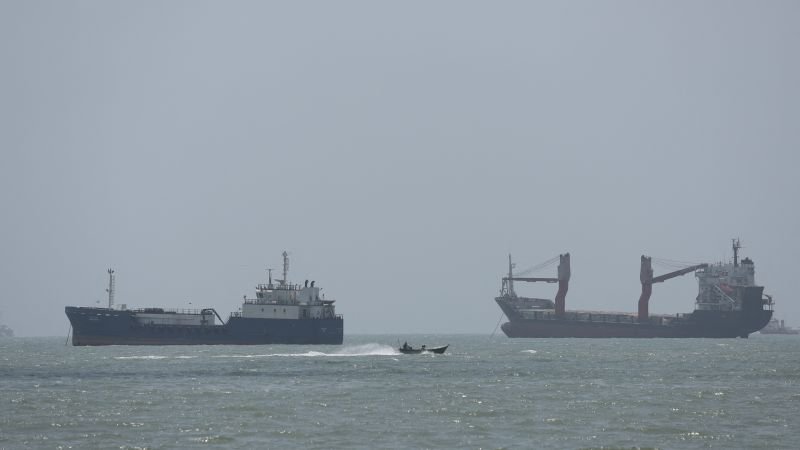
A tanker in the Strait of Hormuz was hit by an unknown projectile causing fire to the vessel which has since been extinguished, UK’s Maritime Trade Operations said on Thursday.
“All crew are reported as safe and accounted for and there has been no report of environmental impact,” it added. No further details were provided.
Qatar’s Prime Minister Sheikh Mohammed bin Abdulrahman bin Jassim Al Thani will visit Tehran on Thursday and meet with Iranian officials, according to the Qatar foreign ministry.
The prime minister will meet with Iranian officials and “discuss ways to de-escalate tensions and create the conditions conducive to dialogue,” foreign ministry spokesperson Majed Al Ansari said on X Wednesday. “The discussions will also address freedom of navigation in the Strait of Hormuz & the need for it to return to the status quo prior to February 28,” he added.
Qatar has been an important mediator in the US-Iran conflict.
Qatar on Tuesday voiced support for ongoing efforts between Oman and Iran to reach an agreement over the Strait of Hormuz, despite US President Donald Trump’s threat last week to attack Oman if it interferes with US operations in the strategic waterway.
Pakistan’s army chief was in Tehran on Monday while Oman’s foreign minister visited for talks on Tuesday.
US Central Command (CENTCOM) marked National Dog Day on Wednesday by highlighting the role of military working dogs serving alongside American forces across the Middle East.
In a post on X, CENTCOM described the dogs as “trusted teammates” that help protect US service members while carrying out a range of missions throughout the region.
“Military working dogs serve alongside US forces throughout the Middle East performing a variety of critical missions. These four-legged fighters are trusted teammates in helping protect American service members from threats,” CENTCOM said.
The command also released a video clip featuring images of military working dogs operating alongside US personnel at locations across the Middle East.
Military working dogs are routinely used in roles including explosives detection, patrol operations, search missions and force-protection duties.
The post coincided with National Dog Day, which is observed annually on August 26 to recognize the contribution of dogs to society and encourage adoption from rescue shelters.
CENTCOM did not provide details on the specific locations or operations featured in the images, but it said the dogs continue to play a critical role in supporting US military missions across the region.
Iran has called on the United Nations to investigate the humanitarian consequences of US sanctions, arguing that Washington’s pressure campaign is harming ordinary Iranians and violating international law.
Tehran “requests the United Nations Secretary-General to assess and report on the humanitarian and human rights implications of these actions,” Iranian Foreign Minister Abbas Araghchi wrote in a letter addressed to UN Secretary-General António Guterres, the president of the UN Security Council and UN member states.
The letter, released Wednesday by Iran’s Foreign Ministry, outlined Tehran’s response to what Araghchi described as US “economic terrorism” against his country.
Araghchi asked the United Nations to examine the impact of US measures on access to food, medicine, healthcare, energy, transportation, humanitarian assistance and other necessities.
He called on the Security Council and UN member states to condemn what he described as unilateral coercive measures and secondary sanctions imposed by Washington.
Iran urged governments not to recognize or implement sanctions that it said were designed to force countries to alter their legal economic and trade relationships with Tehran. Araghchi also called on the United States to halt efforts aimed at pressuring third countries and companies to reduce economic ties with Iran.
He made the appeal after the US Treasury Department began its new campaign to tighten sanctions on Iran, targeting aviation, shipping, technology, gold and digital assets such as cryptocurrency. Even though the measures are aimed at the regime, ordinary Iranians will inevitably be affected.
The head of Iran’s Atomic Energy Organization, Mohammad Eslami, accused the US and Israel on Wednesday of pressuring the UN nuclear watchdog to inspect war-damaged Iranian nuclear facilities in order to assess the impact of military strikes, state media reported.
“At a time when the (International Atomic Energy Agency) has no such protocol and is not taking a position either, it is only the United States and Israel that are applying pressure for the Agency to go to the damaged sites and inspect them,” Eslami said. “The reason for this pressure is that they want to see what happened to these sites as a result of the military operations they carried out.”
CNN has reached out to the IAEA for comment.
Eslami also said Iran remains in a “wartime situation” and that damaged nuclear facilities have not yet been secured for inspections.
He argued that facilities affected by military strikes are subject to legislation passed by Iran’s parliament and said the IAEA lacks a clear protocol governing inspections at sites that have come under attack.
Iran and Oman have outlined a proposal to establish a temporary shipping corridor through the Strait of Hormuz after weeks of negotiations over the strategic waterway, which has become a key issue in stalled US-Iran discussions.
Temporary shipping channel: Iran and Oman discussed a “phased framework” for a joint project to create a temporary shipping route through the Strait of Hormuz. Oman’s foreign minister said he was “hopeful” the two countries would soon formalize the arrangement.
Mine-clearing effort: The proposal also includes a joint initiative to clear mines from the waterway. Technical negotiations are expected to continue as both countries work toward implementation.
Permanent solution still under discussion: Officials said talks will continue with the aim of reaching agreement on a permanent shipping corridor and the future administration of the strait.
A key shipping route could close: Iran said the proposed deal would close a UN-authorized southern shipping route along Oman’s coast, which Iran has opposed. Vessels would instead travel through Iranian waters in both directions, Iranian media reported. An Omani statement did not mention closing the current route.
Part of wider diplomacy: Qatar also discussed the proposal with Tehran and has publicly supported Omani-Iranian efforts to reach an agreement over the strait.
US position: President Donald Trump said earlier that all mines in the Strait of Hormuz have been removed or detonated and warned that any vessel attempting to place new mines would be destroyed. He also said the United States was monitoring “every square inch” of the waterway.
Oil prices fall: Global oil prices have fallen for three consecutive days after Iran and Oman announced the framework. Futures of Brent crude, a major global benchmark, declined 3% to trade at almost $86 a barrel early today, while West Texas Intermediate, the North American benchmark, dropped 2.8% to $80 a barrel. Analysts said traders largely remain in “wait-and-see mode.”
Why it matters: The Strait of Hormuz is one of the world’s most important energy chokepoints. The proposal is the clearest framework so far for restoring navigation after months of disruptions, but major questions remain about implementation, demining, international acceptance of a new route and whether Washington would consent to routing vessels through Iranian-controlled waters.
Iran and Oman have outlined a proposal to jointly establish a temporary shipping channel and to clear mines in the Strait of Hormuz.
The announcement follows US President Donald Trump’s remark that all mines have been detonated or removed.
This raises questions about the difficulties of clearing the waterway of explosives.
Experts say Iran has some demining capability, but they question whether it is sophisticated enough to clear the strait.
Is it possible to demine without Iranian cooperation?
“Iran has some demining capabilities, but most of its mine warfare capacity is designed for laying mines,” Nitya Labh, a Chatham House Schwarzman Academy fellow, told CNN.
Labh said Iran lacks the ability to sweep the ocean meter by meter at varying depths and questioned whether Tehran could be trusted to carry out such an operation.
Paul Heslop, a senior UN mine action expert, said any demining effort would require highly specialized sensors and trained crews, making it an expensive and complex operation. He added that Iranian cooperation remains critical.
Information like the locations of the mines is crucial to help navies predict where the mines may be, their depth and whether they are secured, Heslop said.
“Unless the Iranians provide that information to other countries, then they won’t have the same advantages,” he said.
Labh added that political commitments like those in the June memorandum of understanding cannot guarantee the strait’s reopening.
“Declarations of a reopening alone cannot remove the hazards of sea mines nor restore market confidence within the shipping and insurance industries,” she said.
President Donald Trump said Wednesday he does not believe Iranian Supreme Leader Mojtaba Khamenei is dead, amid speculation over his whereabouts and condition nearly six months after his appointment.
“I don’t think he’s dead,” Trump told conservative radio host Glenn Beck during a live phone interview.
“He was very seriously wounded,” Trump added. “The left side of his body, the arm, the leg, the whole thing. He was very seriously wounded. But I don’t think he’s dead.”
Trump suggested that if Khamenei is dead, Iranian officials have been maintaining the appearance that he is alive — he said they continue to consult him and seek his “final blessing” on important matters. He added that the Iranian negotiators are “not the most honorable group,” suggesting that anything could be possible.
Asked about the prospects of winning the war, Trump said: “Our financial strength is unbelievable, and those things are going toward a very big victory.”
The US Treasury Department this week announced a campaign to tighten sanctions against Iran, threatening economic consequences against countries that refuse to cut ties with Iran.
• Status of diplomacy: Qatar’s prime minister visited Tehran on Thursday and met with Iranian Foreign Minister Abbas Araghchi to discuss the emerging Strait of Hormuz agreement between Oman and Tehran to establish a temporary shipping route. This follows Pakistani and Omani officials visiting Iran this week. Meanwhile, the White House said there are no negotiations happening between the US and Iran right now.
• Threat of sanctions: President Donald Trump remained vague Friday when asked about his campaign to choke off Iran’s economy, refusing to say whether he planned to sanction Chinese banks or if he’d discussed the matter with foreign counterparts.
• Naval deployment: USS Theodore Roosevelt will embark in the coming weeks to the Middle East and is expected to be deployed for at least seven months, officials said. This comes as the US Navy faces strain from the on-going war and global commitments.
• US pressure: President Donald Trump claims the financial strength of the US will move the country “toward a very big victory” over Iran, adding that he does not believe Iran’s supreme leader is dead.
President Donald Trump remained vague Friday when asked about his campaign to choke off Iran’s economy, refusing to say whether he planned to sanction Chinese banks or if he’d discussed the matter with foreign counterparts.
The administration announced earlier this week Operation Economic Outcast, which threatened tough new sanctions on Iran’s trading partners if they didn’t cut off ties to Tehran.
But the administration stopped short of putting in place any new measures, and so far hasn’t listed any major financial institutions from China — Iran’s largest trading partner — as being subject to US sanctions.
Trump bristled when asked why he wasn’t applying new sanctions on Chinese banks doing business with Tehran.
“Who said I’m not? You don’t know if I’m doing it,” he said. “I don’t have to announce everything, do I?”
Later, asked which world leaders he’d discussed the pressure campaign with, Trump suggested it wasn’t on his agenda, even though Treasury Secretary Scott Bessent said Monday that Trump was placing calls to foreign counterparts “with specific requests to cease their interactions with the regime.”
“There’s not a lot to speak to. We don’t want to speak to them,” Trump said Thursday. “We’re not looking to meet or anything.”
Qatar’s Prime Minister and Foreign Minister Sheikh Mohammed bin Abdulrahman Al Thani met a series of senior Iranian officials in Tehran on Thursday, as regional mediators intensified efforts to ease tensions surrounding the US-Iran conflict and the future of the Strait of Hormuz.
Here’s a recap of what we know so far about the talks:
During a meeting with Iranian Parliament Speaker Mohammad Bagher Ghalibaf, the two discussed regional developments and efforts to reduce tensions and create conditions for the resumption of dialogue, according to Qatar’s Foreign Ministry in a statement.
Also during the talks, Ghalibaf, Iran’s top negotiator, criticized the Trump administration, accusing it of making decisions based on inaccurate information and undermining regional stability, according to Iran’s semi-official Tasnim news agency.
Iranian President Masoud Pezeshkian also told the Qatari official that Tehran seeks recognition of what he described as the Iranian people’s legal rights and would not yield to pressure or coercion.
Qatar has emerged as a key mediator in efforts to reduce tensions between Tehran and Washington, and has also voiced support for ongoing diplomatic talks between Oman and Iran aimed at establishing a temporary joint shipping corridor and clearing mines to reopen the critical Strait of Hormuz. Earlier today, the White House said there are no negotiations happening between the US and Iran right now.
Iran said that 40% of the damaged capacity of the South Pars gas field has been restored, according to the semi-official news agency Fars – adding, however, that it will take at least two years to rebuild the facility attacked by Israel this year.
“With the tools we have, we managed to restore about 40% of the damaged capacity. However, the damage that has been inflicted is very severe. It will definitely take at least 2 years of work just for those sites to be rebuilt,” Iran’s deputy oil minister, Ahmad Zeraatkar, told Fars on Thursday.
Iranian officials have acknowledged the desruptions to energy exports that are vital for government finances, but have sought to play them down.
Zeraatkar said that by targeting energy, the US and Israel seek to curtail the government’s ability to provide for the public.
Earlier this week, Iranian Oil Minister Mohsen Paknejad acknowledged that oil sales have “decreased to some extent” during the US blockade, but said they have “continued” nonetheless.
South Pars is part of the world’s largest natural gas reserves, located offshore in the Persian Gulf. It is shared between Iran and Qatar, which calls its part of it the North Field.
In March, an Israeli strike on Iranian facilities in the South Pars gas field marked a significant escalation in the war, prompting a furious Iran to attack major energy facilities of its Gulf neighbors, sending oil prices surging, and leading US President Donald Trump to threaten to “blow up” South Pars if Iran didn’t stop.
White House press secretary Karoline Leavitt said Thursday there are no negotiations happening between the US and Iran right now.
The press secretary said the US is focused on putting economic pressure on Iran, an effort the White House has dubbed “Operation Economic Outcast.” She added that the president “continues to retain all options on the table.”
“We’ve had Operation Epic Fury to destroy their military. Now we have Operation Economic Outcast to destroy their economy,” Leavitt added.
Last week, Trump said his administration had established a direct backchannel with Iran’s Islamic Revolutionary Guard Corps, which the IRGC later denied.
Billy Stockwell and Aida Karimi contributed to this post.
Qatari Prime Minister Sheikh Mohammed bin Jassim Al Thani visited Iran on Thursday, where he met with Foreign Minister Abbas Araghchi and discussed the emerging Hormuz agreement between Oman and Iran.
The officials discussed the “temporary joint shipping corridor” between Tehran and Oman through the Strait of Hormuz, according to a Qatari foreign ministry statement posted on X. They also discussed regional developments, along with efforts to “deescalate and create conditions for dialogue,” the statement said.
The meeting also addressed efforts to demine the strait, as part of Iran and Oman’s proposal to clear mines from the waterway.
Iran and Oman have outlined a proposal to establish a temporary shipping corridor through the Strait of Hormuz after weeks of negotiations over the strategic waterway, which has become a key issue in stalled US-Iran discussions.
They discussed a “phased framework” for a joint project to create a temporary shipping route through the Strait of Hormuz. Oman’s foreign minister said he was “hopeful” the two countries would soon formalize the arrangement.
Qatar has mediated the US-Iran conflict along with Pakistan.
The aircraft carrier USS Theodore Roosevelt and its company of 5,000 will embark in the coming weeks on what is expected to be at least a seven-month deployment to the Middle East, officials said Wednesday. This comes as the US Navy faces strain from the war and global commitments.
President Donald Trump claims the financial strength of the US will move the country “toward a very big victory” adding that he does not believe Iran’s supreme leader is dead.
Global oil prices fell for a third day in a row on Wednesday after Iran and Oman announced a yet-to-be-finalized effort to establish a temporary shipping route through the Strait of Hormuz. Setting up the new route would involve the two countries attempting to “clear mines” from parts of waterway, they said.
Iran’s Revolutionary Guards spokesperson said Wednesday: “agreements were reached regarding each country’s share of the Strait’s waters” and revenues, but claimed that the US is obstructing that agreement process, causing delays, according to the semi-official news agency Tasnim.
Here’s what else you need to know:
Oil prices drop: Brent futures, the global benchmark, declined Wednesday 3% to trade at almost $86 a barrel shortly before 6 a.m. ET while WTI, the US benchmark, dropped 2.8% to $80 a barrel.
Diplomacy: Qatar’s prime minister will visit Tehran on Thursday to discuss the Strait of Hormuz as well as ways to de-escalate tensions, the Qatar foreign ministry said.
Iran’s defense capabilities: Iran is expanding its defense capabilities, according to one Iranian army commander, after much equipment was degraded earlier in the war. Tehran is “producing new systems and equipment, all relying entirely on Iranian knowledge and expertise,” the commander claimed.
Iran’s foreign media bill: Iran’s parliament has made a first move toward approving a bill that would criminalize communications with foreign media outlets. But some Iranian politicians oppose the bill.
CNN’s Nadeen Ebrahim, Todd Symons and Anna Cooban contributed to this post.
As Washington launches its latest plan to cripple Iran’s economy, the Islamic Republic has threatened a regional and global response designed to raise the stakes for the United States and the world.
In a news conference on Monday, Treasury Secretary Scott Bessent announced that the US will target a complex network built by Iran over years to allow its entities to evade Washington’s wide-ranging sanctions. The move comes after six months of a war launched by the US and Israel that has since reached a stalemate amid a lack of diplomatic resolution.
The sweeping secondary sanctions unveiled by Bessent include penalties for Iranian trade partners in sectors that the Islamic Republic uses to prop its economy, such as digital assets, technology and shipping. But the much-anticipated announcement of Trump’s “economic D-Day” measures left many underwhelmed after Washington decided to hold off on imposing major new measures, instead focusing largely on expanding and stepping up enforcement of existing sanctions, while warning that stricter penalties could follow for countries that did not cut ties.
Instead of succumbing to the threats, Iran is touting its ability to inflict reciprocal pain, warning of expanded strikes on regional oil producers and European countries, and even teasing the weaponization of its nuclear program.
Read more: ‘We will retaliate like an earthquake’: How Iran could respond to Trump’s economic ‘D-Day’
The aircraft carrier USS Theodore Roosevelt and its company of 5,000 will embark in the coming weeks on what is expected to be at least a seven-month deployment to the Middle East, top Navy officials said Wednesday.
“They know they’re going to be there longer than seven months. Their [commanding officer] is giving them eight months to plan on,” John Perryman, the master chief petty officer of the Navy, said Wednesday, USNI News reported.
The move will come as the Navy deals with the fallout from the recent deployment of the USS Abraham Lincoln to the region that saw it spend more than 250 days at sea without a port call.
That lengthy deployment raised concerns about the mental health of sailors, including reports of at least one going overboard, as well as reports of low supplies aboard the 100,000-ton warship.
The Lincoln was relieved by the USS George Washington last week, and it is expected to make a port call in Thailand in the coming days, according to several news reports.
The Roosevelt is expected to relieve the George Washington, USNI reported. The carrier USS George H.W. Bush is also operating in the Middle East region.
Perryman, the Navy’s top enlisted sailor, spoke to reporters alongside Chief of Naval Operations Adm. Daryl Caudle at Naval Support Activity Hampton Roads in Virginia on Wednesday.
Caudle acknowledged the stress the Iran war has put on the US fleet and said the service would try to put more certainty into deployment times, but combat demands can make that difficult.
“I would prefer, you know, seven-month deployments. I typically am not a big fan of extensions, and I push back hard on that. But the enemy gets a vote,” USNI quoted Caudle as saying.
A tanker in the Strait of Hormuz was hit by an unknown projectile causing fire to the vessel which has since been extinguished, UK’s Maritime Trade Operations said on Thursday.
“All crew are reported as safe and accounted for and there has been no report of environmental impact,” it added. No further details were provided.
Qatar’s Prime Minister Sheikh Mohammed bin Abdulrahman bin Jassim Al Thani will visit Tehran on Thursday and meet with Iranian officials, according to the Qatar foreign ministry.
The prime minister will meet with Iranian officials and “discuss ways to de-escalate tensions and create the conditions conducive to dialogue,” foreign ministry spokesperson Majed Al Ansari said on X Wednesday. “The discussions will also address freedom of navigation in the Strait of Hormuz & the need for it to return to the status quo prior to February 28,” he added.
Qatar has been an important mediator in the US-Iran conflict.
Qatar on Tuesday voiced support for ongoing efforts between Oman and Iran to reach an agreement over the Strait of Hormuz, despite US President Donald Trump’s threat last week to attack Oman if it interferes with US operations in the strategic waterway.
Pakistan’s army chief was in Tehran on Monday while Oman’s foreign minister visited for talks on Tuesday.
US Central Command (CENTCOM) marked National Dog Day on Wednesday by highlighting the role of military working dogs serving alongside American forces across the Middle East.
In a post on X, CENTCOM described the dogs as “trusted teammates” that help protect US service members while carrying out a range of missions throughout the region.
“Military working dogs serve alongside US forces throughout the Middle East performing a variety of critical missions. These four-legged fighters are trusted teammates in helping protect American service members from threats,” CENTCOM said.
The command also released a video clip featuring images of military working dogs operating alongside US personnel at locations across the Middle East.
Military working dogs are routinely used in roles including explosives detection, patrol operations, search missions and force-protection duties.
The post coincided with National Dog Day, which is observed annually on August 26 to recognize the contribution of dogs to society and encourage adoption from rescue shelters.
CENTCOM did not provide details on the specific locations or operations featured in the images, but it said the dogs continue to play a critical role in supporting US military missions across the region.
Iran has called on the United Nations to investigate the humanitarian consequences of US sanctions, arguing that Washington’s pressure campaign is harming ordinary Iranians and violating international law.
Tehran “requests the United Nations Secretary-General to assess and report on the humanitarian and human rights implications of these actions,” Iranian Foreign Minister Abbas Araghchi wrote in a letter addressed to UN Secretary-General António Guterres, the president of the UN Security Council and UN member states.
The letter, released Wednesday by Iran’s Foreign Ministry, outlined Tehran’s response to what Araghchi described as US “economic terrorism” against his country.
Araghchi asked the United Nations to examine the impact of US measures on access to food, medicine, healthcare, energy, transportation, humanitarian assistance and other necessities.
He called on the Security Council and UN member states to condemn what he described as unilateral coercive measures and secondary sanctions imposed by Washington.
Iran urged governments not to recognize or implement sanctions that it said were designed to force countries to alter their legal economic and trade relationships with Tehran. Araghchi also called on the United States to halt efforts aimed at pressuring third countries and companies to reduce economic ties with Iran.
He made the appeal after the US Treasury Department began its new campaign to tighten sanctions on Iran, targeting aviation, shipping, technology, gold and digital assets such as cryptocurrency. Even though the measures are aimed at the regime, ordinary Iranians will inevitably be affected.
The head of Iran’s Atomic Energy Organization, Mohammad Eslami, accused the US and Israel on Wednesday of pressuring the UN nuclear watchdog to inspect war-damaged Iranian nuclear facilities in order to assess the impact of military strikes, state media reported.
“At a time when the (International Atomic Energy Agency) has no such protocol and is not taking a position either, it is only the United States and Israel that are applying pressure for the Agency to go to the damaged sites and inspect them,” Eslami said. “The reason for this pressure is that they want to see what happened to these sites as a result of the military operations they carried out.”
CNN has reached out to the IAEA for comment.
Eslami also said Iran remains in a “wartime situation” and that damaged nuclear facilities have not yet been secured for inspections.
He argued that facilities affected by military strikes are subject to legislation passed by Iran’s parliament and said the IAEA lacks a clear protocol governing inspections at sites that have come under attack.
Iran and Oman have outlined a proposal to establish a temporary shipping corridor through the Strait of Hormuz after weeks of negotiations over the strategic waterway, which has become a key issue in stalled US-Iran discussions.
Temporary shipping channel: Iran and Oman discussed a “phased framework” for a joint project to create a temporary shipping route through the Strait of Hormuz. Oman’s foreign minister said he was “hopeful” the two countries would soon formalize the arrangement.
Mine-clearing effort: The proposal also includes a joint initiative to clear mines from the waterway. Technical negotiations are expected to continue as both countries work toward implementation.
Permanent solution still under discussion: Officials said talks will continue with the aim of reaching agreement on a permanent shipping corridor and the future administration of the strait.
A key shipping route could close: Iran said the proposed deal would close a UN-authorized southern shipping route along Oman’s coast, which Iran has opposed. Vessels would instead travel through Iranian waters in both directions, Iranian media reported. An Omani statement did not mention closing the current route.
Part of wider diplomacy: Qatar also discussed the proposal with Tehran and has publicly supported Omani-Iranian efforts to reach an agreement over the strait.
US position: President Donald Trump said earlier that all mines in the Strait of Hormuz have been removed or detonated and warned that any vessel attempting to place new mines would be destroyed. He also said the United States was monitoring “every square inch” of the waterway.
Oil prices fall: Global oil prices have fallen for three consecutive days after Iran and Oman announced the framework. Futures of Brent crude, a major global benchmark, declined 3% to trade at almost $86 a barrel early today, while West Texas Intermediate, the North American benchmark, dropped 2.8% to $80 a barrel. Analysts said traders largely remain in “wait-and-see mode.”
Why it matters: The Strait of Hormuz is one of the world’s most important energy chokepoints. The proposal is the clearest framework so far for restoring navigation after months of disruptions, but major questions remain about implementation, demining, international acceptance of a new route and whether Washington would consent to routing vessels through Iranian-controlled waters.
Iran and Oman have outlined a proposal to jointly establish a temporary shipping channel and to clear mines in the Strait of Hormuz.
The announcement follows US President Donald Trump’s remark that all mines have been detonated or removed.
This raises questions about the difficulties of clearing the waterway of explosives.
Experts say Iran has some demining capability, but they question whether it is sophisticated enough to clear the strait.
Is it possible to demine without Iranian cooperation?
“Iran has some demining capabilities, but most of its mine warfare capacity is designed for laying mines,” Nitya Labh, a Chatham House Schwarzman Academy fellow, told CNN.
Labh said Iran lacks the ability to sweep the ocean meter by meter at varying depths and questioned whether Tehran could be trusted to carry out such an operation.
Paul Heslop, a senior UN mine action expert, said any demining effort would require highly specialized sensors and trained crews, making it an expensive and complex operation. He added that Iranian cooperation remains critical.
Information like the locations of the mines is crucial to help navies predict where the mines may be, their depth and whether they are secured, Heslop said.
“Unless the Iranians provide that information to other countries, then they won’t have the same advantages,” he said.
Labh added that political commitments like those in the June memorandum of understanding cannot guarantee the strait’s reopening.
“Declarations of a reopening alone cannot remove the hazards of sea mines nor restore market confidence within the shipping and insurance industries,” she said.
President Donald Trump said Wednesday he does not believe Iranian Supreme Leader Mojtaba Khamenei is dead, amid speculation over his whereabouts and condition nearly six months after his appointment.
“I don’t think he’s dead,” Trump told conservative radio host Glenn Beck during a live phone interview.
“He was very seriously wounded,” Trump added. “The left side of his body, the arm, the leg, the whole thing. He was very seriously wounded. But I don’t think he’s dead.”
Trump suggested that if Khamenei is dead, Iranian officials have been maintaining the appearance that he is alive — he said they continue to consult him and seek his “final blessing” on important matters. He added that the Iranian negotiators are “not the most honorable group,” suggesting that anything could be possible.
Asked about the prospects of winning the war, Trump said: “Our financial strength is unbelievable, and those things are going toward a very big victory.”
The US Treasury Department this week announced a campaign to tighten sanctions against Iran, threatening economic consequences against countries that refuse to cut ties with Iran.




Responses